Roquefort: Legend, Early Privileges and the 1925 Appellation Law
Fresh, humid air slips through cracks beneath the Combalou at Roquefort-sur-Soulzon.
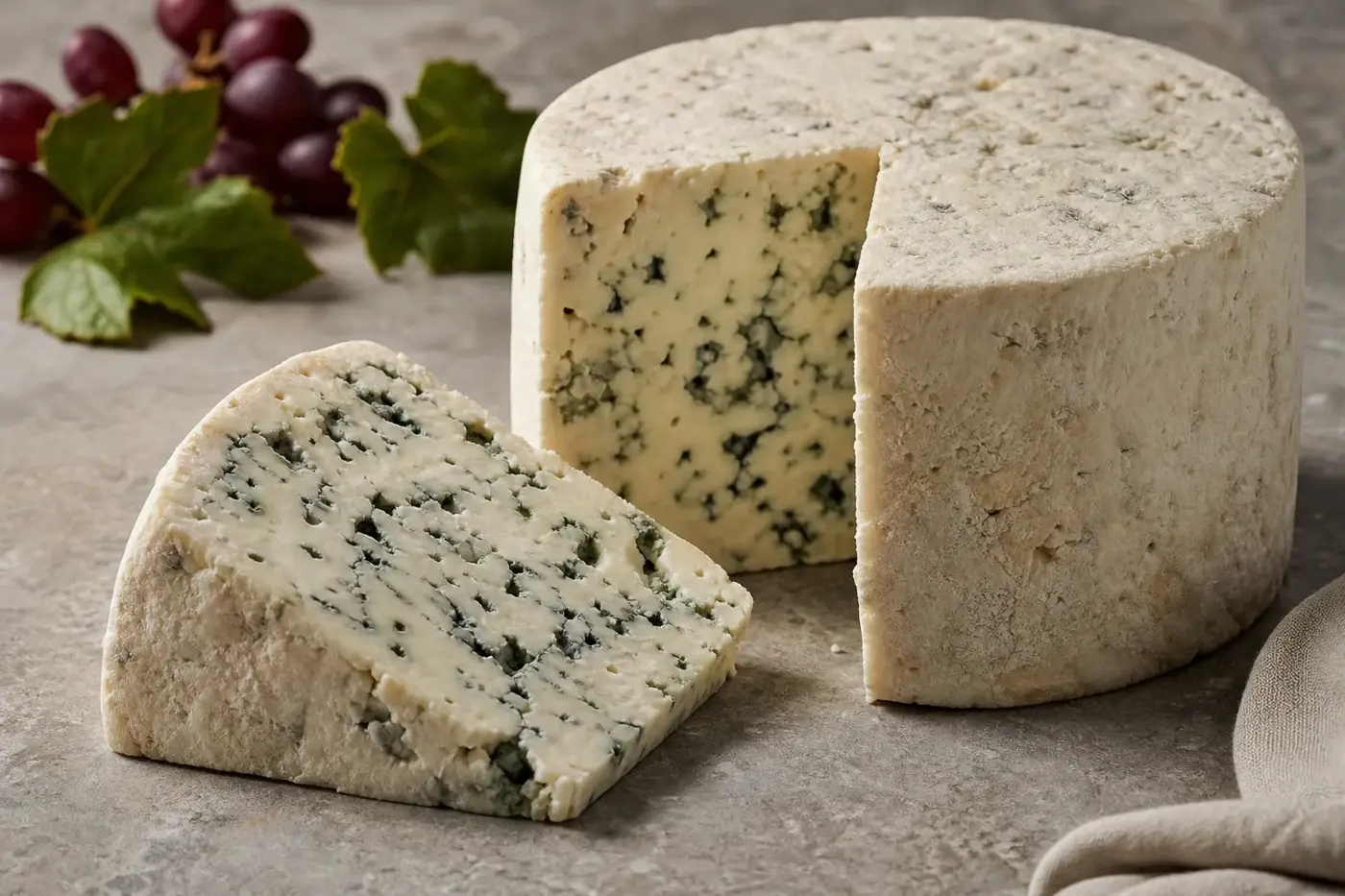
Fresh, humid air slips through cracks beneath the Combalou at Roquefort-sur-Soulzon. In the caves below, blue-green mould threads its way through ivory cheese. Follow that air and you arrive at Roquefort’s physical heart, where a place and a cheese became inseparable. [1]
On 26 July 1925, a French law set out to guarantee that cheese’s appellation of origin. [7] The journey from cave to statute takes you past a shepherd’s forgotten lunch, medieval documents, royal privileges and disputes over imitation. The legend gives you the romance; the documents show how a reputation acquired legal protection.
A shepherd leaves lunch, and finds a legend
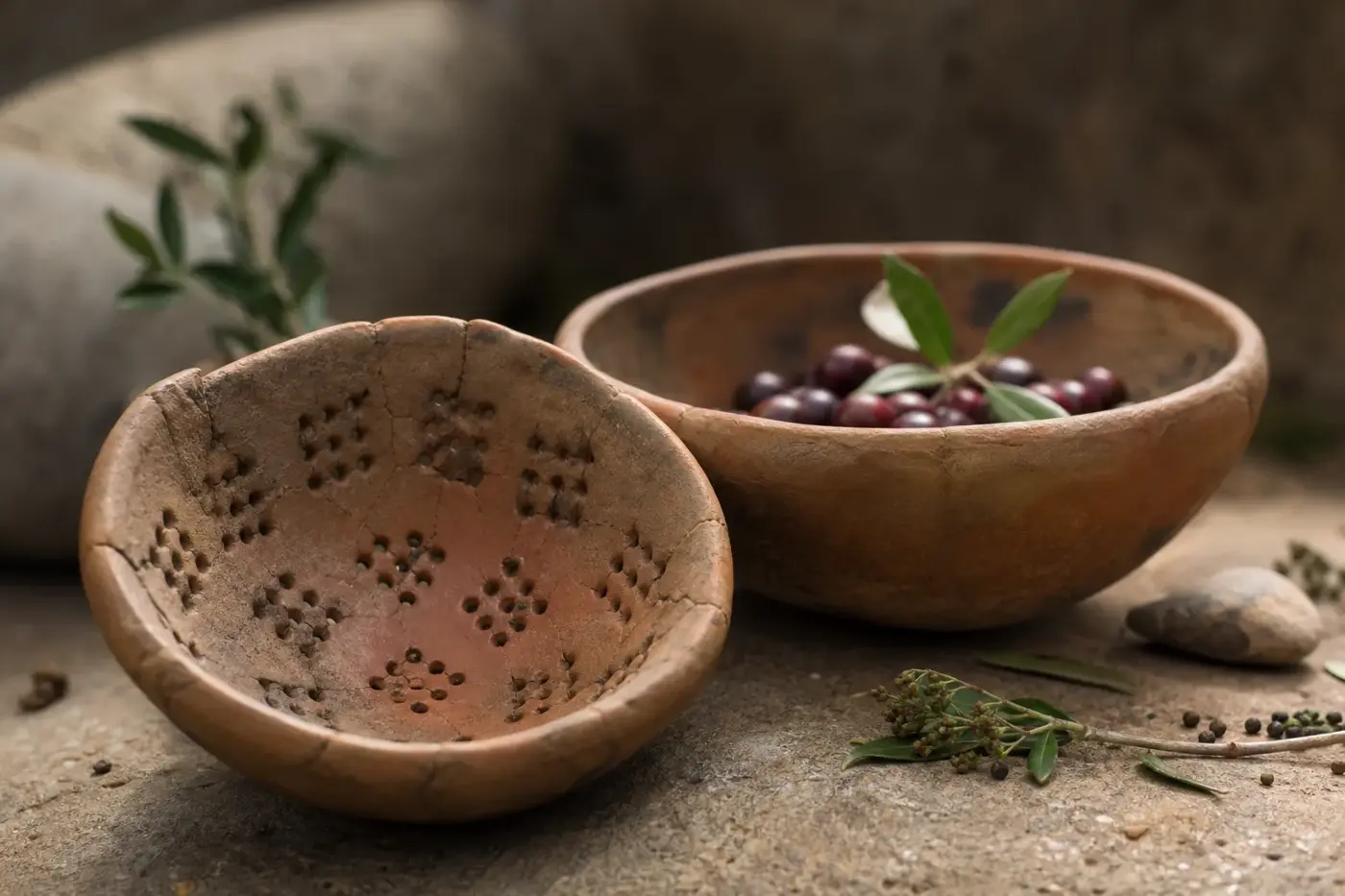
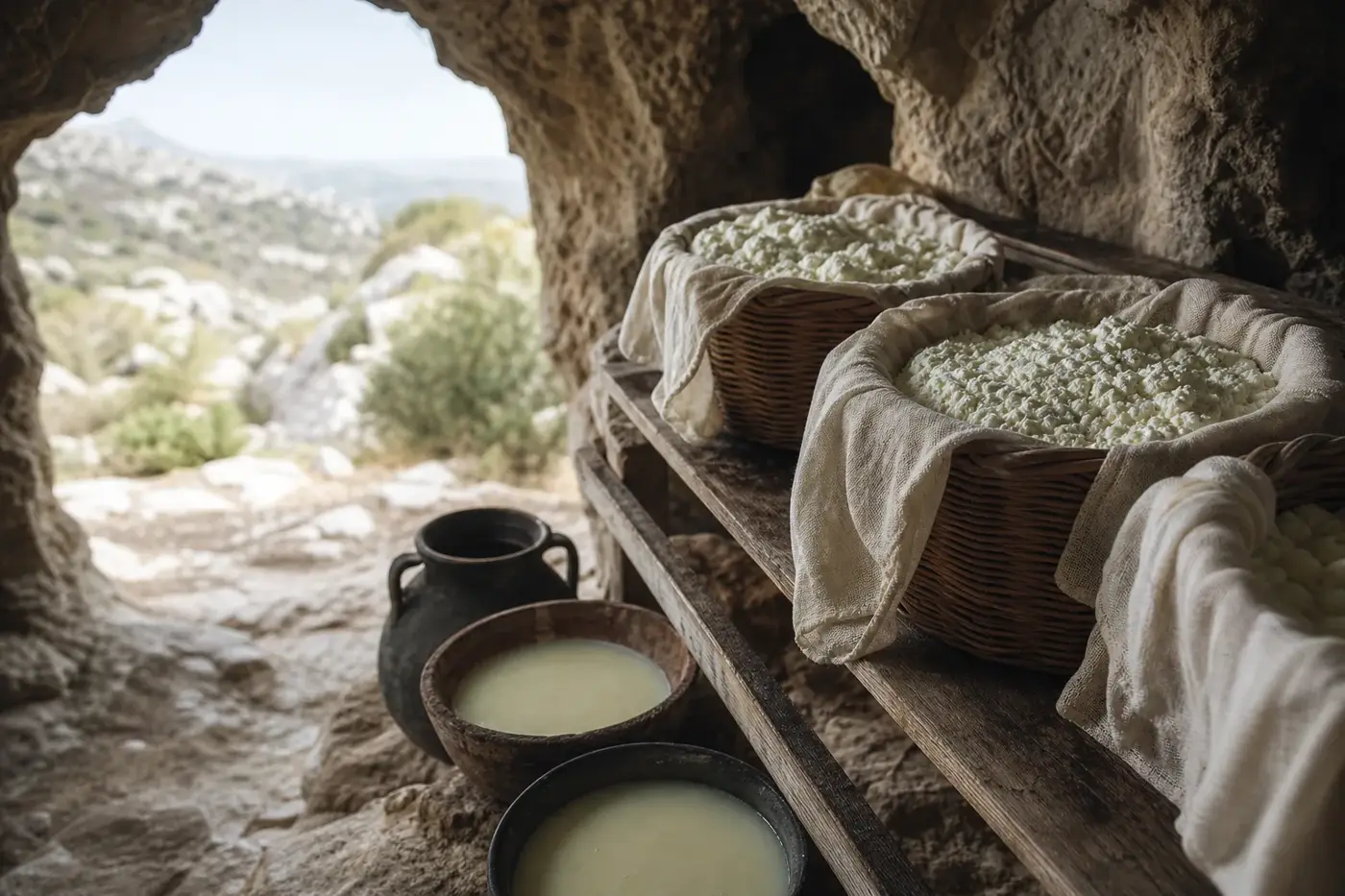
A shepherd leaves bread and sheep’s milk curd in a cave, distracted by a passing young woman. When he returns, mould has transformed his abandoned food. He tastes the blue-veined cheese and finds something worth keeping: that is the origin legend recounted by the producers’ organisation. [2]
You hardly need a cast list: shepherd, bread, curd, cave. The bread supplies the mould, the cave provides the setting, and an accident becomes a discovery. As forgotten lunches go, this one has enjoyed an unusually distinguished afterlife.
The story’s simplicity helps it endure. You can picture food left behind, changed by its surroundings, then rediscovered. A complicated transformation becomes something you can imagine happening in front of you.
The shepherd belongs to Roquefort’s cultural history, but dating an invention takes different evidence. A dated account, an identifiable witness or material evidence must connect a practice to a particular time. To follow the cheese’s legal history, you have to put down the lunch and open the documents.
Follow the cave air into the cheese
These caves have work to do. The producers’ organisation describes fissures called fleurines, which carry fresh, humid air through the rock beneath the Combalou. Inside the cheese, Penicillium roqueforti develops in air-filled cavities, making that blue-green marbling. [1]
Affinage is the managed ripening of cheese. Here, it brings circulating cave air together with mould developing within the paste. The organisation describes an ivory background crossed by blue-green markings, so you can see the effects of ripening in the cheese itself. [1]
The place matters, but so does knowing how to use it. Cave air needs understanding and management; the rock does not do the entire shift. The milk-to-cheese process follows the earlier transformation, while Roquefort shows you how the place of ripening can become just as central to a cheese’s identity.
Pliny’s praise comes with a fresh detail
Pliny offers you an intriguing Roman reference, with a detail worth lingering over: this cheese was best fresh. In Natural History, Book XI, section 240, he praises provincial cheese associated with Nemausus, Lesura and Gabalicus. The Latin passage makes its merit brief and dependent on freshness. [3]
The English translation reproduced by Attalus keeps that distinction. The praise applies only for a short time, while the cheese is fresh. Neither text identifies Roquefort’s caves, blue veining or a process matching the modern appellation’s production rules. [3][4]
What you do have is a regional reputation for cheese in antiquity. Pliny distinguishes cheeses by origin, making geography part of his account of quality. That is interesting in its own right, without stretching the passage further. [3][4]
A connection to modern Roquefort remains uncertain and would need evidence linking place, ingredients and method. The geographical resemblance gives you a worthwhile historical question. The passage answers a narrower one clearly: provincial cheeses were known and praised by their origins.
Turn the pages of the medieval record
Your next stop is the 1070 cartulary of the Abbey of Conques. The historical section of the Roquefort specification approved in 2017 presents a reference there as an early mention of Roquefort. [5] A cartulary gathers documents recording an institution’s rights and transactions.
The interest lies in more than finding a convenient birthday for the cheese. An entry might show you where cheese fitted into medieval life. A payment in cheese, an obligation attached to property and a merchant’s consignment would each tell a different story about production and circulation.
To reconstruct that commerce, you need to connect individual entries with their dates, locations and purposes. A later history repeating an early date belongs to the trail as well. It shows you how information passed from one account to another.
The underlying cartulary entry and relevant trade records are the places to look for more detail. For now, the reference gives you a starting point. It is not a full account of the cheese or its travels through medieval trade.
Look closely at Charles VI’s 1411 privilege
In the producers’ organisation’s account, letters patent from Charles VI date to 1411 and protect the village’s production. The account places that privilege in a settlement dependent on its cheese. [2] Protection here was tied to a community’s livelihood.
Letters patent allowed royal authority to grant or confirm rights. The questions you need to ask are specific: rights for whom, covering which activities, and within what boundaries? Rights for inhabitants, rights over cave use and exclusive rights to a product name would have different consequences.
That is why describing 1411 as an early appellation needs care. A royal privilege and a modern geographical indication belong to different legal structures. Their wording and operation tell you more than placing them under a shared label.
The producers’ account supplies the date and an interpretation. To establish the beneficiaries, scope and protected activities, you need the original royal instrument or an authoritative archival record. That is where the precise shape of Charles VI’s privilege would emerge.
Ripening takes centre stage in Toulouse
According to the historical account in the 2017 specification, a decision of the Parlement of Toulouse in 1666 confirmed royal privileges granted since Charles VI. It also gave Roquefort-sur-Soulzon’s inhabitants exclusive rights to ripen Roquefort. [5]
Keep your eye on that word: ripen. Exclusive rights to this work would place maturation at the heart of the dispute. The parliamentary record is needed to establish exactly what the decision protected, including whether it addressed imitation.
Imitation can cover quite different things. Cheese matured elsewhere is one issue; cheese made with another milk species or sold under a misleading description is another. To understand the ruling, you need the parties, prohibited conduct, remedy and geographical reach of the court’s order.
Popular summaries often compress this history into a sentence about punishing imitation. The later specification preserves the reported decision. The original record is where you would look for the particular dispute behind that shorthand.
The livelihoods behind the name
By 1925, the case for protecting Roquefort extended beyond cheesemakers’ reputations. The Senate archives explain that a proposal deposited on 24 March 1925 sought to protect the appellation against competing products made with cow’s milk. [6] The name had become a matter for legislation.
The argument reached across the sheep-farming economy. According to the Senate’s account of the explanatory memorandum, reduced demand for sheep’s milk affected activities connected with flocks, including skins, wool and cheese packaging. Roquefort was presented as part of an interdependent regional economy. [6]
Think about what that meant from your side of the cheese counter. A name could suggest a particular kind of cheese, while differently made products competed under the same reputation. Legislation offered a way to make the relationship between name and product enforceable.
The parliamentary case was advocacy, written to secure a legal result. It tells you about the pressures and interests behind the proposal. The protection eventually granted, however, comes from the enacted provisions rather than the arguments made for them.
Read the purpose of the 26 July 1925 law
The legislation’s title states its purpose plainly: guaranteeing the appellation of origin of Roquefort cheese. The producers’ organisation dates recognition of the French appellation to 26 July 1925. It distinguishes that recognition from the later European PDO. [2][7]
The purpose gives you the starting point, not the detailed rules. For milk conditions, geographical scope, exceptions and enforcement provisions, you need the original articles. Those details determine how the protection actually worked.
| Your question about the original French law of 26 July 1925 | Where to find the answer |
|---|---|
| What did it set out to do? | Guarantee the appellation of origin of Roquefort cheese. [7] |
| What milk did it require, and were there exceptions? | The original articles are needed to establish the exact milk condition and any exception. |
| Which caves qualified, and on what terms? | The original articles are needed to establish the exact cave boundary and qualifying conditions. |
| How did it deal with misleading names and enforcement? | The original articles are needed to establish those provisions. |
A law can protect a name while its detailed requirements change over time. Keep that distinction in mind as you move between documents from different periods. A later specification may retain the central connection between cheese and place while adding, removing or refining individual rules.
You cannot simply carry that later wording back into the original law. Understanding protection at a particular moment means looking at the provisions belonging to that moment.
Give each French and European label its place
Three expressions accompany you through this legal history: appellation d’origine; appellation d’origine contrôlée, usually shortened to AOC; and the European protected designation of origin, PDO, called AOP in French. They mark different legal concepts. Treating them as interchangeable makes the story harder to follow.
The producers’ organisation dates French appellation recognition to 1925 and European AOP recognition to 1996. [2] The official register and legal act are the sources needed to establish the European registration date and status.
Recognition of one cheese is also different from legislation organising a national system. To date that wider development, you need the original national legislation, its scope and its subsequent extension to different agricultural products. A milestone for Roquefort cannot, by itself, tell you the history of the whole system.
For the broader picture, explore protected names explained. With Roquefort, keep each legal label attached to its own instrument and period. Today’s vocabulary is useful, provided it does not blur the different forms that protection took.
Milk, mould and the patient business of ripening
Raw, whole sheep’s milk remains central to the producers’ published description of Roquefort, alongside the caves and their ventilation. [1][8] If you want the technical detail, dated specifications bring the process into sharper focus.
The specification approved in 2017 required raw, whole sheep’s milk and inoculation with Penicillium roqueforti. It also required drainage without pressing and piercing to aerate the paste. Ripening and maturation had to last at least 90 days from manufacture, including at least two weeks exposed in the specified caves. [5]
Those requirements show you the connections between milk, mould and the air inside the cheese. Together, they provide a precise technical baseline for that version of the rules. The date is an essential part of what makes the detail useful.
INAO’s product record lists a specification amendment associated with an order dated 6 February 2026. [9] The amendment text is needed to establish its contents and applicability. The current EU registered specification is also needed for the present requirements.
Looking across time reveals an important distinction. Detailed conditions for milk, cultures, manufacture and maturation belong to identifiable versions of the rules. Requirements and numerical limits in a later specification cannot automatically be attributed to the law of 1925.
From living caves to a protected name
Roquefort’s history brings very different kinds of evidence to the table. You encounter a remembered discovery, an ancient author’s geographical distinctions, references to medieval documents, royal privileges, a reported court decision and a twentieth-century statute. Each tells you more when you ask it the question it can answer.
The caves make the connection between place and practice tangible. Air passing through rock helps shape the blue-green markings inside the cheese. The disputes reveal another connection: a name can carry a reputation shared by farmers, cheesemakers and others whose livelihoods depend on the same production system. [1][6]
Food law gives that relationship boundaries. An association recognised through custom and trade becomes written conditions that others can examine, contest and enforce. Something rooted in place acquires a legal shape.
That is the lasting significance of Roquefort’s legal history. The shepherd keeps his place in legend, and the caves retain their practical importance. As you follow the legal milestones, each becomes clearer when it keeps its own date, document and scope.
Questions people ask
What makes Roquefort blue?
The mould Penicillium roqueforti develops in air-filled cavities inside the cheese, creating its blue and green marbling. Fissures called fleurines carry fresh, humid air through the rock beneath the Combalou and into the caves.
Did Pliny write about Roquefort?
Pliny praised provincial cheese associated with Nemausus, Lesura and Gabalicus, but said its merit depended on freshness. His passage does not identify Roquefort’s caves, blue veining or a matching production process, so a connection to modern Roquefort remains uncertain.
What did Charles VI do for Roquefort?
The producers’ organisation dates letters patent from Charles VI to 1411 and describes them as protecting the village’s production. The original royal instrument or an authoritative archival record is needed to establish exactly who and what the privilege protected.
When was Roquefort legally protected?
A French law dated 26 July 1925 stated its purpose as guaranteeing the appellation of origin of Roquefort cheese. The producers’ organisation dates European AOP recognition to 1996, although the European registration date and status still need checking against the official register and legal act.
How long is Roquefort matured?
The specification approved in 2017 required at least 90 days of ripening and maturation from manufacture, including at least two weeks exposed in the specified caves. A specification amendment associated with an order dated 6 February 2026 is listed by INAO, but its contents and applicability remain unverified.
Sources
- Confédération générale des producteurs de lait de brebis et des industriels de Roquefort, L’affinage naturel, undated web account, retrieved November 2026. Producer organisation’s description of caves, ventilation, mould development and ripening.
- Confédération générale des producteurs de lait de brebis et des industriels de Roquefort, 1re AOP de l’Histoire, undated web account, retrieved November 2026. Producer organisation’s historical narrative and chronology.
- Pliny the Elder, Naturalis historia, Book XI, sections 240 to 242, Latin text reproduced by LacusCurtius, University of Chicago, retrieved November 2026.
- Pliny the Elder, Natural History, Book XI, sections 240 to 242, English translation reproduced by Attalus, retrieved November 2026.
- INAO, Cahier des charges de l’appellation d’origine protégée « Roquefort », approved by the order of 12 September 2017, published in BO Agriculture No. 39 of 28 September 2017. Copy hosted by the producers’ organisation.
- Archives du Sénat, La loi du 26 juillet 1925 protégeant le Roquefort, historical presentation of the parliamentary proposal and explanatory memorandum, retrieved November 2026.
- Légifrance, Loi du 26 juillet 1925 ayant pour but de garantir l’appellation d’origine du fromage de Roquefort, indexed legislative record. The title was retrieved; the articles were inaccessible during this research session.
- Confédération générale des producteurs de lait de brebis et des industriels de Roquefort, Un fromage de brebis au lait cru, undated web account, retrieved November 2026. Used only for the organisation’s description of milk, not its health or environmental assertions.
- INAO, Roquefort, product record listing the order of 6 February 2026 and amended specification published in BO No. 7 of 12 February 2026. Indexed record retrieved November 2026; the amended specification was not read.
This desk research compared the retrieved historical accounts, Pliny’s text and translation, and the dated 2017 specification, while recording the primary documents still required for legal verification.
Last checked: November 2026
Last checked November 2026.
The editors suggest you read next
A History of Cheese: From the First Curds to Global Food
Picture cheese lying beside Bronze Age burials in China's Tarim Basin, surviving for approximately 3,500 years.