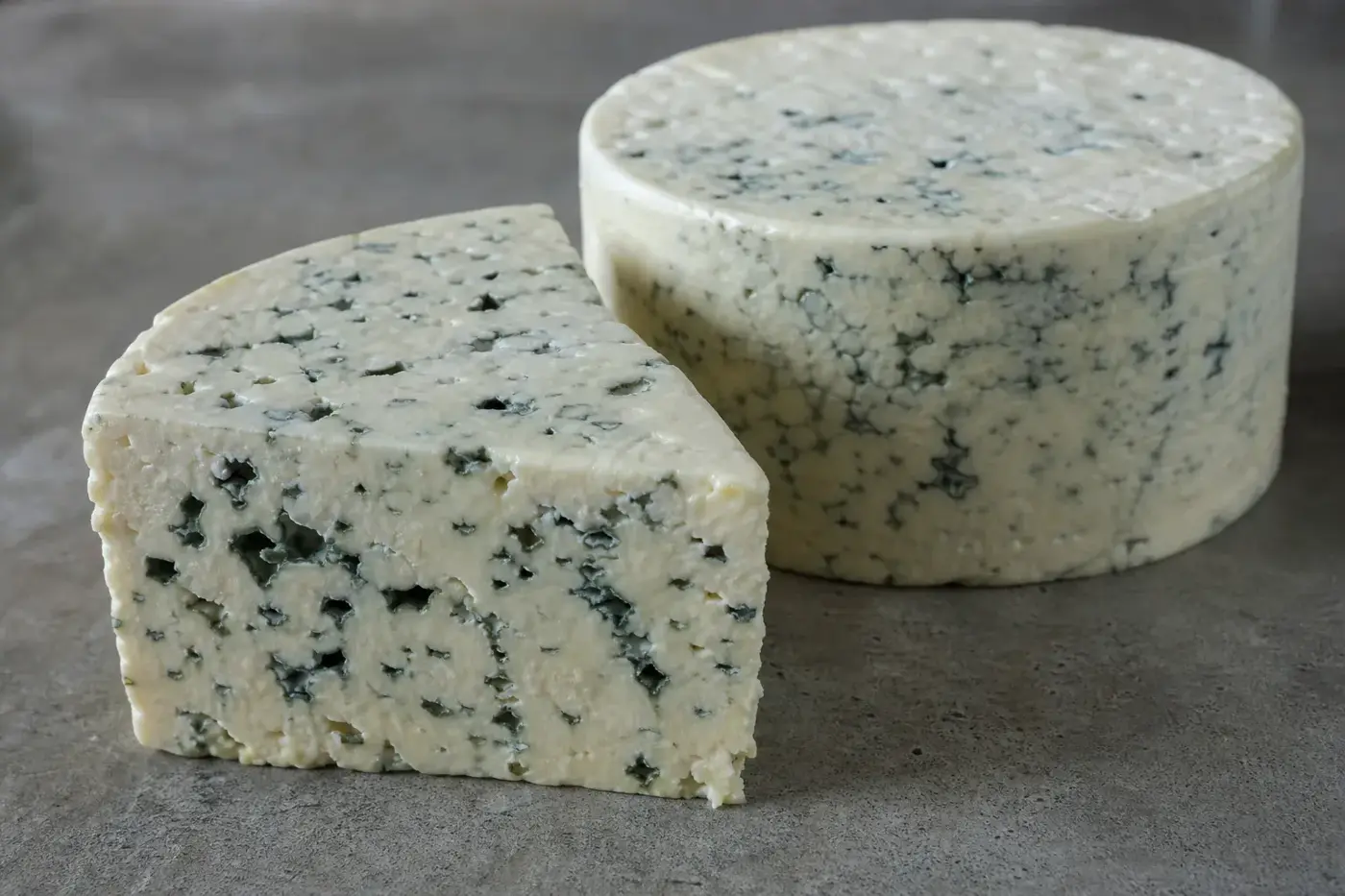
Step into the cool, humid air beneath Roquefort-sur-Soulzon. Here, in an Aveyron village, caves nurture the blue-green veins of a French cheese made from raw sheep milk. Taste the moist white paste and its pronounced flavour, and you begin to understand how much character one small place can give a cheese. [1]
| Your first taste of the facts | Roquefort |
|---|---|
| Name on the label and register | Roquefort. [1][2] |
| Registration authorities | European Commission, EU scheme; Defra, Great Britain scheme. [1][2] |
| Protection status | EU and Northern Ireland: EU register confirmation outstanding. Great Britain: registered PDO, November 2026. [2] |
| Recorded registration dates | EU: 21 June 1996; Great Britain scheme: 31 December 2020 at 23:00. [2] |
| Milk | Raw, whole sheep milk from Lacaune sheep. [1] |
| Where it happens | Milk production and cheesemaking in a defined southern French area; ripening and maturation in Roquefort-sur-Soulzon. [1] |
| Principal blue mould | Penicillium roqueforti. [1] |
| Minimum maturation | At least 90 days from manufacture, including at least two weeks exposed in the designated caves. [1][3] |
| Pregnancy guidance | UK NHS advice for pregnant people, November 2026: avoid Roquefort unless cooked until steaming hot. [8] |
Look at the marbling, then take a bite
Before you taste, give the white paste a moment of your attention. The producers’ organisation describes it as slightly moist, with blue-green marbling reaching towards the edges. The French production decree adds a detail you might otherwise overlook: a moist outer surface. [3][4]
Now notice what changes between makers. Texture, colour and aromatic strength all vary, and the producers’ tasting account reaches beyond salty and tangy. Look for the acidity of curdled milk and a pronounced bitter note, particularly when you try different selections side by side. [4]
Time leaves its mark, too. INAO links slow maturation with a more unctuous paste, while producers credit their mould cultures with individual aromatic and textural characteristics. Ask for a firmer piece to crumble or a softer selection to spread: both the maker and the stage of maturation matter. [1][4]
Meet the mountain doing its share
Beneath the Combalou mountain in southern Aveyron, Roquefort-sur-Soulzon’s caves sit within limestone rockfall. Natural fissures called fleurines connect them to the outside air. These openings bring the freshness and humidity that help create the caves’ particular ripening conditions. [1]
The cave holds the cheese; the fleurine brings the air. Outside conditions influence that airflow, but the affineur, the person responsible for ripening, can regulate its circulation through doors and openings. In the producers’ account, mountain and human judgement work together. [5]
Inside, cheeses stand on their sides on shelves, exposed to the moving air. The affineur watches moisture and ventilation, adjusting conditions around them. A mountain makes an impressive workplace, but it does not do all the work. [5]
Follow the milk from flock to dairy
The milk’s journey begins across a much wider area than the caves occupy. INAO places milk production and transformation in a defined part of the southern Massif Central: portions of Aveyron, Tarn, Hérault and Lozère, plus some communes in Aude and Gard. The legal boundary follows named communes, sometimes only parts of them, rather than whole departments. [1][3]
Lacaune sheep supply the milk, which is used raw and whole. The French production text allows warming to the renneting temperature, but pasteurisation is incompatible with that raw-milk requirement. For a clearer picture of the treatments, turn to raw, thermised and pasteurised cheese. [3]
Rennet, an enzyme preparation, sets the milk into curd: the solid material separated from liquid whey. The cheesemaker then builds an open structure. What matters here is leaving spaces inside, rather than creating the close texture of a pressed cheese. [3]
| In the dairy | What happens to the cheese |
|---|---|
| Setting the milk | Rennet coagulates the milk; lactic cultures may be added. [3] |
| Handling the curd | The curd is divided, stirred and partly drained before moulding. [3] |
| Letting it drain | More whey drains away, without pressing. [3] |
| Adding salt | The cheeses are dry-salted. [3] |
| Piercing the cheese | Channels aerate the interior before cave ripening. [3] |
Those spaces give the blue mould room to develop. Piercing carries air into the paste rather than leaving it at the surface. The mould itself is deliberately introduced during manufacture, so those blue veins begin with a planned process, not a chance encounter in a cave. [3][5]
Give those blue veins breathing space
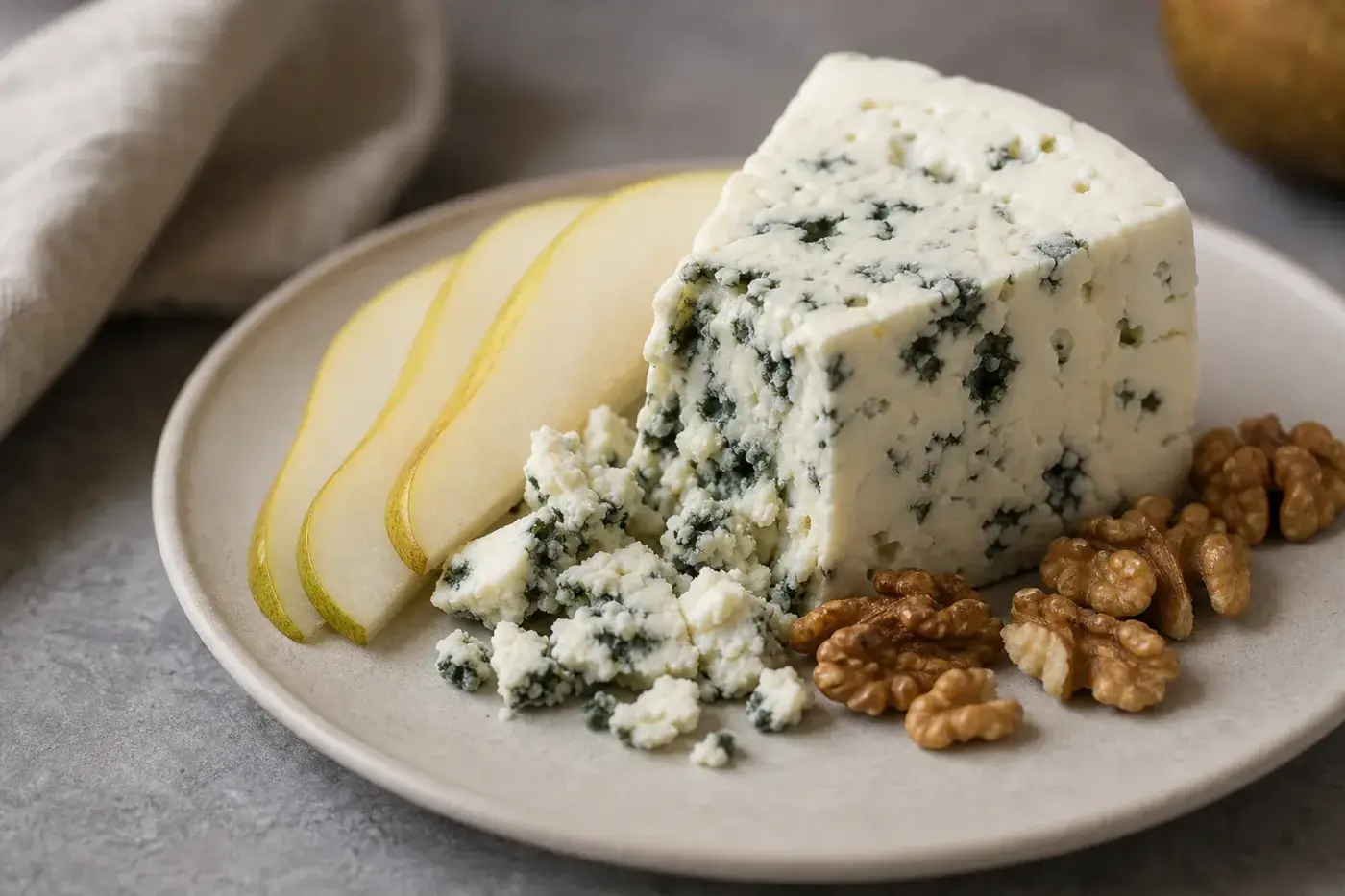
Penicillium roqueforti gives Roquefort its blue-green appearance. The producers explain that it is aerobic, meaning it develops with oxygen. The cavities and pierced channels are therefore essential: they give air a route into the cheese. [5]
French rules require cultures prepared from traditional strains isolated in the designated caves’ microclimate. Producers retain strains with their own aromatic and textural characteristics. The flavour you taste and the veins you see reflect that culture, the open structure, the cave conditions and the time allowed for development. [3][4]
France’s agriculture ministry identifies mould development during cave ripening as central to flavour and softening. When the cheese reaches the desired stage, it is wrapped and moved into colder storage. Maturation then continues more slowly. [6]
Read the place behind the name
Roquefort carries a protected designation of origin, or PDO, in the EU and Great Britain. INAO identifies it as an AOP, the French abbreviation for the same designation. The Great Britain register records its registered PDO status; November 2026 is the reference date for both entries here. [1][2]
To understand the geography, picture two areas. Milk production and cheesemaking belong to the wider defined production area. Cave ripening must happen in the designated Combalou rockfall zone at Roquefort-sur-Soulzon, while subsequent maturation must remain within the commune. [1][3]
The cheese must mature for at least 90 days from manufacture, including at least two weeks exposed in the designated natural caves. These are requirements within one maturation process, not separate clocks. The remaining time can include slow maturation under protective wrapping, in the caves or in temperature-controlled rooms. [3]
At the counter, distinguish the protected name from the maker’s selection. Roquefort tells you the cheese and its defined production system; the producer’s name tells you who made that particular product. For the wider picture, explore PDO, PGI and TSG. [2][4]
From a shepherd’s lunch to a landmark law
A shepherd leaves bread and sheep-milk cheese in a cave. When he returns, the bread is mouldy and the cheese is blue. France’s agriculture ministry records this familiar story as a legend: an abandoned lunch with a rather better legacy than most. [6]
The documented landmark is the law of 26 July 1925. It recognised Roquefort’s French appellation and appears in the subsequent production decree. INAO describes Roquefort as the first cheese recognised through a French appellation of origin. [1][3]
The later registrations belong to different legal systems. The Great Britain register records 21 June 1996 as the original EU registration date. Its own scheme entry dates from 31 December 2020 at 23:00, decades after the French recognition. [2]
Let your cheesemonger in on dinner
Start by saying what you want to do with the cheese. Ask who made it, how mature the selection is and whether it suits crumbling, spreading or cooking. The producers’ tasting guidance confirms that softness and aromatic power differ between makers, so your intended dish gives the conversation a useful starting point. [4]
Before buying, read the label’s storage instructions and dates, and choose an amount that fits your plans. For England, Northern Ireland and Wales, the Food Standards Agency advises refrigerating dairy products and following pack instructions. Keep your domestic fridge between 0 and 5 °C. [7]
Take out only what you need for serving, following the label’s storage instructions. Consult current FSA guidance for how long chilled food can remain out of refrigeration. [4][7]
Cut portions from the centre towards the outside so everyone gets a share of the different parts of the paste. Keep the rest wrapped and refrigerated as the label directs. For the broader routine, see storing cheese at home. [4][7]
Make room for pears and walnuts
Try a small piece with pear and walnut. Juicy sweetness and crisp texture sit alongside the cheese. The producers’ organisation recommends both, plus figs, apples, quince paste and several kinds of bread, giving you plenty of starting points for finding your favourite combinations. [4]
For adults of legal drinking age, a small serving of sweet wine contrasts sweetness with the cheese’s saltiness. For an alcohol free alternative, try pear juice diluted with sparkling water, or water with fresh pear. People who are pregnant, driving, taking medicines that interact with alcohol or recovering from alcohol dependence should not drink; consult current NHS or equivalent national advice.
In the kitchen, Roquefort can provide the main flavour in a simple cream-based sauce for potatoes, vegetables or meat. Use a sourced recipe and follow its cheese quantities. INAO also lists bread, meat dishes, soufflés and pear desserts among its uses, so you need not keep it for the cheeseboard. [1]
This page summarises published guidance from the official sources it cites. It is not medical advice. Guidance differs between countries and changes over time, so check the current source for where you live, and ask your doctor, midwife, pharmacist or dietitian about your own circumstances.
Serving during pregnancy? Cook until steaming hot
UK NHS guidance, November 2026, names Roquefort among the soft blue-veined cheeses that must be thoroughly cooked during pregnancy. The permitted option is cheese cooked until steaming hot. Simply melting it or warming it does not describe that endpoint. [8]
The NHS also advises that babies and young children should not eat soft blue-veined cheeses such as Roquefort, while allowing them in cooked recipes. Its listeriosis guidance identifies pregnancy, older age, and conditions or treatments that weaken immunity as circumstances linked to a greater risk of serious illness. [9][10]
Before serving Roquefort to someone in a higher-risk group, consult current official guidance where they live. Discuss individual circumstances with their healthcare professional. For the wider subject, read Listeria and cheese safety.
Questions people ask
What milk is Roquefort made from?
Roquefort is made from raw, whole milk from Lacaune sheep. Milk production and cheesemaking take place within a defined area of the southern Massif Central.
Why does Roquefort have blue and green veins?
A mould called Penicillium roqueforti gives the cheese its blue and green appearance. The cheese is pierced before cave ripening so air can reach the interior and help the mould develop.
How long is Roquefort matured?
Roquefort must mature for at least 90 days from manufacture. This includes at least two weeks exposed in the designated natural caves.
Can you eat Roquefort during pregnancy?
The UK NHS advises avoiding Roquefort during pregnancy unless it is cooked until steaming hot. See the current NHS guidance on foods to avoid in pregnancy.
What goes well with Roquefort?
The producers’ organisation recommends pear and walnuts, as well as figs, apples, quince paste and several kinds of bread. Roquefort can also be used in a cream based sauce for potatoes, vegetables or meat.
Sources
[1] Institut national de l’origine et de la qualité. Roquefort. Current product page and linked regulatory index, accessed November 2026.
[2] Department for Environment, Food & Rural Affairs. Roquefort. Great Britain protected food names register, published 4 January 2021, accessed November 2026.
[3] French Republic. Décret du 22 janvier 2001 relatif à l’appellation d’origine contrôlée « Roquefort », with amendments reproduced on INAO’s regulatory page. Historical production text, accessed November 2026. Current amendment verification is recorded in the editorial evidence log.
[4] Confédération Générale de Roquefort. Précis de dégustation. Undated industry tasting, storage and serving guidance, accessed November 2026. This organisation represents the production sector and has a commercial interest in promoting Roquefort.
[5] Confédération Générale de Roquefort. L’affinage naturel. Undated industry account, accessed November 2026.
[6] French Ministry of Agriculture. Le Roquefort AOP, le fromage emblématique de l’Aveyron. 23 June 2025, accessed November 2026.
[7] Food Standards Agency. How to chill, freeze and defrost food safely. 18 December 2017, current retrieved guidance applying to England, Northern Ireland and Wales, accessed November 2026.
[8] NHS. Foods to avoid in pregnancy. Current retrieved version, accessed November 2026.
[9] NHS. Dairy and alternatives in your diet. Current retrieved version, accessed November 2026.
[10] NHS. Listeriosis. Current retrieved version, accessed November 2026.
Researched from official product and register pages, published French production rules, NHS and FSA guidance, and attributed industry accounts, with editorial pairing suggestions clearly distinguished from sourced descriptions.
Last checked: November 2026
Last checked November 2026.
The editors suggest you read next