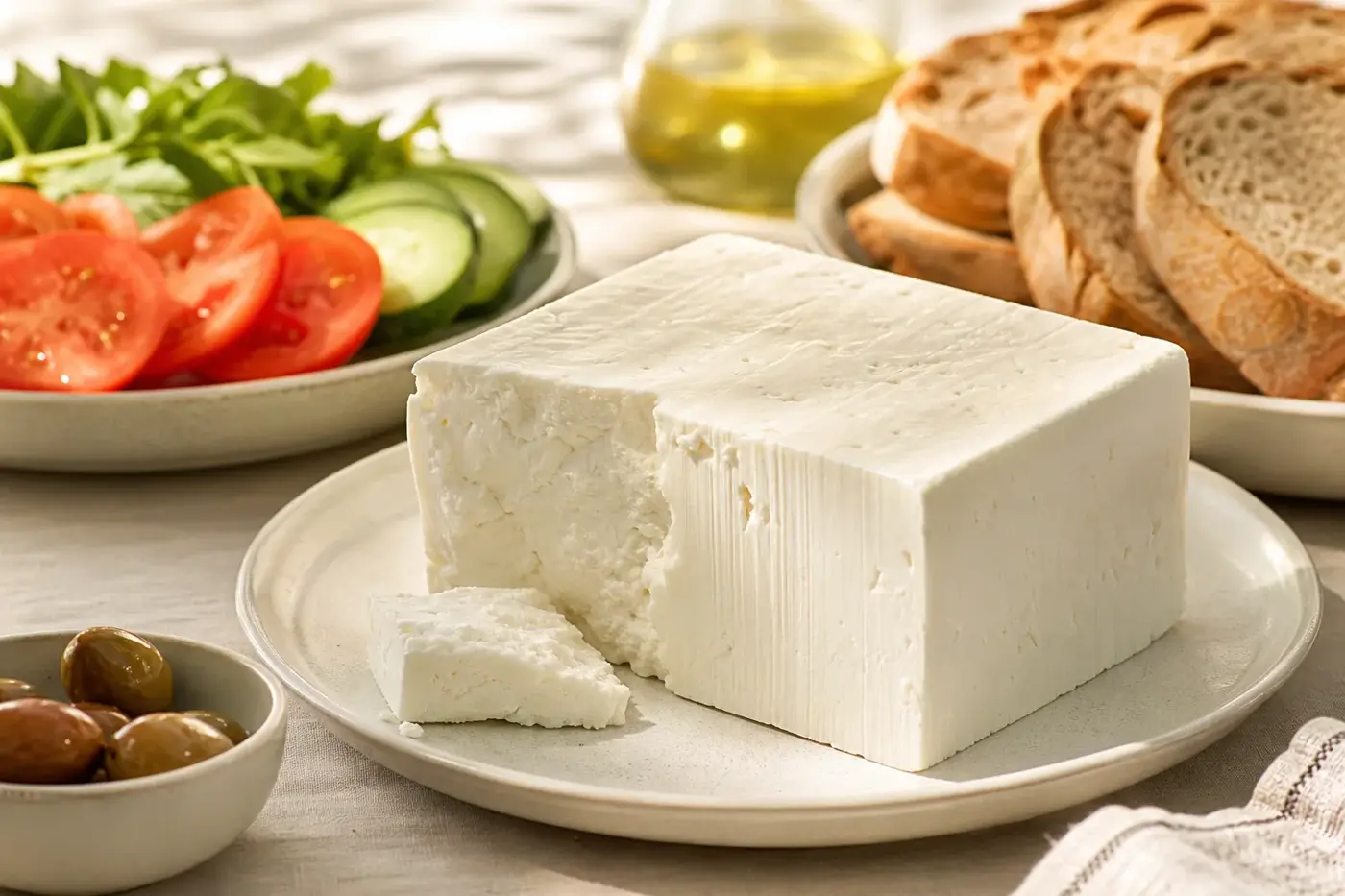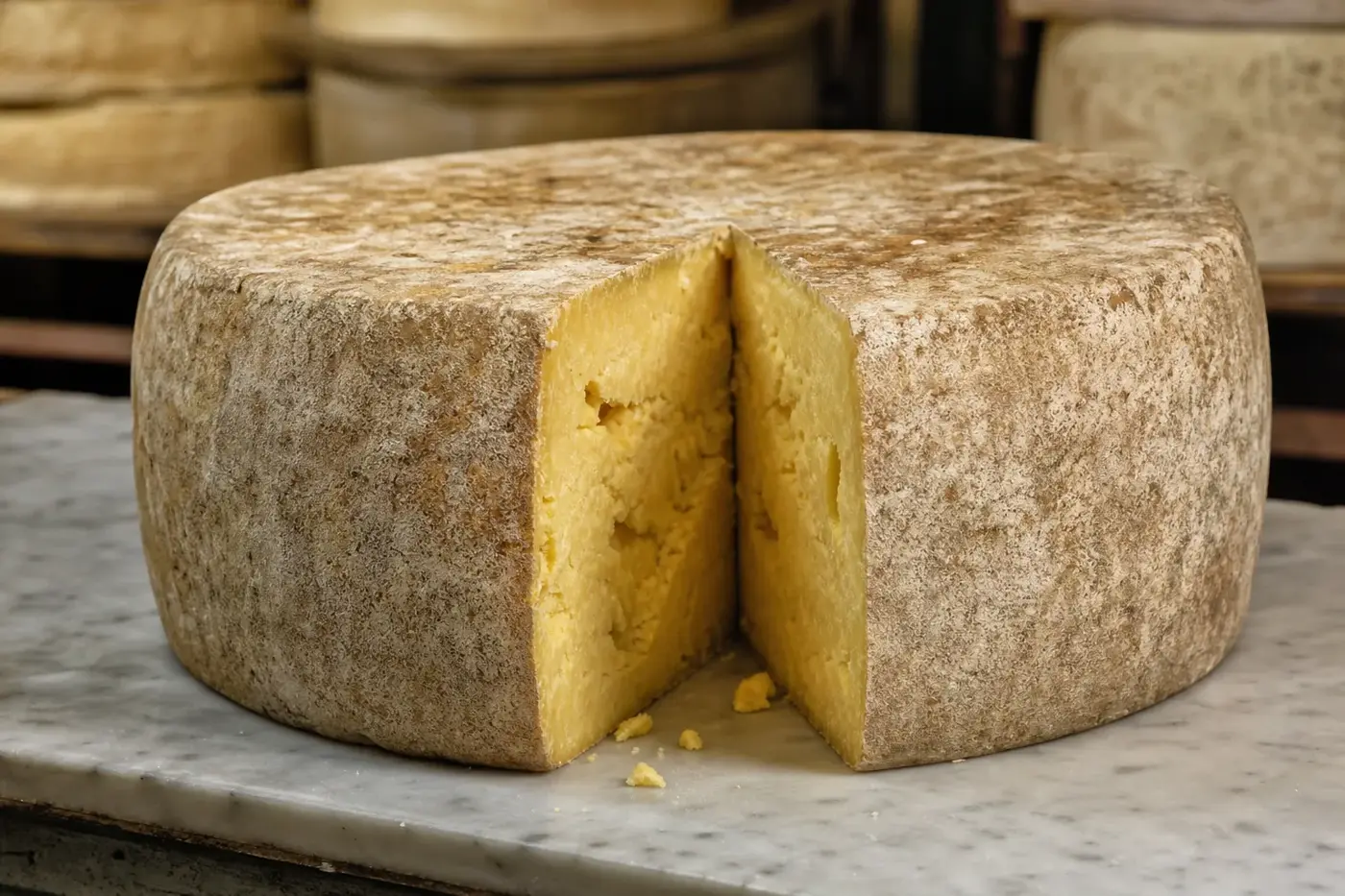
Slide a slice into bread and let that savoury bite announce itself. Beneath Roumy’s natural rind is a yellow, crumbly cheese: Egypt’s everyday hard cheese, pressed, salted and aged.[7,8] Also called Ras, it changes substantially as it ripens, a transformation recorded in Egyptian research.[1,2]
Your first introduction to Roumy
| What to know | The details |
|---|---|
| Names you might spot | Roumy; Ras; Romi and Romy in Egypt’s standards catalogue.[2,4,5] |
| Where it comes from | Egypt, including the Nile Delta.[1] |
| Its cheese family | Hard, ripened cheese.[2] |
| Milk used in research | Cow’s milk, or a mixture of cow’s and buffalo’s milk.[6] |
| Milk treatment | Check the named product’s label.[10] |
| Ripening ages studied | Samples examined at 30, 90 and 180 days in one experiment.[1] |
| Egyptian standard catalogue entries | ES 1007-4/2020, Romi (romy); ES 1007-5/2005, Ras.[4,5] |
| Registered name and register ID | Jurisdiction-specific status remains uncertain. |
| Legal milk proportions and minimum ageing | Requirements remain uncertain. |
Plenty of names, but which wedge is yours?
Roumy, Roumi, Rumi, Romy and Romi are spellings you may meet at the cheese counter. Ras appears especially often in dairy research: a 2023 manufacturing study calls its subject “Ras or Roumy”. Egypt’s standards catalogue uses Romi and romy in its English title, while listing Ras separately.[1,4,5,7]
The names get you to the counter. The maker, milk and maturity tell you more about what you’re taking home. For your first purchase, ask who made it, which milk went into it and how long it matured. When you’re choosing strength, an age description is more useful than winning the spelling round.
Take a closer look at that yellow wheel
Roumy comes in substantial round wheels, sold whole or cut into wedges and slices. The reference entry for Rumi describes discs of about 10 kg, alongside vacuum-packed slices. That weight describes a commercial format, not a fixed size every maker must follow.[7]
Cheese.com describes a natural rind, yellow colour and crumbly texture. Beneath the rind is the paste, the cheesemaker’s word for the body of the cheese. Some Roumy has an open interior rather than a completely closed, even cut surface. The reference account describes those openings developing during ripening.[7,8]
Give your prospective wedge more attention than a quick glance at its colour. Look at the rind and centre, and notice how a slice holds together. Ask the seller about irregular openings and that particular wheel’s maturity. If there’s a separate coating or wrapping, follow the maker’s removal instructions.
Get to know the milk behind the wheel
Cow’s milk and mixtures of cow’s and buffalo’s milk both appear in Egyptian Ras research. Buffalo’s milk has a place in Roumy’s documented story, but the recipe still depends on the wheel. Ask whether yours contains cow’s milk, buffalo’s milk or both, rather than expecting every producer to use the same blend.[6]
The Egyptian Organization for Standardization and Quality catalogue has two separate entries: ES 1007-4/2020 for Romi (romy) cheese and ES 1007-5/2005 for Ras cheese. If you’re reading a manufacturer’s specification, ask which standard the product follows.[4,5]
Follow the milk from vat to wheel
A wheel of Roumy takes shape through cutting, heating, draining, moulding, pressing, surface salting and ripening. Egyptian production research lays out the sequence. First comes rennet, an enzyme preparation that sets milk into a gel to form the curd. Whey is the liquid separated from it.[1]
Cutting breaks that gel into smaller pieces. Heating and stirring accompany whey separation, then pressing brings the curd together into a wheel. In the 2023 experiment, researchers added salt before moulding and again to the surface afterwards. They made three batches and examined the cheese at different ripening ages.[1]
Fermentation can begin with microorganisms already present in the milk and dairy environment. Traditional Ras research describes this approach, often without a deliberately added starter culture. A starter is a selected microbial culture that guides fermentation. If that distinction matters to you, ask the manufacturer which method it uses.[6]
Curious about the whole journey? Read how cheese is made. For the differences between coagulants, turn to rennet explained.
Let maturity lead you to your favourite
Age changes Roumy’s substance, and how you’ll want to eat it. Egyptian research commonly discusses ripening in months. The 2023 experimental study examined cheese at 30, 90 and 180 days, offering a view of early, middle and later maturation.[1]
Moisture loss plays a part in that transformation. A 2025 survey of 40 Egyptian market samples found moisture in the whole cheese ranging from 23.65% to 41.84%. The samples’ ages weren’t controlled. Still, that range shows how markedly two wedges carrying the same name can differ.[6]
Published descriptions emphasise mature Roumy’s saltiness, sharpness and pungency. Take those qualities to the counter: ask for younger cheese for a gentler sandwich filling, or an older wedge for an assertive grated finish. Ask about the actual batch, especially if you’re hoping for a mild, buttery impression rather than a piquant one.[7,8]
Let your dish help choose the texture, too. For bread, ask for a piece that slices cleanly; for scattering over food, choose one that breaks and grates readily. Age points you in the right direction. The wedge itself gets the final say.
A little pepper, or nothing added?
A reference account of Roumy includes peppercorns as an optional addition.[7] Whether these are specifically black peppercorns remains uncertain without producer or production-study information. If you want to know exactly which seasoning you’re getting, look at that cheese’s ingredient information.
At home in Egypt, with a hazier beginning
Roumy has a firm place in Egypt’s living dairy culture. Egyptian research treats Ras as an established traditional hard cheese, exploring its making and maturation in detail.[2] The serving ideas below are suggestions for your table, rather than a documented account of how Roumy is eaten in Egypt.
Its earlier history is less settled. A 2023 Egyptian dairy paper repeats the belief that the basic cheese came from the Balkans before spreading to Egypt.[3] Dairy literature also compares it with Greek kefalotyri. You have an attributed origin account and a comparison of styles, rather than the firmer historical footing of a dated manufacturing record.[1,3]
Bring bread and keep the grater handy
Start with bread and thin slices of Roumy. Add tomato, cucumber or leafy vegetables to taste for a straightforward sandwich. A softer, younger wedge sits neatly inside the bread. A stronger one makes it quite clear which ingredient is in charge.
Then give your grater a turn. Try Roumy over hot pasta, baked vegetables or potatoes, adding a little before tasting for more salt. Finely grated cheese distributes its flavour differently from a thick slice. Match the cut to your dish rather than reaching for the same preparation every time.
For a simple plate, put small pieces beside bread and fresh vegetables. Let the cheese’s salt and sharpness guide your accompaniments. Plain Roumy leaves you free to add pepper at the table. Peppercorn Roumy brings the seasoning already distributed through the slice.
Meeting Roumy for the first time? Try one cheese in two forms: a thin slice with bread, then a small amount grated over a hot dish. Notice how texture shifts the balance between cheese and accompaniment. That gives you something concrete to ask for next time, especially with different makers, where an age word alone may tell you less.
Choose your wedge and give it a chilled home
Before buying, ask for the maker, milk species, milk treatment and age. Look through the ingredients for pepper or other additions, and keep the product’s date and storage instructions with your wedge. For help untangling a pack’s details, see how to read a cheese label.
Buying a cut piece? Ask the seller for suitable food wrapping and storage instructions for that cheese. Keep it wrapped or covered as directed, and refrigerate it according to the label. If you move it into another container, keep the original information so its identity, date and instructions stay together.
The Food Standards Agency advises keeping a fridge at 5 °C or below. The cited guidance applies to England, Northern Ireland and Wales; its reference date here is November 2026.[9] Follow the product’s instructions for refrigeration and use after opening. The cheese storage guide covers wider handling questions; your maker or seller can address the details for your wedge.
Ask about pasteurisation separately
“Which milk?” and “Was it pasteurised?” are two different questions. Ask explicitly whether your Roumy was made from pasteurised milk, especially if you’re buying a piece cut from an unlabelled wheel. For the distinctions between treatments, see raw, thermised and pasteurised cheese.
In the United States, the CDC recommends that everyone choose pasteurised milk and dairy products. Its dairy guidance explains that cheese made with raw milk can contain Listeria and other harmful germs.[10] When choosing what to buy, consult the current official advice for your country.
If you’re in the United States and pregnant, aged 65 or older, or have weakened immunity, you can consult the CDC’s guidance on preventing Listeria infection. Discuss your circumstances with a healthcare professional.[11] The guidance reference date here is November 2026.
General information only, not medical advice: follow the official guidance where you live.
Questions people ask
What is Roumy cheese?
Roumy is an Egyptian hard, ripened cheese with a natural rind and a yellow, crumbly interior. It is also known as Ras, Romi and Romy.
What milk is Roumy made from?
Egyptian research documents Roumy made from cow’s milk or a mixture of cow’s and buffalo’s milk. The recipe depends on the wheel, so ask which milk was used.
What does Roumy taste like?
Mature Roumy is described as salty, sharp and pungent. A younger cheese may be a gentler sandwich filling, while an older wedge can provide a stronger grated finish.
How can you eat Roumy?
Try thin slices in a sandwich with tomato, cucumber or leafy vegetables. It can also be grated over hot pasta, baked vegetables or potatoes.
Can you eat Roumy during pregnancy?
In the United States, the CDC recommends that everyone choose pasteurised milk and dairy products. The CDC’s guidance on preventing Listeria infection is available for people who are pregnant, and the page suggests discussing individual circumstances with a healthcare professional.
Sources
- Biology, Effect of Ripening and In Vitro Digestion on Bioactive Peptides Profile in Ras Cheese and Their Biological Activities, volume 12, article 948, 2023. Introduction and section 2.2, including the experimental manufacturing sequence and sampling ages. Full text.
- International Journal of Current Microbiology and Applied Sciences, Characteristics and Technological Aspects of the Egyptian Cheeses, volume 9, issue 6, pages 3338 to 3354, 2020. Review used for the names and Egyptian cultural context. Article.
- Foods, Neoteric Biofilms Applied to Enhance the Safety Characteristics of Ras Cheese during Ripening, volume 12, article 3548, 2023. Introductory passage reporting a belief about Balkan origins. Article record.
- Egyptian Organization for Standardization and Quality, Hard cheese -: Part 4 Romi ( romy ) cheese, ES 1007-4/2020, catalogue entry, endorsement dated 4 February 2020. Official entry.
- Egyptian Organization for Standardization and Quality, HARD CHEESE PART : 5 RAS CHEESE, ES 1007-5/2005, catalogue entry, endorsement dated 17 April 2005. Official entry.
- Alexandria Science Exchange Journal, Chemical and Microbial Safety Criteria for Egyptian Ras Cheeses, volume 46, issue 1, 2025. Introduction, sampling method and Table 1. Full paper.
- Wikipedia contributors, Rumi cheese, reference entry retrieved November 2026. Secondary documentation of spellings, wheel presentation, open texture and optional peppercorns. Entry.
- Cheese.com, Roumy, undated reference entry retrieved November 2026. Its descriptions of rind, colour, texture and mature flavour are attributed in the article. Entry.
- Food Standards Agency, How to chill, freeze and defrost food safely, GOV.UK publication, 2017, retrieved November 2026. Publication applies to England, Northern Ireland and Wales. Official guidance.
- US Centers for Disease Control and Prevention, How Listeria Spread: Soft Cheeses and Raw Milk, 2025, retrieved November 2026. Official guidance.
- US Centers for Disease Control and Prevention, Preventing Listeria Infection, 31 January 2025, retrieved November 2026. Risk groups and the food-choice table. Official guidance.
Researched through Egyptian standards catalogue records, published dairy research, attributed reference descriptions and official food safety guidance, with serving suggestions developed as editorial synthesis.
Last checked: November 2026
Last checked November 2026.
The editors suggest you read next