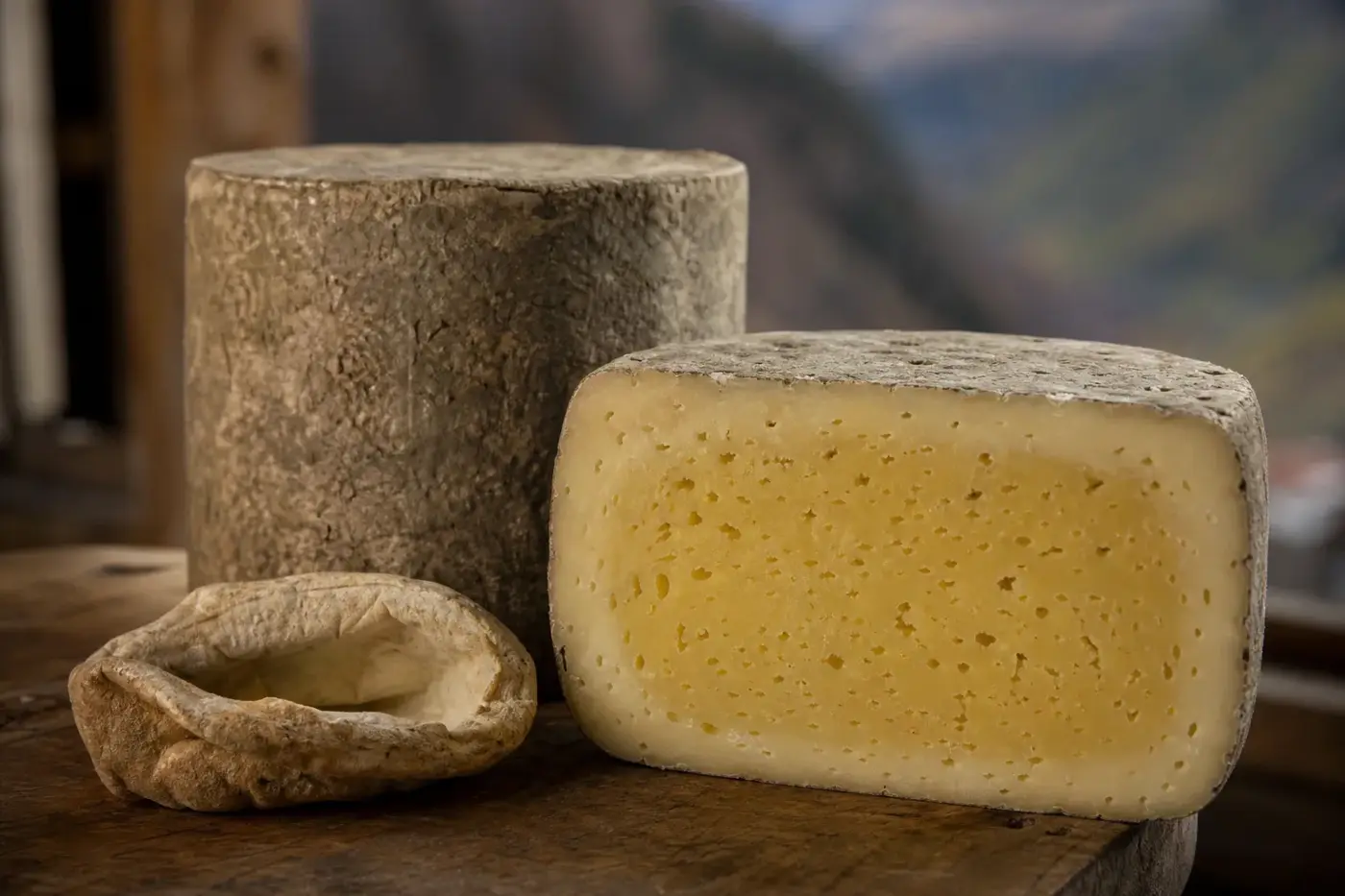
Sulguni
Pull apart the warm, folded curd and watch its supple layers separate.
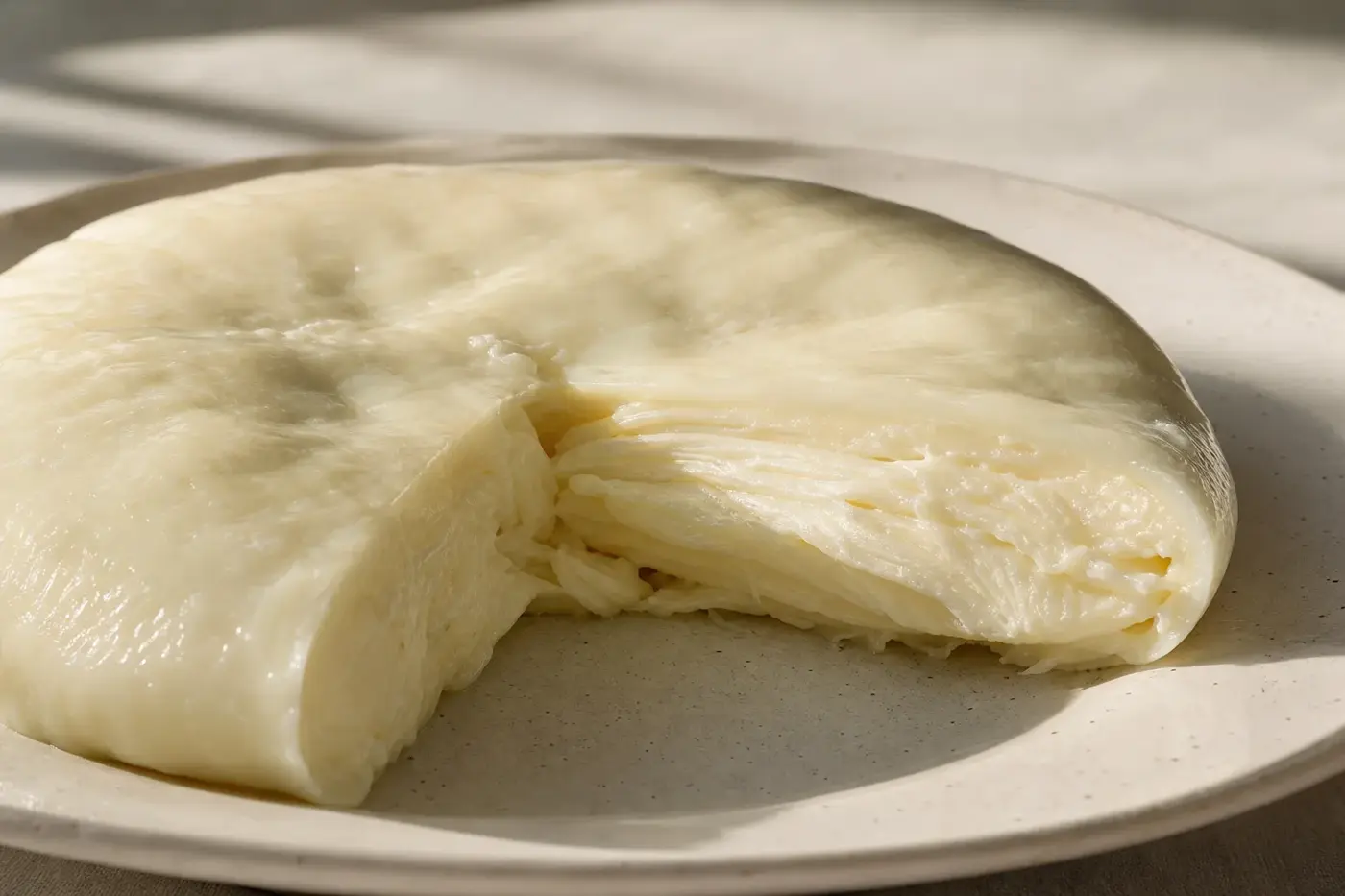
Pull apart the warm, folded curd and watch its supple layers separate. This is Sulguni, the Georgian cheese especially associated with Samegrelo in the west. Its young curd begins tangy; stretching gives it the character that makes elarji and Megrelian khachapuri so distinctive. You can see the promise before you take a bite.[1][3][4]
Your first look at Sulguni
| What you might ask | What to know |
|---|---|
| Its registered name | სულგუნი; English: Sulguni.[1] |
| Who registers it? | Sakpatenti, Georgia; geographical indication No. 10; registered 24 January 2012.[2] |
| Where is it from? | Georgia; the milk must come from Georgia too.[1] |
| Which milk goes in? | Cow, buffalo, goat or mixtures.[1] |
| How is the milk treated? | Raw or pasteurised.[1] |
| What sets the milk? | Animal or microbial rennet.[1] |
| Does it have a rind? | Usually rindless.[1] |
Begin at the table in Samegrelo
Samegrelo is the place most closely tied to Sulguni at the table, although its Georgian registration reaches further. The Honorary Consulate of Georgia describes it as a cheese from Samegrelo. It also connects its manufacture with the thermal processing of Imeretian cheese.[2][5]
Picture that transformation: fresh curd meets heat and stretching, emerging as a distinctly different cheese. Sulguni belongs to the stretched-curd family, often called pasta filata. A white colour or a spell in brine does not, by itself, make a cheese part of that family.[1]
You can eat Sulguni plain, tuck it into bread or work its stretch through cornmeal. Choose with your dish in mind, rather than relying on a maturity label. What you need the cheese to do matters as much as the words describing it.[3][4]
Get to know those pale, supple layers
The familiar Sulguni is a flattened wheel, pale and smooth, with no rind. Inside, Sakpatenti describes an elastic, layered texture, with moisture between the layers when fresh. On your tongue, expect moderate salt and a cultured-milk tang.[1]
Start with a small piece of plain, fresh Sulguni. Notice how the salt and sourness balance, then see how readily the layers part. Try it sliced and warmed: you will discover your preference and have a useful starting point for cooking.
Smoke shifts your attention. Saguleti describes its cherry-wood-smoked version as clean in dairy flavour, with delicate smoke. Those notes belong to this producer's restrained style, rather than every smoked Sulguni you might meet.[6]
Let the milk label tell its story
Sulguni's specification allows cow, buffalo or goat milk, alone or mixed. Both raw and pasteurised milk are permitted. Your particular cheese's declaration is the place to begin.[1]
Ask which milk went into it and whether the cheese is fresh, dried or smoked. “Georgian cheese” leaves rather a lot unsaid. That matters especially when you have a particular dish in mind.
Milk is useful information when comparing cheeses, but let the maker explain this one rather than predicting flavour from the animal. Give two versions the same treatment: plain slices, for example, rather than one fresh cheese beside one smoked cheese. Keep the labels with your tasting notes, so milk, treatment and finishing method remain separate observations.
Follow the curd into hot water
First, rennet, the coagulating enzyme, sets the milk. The curd is cut, drained and fermented. Then comes Sulguni's defining sequence: slicing, softening in hot water, stretching, folding and shaping. Salting follows, either dry or in brine.[1]
Think of the process in two acts. First comes the initial curd; then heat and working turn it into the finished cheese. Keep those stages separate and you can see where Sulguni acquires its distinctive structure.
For the wider story of setting milk and draining whey, visit how cheese is made. Follow a maker's account in that order too: milk setting, curd development, then working the curd. Shared colour alone is a poor basis for grouping cheeses. Your cheese board need not operate a dress code.
Meet Imeruli, with a beginning in common
Imeruli, or Imeretian cheese, has a character and identity of its own. Georgia's tourism authority describes cow's milk set with rennet, then drained, shaped and salted. It calls the fresh cheese squeaky and records its place beside mchadi, Georgian cornbread, and inside Imeretian khachapuri.[7]
The consulate's account connects Sulguni with further heat treatment of Imeretian cheese. A young cheese or curd can continue through the process and emerge as another cheese entirely. Both have their own entries in Georgia's geographical indications register.[2][5]
When you cook from a Georgian recipe, give those names your attention. “Fresh cheese for filling” and “cheese for stretching” are different jobs, even when their manufacture shares a connection. If the recipe asks for both Imeruli and Sulguni, seek out both before deciding how to adapt it.[3]
Look beyond Samegrelo for the registered name
Sakpatenti lists Sulguni as Georgian geographical indication No. 10, registered on 24 January 2012. The published specification defines Georgia as its production area and requires Georgian milk.[1][2]
Keep those two scales in mind: Samegrelo is the cultural reference point, while the registered production area is national. The register also lists Megrelian Sulguni Cheese and Svanetian Sulguni Cheese separately. Those names deserve their own attention; they are not alternative spellings of Sulguni.[2][5]
To trace origin, distinguish the product name from the maker, distributor and packer. Read the stated place of manufacture alongside the milk and product details. The guide to protected names explains how geographical indications connect a name to a defined specification.
Ask your retailer exactly which cheese you are buying. Keep the registered name and maker together, particularly if you want to find it again. “That Georgian cheese I liked” is an affectionate memory, but a rather ambitious shopping instruction.
Start with a slice, then try khachapuri
Begin with a plain slice and some bread, then try Sulguni cooked. That gives you room to explore its cold texture and its behaviour in a filling. No complicated accompaniment needs to compete for your attention.
Khachapuri is a family of Georgian cheese breads, with regional differences worth getting to know. The Georgian National Tourism Administration describes Imeretian khachapuri as using fresh, crumbly Imeretian cheese with moderate salt. Its account of Megrelian khachapuri pairs fresh chkinti cheese with Sulguni, including versions with Sulguni laid or grated on top.[3]
Let the bread guide your shopping. Will your cheese go inside, on top, or both? When a recipe calls for two cheeses, respect their separate roles. Replacing the entire filling with one strongly salted cheese loses the distinction the recipe makes.
For elarji, freshness comes first
Here you can put Sulguni's stretch to work. Elarji is a Megrelian preparation that brings cornmeal and cheese together into a cohesive, stretchy mass. The tourism authority specifies very fresh Sulguni or newly ripe elarji cheese, cut into thin strips and worked thoroughly into the cornmeal.[4]
Take the words “very fresh” to your cheesemonger. Explain what you plan to cook, rather than asking for Sulguni alone. For your first attempt, follow a Georgian recipe's choice of fresh cheese before exploring smoke.
The same tourism source records a modern version of elarji balls combining plain and smoked Sulguni. That is a different preparation with a different intended result. Choose for the dish in front of you: fresh cheese for the stretchy cornmeal mixture and the combination used for elarji balls serve distinct purposes.[4]
Ask at the counter, then keep it chilled
Ask who made the cheese, its country of production, its milk type and its milk treatment. Find out whether it is fresh or smoked, then read the storage instructions and date marking before choosing your pack. If you buy a cut portion, request the same details in writing.
At home, follow the UK Food Standards Agency's advice to keep your fridge between 0 and 5 °C. It says dairy products should be refrigerated and their packaging instructions followed. Use the maker's opening instructions for the particular cheese you have bought.[8]
Keep the label with your cheese, or photograph it before discarding the wrapper. Follow any instruction about retaining the packing liquid. If the opening instructions leave you unsure, ask the maker or retailer. For the broader handling routine, turn to storing cheese at home.
Choose a substitute for the job
If you need a substitute for a cooked filling, start with the dish. Saltiness, acidity and melting behaviour are separate qualities. Two cheeses can look alike without behaving alike, so compare those qualities rather than trusting appearances.
Read the salt declaration and taste each cheese before combining them. Cook a small trial portion before committing your whole filling. Note exactly which products you used, including their label details: a successful adaptation is much easier to repeat when you know what went into it.
For elarji, put your effort into finding the cheese specified by a Georgian recipe. For serving in slices, seek Sulguni itself. These are different aims. A cheese that works in a baked filling is not necessarily the one you would choose to eat plain.
This page summarises published guidance from the official sources it cites. It is not medical advice. Guidance differs between countries and changes over time, so check the current source for where you live, and ask your doctor, midwife, pharmacist or dietitian about your own circumstances.
If you are at higher risk, start with milk treatment
The NHS publishes UK guidance on foods to avoid in pregnancy, including specific advice for different cheese categories. Consult the linked guidance for its current recommendations.[9]
That pregnancy list names categories and examples of cheese. For Sulguni, look at your actual product's milk treatment and ask your midwife or another clinician if you are unsure how the guidance applies. The guide to milk treatments helps you understand those label terms.
The NHS identifies pregnancy, newborn babies and conditions or treatments that weaken immunity as circumstances associated with greater risk of serious listeriosis. Its guidance includes dairy products made from unpasteurised milk among foods associated with infection.[10]
If you are in a higher-risk group, follow current official guidance where you live and your clinical team's advice. Keep the product information to hand when you ask for help. This lets the conversation focus on your particular cheese and its milk treatment, rather than the name Sulguni alone.
Questions people ask
What is Sulguni and how is it made?
Sulguni is a Georgian stretched curd cheese especially associated with Samegrelo. Its fermented curd is softened in hot water, then stretched, folded and shaped before salting.
What milk and rennet are used in Sulguni?
The specification permits cow, buffalo or goat milk, used singly or mixed, and the milk can be raw or pasteurised. It also permits animal or microbial rennet.
What dishes use Sulguni?
Sulguni is used in Megrelian khachapuri, including versions with the cheese laid or grated on top. It is also worked into cornmeal to make elarji.
How should Sulguni be stored?
The UK Food Standards Agency advises keeping the fridge between 0 and 5 °C. It says dairy products should be refrigerated and their packaging instructions followed.
Can I eat Sulguni during pregnancy?
The NHS publishes guidance on foods to avoid in pregnancy, including advice for different cheese categories. Consult the current NHS guidance and ask your midwife or another clinician if you are unsure how it applies to a particular Sulguni.
Sources
- Georgian National Intellectual Property Centre, Sakpatenti. Specification of the Protected Geographical Indication Sulguni. Registration No. 10; English document hosted in the November 2025 upload directory; revision and operative amendment date not stated in the retrieved document. Official specification.
- Sakpatenti. State registry, geographical indications table, live edition retrieved November 2026. Official register.
- Georgian National Tourism Administration. Khachapuri: True Symbol of Georgian Cuisine. Undated web edition retrieved November 2026. Cultural and culinary account.
- Georgian National Tourism Administration. Elarji. Undated web edition retrieved November 2026. Culinary account.
- Honorary Consulate of Georgia in Bulgaria. Traditional Georgian Cuisine, “Suluguni” section. Undated web edition retrieved November 2026. Cultural account.
- Saguleti. Smoked Sulguni Cheese. Undated producer product description retrieved November 2026. Commercial source, used only for its attributed production and tasting description. Producer account.
- Georgian National Tourism Administration. Imeretian Cheese. Undated web edition retrieved November 2026. Cheese and culinary account.
- Food Standards Agency. How to chill, freeze and defrost food safely. GOV.UK web edition retrieved November 2026. Official refrigeration guidance.
- NHS. Foods to avoid in pregnancy. Current web edition retrieved November 2026. Official pregnancy guidance.
- NHS. Listeriosis. Current web edition retrieved November 2026. Official guidance.
Researched through official Georgian registration material, Georgian cultural accounts, an attributed producer description and UK official food guidance; practical suggestions are editorial synthesis.
Last checked: November 2026
Last checked November 2026.
The editors suggest you read next
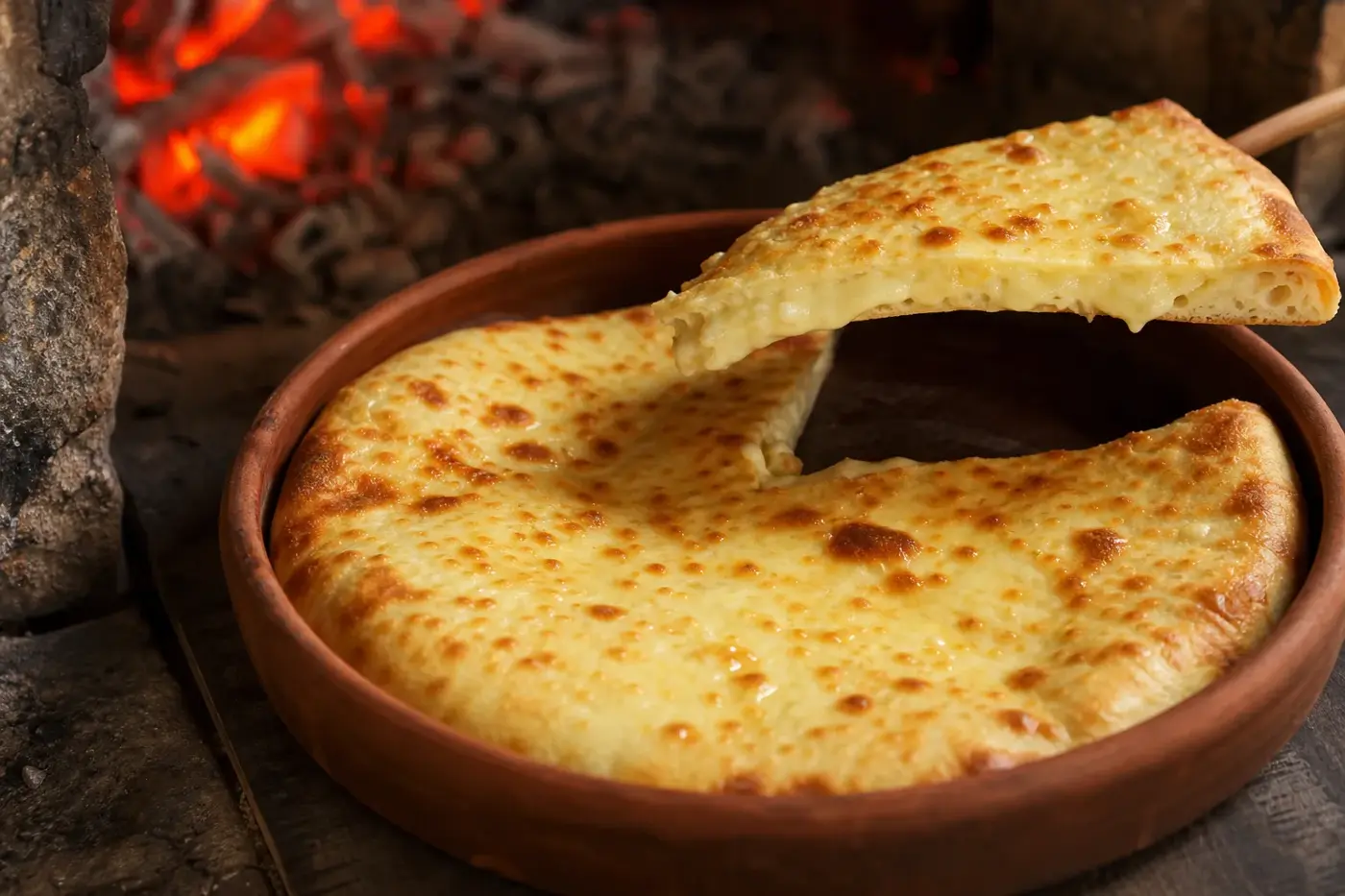
Imeruli
A clay pan sits over embers in an Imereti village, bread wrapped around a filling of fresh, crumbly cheese.