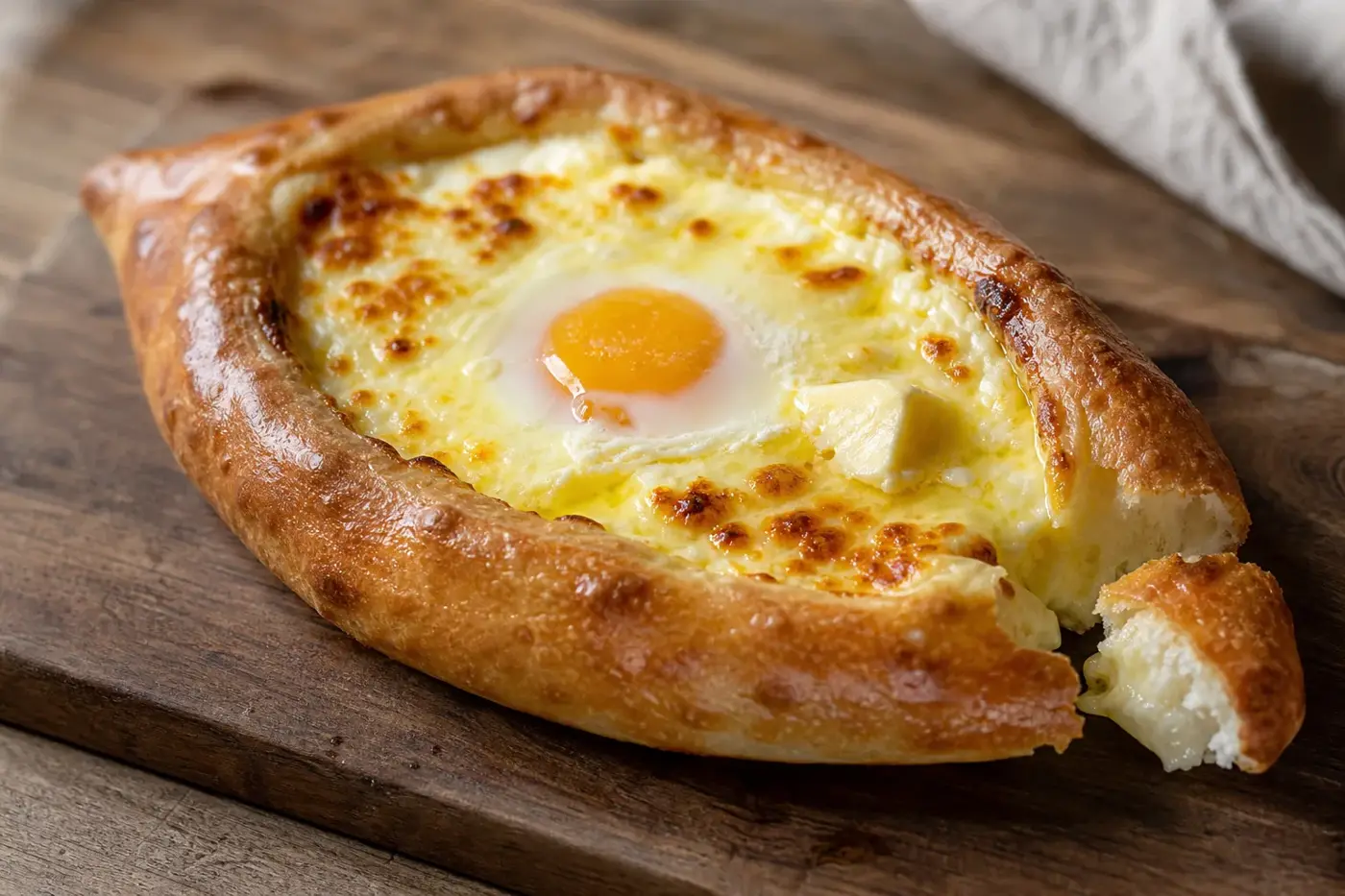
Tear a piece from the pointed end. Dip it into hot cheese, egg and butter: your first bite of Adjarian khachapuri comes with its own bread utensil. Across Georgia, you will find other shapes, from a round loaf enclosing Imeretian cheese to a Megrelian round with still more cheese on top. In your British kitchen, mozzarella brings the stretch and feta the salty tang. [1,2,5]
Meet the breads beyond the famous boat
The open boat gets plenty of attention abroad, but Georgia's most widespread khachapuri keeps its cheese tucked inside. Georgia's official tourism website gives that distinction to the Imeretian version: tender bread wrapped around cheese. Its regional accounts lead you through home kitchens, village cooking and festive meals. This enclosed loaf sits at the heart of the tradition, not in the boat's shadow. [1,2]
| Style | What awaits you |
|---|---|
| Imeretian, or imeruli | An enclosed round, traditionally filled with Imeretian cheese. [1] |
| Megrelian, or megruli | A filled round with more cheese on top, commonly sulguni mixed with egg. [2] |
| Adjarian, or adjaruli | An open cheese boat finished with egg and butter. [6] |
Each shape has its own eating ritual. Cut enclosed rounds into wedges; with an Adjarian boat, let the crust do the scooping. Choose the boat when you can bake and eat straight away, with everyone ready before the eggs go into the oven. Late guests will need to negotiate with the punctual ones. [2,6]
Get acquainted with the cheeses inside
Crumbly, smelling of milk and not too salty: that is how Georgia Travel describes the cheese chosen for Imeretian khachapuri. Imeruli, also called Imeretian cheese, gives the bread its fresh cheese character. The site's separate cheese account describes a squeaky texture and storage in brine. When you choose it for bread, pay attention to both freshness and salt. [1,3]
Sulguni brings an elastic, layered body. The specification published by Georgia's intellectual property authority describes a stretched curd cheese with a cultured milk flavour and moderate saltiness. Georgia Travel combines both cheeses in its Adjarian filling, which is baked and stirred while hot. Choose fresh, unsmoked sulguni here; the smoked version would take the flavour in a different direction. [4,6]
Find your filling in a British kitchen
For the recipe below, you need 227 g mozzarella, 57 g feta and 113 g ricotta. This combination comes from King Arthur Baking's published version: mozzarella and feta provide the main contrast, while ricotta softens the filling. You are making an adaptation with familiar ingredients and its own balance of stretch, acidity and salt, rather than an exact recreation of Georgian cheeses. [5]
Block mozzarella sold for cooking is your practical choice, rather than balls sitting in liquid. The published cookbook adaptation also specifies low moisture mozzarella. If you use fresh mozzarella, drain it thoroughly and pat it dry before grating or tearing. Drain any liquid from the ricotta pot, too: you want a spoonable filling, not a puddle of whey. [7]
Taste the cheeses together before the raw egg goes in. The feta brings salt, so this adaptation needs no extra salt in the filling. For a gentler result, replace some feta with the same weight of mozzarella: you will get less salt and tang, and more stretch. Drain the mozzarella if needed, keep the total cheese weight unchanged and stick to this substitution for the adaptation. [5]
Make four Adjarian boats for your table
This version adapts King Arthur Baking's published recipe, simplifying the filling and adding the eggs later. Set out your ingredients and equipment before you begin, so everything is ready when you need it. [5]
Yield: 4 small boats, serving 4.
Time: allow about 4 hours, including proving; approximately 1 hour active preparation.
Oven: 190 °C conventional (375 °F), or 170 °C fan (340 °F).
Equipment: scales, mixing bowls, saucepan, rolling pin, two baking trays, baking parchment, pastry brush, spoon and clean food thermometer. [5,8]
Set out your dough, filling and finishing touches
For the dough
- 330 g strong white bread flour, about 11.6 oz, plus a little for dusting
- About 220 ml milk, weighed as 227 g or 8 oz
- 43 g unsalted butter, about 1.5 oz, plus a little for greasing
- 6 g sugar, about 0.21 oz
- 9 g fine salt, about 0.32 oz
- 6 g instant yeast, about 0.21 oz
For the filling
- 227 g block mozzarella, grated
- 113 g ricotta, drained if wet
- 57 g feta, crumbled
- 1 large hen egg
- 14 g plain flour
For finishing
- 1 large hen egg beaten with 5 ml water, for brushing
- 4 large hen eggs, one per boat
- 20 g unsalted butter, divided into four pieces [5]
Allergens: wheat, milk and eggs. Read every ingredient label, including substitutes. If you are cooking for vegetarians, check the cheeses' coagulants rather than assuming the whole dish qualifies.
Give the dough a knead, then a little peace
-
Warm the milk with the butter until the butter melts. Stir in the sugar and salt, then cool until lukewarm, about 38 to 43 °C (100 to 110 °F). Add the yeast and flour, mix, cover and rest for 10 minutes. [5]
-
Knead by hand for 8 to 10 minutes, until smooth. Push the dough away with the heel of your hand, fold it back and turn it. You are aiming for soft dough that holds together, so go easy on the dusting flour. [5,7]
-
Put the dough in a greased bowl, cover and leave for 1 to 1½ hours, until visibly expanded by at least a third. Mix the filling ingredients separately. Refrigerate the mixture until you are ready to shape. [5,9]
Shape the boats and give those tips a firm pinch
-
Line both trays with parchment and divide the dough into four equal pieces. Roll each piece into an oval approximately 25 cm long and 15 cm wide. Cover and rest for 15 minutes. [5]
-
Divide the filling between the ovals, leaving a border. Lift and roll the long edges towards the cheese to make raised sides, keeping the middle open. Firmly pinch and twist the two ends together. Aim for a shallow boat with sealed tips, not a flat oval with loose corners. [5,6]
-
Space the boats apart on the trays. Cover and leave for about 20 minutes, until puffy. Preheat the oven and brush the exposed dough with egg wash. Keep the filling below the raised rim. [5,7]
Bake until golden, then welcome the eggs
-
Bake, looking from 20 minutes onwards for golden bread and bubbling filling. Carefully lift an edge with a spatula to inspect the base: it should look baked, not pale and damp. If the dough still looks raw, give it longer. [5,7]
-
Press a hollow into each filling with a spoon and add an egg. Return to the oven, allowing approximately 8 to 10 minutes for soft eggs or 12 to 15 minutes for firmer eggs. Use the doneness guidance below rather than trusting the clock alone. Add the butter when serving. [5,6,8]
Choose an egg finish that suits your circumstances
For a fully cooked finish, both white and yolk should be firm. The FSA's general cooking check is a centre temperature of 70 °C (158 °F) for 2 minutes, or 75 °C (167 °F) for 30 seconds. Use a clean probe in the centre of each filling and the thickest part of each egg. Keep it clear of the tray. [8]
The FSA's November 2026 advice for England, Wales and Northern Ireland allows raw or lightly cooked hen eggs for young children, pregnant people, older people and people with an underlying health condition, provided the eggs carry the British Lion mark or come from the Laid in Britain scheme. People who are severely immunocompromised and require medically supervised diets should seek their healthcare team's advice. Without that assurance, cook egg dishes thoroughly. [10,11]
Food Standards Scotland gives corresponding advice on these two assurance schemes and the medically supervised diet exception. If you live elsewhere, follow your national agency's egg guidance. Wash your hands and clean utensils after handling raw eggs. [11,12]
Bring everyone in for the first scoop
Bring the boats to the table promptly. Break the egg with a fork and stir it with the butter into the hot cheese, keeping the bread walls intact. Georgia Travel describes this mixing as part of eating Adjarian khachapuri. Tear a piece from one pointed end, scoop up the filling, then work your way around the sides. [6]
If your egg is fully cooked, break it into small pieces and fold it through the cheese. Finish cooking the egg in the oven first: stirring is for serving, not cooking. Take your first scoop carefully, because both filling and baking tray will be very hot. [6,8]
Give all that cheese some fresh company
A tomato and cucumber salad with herbs and a sharp dressing makes a fresh accompaniment. So do sliced tomatoes with parsley; season lightly alongside that salted cheese. The published cookbook version serves the bread with a vegetable salad and walnut dressing. If you use walnuts, include them in your allergen check. [7]
For a drink, sparkling water or unsweetened black tea keeps things simple. Water offers a neutral accompaniment; tea gives you a brisk contrast to the bread and butter. Put both on the table before the baking finishes, leaving you free to enjoy that first scoop.
This page summarises published guidance from the official sources it cites. It is not medical advice. Guidance differs between countries and changes over time, so check the current source for where you live, and ask your doctor, midwife, pharmacist or dietitian about your own circumstances.
Keep your leftovers safely for another meal
Cool leftovers promptly, dividing large pieces into smaller portions, and refrigerate within 1 to 2 hours. Keep your fridge at 0 to 5 °C (32 to 41 °F). Eat refrigerated leftovers within 48 hours or freeze them. This follows the FSA's November 2026 home guidance for England, Wales and Northern Ireland. [9]
Reheat only once, until steaming hot throughout, including the centre of the cheese filling. An oven is a practical choice for the bread, but thorough heating matters more than a fixed reheating time. For the cheeses you have left, see how to store cheese at home. [8,9]
Defrost frozen leftovers in the fridge and use within 24 hours of complete defrosting. Keep them covered while stored. Follow any shorter instructions on the ingredients' packaging. [9]
Questions people ask
What is the difference between Imeretian, Megrelian and Adjarian khachapuri?
Imeretian khachapuri is an enclosed round filled with cheese, while Megrelian is a filled round with more cheese on top. Adjarian is an open boat finished with egg and butter.
What cheese can I use for khachapuri in Britain?
The page’s adaptation uses 227 g mozzarella, 57 g feta and 113 g ricotta. Mozzarella provides stretch, feta adds a salty tang and ricotta softens the filling.
How do you eat Adjarian khachapuri?
Break the egg with a fork and stir it with the butter into the hot cheese, leaving the bread walls intact. Tear a piece from a pointed end, scoop up the filling and work around the sides.
How long does it take to make khachapuri?
The page’s recipe for four small boats takes about four hours, including proving. Approximately one hour is active preparation.
How should I store and reheat leftover khachapuri?
The FSA advises refrigerating leftovers within one to two hours, eating them within 48 hours or freezing them. It also advises reheating only once, until steaming hot throughout; see the FSA’s home guidance.
Sources
-
Georgian National Tourism Administration, Khachapuri: True Symbol of Georgian Cuisine. Undated web edition, retrieved November 2026. Regional forms, customary cheese characteristics and domestic and festive contexts. Official page.
-
Georgian National Tourism Administration, Megrelian Khachapuri. Undated web edition, retrieved November 2026. Enclosed filling, additional cheese topping and preparation traditions. Official page.
-
Georgian National Tourism Administration, Imeretian Cheese. Undated web edition, retrieved November 2026. Fresh texture, brining and culinary use. Official page.
-
National Intellectual Property Center of Georgia, Sakpatenti, Specification of the Protected Geographical Indication Sulguni. Official English specification in the file uploaded November 2025, retrieved November 2026. Section II, product description and sensory characteristics. Official specification.
-
King Arthur Baking, Khachapuri (Georgian Cheese Bread). Updated 5 November 2025. Recipe formulation, dough handling, shaping and indicative baking times. King Arthur Baking sells flour and baking products; its recipe is a commercial cookery source. Published recipe.
-
Georgian National Tourism Administration, Ajarian Khachapuri. Undated web edition, retrieved November 2026. Traditional cheese mixture, boat shaping, egg and butter finish and serving method. Official page.
-
Rizzoli, BUDMO! Recipes from a Ukrainian Kitchen, “Adjarian Khachapuri”, pages 113 to 115. Publisher's recipe extract, 2022. Low moisture mozzarella, ricotta, shaping photographs, baking before the egg addition and salad accompaniment. Publisher's extract.
-
Food Standards Agency, Cooking your food. Published 2017, current official web edition retrieved November 2026. Cooking temperatures and times; section 7 on leftovers and reheating. Applies to England, Northern Ireland and Wales. Official guidance.
-
Food Standards Agency, How to chill, freeze and defrost food safely. Published 2017, current official web edition retrieved November 2026. Domestic refrigeration, cooling, leftovers and defrosting. Applies to England, Northern Ireland and Wales. Official guidance.
-
Food Standards Agency, Home food fact checker. Updated 21 August 2026. “Are raw eggs safe to eat?” and the medically supervised diet exception. Applies to England, Northern Ireland and Wales. Official guidance.
-
Food Standards Agency, Advice on safe storage, handling and use of eggs for catering. Current 2026 web edition, retrieved November 2026. Assurance schemes, thorough cooking where assurance cannot be verified, vulnerable consumers and hygiene. Official guidance.
-
Food Standards Scotland, Update of FSS advice on the consumption of raw/lightly cooked eggs. Reference FSS-ENF-21-005, 2021, particularly Annex B. Official guidance.
Research combined Georgian official culinary accounts and a cheese specification with published cookery methods and current official food safety guidance.
Last checked: November 2026
Last checked November 2026.
The editors suggest you read next