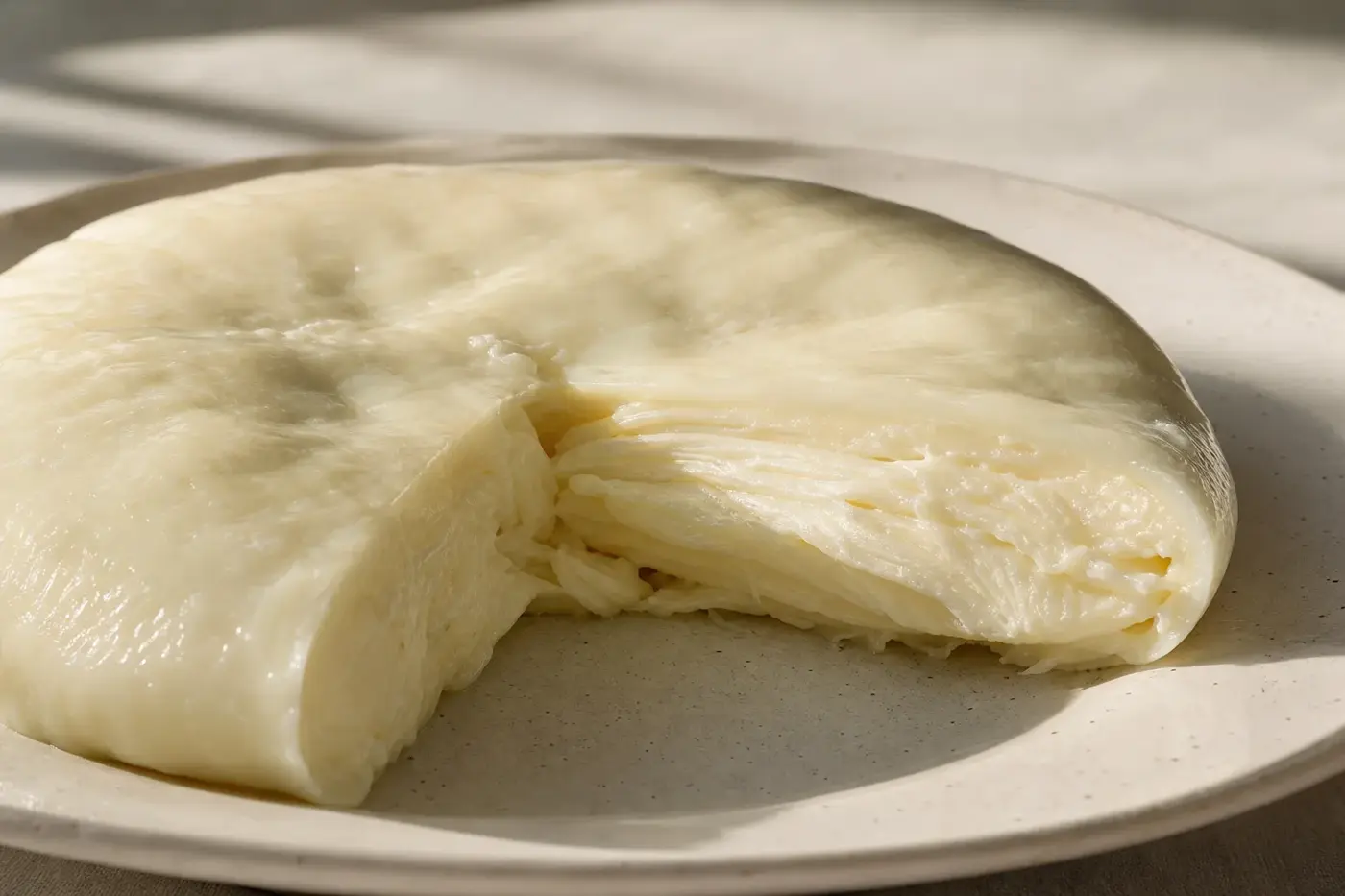
Tushetian Guda
High in Georgia’s Caucasus mountains, cheese ripens pressed against clipped wool.
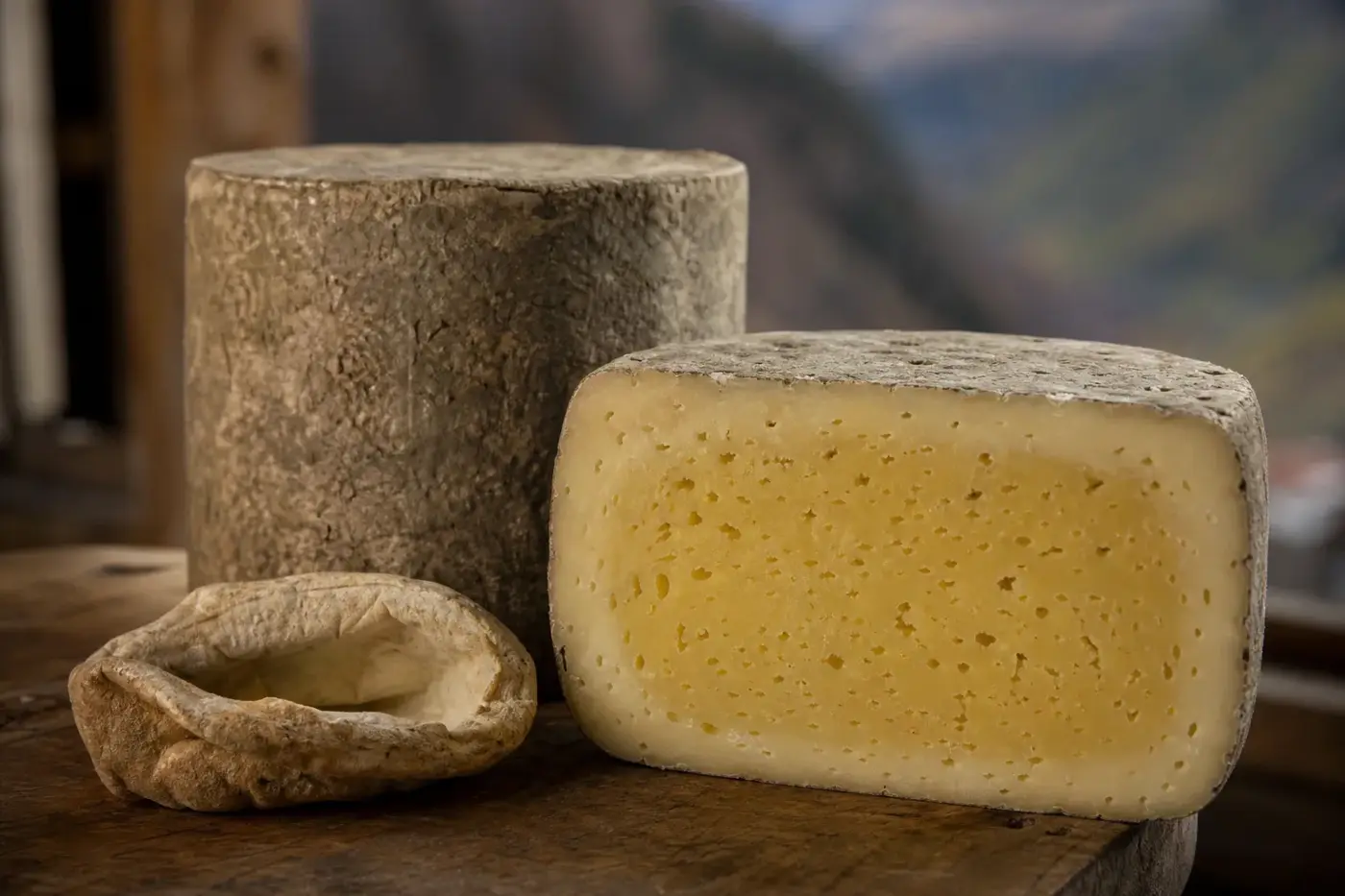
High in Georgia’s Caucasus mountains, cheese ripens pressed against clipped wool. If you pictured a smooth container, Tushetian Guda has other ideas. Its name comes from the guda, a skin sack traditionally turned with its wool facing inwards. In Tusheti, that close contact belongs to a shepherding tradition shaped by mountain grazing, raw milk, salt and patient maturation inside the sack. [3,4]
| What to know | The details |
|---|---|
| Registered name | თუშური გუდა, translated as Tushetian Guda. [1,2] |
| Authority and register ID | Sakpatenti, Georgia; registration 14. [1] |
| Georgian protection | Appellation of origin; registered 24 January 2012. Reference date: November 2026. [1] |
| Milk | Raw whole sheep’s milk, cow’s milk or a mixture; limited goat’s milk addition permitted. [2] |
| Maturing time | At least 60 days in a guda. [2] |
| Rind | No crust. [2] |
| Milk allergen | Contains milk. [2] |
Meet the sack that shapes the flavour
The guda does much more than hold the cheese. Trimmed wool or hair touches it directly during ripening, contributing to its distinctive flavour, as FAO’s account describes. Name, method and character all meet inside that sack. [3]
The official specification allows sheep, goat or calf skin. Makers dry, soak, trim and rinse it before turning the hair inside. If you are browsing photographs, look closely: the clipped hairy side faces the cheese, not the smooth outer surface. [2]
Keeping this method alive takes knowledge, not just equipment. From 2017 to 2019, FAO documented support for a Tushetian Guda initiative focused on preserving the tradition and creating opportunities for younger people. The skills passed between makers are as much a part of this cheese’s identity as its sack. [3]
Follow the herds uphill
By June, weather permitting, flocks and herds are heading into the mountains. They return in September or October. The specification describes this transhumance, the seasonal movement between upland and lowland pastures, and permits pasture grass as feed during mountain grazing, with salt allowed. This seasonal rhythm supplies the milk for the cheese. [5]
You will find Tusheti in north-eastern Georgia, among the Greater Caucasus mountains. Local cheesemaking cooperative Alaznistavi puts alpine grazing and local livestock breeds at the heart of its cheese. Its account connects the mountain climate with the diversity of pasture plants available to the animals. [4]
The cheese’s defined geography follows it downhill, too. Milking, making and the start of ripening must happen in Tusheti, but ripening may finish in Pshaveli, Kvemo Alvani, Zemo Alvani and Laliskhuri, where cutting and packing are also permitted. All are within Kakheti. A lowland packing address can therefore sit perfectly comfortably within the specified production chain. [2]
From raw milk to a carefully prepared bag
Everything begins with whole, raw milk. Sheep’s milk is central to the tradition, although the specification also allows cow’s milk and mixed versions. The mixed formula is 50% sheep’s and 50% cow’s milk, with a tolerance of five percentage points; goat’s milk may be added up to the specified 10% limit. [2]
Georgia’s National Tourism Administration describes milk filtered through a net carrying herbs before rennet goes in. Rennet clots the milk into curd. Makers break up that curd, drain away the whey, then gather the cheese in cloth for pressing before it enters the prepared skin bag. [6]
In this account, several cheeses share one sack, with salt placed between them. The bag is closed and covered for an initial warm rest, then turned to distribute the salt. Ripening continues inside, with the official specification requiring at least 60 days of maturation. [2,6]
Cloth and skin have different jobs here. The cloth gathers and drains the curd; the guda holds the formed cheese while it ripens. To follow those transformations a little further, explore how cheese is made and rennet explained. [6]
Look beneath that uneven surface
Where a cheese sits in the sack helps shape what you see. The specification describes pieces weighing 5 to 10 kg: those at the ends can be hemispherical, while those in the middle are cylindrical. Contact with the guda leaves an uneven surface, with no crust. This is not a cheese aiming for showroom symmetry. [5]
Cut into a sheep’s milk version and you find a striking contrast in the specification’s description. The exterior ranges from white to greyish or greenish, while a paler outer ring surrounds a strongly yellow centre. The paste, meaning the interior, is dense and slightly elastic, with irregular holes. Cow’s milk versions are described as paler inside. [5]
Expect the specified flavour to be salty, piquant and umami, that savoury quality you might recognise in stock. Sheep’s milk, cow’s milk and mixed cheeses each have their own aroma descriptions in the official specification. [5]
Get to know the full name
Tushetian Guda and Guda have separate entries in Sakpatenti’s Georgian register. Tushetian Guda is an appellation of origin, number 14, registered on 24 January 2012, with its requirements in the product specification. Guda is separately listed as number 13, also dated 24 January 2012. The reference date for both entries here is November 2026. [1,2]
At the counter, ask for the full product name, maker, milk and maturing vessel. The shorter word alone does not establish whether a cheese follows either Georgian specification. Alaznistavi’s account distinguishes sheep’s milk, cow’s milk and mixed cheeses, a useful reminder of the detail behind each piece. [4]
Start with the complete registered name when exploring origin and method. Ask the seller to connect your cheese to its producer and product information, especially when buying a cut piece. For help finding your way around the details, turn to reading a cheese label.
Ask about the cheese in front of you
How was it salted? How long did it mature? Has the seller tasted this batch? Those answers make words such as “assertive” or “salty” useful, describing the cheese in front of you rather than its name alone.
The production accounts offer some clues. Salt sits between cheeses in the sack, FAO describes the skin’s contribution to flavour, and the specification gives different aroma descriptions for sheep’s milk, cow’s milk and mixed cheeses. For the saltiness and flavour of your particular batch, ask the maker or seller. [3,5,6]
Bring bread and let the cheese talk
Georgia’s National Tourism Administration associates Tushetian Guda with dedas puri or shoti bread. Start with a small piece of cheese alongside plain bread, adjusting the balance between mouthfuls. Taste before adding anything else. There is plenty here to occupy a cheese lover without recruiting half the cupboard. [6]
If you are an adult of legal drinking age and choose wine, a small serving of Georgian amber wine is one possible partner for its piquant character. People who are pregnant, driving, taking medicines that interact with alcohol, or recovering from alcohol dependence should not drink. See the NHS pregnancy guidance and consult the relevant official advice for your circumstances.
Still or sparkling water, or unsweetened tea, gives you an alcohol-free option that keeps cheese and bread centre stage. Offer everyone the same food and make the drink optional. For more combinations to explore, try the broader cheese and wine pairing guide.
This page summarises published guidance from the official sources it cites. It is not medical advice. Guidance differs between countries and changes over time, so check the current source for where you live, and ask your doctor, midwife, pharmacist or dietitian about your own circumstances.
Ask at the counter, store carefully at home
Before buying, ask for the milk treatment, batch identification, storage instructions and date marking. If you choose a cut piece, get those details in writing or keep the original label. Ask whether the cheese needs to stay in its supplied liquid or packaging.
At home, follow the product’s instructions. The UK Food Standards Agency’s guidance for England, Wales and Northern Ireland recommends a fridge temperature between 0 and 5 °C. It also advises keeping chilled food out for the shortest possible time during preparation, with a maximum of four hours. [8]
Cut only what you plan to serve and leave the rest chilled. The NHS advises following label instructions, separating raw and ready-to-eat foods, and using opened food within two days unless the packaging says otherwise. Its listeriosis guidance also says to eat, cook or freeze food by its use-by date. [9]
Raw milk: find the UK guidance you need
If you are pregnant, older or have weakened immunity, UK NHS guidance identifies a higher risk of serious listeriosis. Dairy products made from unpasteurised milk are among the foods it lists as possible carriers of the infection. Consult the linked official guidance for your circumstances and ask your healthcare professional about individual decisions. [9]
For pregnancy, the NHS distinguishes between cheese types and milk treatments, and identifies cheeses that should be cooked until steaming hot throughout. Consult its foods to avoid in pregnancy guidance and ask your midwife if unsure. The reference date for this guidance here is November 2026. [10]
November 2026 is also the reference date for these UK sources as a group. If you live elsewhere, follow your own country’s official advice. For more on milk treatment, read raw milk, thermised and pasteurised cheese; for practical storage decisions, continue to how to store cheese at home.
Questions people ask
Why is Tushetian Guda matured in a skin sack?
The guda is the cheese’s traditional ripening vessel, with its clipped hairy side turned inwards. FAO describes the hair touching the cheese and contributing to its distinctive flavour.
What milk is used to make Tushetian Guda?
It is made from raw whole sheep’s milk, cow’s milk or a mixture of the two. Goat’s milk may be added up to the specified 10% limit.
Where is Tushetian Guda made?
Milking, cheesemaking and the start of ripening must take place in Tusheti in north eastern Georgia. Ripening may be completed, and the cheese cut and packed, in Pshaveli, Kvemo Alvani, Zemo Alvani or Laliskhuri in Kakheti.
What does Tushetian Guda taste like?
The specification describes its flavour as salty, piquant and umami. For the saltiness and flavour of an individual batch, ask the maker or seller.
Can I eat Tushetian Guda during pregnancy?
The NHS distinguishes between cheese types and milk treatments, and identifies cheeses that should be cooked until steaming hot throughout. Consult the NHS foods to avoid in pregnancy guidance and ask your midwife if unsure.
Sources
[1] Sakpatenti, National Intellectual Property Center of Georgia. State registry, live register, November 2026. Entries for Tushetian Guda and Guda. Official register.
[2] Sakpatenti. Specification of the Protected Appellation of Origin Tushetian Guda, register-linked English document, revision date not stated; retrieved November 2026. Official specification.
[3] Food and Agriculture Organization of the United Nations. Geographical Indications for sustainable food systems, 2019, section on Georgia. FAO publication retrieved from an institutional repository. Publication.
[4] Cooperative Alaznistavi. Guda Cheese, undated producer account, retrieved November 2026. Its descriptions represent the cooperative’s own account. Producer source.
[5] Sakpatenti. Official Bulletin No. 15, 12 August 2019, Tushetian Guda specification, pages 133 to 135. Official bulletin.
[6] Georgian National Tourism Administration, Georgia Travel. Tushetian Guda, undated web account, retrieved November 2026. Official tourism source.
[7] Transactions of Telavi State University. Chemical Characteristics of Sheep Cheese Ripened in a Traditional Shepherd’s Skin Bag and Polyethylene Bag, issue 1(38), pages 23 to 30, 2025. English abstract and publication record consulted. Research article.
[8] Food Standards Agency. How to chill, freeze and defrost food safely, published 18 December 2017; current page retrieved November 2026. Applies to England, Northern Ireland and Wales. Official guidance.
[9] NHS. Listeriosis, current web guidance retrieved November 2026. Official guidance.
[10] NHS. Foods to avoid in pregnancy, current web guidance retrieved November 2026. Official guidance.
This desk-researched article brings together Georgian registration records, the published specification, agricultural and producer accounts, compositional research and UK official food safety guidance.
Last checked: November 2026
Last checked November 2026.
The editors suggest you read next