The Great Nottingham Cheese Riot of 1766
A heap of cheese sits under watch at Nottingham Goose Fair.
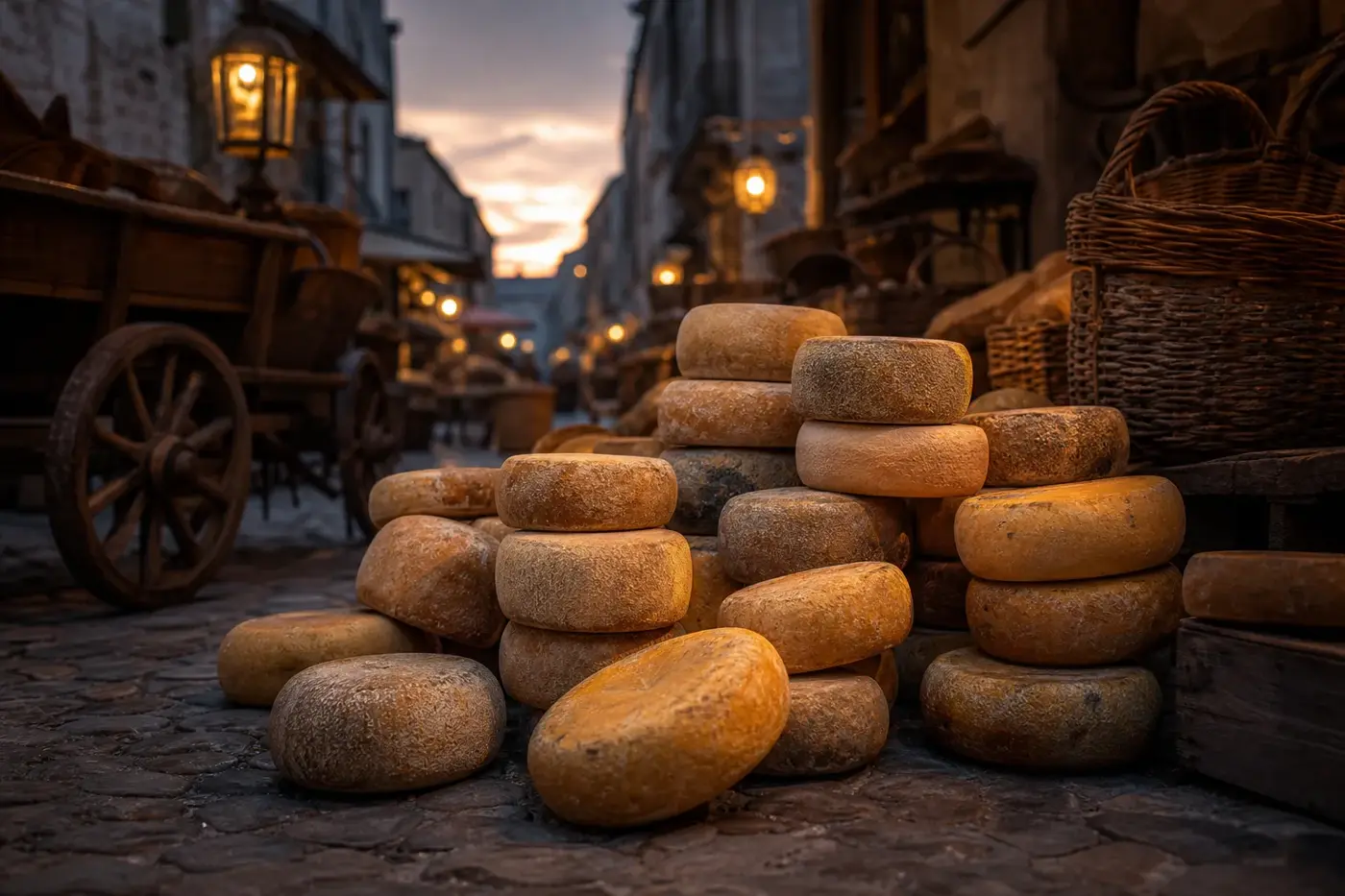
A heap of cheese sits under watch at Nottingham Goose Fair. It is 2 October 1766, and the dealers who bought it face a struggle over who gets the town’s food. Contemporary newspapers describe resistance to its removal, seized stocks and military intervention. If you have heard about a rolling cheese felling the mayor, hold that thought: that memorable scene comes from later accounts, with a different documentary history. [1][2][3]
Walk into Goose Fair, and follow the cheese
You have arrived at what one contemporary report calls Nottingham’s annual cheese fair. Another calls it Goose Fair, with visitors crowding the town and more cheese on offer than had been seen for several years. These were substantial goods, bought in large parcels. Nobody was simply choosing a little something for after dinner. [1][2]
Farmers brought produce; merchants bought stocks to trade elsewhere. The reports distinguish farmers’ cheese from purchases made by factors, the commercial agents or dealers. One describes the custom of gathering purchased cheese into a heap and watching it overnight. There it sat, a conspicuous store of food within reach of an increasingly hostile crowd. [1]
Later newspapers describe livestock, horses, onions and different cheeses at Goose Fair. They give you a sense of its breadth and continuing commercial importance, but those details belong to their own years. For 1766, keep your eye on the transaction at the heart of the trouble: buying cheese, then trying to take it away. [2][4]
Why that cheese heap mattered
Nottingham was not alone in worrying about food. Later historical research places the disturbance within a wider season of unrest over harvests, grain supplies and access to provisions. Cheese was one necessary food among others whose journey through commercial markets could provoke confrontation. [3][5]
An argument over cheese might sound peculiar on its own. Set it beside disturbances involving grain and other provisions, and you can see what mattered. Who could obtain food, and whose claim came first? [3][5]
The clearest local demand was that cheese should stay until Nottingham had been supplied. Household anxiety, resentment of dealers and opportunities to carry goods away could all exist within the same crowd. That demand tells you more than assuming everyone shared the same hunger or motive. [1][2]
Plenty on show, but what would be left?
This was no empty marketplace. The contemporary report reproduced from the Derby Mercury describes an unusually large quantity of cheese, distinguishing ordinary cheese from Cheshire in its market quotation. Food was plainly there. Substantial stocks, however, already belonged to merchants. [2]
The numerical quotations are omitted under the site’s rule against prices. Their historical importance remains: a market report records particular goods and transactions. Later narratives may turn that into a broad claim that cheese had become intolerably dear. You are reading different kinds of evidence. [2][3]
Plenty today could still leave you anxious about tomorrow. The objection concerned what would remain once buyers removed their purchases. You could look straight at considerable stocks and fear that the food in front of you was about to leave.
The newspaper identifies buyers from Lincolnshire, helping explain the confrontation over removal. Their county alone cannot tell you who their eventual customers would have been. Nor does it establish that they intended to deprive Nottingham. [2]
Follow the trouble out into the streets
The surviving newspaper accounts, available through published transcriptions, agree on the opening dispute. Their versions of the first night differ. Read them together and you get a less seamless story, but you can follow the chronology without losing sight of those differences. [1][2]
| Stage | What the reports describe | Keep this in mind |
|---|---|---|
| Opening day, 2 October | Cheese trading and substantial dealer purchases | The buying came before the confrontation |
| Evening | Threats against removal, followed by seizure of purchased stocks | The accounts differ over which cheese was targeted |
| First night | Officials intervened amid further disorder | One report records quiet before ten; another describes continued unrest |
| Following morning and evening | Soldiers arrived; confrontation and gunfire followed | The longer report appeared before full particulars were available |
[1][2]
In the Stamford Mercury account, magistrates and constables surrounded the purchased cheese and read a proclamation against rioting. They could not protect it. Dealers’ cheese was stolen or distributed, the report says, while farmers’ cheese remained undisturbed. It then records quiet before ten that night. [1]
The longer account reproduced from the Derby Mercury takes you through cheese being carried away, searches of warehouses near the Trent bridges and arrests. Prisoners appeared before justices meeting at a coffee house in Peck Lane. A crowd attacked the building and threatened opponents. The detained youths were released. [2]
Perhaps the reports describe different places or moments. That remains a possibility to explore against the records. It is not a reason to smooth away the disagreement.
Look closer at the people in the crowd
Women and boys carried off much of the cheese, according to the longer newspaper report. Young men had threatened merchants before the main seizure. You are getting glimpses of particular people doing particular things, not a complete portrait of everyone involved. [2]
You cannot give this crowd a single occupation or purpose. The descriptions establish neither a shared trade nor common organisation or recognised leadership. Someone carrying cheese might have intended to feed a household, redistribute it or resell it. The action alone does not tell you which.
Farmers and dealers occupied different positions, too. The Stamford account’s distinction between their stocks suggests selective targeting in the episode it describes. Officials attempted protection and negotiation, including releasing prisoners. Control of the streets mattered alongside possession of food. [1][2]
A rolling cheese, a mayor, and a later story
Cheeses roll through Wheeler Gate and Peck Lane; one knocks down the mayor. That is probably the image you will remember. It appears in the nineteenth-century Nottingham Date Book, in a passage repeatedly quoted by later writers, describing cheeses rolled along streets and others carried away. [3][6]
Published in 1880, the account puts the story in print by then. Its connection to an eyewitness in 1766 remains an open question. The two contemporary newspaper transcriptions focus on heaps of cheese, seizure, officials and soldiers. Neither mentions the mayor’s collision. [1][2][6]
Later retellings give the scene extra movement and drama. The cheese accelerates or flies; the mayor’s position becomes more precisely staged. Those variations show you how the story developed. They do not settle the cheese’s shape, speed or route, or the nature of an injury. [3][7]
So you have a later account of rolling cheese and a fallen mayor. Connecting that particular detail to the contemporary event requires its documentary chain. Memorable scenes are not always obliging about leaving a paper trail.
When the soldiers arrived
Late at night, a messenger went to Derby to request military assistance, according to the longer newspaper account. Mounted soldiers arrived the following morning, with another party following on foot. That evening, confrontation resumed around soldiers guarding the New Change. [2]
The report describes gunfire and the crowd dispersing within the town. Next comes a party heading towards Trent Bridge and a reported seizure of a boat laden with cheese. The newspaper presents that incident as information received. It closes by explaining that particulars of the damage could not be gathered before publication. [2]
You can feel the reporting catching up with events. It records escalation and military intervention. Its early deadline leaves the final outcome incomplete.
The release of detained youths is specifically recorded. Subsequent prosecutions, injuries and punishments remain questions for court and administrative records. This opening newspaper narrative follows an unfolding disturbance, not its complete judicial aftermath. [2]
Who should have first claim on the cheese?
Nottingham should be supplied before the cheese went elsewhere. That reported demand puts the argument plainly: dealers had bought goods through the market, while their opponents claimed priority for local access. Food was at stake. So were the terms on which people considered trade socially acceptable. [1][2]
Historians often approach such expectations through the idea of a moral economy. Think of shared beliefs about the proper way to supply necessities. A commercially ordinary transaction could attract public condemnation if it seemed to threaten subsistence. Research on the disturbances of 1766 explores those expectations alongside changes in how markets operated. [3][8]
That framework helps you understand the confrontation without treating every action as the same. Preventing removal, distributing stocks, carrying food away and attacking a building were distinct acts. Gathering them under the heading of food protest does not erase those differences.
Here, the Nottingham reports are particularly valuable. Their disagreement resists a tidy split between disciplined protest and indiscriminate looting. Each account asks you to attend to what it actually describes. [1][2]
How the riot became a Nottingham legend
The incident’s modern name turns a complicated disturbance into a memorable local story. Contemporary reports describe a riot or mob activity during the fair. They do not establish that participants or newspaper editors used the full title you recognise today. [1][2]
Later historical writing put the rolling cheeses and mayor centre stage. By November 2014, The Great Cheese Riot of 1766 featured prominently in the title of a locally published historical study. That gives you a use of the familiar wording by that date, not its first appearance. [3]
Commemoration has kept the disturbance tied to Nottingham’s cheese trade. In October 2016, a local cheese shop and the civic mayor marked its 250th anniversary by retracing the reported route. The organiser’s account records that commemoration and the story’s continuing local appeal. [9]
Follow the cheese back to the records
The strongest surviving outline is clear. A confrontation over purchased cheese and its removal led to seizures, unsuccessful civil intervention and military involvement. Questions remain about the precise chronology, the full range of participants, casualties, subsequent proceedings and the documentary ancestry of the mayor story. [1][2][3]
If you want to follow the trail, start with the newspapers: the Stamford Mercury of 9 October and Derby Mercury of 10 October 1766, then the Leicester and Nottingham Journal. Keep publication dates separate from the dates of events described inside their reports. They are not necessarily the same thing. [1][2][3]
The published Records of the Borough of Nottingham, volume VII, offers another route into municipal evidence. Later histories are most useful when you follow them backwards to the records they cite. Whether a cheese struck the mayor is irresistible. Beyond it lies a richer question: how did a busy market become a place where competing claims to food were enforced in public? [3][10]
Questions people ask
When and where did the Nottingham cheese riot begin?
The disturbance began on 2 October 1766 at Nottingham Goose Fair. Cheese trading and substantial purchases by dealers came before the confrontation.
Why did people object to the cheese being taken away?
The reports record a demand that Nottingham should be supplied before the cheese went elsewhere. Although plenty of cheese was visible at the fair, substantial stocks had already been bought by merchants.
Who carried off the cheese?
The longer newspaper report says women and boys carried off much of it. It also says young men had threatened the merchants before the main seizure.
Was the mayor really knocked down by a cheese?
The story appears in a later account published in 1880, but its connection to an eyewitness in 1766 still needs tracing. Neither of the two contemporary newspaper transcriptions examined on the page mentions the collision.
Were soldiers sent to the cheese riot?
According to the longer newspaper account, a messenger went to Derby to request military assistance. Mounted soldiers arrived the following morning, followed by another party on foot, and gunfire was reported that evening.
Sources
- Stamford Mercury, “Country News”, 9 October 1766, p. 3, column 1. Report dated Nottingham, 2 October. Consulted as a transcription reproduced in CooksInfo, Nottingham Goose Fair, 2021. Retrieved transcription.
- Derby Mercury, “Country News from the Nottingham Journal”, 10 October 1766, p. 2, column 2. Consulted as a transcription reproduced in CooksInfo, Nottingham Goose Fair, 2021. Retrieved transcription.
- Loaf On A Stick Press / People’s Histreh, Nottingham Rising: The Great Cheese Riot of 1766 & the 1831 Reform Riots, free digital edition, November 2014. Introduction, research discussion and opening of the cheese-riot chapter. Retrieved edition.
- CooksInfo, Nottingham Goose Fair, 2021, “Business side of fair”. Includes attributed newspaper transcriptions from 1778, 1826 and 1829. Retrieved page.
- National Food Strategy, The Plan, 2021, chapter 12, “At what price?”. Used for the later national framing of food unrest, not as contemporary evidence. Retrieved document.
- Nottingham Date Book, 1880 edition, October 1766 passage. Consulted indirectly through the quotation reproduced in Coates, Odd this day: 2 October 1766, 2 October 2024. Retrieved quotation and attribution.
- Notts TV, Cheese riots and dragoons: The complete history of Nottingham Goose Fair, 2016. Used solely as evidence of a modern retelling. Retrieved search record.
- People’s Histreh, Nottingham Rising, 2014, research framework and contents identifying discussion of market intervention, provisions and interpretations of food rioting. Used as secondary interpretation, not proof of individual motives.
- Flying Horse Walk, Nottingham Cheese Shop Marks 250th Anniversary of the Nottingham Great Cheese Riot, 12 October 2016. Organiser’s account of the commemoration. Retrieved account.
- Corporation of Nottingham, Records of the Borough of Nottingham, volume VII, 1760 to 1800, 1947. Retrieved catalogue/search extract identifies the cheese riot in an editorial footnote; the full volume could not be opened. Used only to identify a research lead.
This desk-researched draft compares published newspaper transcriptions with later historical accounts and commemorative material; original newspaper images and municipal entries remain publication checks.
Last checked: November 2026
Last checked November 2026.
The editors suggest you read next
A History of Cheese: From the First Curds to Global Food
Picture cheese lying beside Bronze Age burials in China's Tarim Basin, surviving for approximately 3,500 years.