Trademarks vs Protected Cheese Names
You pause at the cheese counter, eye on the Gruyère, already thinking about supper.
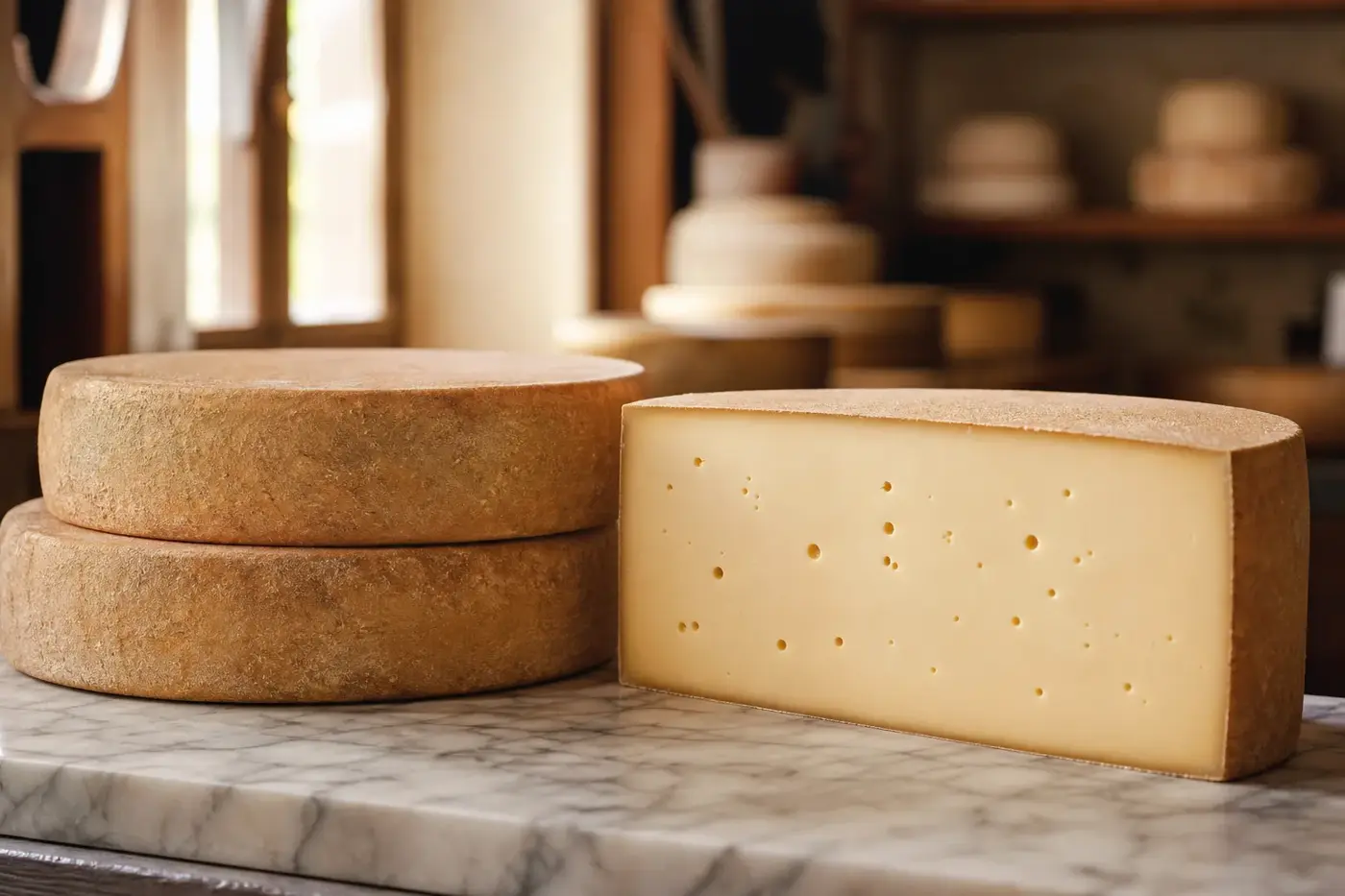
You pause at the cheese counter, eye on the Gruyère, already thinking about supper. Then the label gives you something else to chew over. In Switzerland, that name is a protected appellation of origin. Yet on 3 March 2023, an American court upheld a finding that GRUYERE was generic for cheese in the United States.[13][14]
Same name, different rights across a border. A producer’s brand tells you which business is behind the cheese; a protected geographical name can tell you that it comes from a particular place and follows a shared specification. Both can appear on one label, but they protect different things. Permission to use either depends on where the cheese is sold.[1][2]
Start with the brand: whose cheese is this?
A trademark helps you distinguish the commercial source of goods or services. It can be a word, a logo or a combination of signs, rather than simply a company’s name. Its protection concerns commercial use of that sign for particular goods or services. It does not give someone ownership of a word wherever it appears.[1]
How those rights arise depends on the country. In the United States, the USPTO explains that use can establish rights, although their geographical reach is limited; federal registration offers broader protection. In the United Kingdom, registration through the Intellectual Property Office provides a route to protecting a brand. That includes taking action against unauthorised use and licensing the mark.[1][3]
At the counter, the brand answers your question: whose product am I choosing? Its legal protection centres on distinguishing that commercial source from others. A protected geographical name asks a different question: does this cheese meet the requirements attached to a name linked to this place?[1][2]
A protected name takes you somewhere
A geographical indication, usually shortened to GI, connects a product’s quality, reputation or another characteristic to its geographical origin. Under a dedicated GI scheme, a registered specification sets the conditions for using the name. Behind those few words on your label sits a set of requirements.[4]
Unlike a privately controlled brand, a GI under the UK schemes does not belong to one individual or business. Defra states that these schemes protect registered names in Great Britain.[2] Any producer can use a registered name if the product follows its specification and the producer is verified as complying. A dairy’s address inside the production area is only part of the test.[2]
PDO, PGI and TSG: read the promise behind the letters
For agricultural products under the EU schemes, these three terms offer you different information:
- Protected designation of origin, or PDO: the product’s qualities or characteristics are essentially or exclusively linked to its geographical environment, including natural and human factors. Every production step takes place in the defined area.
- Protected geographical indication, or PGI: a quality, reputation or other characteristic is attributable to geographical origin. At least one production step takes place in the defined area.
- Traditional speciality guaranteed, or TSG: protection concerns a traditional composition, ingredients or production method. Production does not have to take place in a particular geographical area.[4][5]
These describe different legal relationships, rather than levels of quality. TSG belongs alongside PDO and PGI when you explore protected food names, but its promise concerns traditional character. It does not impose a geographical production restriction.[4][5]
For a closer look at those differences, turn to protected names explained.
One label, two names, separate permissions
A producer can place its own brand beside a protected cheese name when it is entitled to use both. The brand identifies the commercial source. The protected name tells you that the cheese complies with the registered product requirements.[1][2]
Picture two eligible dairies making cheese under the same registered geographical name. Each can give its cheese a distinct brand, while both use the shared name because their products meet the specification and verification requirements. Choosing one dairy’s brand does not give that dairy exclusive control of the geographical name.[2]
The permissions remain separate. Owning a trademark does not establish compliance with a cheese specification, and eligibility to use a geographical name does not grant permission to use another business’s brand. When reading a cheese label, identify each sign separately. Prominent wording on the pack is not necessarily one legal name.[1][2]
When producers share a mark
Trademark law makes room for shared signs too. Collective and certification marks take you beyond the straightforward contrast between one business’s brand and a regional name. They are particularly important to understanding the position in the United States.[6]
A collective mark identifies goods or services supplied by members of a collective organisation. Under USPTO guidance, the organisation owns the mark, and members use it subject to that organisation’s requirements. An association, cooperative or union can apply.[7]
A certification mark tells you that goods or services meet defined standards. These can cover geographical origin, materials, manufacturing methods or other characteristics. The certifying owner controls the mark and authorises qualifying suppliers to use it. Suppliers do not need to belong to an organisation to obtain certification.[8]
US law expressly allows bodies exercising legitimate control over their use to register collective and certification marks indicating regional origin. This is why the USPTO protects geographical indications through the trademark system, including certification and collective marks. Relevant common law protection sits alongside them.[6][9]
Before you apply that explanation across the Atlantic, note an important difference. Regulation (EU) 2017/1001 distinguishes EU collective marks from EU certification marks, and EU certification marks exclude certification of geographical origin. The US approach to certification marks cannot simply be transferred into the EU system.[10]
Getting a name registered, then keeping it protected
A conventional trademark application seeks protection for a sign that distinguishes commercial origin. The owner can license the mark and act against infringement. For collective and certification marks, an organisation controls the shared sign under its governing requirements.[3][7][8]
An application for a protected food name needs a product specification and evidence supporting the proposed protection. Defra’s application guidance normally directs producers of the same product towards a joint application by a producer group. Individual applications are allowed in specified circumstances.[11]
Registration brings two distinct jobs: verifying production and enforcing protection against misuse. In the EU, public authorities check compliance and act against unlawful use. Producer groups can also defend a shared name, but they remain separate from the public authority.[5]
Find your market: the November 2026 guide
| Market | Main protection routes covered here | Who handles registration? | Source |
|---|---|---|---|
| European Union | PDO, PGI and TSG schemes; separate trademarks | European Commission for food names; EUIPO for EU trademarks | [4][5][10] |
| Great Britain | UK protected food name schemes; separate trademarks | Defra for protected food names; UK Intellectual Property Office for UK trademarks | [2][3] |
| Northern Ireland | EU protected food name schemes | EU scheme; Defra is the UK competent authority | [2] |
| United States | Trademark tools, including collective and certification marks | USPTO for federal trademark registration | [6][9] |
Here, you need to be precise about geography. Defra’s guidance expressly distinguishes Great Britain, meaning England, Scotland and Wales, from Northern Ireland. The EU schemes protect registered names in Northern Ireland and the EU. The UK schemes protect registered names in Great Britain.[2]
When an earlier trademark changes the picture
Dates can determine whether rights clash or coexist. Under EU Regulation 2024/1143, Article 31 requires rejection of a later trademark application whose use would breach GI protection. A qualifying earlier trademark established in good faith may continue alongside the GI, subject to the statutory conditions. Article 30 can also prevent GI registration where an established trademark’s reputation and history would make registration misleading.[5]
To understand the position, you need more than the date on a registration certificate. An investigation needs the application dates, any rights established through use, the territory concerned and the goods covered. Together, these details establish which rights arose, where they apply and what they cover.
In Great Britain, check the applicable conflict and coexistence rules separately, including the dates and status of the competing rights. Before committing to a new sign, search both trademarks and protected names. Record what each search establishes, rather than reducing the result to “the name was available”. For a contested launch, take those records for an assessment specific to the jurisdiction.
Why “style” needs a closer look
Adding a small word does not settle the question of permission. EU GI protection reaches beyond exact copies of registered wording. Article 26 covers misuse, imitation and evocation, including certain uses with translations or expressions such as “style” and “type”, even when the true origin is stated. It also addresses misleading presentation and origin claims.[5]
You need to consider the whole presentation: wording, imagery, packaging and online description. Adding “style” calls for legal assessment. It is not a ready solution to a protected name problem.
The international baseline makes an important distinction. TRIPS Article 22 requires legal means against misleading geographical presentation and unfair competition for goods generally. Article 23’s additional protection, expressly addressing translations and terms such as “style”, concerns wines and spirits. For cheese, you need the applicable domestic or regional rules.[12]
Follow Gruyère across the border
The dispute over GRUYERE shows why the destination market matters. On 3 March 2023, the United States Court of Appeals for the Fourth Circuit upheld the finding that GRUYERE was generic for cheese in the United States. It could not be registered as the proposed certification mark.[13]
That proposed mark would have restricted use to cheese from a defined area of Switzerland and France. The court examined what the term primarily meant to the relevant American public. Its evidence included US production, labelling, sales and dictionary usage. The judgment turned on American trademark law and American consumer understanding.[13]
Now turn to Switzerland, where the name has a different legal position. The Federal Office for Agriculture’s register records Gruyère as an appellation d’origine protégée, or AOP, under the registration decision of 6 July 2001. The specification defines the geographical area, production requirements and controls attached to the name.[14][15]
The same word can therefore function as a protected origin name in one jurisdiction and a generic cheese term in another. The US judgment addressed the proposed GRUYERE word certification mark. The status of other signs remains a separate question.[13][14]
If you want to return to the cheese itself, turn to the Le Gruyère article. For the legal lesson, keep the border in view: this finding belongs to a particular territory.
International agreements, different local answers
The World Trade Organization’s TRIPS Agreement requires members to provide protection for geographical indications. It also allows different legal mechanisms. The United States’ use of trademark law is one such mechanism.[6][12]
Exceptions matter too. TRIPS Article 24 addresses qualifying earlier trademarks established in good faith, terms customary as common names in the relevant member’s territory, and indications that lack protection in their country of origin. These provisions help explain why international recognition can produce different outcomes in different markets.[12]
The agreement establishes obligations between WTO members. For a practical investigation, you still need the law, registers and decisions applying in the destination market. Read regional schemes, national rights and international agreements together. Keep the geographical coverage of each distinct.[6][12]
Before you use a name: six practical checks
If you are planning a label, product listing or new brand, work through these checks in order. Each addresses a different part of your permission to use a name or sign.
- Pin down your market. Write down where the product will be offered for sale. Treat Great Britain and Northern Ireland separately when checking protected food name schemes.[2]
- Separate the signs. List the proposed brand, geographical wording, collective or certification mark and any scheme logo. Assess the permission you need for each.[1][7][8]
- Find the protected name record. Check the exact registered wording, status and specification in the official register for the market. For Great Britain, use the UK protected food names register and its scheme records.[2]
- Check your eligibility. Where the relevant scheme requires a specification and verification, compare the product and operation against both. For the UK scheme in Great Britain, location alone does not complete the check.[2]
- Search trademark records separately. Investigate the sign, owner, goods, territory and status. In the United States, include possible unregistered rights in your assessment.[1][6]
- Keep a dated record. Preserve the relevant applications, registrations and decisions. Where rights overlap, obtain advice for that jurisdiction before approving the final presentation.
Ready for another look at the pack? Cheese lovers rarely need much encouragement. Start with Protected Names Explained: PDO, PGI and TSG for the schemes, then How to Read a Cheese Label for separating the information you find there.
Questions people ask
What is the difference between a cheese trademark and a protected name?
A trademark distinguishes the commercial source of goods or services. A protected geographical name identifies a product linked to a place and subject to a registered specification. Both can appear on one label if the producer is entitled to use them.
What is the difference between PDO, PGI and TSG?
Under the EU schemes, all PDO production steps must take place in the defined area, while a PGI requires at least one production step there. TSG protects a traditional composition, ingredients or production method and does not require production in a particular geographical area. They are different legal relationships, not grades of cheese.
Can any dairy in a region use its protected cheese name?
Under the UK schemes, a producer may use a registered name if the product follows its specification and the producer is verified as complying. An address inside the production area is only part of that test.
Can a cheesemaker use a protected name by adding the word style?
Not necessarily. EU protection covers misuse, imitation and evocation, including certain uses with expressions such as “style” or “type”, even when the true origin is stated. Adding “style” requires legal assessment.
Which protected food name schemes apply in Great Britain and Northern Ireland?
The UK schemes protect registered names in Great Britain, meaning England, Scotland and Wales. The EU schemes protect registered names in Northern Ireland and the EU.
Sources
[1] United States Patent and Trademark Office, What is a trademark?, current online guidance, checked November 2026.
[2] Department for Environment, Food & Rural Affairs, Protected geographical food and drink names: UK GI schemes, current online guidance, checked November 2026.
[3] Intellectual Property Office, Register a trade mark: Overview, current online guidance, checked November 2026.
[4] European Commission, Geographical indications and quality schemes explained, current online guidance, checked November 2026.
[5] European Union, Regulation (EU) 2024/1143, consolidated text dated 18 March 2026, particularly Articles 26, 30, 31, 46 and 52 to 53, checked November 2026.
[6] United States Patent and Trademark Office, Geographical indications, current online guidance, checked November 2026.
[7] United States Patent and Trademark Office, Collective mark applications, current online guidance, checked November 2026.
[8] United States Patent and Trademark Office, Certification mark applications, current online guidance, checked November 2026.
[9] United States, United States Code, Title 15, section 1054, 2024 edition, registration of collective and certification marks, checked November 2026.
[10] European Union, Regulation (EU) 2017/1001 on the European Union trade mark, 14 June 2017, particularly Articles 74 and 83. Official published text retrieved November 2026; current operative provisions require final legal verification.
[11] Department for Environment, Food & Rural Affairs, Protect a geographical food or drink name, current online guidance, particularly “Who can apply for a PFN”, checked November 2026.
[12] World Trade Organization, Agreement on Trade-Related Aspects of Intellectual Property Rights, as amended by the 2005 Protocol, Articles 22 to 24, checked November 2026.
[13] United States Court of Appeals for the Fourth Circuit, Interprofession du Gruyere v. U.S. Dairy Export Council, No. 22-1041, published judgment, 3 March 2023.
[14] Swiss Federal Office for Agriculture, AOP / IGP: appellations d’origine et indications géographiques, Gruyère register entry, including the registration decision of 6 July 2001 and listed amendments, checked November 2026.
[15] Swiss Federal Office for Agriculture, Cahier des charges: Gruyère, registration decision of 6 July 2001, incorporating the amendments listed through 14 December 2015, official download dated 27 July 2016, checked November 2026.
This desk-researched article compares official legislation, government and registry guidance, a published court judgment and the Swiss register and specification.
Last checked: November 2026
Last checked November 2026.
The editors suggest you read next
Cheese Law Around the World: The Complete Guide
GRUYERE reached an American legal border and lost its exclusivity.