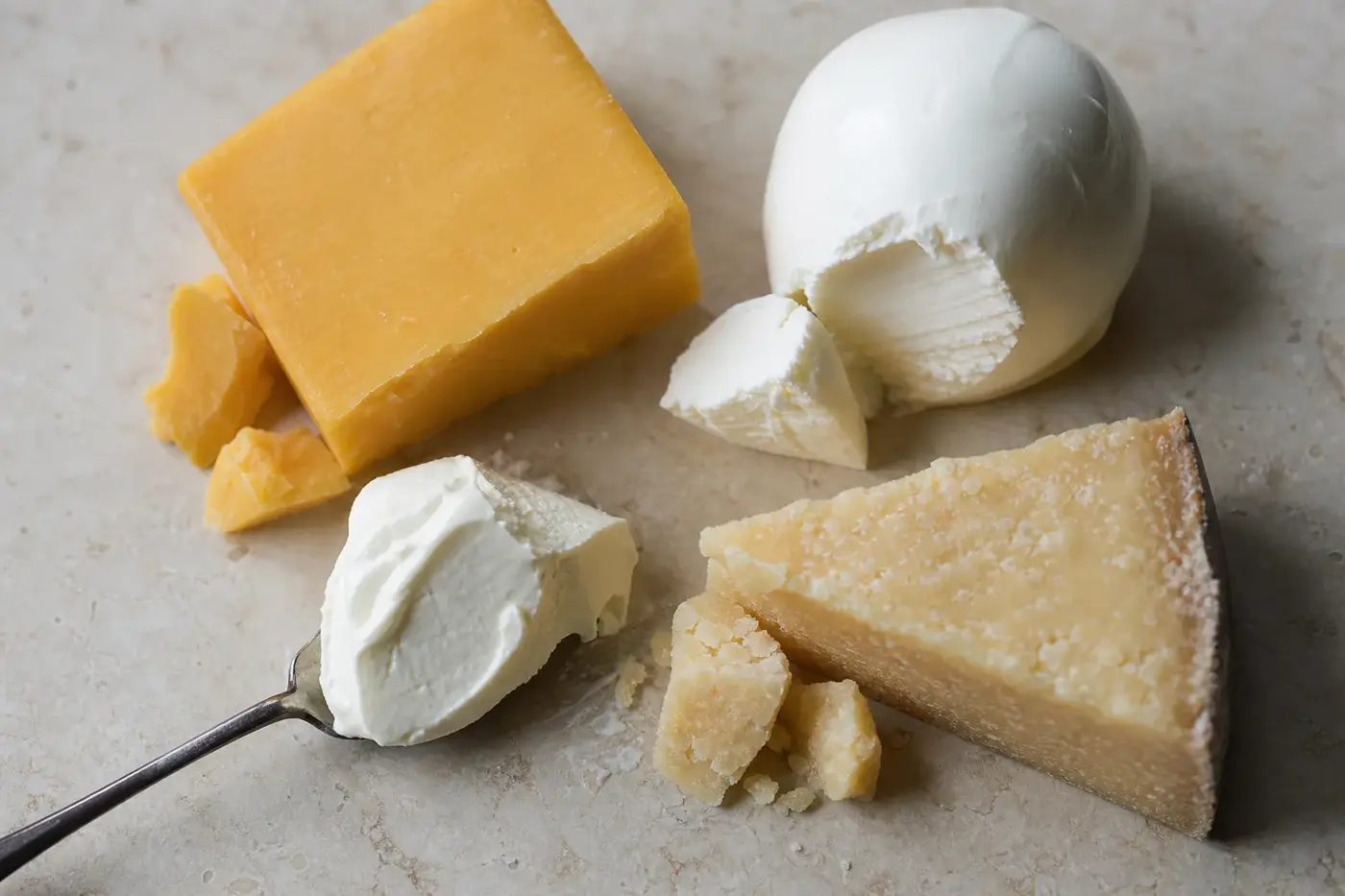
First comes the hard, brittle rind. Then the granular texture, ready to yield to your grater. Parmesan or reggiano offers those pleasures, and perhaps explains why you rarely put the grater away after one helping.
In the United States, those qualities are also legal descriptions. Section 133.165 sets them alongside composition and curing requirements: the name promises more than simply a hard cheese.[10]
Your Cheddar, mozzarella and cream cheese have legal recipes, too. Cheddar has a moisture ceiling, mozzarella a defined moisture band, while cream cheese measures its minimum fat against the whole product. Federal standards of identity set these boundaries, alongside other requirements for putting particular cheese names on US labels.[6][7][9]
What your cheese name promises
Pick up a named cheese and a federal legal definition may sit behind it. Section 401 of the Federal Food, Drug, and Cosmetic Act, codified at 21 USC 341, authorises standards of identity to promote honesty and fair dealing for consumers. For cheese, those standards can govern composition, ingredients and manufacturing, as well as the name itself.[1][3]
Section 403(g) makes that promise enforceable. A food represented as a standardised food is misbranded unless it meets the standard and bears the prescribed name. An accurate ingredient list cannot make a nonconforming product compliant: both the formula and the description must meet the applicable requirements.[2]
You will find the cheese standards in Title 21, Part 133 of the Code of Federal Regulations, administered by the Food and Drug Administration, FDA. Subpart A holds the general provisions; Subpart B covers specific standardised cheeses and related products. The electronic Code of Federal Regulations, eCFR, gathers the regulatory text into a continuously updated edition.[3][4]
Identity is not a quality grade, though. The US Department of Agriculture's Agricultural Marketing Service publishes Cheddar grade standards assessing flavour, body and texture, colour, and finish. Those assessments serve a different purpose from FDA's definition of Cheddar, so a standardised name does not establish that your cheese holds a particular USDA grade.[5][6]
Five familiar cheeses, five sets of rules
November 2026 is the reference point for these selected US requirements. Moisture percentages measure water in the whole cheese; fat in dry matter measures milkfat against the solids left after you exclude water. Cream cheese takes a different approach, and each cited regulation gives the full definition beyond this summary.[6][7][8][9][10]
| Cheese name | Water in the whole cheese | Minimum milkfat | What else to know | US regulation |
|---|---|---|---|---|
| Cheddar | No more than 39% | 50% fat in dry matter | Unpasteurised ingredients: at least 60 days at 1.7 °C (35 °F) or above | § 133.113 [6] |
| Mozzarella | More than 52%, no more than 60% | 45% fat in dry matter | Pasteurised dairy ingredients | § 133.155 [7] |
| Low-moisture mozzarella | More than 45%, no more than 52% | 45% fat in dry matter | Pasteurised dairy ingredients | § 133.156 [8] |
| Cream cheese | No more than 55% | 33% of whole cheese | Soft, uncured cheese | § 133.133 [9] |
| Parmesan or reggiano | No more than 32% | 32% fat in dry matter | Cured for at least 10 months | § 133.165 [10] |
That fat measurement is worth pausing over. Using the formula in § 133.5(d), a hypothetical Cheddar with 39% water and 50% milkfat in its dry matter would contain 30.5 g milkfat per 100 g of cheese. That is arithmetic at the stated limits, not a nutrition figure for a particular product.[3][6]
Follow the curd from milk to press
The Cheddar standard takes you through manufacture, from coagulating milk to cutting and heating the curd. Next come draining whey, matting the curd into slabs, cutting it again, salting and pressing. It also allows another procedure if it produces cheese with the same physical and chemical properties: the result is defined, with that specified flexibility in how the maker reaches it.[3][6]
Cream cheese shows you another side of the rules: optional ingredients have conditions, too. Its definition permits milk, nonfat milk or cream, specified clotting enzymes, salt, certain whey ingredients and stabilisers. Together, stabilisers may make up no more than 0.5% of the finished food, so a permitted stabiliser can belong in cream cheese when those conditions are met.[9]
A familiar name, but not a birthplace
The Cheddar standard defines a food, not its place of production. It does not restrict manufacture to an English county or a US state. Meeting its provisions establishes eligibility for that food name; geographical names and certification marks raise a separate question about the particular name and rights recognised in the United States.[6][11]
The US Patent and Trademark Office explains that geographical indications can have protection through certification marks, collective marks and trademarks, with common law protection also possible. Looking up Part 133 therefore answers a different question from investigating origin rights. To separate production specifications from territorial name protection, read protected names explained.[11]
When the cheese no longer fits the name
If a product falls outside a standard, it cannot simply keep its unqualified standardised name. It may need a different, truthful identity, subject to the imitation rule and any applicable route for modified standardised foods. A new name is no licence to mislead: federal misbranding provisions cover both presentation and actual composition.[2][12]
Under § 101.3(e), a food is an imitation if it substitutes for and resembles another food but is nutritionally inferior to it. Its label must put 'imitation' immediately before the imitated food's name, in uniform size and prominence. A substitute that is not nutritionally inferior can instead use an appropriate, nonmisleading common or descriptive name.[12]
If you see 'nutritional inferiority', do not read it as a verdict on flavour or craftsmanship. It is a defined regulatory test: section 101.3(e)(4) addresses reductions in measurable essential nutrients and sets specific exclusions for reduced calories or fat. Missing a moisture limit alone does not decide whether a product is an imitation.[12]
What changes when the label says 'reduced fat'?
Section 130.10 provides a controlled route for names that combine a defined nutrient content claim with a standardised term. Take reduced fat Cheddar: it must qualify for the relevant FDA claim and meet this framework. Those extra words do not remove the other conditions attached to the cheese name.[14]
The product must follow the underlying standard except where § 130.10 allows deviations, with nutrients restored as required to avoid nutritional inferiority. Changes must be the minimum necessary to achieve the claim while maintaining similar performance. If a significant performance difference materially limits how you can use the product, the label must tell you.[14]
Finding a name when no standard applies
What happens when no applicable federal name is prescribed? Section 101.3 directs the label towards the food's common or usual name, or an appropriately descriptive term if none exists. Section 102.5 requires common or usual names to identify the food's basic nature or characterising ingredients simply and accurately, giving cheeses beyond individually standardised varieties a naming framework.[2][12][13]
The statement of identity must be a principal feature on the main display panel. Read that legal food name alongside any brand or imaginative product name. For a broader guide to the distinction, including information elsewhere on the pack, see how to read a cheese label.[12]
Process cheese, cheese food and spread: the words matter
Pasteurised process cheese has its own definition in § 133.169. Eligible cheeses are broken up and mixed with heat and a specified emulsifying agent into a uniform mass, distinct from the categories for Cheddar or mozzarella. When you compare packs, pay attention to the words process, food and spread: they signal regulatory differences.[15]
Pasteurised process cheese food, defined in § 133.173, combines specified cheese and dairy ingredients, with no more than 44% moisture and at least 23% fat in the whole food. Pasteurised process cheese spread follows § 133.179 instead. It must contain more than 44% but no more than 60% moisture, with at least 20% milkfat in the whole food.[16][17]
Pasteurisation and curing: read cheese by cheese
For Cheddar made with dairy ingredients that are not pasteurised, § 133.113 requires curing for at least 60 days at no less than approximately 1.7 °C (35 °F). That temperature is a curing minimum. Both mozzarella standards above instead require pasteurised dairy ingredients, while Parmesan or reggiano requires at least 10 months of curing.[6][7][8][10]
Read these provisions cheese by cheese, alongside the dairy ingredient definitions in § 133.3. An ageing condition in one standard is not an alternative route around another variety's requirements. For the language behind milk treatment, read raw milk, thermised and pasteurised cheese.[3][6][7]
Your next cheese pack: three places to look
Start with the complete food name, including any nutrient claim and words such as process cheese food. Open the corresponding Part 133 section and compare its description, permitted ingredients and naming provisions. Keep the figures in context: fat as a percentage of dry matter is not the same as fat per serving on a nutrition panel.[3][12][14][16]
Next, compare the ingredient list with the optional ingredients that section allows. Cream cheese with a permitted stabiliser shows why an unfamiliar ingredient need not signal noncompliance. Permission does not mean an ingredient is present, either, so read what your individual pack declares rather than assuming every maker uses everything allowed.[9]
Finally, look at the date and any linked amendments. A final rule published on 13 October 2026 permits salt substitutes in numerous standardised foods, including specified cheeses, with a scheduled effective date of 14 December 2026. In November 2026, that amendment still lies ahead and must be distinguished from the operative text: publication and entry into force are separate events.[18]
Questions people ask
What is a US standard of identity for cheese?
It is a federal legal definition of a food sold under a specified name. For cheese, it can govern composition, ingredients and manufacturing as well as the name itself.
Can cheese be called Cheddar in the US if it is not made in England?
The US Cheddar standard defines a food, not a place of production. It does not confine manufacture to an English county or a US state. Geographical names and certification marks are a separate question.
What is the difference between mozzarella and low moisture mozzarella under US rules?
Mozzarella must have more than 52% moisture and no more than 60%. Low moisture mozzarella must have more than 45% and no more than 52% moisture. Both require pasteurised dairy ingredients and at least 45% milkfat in dry matter.
When must a cheese substitute be labelled imitation?
Under section 101.3(e), a food is an imitation when it substitutes for and resembles another food but is nutritionally inferior to it. The label must place 'imitation' immediately before the imitated food's name, with uniform size and prominence. A failed moisture limit alone does not determine whether a product is an imitation.
What is the difference between pasteurised process cheese food and process cheese spread?
Pasteurised process cheese food must contain no more than 44% moisture and at least 23% fat in the whole food. Pasteurised process cheese spread must have more than 44% but no more than 60% moisture, with at least 20% milkfat in the whole food.
Sources
- US Congress. Federal Food, Drug, and Cosmetic Act, section 401: Definitions and standards for food, codified at 21 USC 341. Current government text retrieved November 2026.
- US Congress. Federal Food, Drug, and Cosmetic Act, section 403: Misbranded food, codified at 21 USC 343, particularly paragraphs (a), (c), (g) and (i). Current government text retrieved November 2026.
- FDA, published through the Office of the Federal Register and Government Publishing Office. 21 CFR Part 133: Cheeses and Related Cheese Products, including §§ 133.3 and 133.5. eCFR text current through 5 November 2026.
- FDA. Standards of Identity for Food. Online edition retrieved November 2026.
- USDA Agricultural Marketing Service. Cheddar Cheese Grades and Standards. Online edition retrieved November 2026.
- FDA. 21 CFR 133.113: Cheddar cheese. eCFR text current through 5 November 2026.
- FDA. 21 CFR 133.155: Mozzarella cheese and scamorza cheese. eCFR text current through 5 November 2026.
- FDA. 21 CFR 133.156: Low-moisture mozzarella and scamorza cheese. eCFR text current through 5 November 2026.
- FDA. 21 CFR 133.133: Cream cheese. eCFR text current through 5 November 2026.
- FDA. 21 CFR 133.165: Parmesan and reggiano cheese. eCFR text current through 5 November 2026.
- US Patent and Trademark Office. Geographical Indications (GI) Protection. Updated 31 October 2019; retrieved November 2026.
- FDA. 21 CFR 101.3: Identity labeling of food in packaged form. eCFR text current through 5 November 2026.
- FDA. 21 CFR 102.5: General principles. eCFR text retrieved November 2026.
- FDA. 21 CFR 130.10: Requirements for foods named by use of a nutrient content claim and a standardized term. eCFR text current through 5 November 2026.
- FDA. 21 CFR 133.169: Pasteurized process cheese. eCFR text current through 5 November 2026.
- FDA. 21 CFR 133.173: Pasteurized process cheese food. eCFR text current through 5 November 2026.
- FDA. 21 CFR 133.179: Pasteurized process cheese spread. eCFR text current through 5 November 2026.
- FDA. Use of Salt Substitutes To Reduce the Sodium Content in Standardized Foods. Final rule, 91 FR 65057, published 13 October 2026; scheduled effective date 14 December 2026.
Researched through desk research comparing federal legislation, individual cheese standards, FDA explanations, USDA grading material and USPTO guidance.
Last checked: November 2026
Last checked November 2026.
The editors suggest you read next
Cheese Law Around the World: The Complete Guide
GRUYERE reached an American legal border and lost its exclusivity.