What Happens to the Whey?
Watch the liquid drain from a cheese vat.
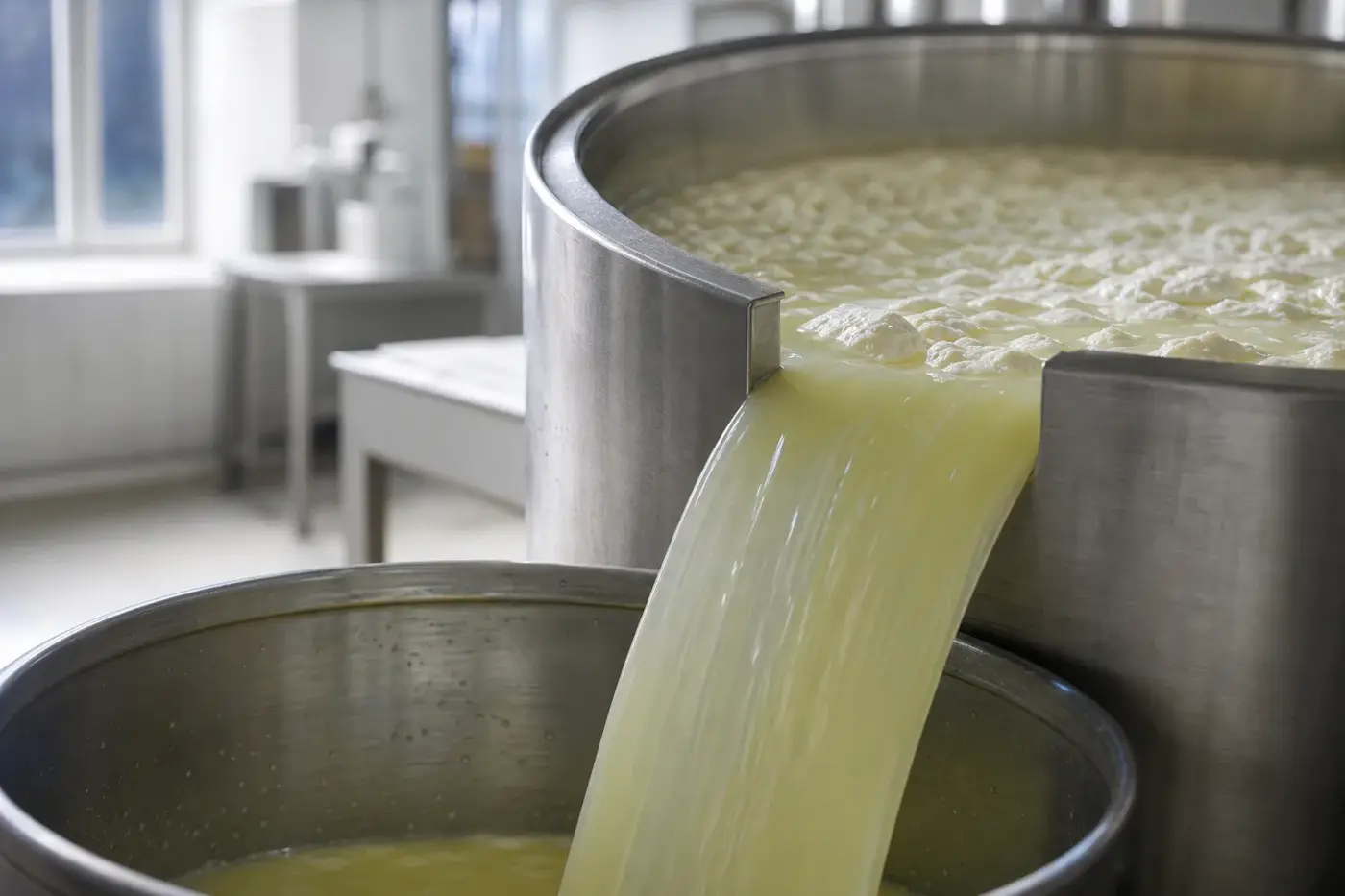
Watch the liquid drain from a cheese vat. The curds get the glory, but you might be looking at tomorrow's ricotta, an ingredient for bread or drinks, livestock feed or fuel for a biogas plant. Let that liquid reach a waterway untreated, though, and it can strip the water of oxygen. Its next destination depends on what's in it and which outlets are within reach. [2, 8, 9]
At the vat, curds and whey go their separate ways
Milk's transformation begins when its proteins gather into a solid network: the curd that becomes cheese. This coagulation happens with help from rennet, a group of milk-clotting enzymes, or through acidification. The liquid released from that network is whey. [1]
Cut, stir and heat the curd, and more liquid escapes. Much of the casein, milk's main protein group, stays with the fat in the curd. Dissolved lactose, minerals and soluble proteins leave with the whey, in proportions shaped by the milk, its treatment and the cheesemaking method. [1, 2]
You can follow those earlier stages in the milk-to-cheese process. Once the whey drains away, recovery begins with an unglamorous but crucial job: keeping it separate from cleaning water and other effluent. [8]
Sweet or acid? Get to know your whey
“Sweet” whey isn't a sugary drink. It's the less acidic stream, usually from rennet-coagulated cheese, while acid whey comes from processes where acid drives coagulation. Tetra Pak's processing handbook gives sweet whey a typical pH of 5.9 to 6.6 and cottage-cheese whey about 5. [2]
That acidity matters well beyond flavour. Acidification brings more calcium and phosphate into solution, changing how whey behaves during filtration and heating. In one study of mineral acid whey, researchers split 1,800 litres into two batches and filtered them at different pH values. [3]
The higher-pH concentrate retained more calcium and phosphorus, useful knowledge for dairies seeking predictable protein ingredients. This particular whey came from casein production. If you're a cheesemaker considering filtration, the practical lesson is to describe your stream to the processor, including its acidity and mineral balance. [3]
Mostly water, but worth the journey?
In Tetra Pak's illustrative composition, about 94% of separated cheese whey is water. The rest includes 4.5% lactose, 0.6% true protein, 0.5% minerals and 0.05% fat. Individual vats vary, and residual fat and tiny curd particles can be recovered before further processing. [2]
Here comes the transport headache: useful material, but mostly water enjoying a tanker ride. Concentration removes water before the remaining solids travel further. That changes the practical balance of the journey. [6, 7]
Ricotta gives the vat a second act
Reheat whey and its proteins gather together, ready for you to collect and drain. That's the basis of ricotta. In a peer-reviewed whey-cheese experiment, researchers used sweet whey without added milk to compare membrane-concentrated whey with a traditional unconcentrated process. Heat and added lactic acid brought about protein recovery. [4]
The researchers looked beyond the weight of the finished whey cheese. They tracked recovery of protein, fat, lactose and mineral material too. Membrane pre-concentration increased yield compared with the experiment's traditional process, but recovering those components still left liquid to manage. [4]
Your recipe matters as well. Research on the liquid left after ricotta production describes whey used alone or with milk or cream, additions that can increase yield and change the curd's cohesiveness. Acid adjusts the conditions for aggregation; milk contributes material that can become part of the finished food. [5]
Whey's food story doesn't stop at cheese. It also goes into beverages, bakery products and confectionery. Each outlet recovers useful material, but taking out protein leaves another liquid stream needing a destination. [2, 5]
This page summarises published guidance from the official sources it cites. It is not medical advice. Guidance differs between countries and changes over time, so check the current source for where you live, and ask your doctor, midwife, pharmacist or dietitian about your own circumstances.
From liquid whey to proteins, lactose and powders
Think of ultrafiltration as sorting whey by molecular size. Larger molecules, including proteins, stay in a concentrate called the retentate. Water and smaller dissolved substances pass through the membrane as permeate. Diafiltration adds water during filtration to wash out more small components, commonly lactose and minerals. [6]
You get a range of whey protein concentrates with different compositions, not one interchangeable powder. Lactose-rich permeate can be concentrated until lactose crystallises, then the crystals are separated and dried. Permeate itself can become an ingredient powder too, and every route leaves residual streams to manage. [2, 6]
Whole whey can also become powder. Evaporation removes much of the water first; spray drying turns the concentrate into powder, improving keeping and handling but requiring energy. Efficient plants combine concentration, drying and heat recovery rather than simply evaporating every litre in one step. [7]
The farm nearby could be the answer
A nearby farm can give whey a practical destination, including as pig feed, through an authorised supply chain. Defra and APHA guidance for Great Britain distinguishes processed dairy material for general feed sale from unprocessed material supplied to specified farms. Both routes have controls to meet. [10]
Getting it there in suitable condition takes planning. You need appropriate tanks, hygienic handling and a collection schedule that preserves its intended quality. Long journeys carry a great deal of water. Drying avoids that transport burden but adds processing, so your comparison needs the actual journey and equipment. [6, 7, 10]
Big dairy, small cheesemaker, different options
Volume and consistency help decide which routes are available. A large dairy can assemble steady supplies for filtration, evaporation and drying. A small cheesemaker may have enough for a local food product, farm collection or shared processing arrangement. That's about practical circumstances, not the quality of the cheese. [6, 7]
Ask three questions: how much whey arrives, how consistent is it, and who can collect it? Digesters may need a consistent supply. That can limit their suitability for some smaller operations. [8]
Why whey must stay out of the river
In a river, microorganisms breaking down whey's organic matter consume dissolved oxygen. Less remains for the fish and aquatic insects that depend on it. NetRegs, the environmental guidance service for Scotland and Northern Ireland, describes this mechanism for organic dairy pollution. [9]
You'll encounter the term biochemical oxygen demand, or BOD: the oxygen microorganisms consume while breaking down organic material under specified test conditions. Nutrients bring a separate problem. Nitrogen and phosphorus can encourage excessive growth of algae and other aquatic plants, so treatment must tackle both nutrients and the organic load. [8]
Recover the energy, then mind what remains
Anaerobic digestion puts microorganisms to work without oxygen, turning biodegradable material into biogas and digestate. The gas can supply heat or electricity. Nutrients stay in the digestate, which may have an agricultural use under applicable controls, while liquid residues can still need treatment, particularly for nutrients. [8]
Wastewater treatment can combine solids removal, biological treatment supplied with oxygen, and nutrient removal before an authorised discharge. Keeping recoverable whey out of the drain reduces the load reaching the treatment plant. [8]
UK requirements: plan the destination first
The destination determines the requirements. Animal by-product controls, feed hygiene and environmental permissions cover different stages, so arranging a feed outlet doesn't settle separate wastewater or land application requirements. Use this November 2026 route map to find the relevant official requirements. [10, 11, 12]
| Where you are | Where your whey goes | Requirements to follow, November 2026 |
|---|---|---|
| England and Wales | Unprocessed whey for feed | APHA requires milk processors to register on the national milk register; the England and Wales arrangements identify receiving farms. Feed hygiene registration also applies. [10] |
| Scotland | Dairy feed supply | Great Britain guidance applies. Confirm registration arrangements with the Scottish authorities. [10] |
| Northern Ireland | Dairy feed supply | DAERA provides separate animal by-product guidance and dairy-specific requirements. Confirm the material, treatment and receiving holding with DAERA. [11] |
| England and Wales | Discharge to the environment | Environmental Permitting Regulations 2016, regulation 12, prohibits unauthorised water discharge activities. The regulators are the Environment Agency and Natural Resources Wales. [12, 13, 17] |
| Scotland and Northern Ireland | Discharge to water | NetRegs identifies Scottish environmental authorisation and Northern Irish discharge consent or other applicable permissions. Sewer discharges need the sewerage provider's agreement or consent. [9, 14] |
In England, the Environment Agency separately directs businesses discharging trade effluent to a public sewer to obtain the sewerage undertaker's consent or agreement. A connection to a drain isn't permission to use it. [13]
Follow the whole journey for a greener choice
Start by asking what your chosen route replaces. Food recovery keeps edible material in use; local feed use can retain nutrients without drying. Both need a genuine destination able to accept the material. Concentrating or drying opens more distant outlets while adding electricity demand, heat demand and cleaning. [6, 7, 10]
Follow the whole chain: collection distance, refrigeration or other preservation, processing energy, water use, usable output and treatment of every remaining stream. Reverse osmosis uses pressure to remove water through a membrane, while evaporation and drying use heat-driven processes. Their implications depend on the plant and its energy supply. [6, 7]
Digestion recovers energy from biodegradable material, but collection, heating and managing digestate and liquid residues have impacts too. Wastewater treatment reduces pollution while consuming energy and leaving material to manage. The better environmental choice depends on your site and its outlets, not just the route's name. [8]
Milk allergy or lactose intolerance? Know what you need to avoid
Whey contains milk proteins and usually lactose, so the essential question is which substance you need to avoid. In England, Cambridge University Hospitals NHS guidance distinguishes milk protein allergy from difficulty digesting lactose. Its milk allergy guidance (November 2026) explains the difference. Removing lactose does not remove the milk proteins relevant to allergy. [15]
The NHS in England notes that processed foods, including protein shakes, can contain lactose. Consult its lactose intolerance guidance (November 2026), or current official guidance for where you live, and ask a doctor or dietitian about personal suitability. [16] For more on the distinction, see cheese allergy versus lactose intolerance and lactose in cheese.
Questions people ask
What is whey?
Whey is the liquid released when milk is divided into curds and whey during cheesemaking. It carries dissolved lactose, minerals and soluble proteins.
Can ricotta be made from whey?
Yes. Reheating whey makes its proteins gather so they can be collected and drained. Whey can be used alone or with milk or cream, which can increase yield and change the curd’s cohesiveness.
Can whey be fed to animals?
Whey can be used as livestock feed, including for pigs, through an authorised supply chain. In Great Britain, Defra and APHA guidance distinguishes processed dairy material for general feed sale from unprocessed material supplied to specified farms.
Why is whey harmful to waterways?
Microorganisms breaking down whey’s organic matter consume dissolved oxygen, leaving less for fish and aquatic insects. Nitrogen and phosphorus can also encourage excessive growth of algae and other aquatic plants.
Does removing lactose from whey make it suitable for someone with a milk allergy?
Cambridge University Hospitals NHS guidance explains that removing lactose does not remove the milk proteins relevant to allergy. See its milk allergy guidance at https://www.cuh.nhs.uk/patient-information/milk-allergy/ and ask a doctor or dietitian about personal suitability.
Sources
[1] Tetra Pak. Dairy Processing Handbook, chapter 16, “Cheese”. Online edition, publication year not stated. Source.
[2] Tetra Pak. Dairy Processing Handbook, chapter 18, “Milk and whey fractionation”. Online edition, publication year not stated, particularly tables 18.1 and 18.2 and the lactose-processing sections. Tetra Pak supplies dairy-processing equipment. Source.
[3] International Journal of Dairy Technology. “Effect of ultrafiltration of acid whey at pH 4.6 or 6.5 on whey concentrate composition and resultant powder properties”, 2025. Original experimental research, DOI 10.1111/1471-0307.13116. Source.
[4] Journal of Dairy Research. “Whey cheese: membrane technology to increase yields”, 2016. Original experimental research, abstract indexed by the US National Library of Medicine. Source.
[5] International Dairy Journal. “Application of membrane technologies to bovine Ricotta cheese exhausted whey (scotta)”, 2018. Publisher's retrieved extract. Source.
[6] Tetra Pak. Dairy Processing Handbook, chapter 7.4, “Membrane technology”. Online edition, publication year not stated. Source.
[7] Tetra Pak. Dairy Processing Handbook, chapter 19, “Milk and whey powdered ingredients”. Online edition, publication year not stated. Source.
[8] European Commission, Joint Research Centre. Best Available Techniques (BAT) Reference Document for the Food, Drink and Milk Industries, 2019. Technical reference hosted by SEPA, particularly sections 2.3.5.1, 2.3.6 and 5.2.7. Source.
[9] NetRegs, SEPA and Northern Ireland Environment Agency. “Preventing water pollution, wastewater management on farms”. Current online guidance, publication year not stated. Source.
[10] Defra and Animal and Plant Health Agency. “Using leftover milk and milk products as farm animal feed”, published 2014, current retrieved guidance applying to England, Scotland and Wales. Source.
[11] Department of Agriculture, Environment and Rural Affairs. “Animal by-products specific guidance”, current online edition, and “Disposal, treatment and use of milk and milk products”, dairy-specific guidance landing page. General guidance; dairy guidance.
[12] UK legislation. The Environmental Permitting (England and Wales) Regulations 2016, SI 2016/1154, regulation 12, retrieved amended text. Source.
[13] Environment Agency. “Discharges to surface water and groundwater: environmental permits”, current online guidance, particularly “Trade effluent discharges”. Applies to England. Source.
[14] Department of Agriculture, Environment and Rural Affairs. “Regulating water discharges”, current online guidance for Northern Ireland. Source.
[15] Cambridge University Hospitals NHS Foundation Trust. “Milk allergy”, current online patient guidance, particularly “What is cow's milk allergy?”. Source.
[16] NHS. “Lactose intolerance”, current online guidance, particularly “Foods that contain lactose” and “Food allergy”. Source.
[17] Natural Resources Wales. “Discharges to surface water and groundwater”, official permitting page, current online edition. Source.
This desk-researched article brings together dairy-processing references, original experiments, environmental guidance and official UK health advice, with the outstanding legal checks recorded for the editor below.
Last checked: November 2026
Last checked November 2026.
The editors suggest you read next
Sustainability in Cheese: The Complete Guide
At the cheese vat, curd parts company with liquid whey.