Lactose in Cheese: Which Cheeses Are Lowest?
Set rindless Brie beside blue-veined Roquefort and Gouda.
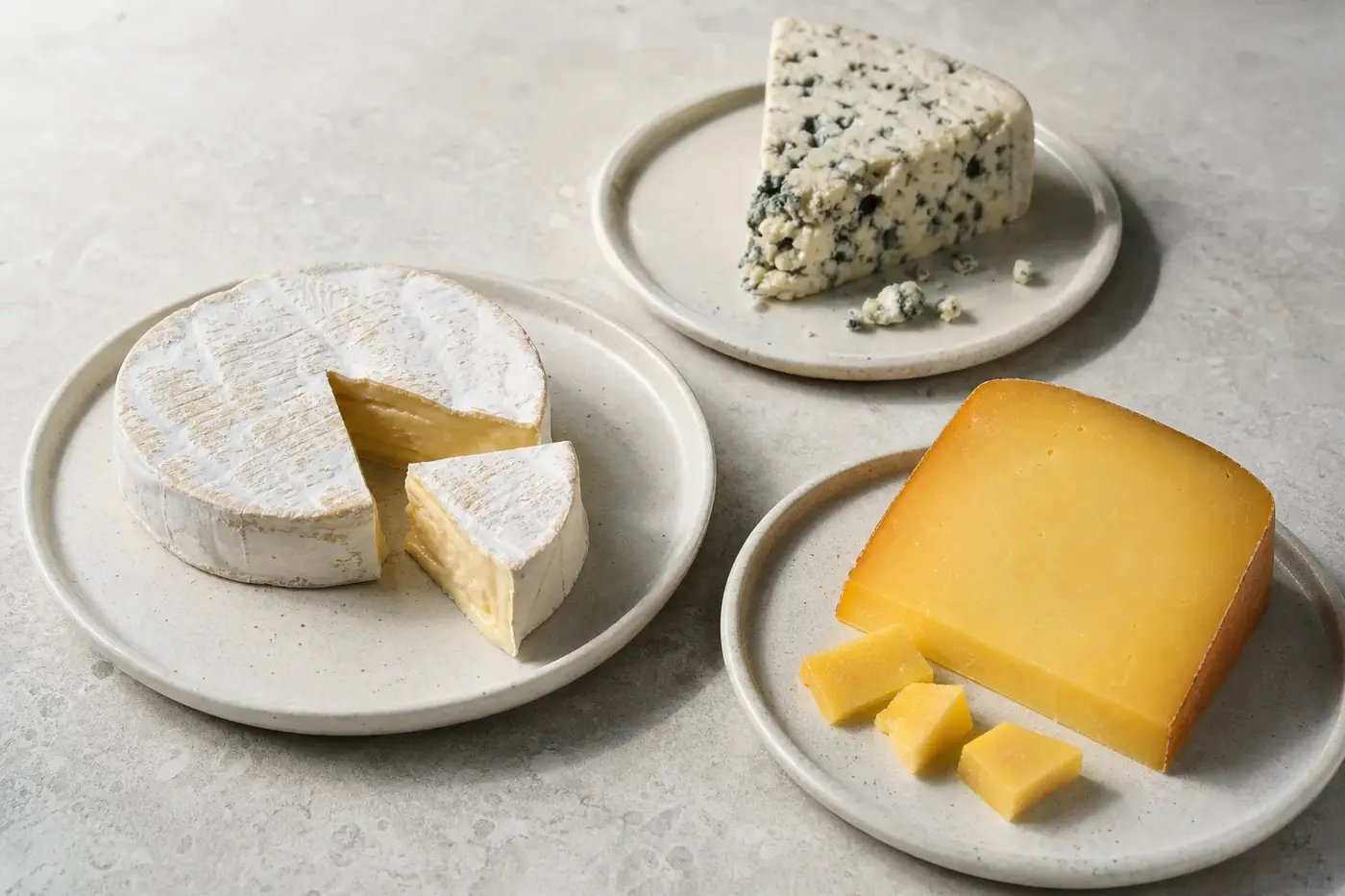
Set rindless Brie beside blue-veined Roquefort and Gouda. They might not look like a natural trio, but lactose gives them something in common: UK CoFID 2021 records only trace amounts in each. English Cheddar comes in at 0.1 g per 100 g. An unlikely little club, with no dress code for rinds. [1]
Cheddar, Swiss-style cheeses and several other ripened cheeses rank among the lowest-lactose choices in national food composition tables. So the useful question for you is not simply “hard or soft?” It's “which cheese, made how?” [1][2]
Follow the whey out of the vat
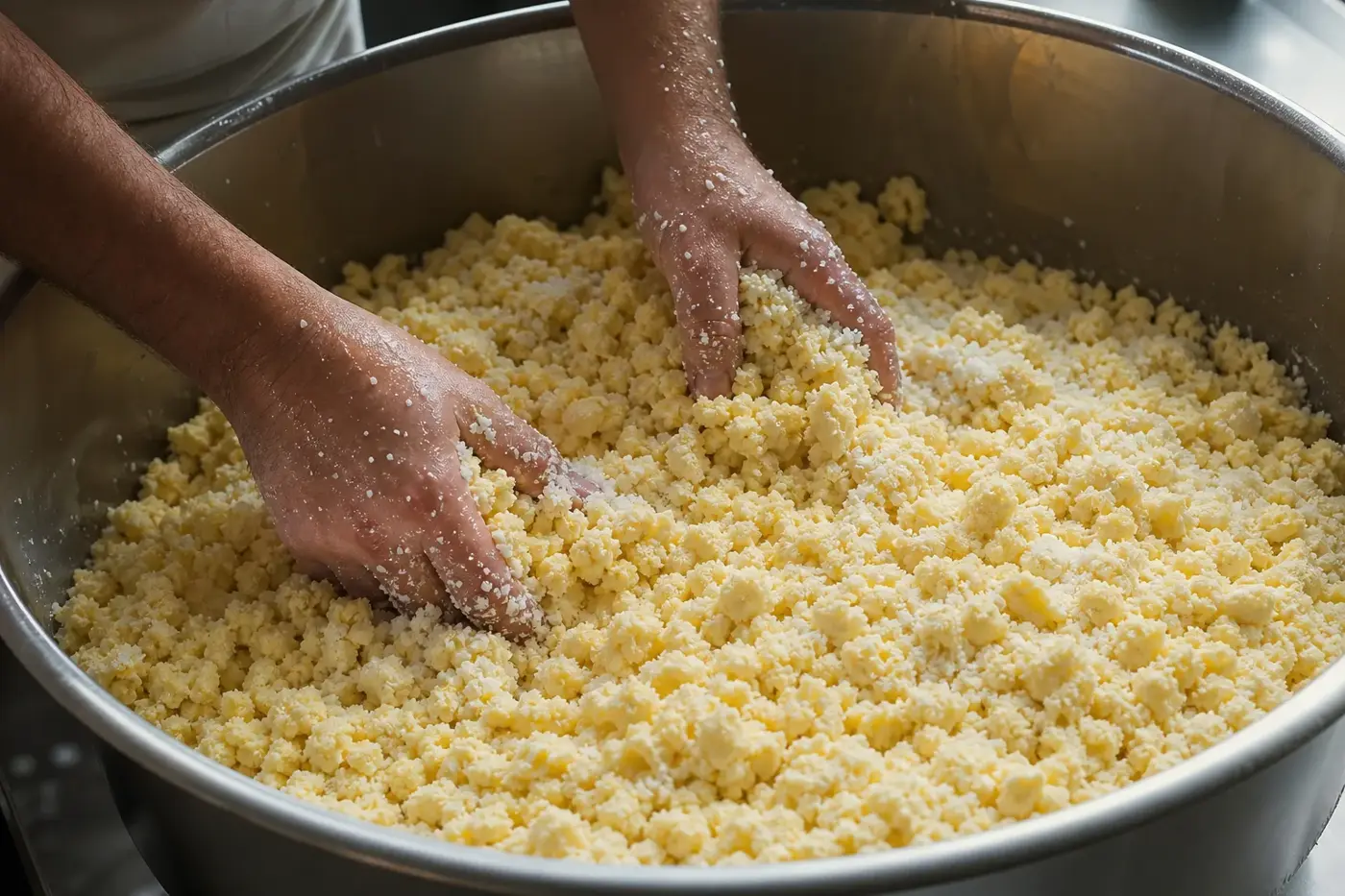
Picture milk separating into curd and whey in the cheese vat. The curd is the solid part that becomes cheese. The whey drains away, taking much of milk's lactose, its naturally occurring sugar, with it. Lactic acid bacteria then ferment the lactose left behind into other compounds, including lactic acid. [3]
That journey through draining, fermentation and ripening explains why many hard cheeses contain very little lactose. In Gouda production, washing the curd removes more before ripening even begins. But age cannot tell you everything: fresh mozzarella and some soft ripened cheeses also have low entries in the tables. How your cheese is made matters. [1][3]
Meet the cheeses in the UK table
The UK's CoFID 2021 food composition dataset gives typical lactose values in grams per 100 g for individually described foods. You'll see “Tr” below: it means a trace amount, not a measured zero. These figures describe food categories, rather than guaranteeing what's in the particular cheese in your fridge. [1]
| Cheese as described in CoFID 2021 | Lactose (g per 100 g) |
|---|---|
| Brie (rind removed) | Tr |
| Camembert | Tr |
| Danish blue | Tr |
| Edam | Tr |
| Emmental | Tr |
| Gouda | Tr |
| Gruyère | Tr |
| Roquefort | Tr |
| Mozzarella, fresh | Tr |
| Cheddar, half fat | Tr |
| Cheddar, English | 0.1 |
| Caerphilly | 0.1 |
| Red Leicester | 0.1 |
| Stilton, blue | 0.1 |
| Wensleydale | 0.1 |
| Parmesan, fresh | 0.9 |
| Paneer | 0.9 |
| Goats' milk soft cheese, white rind | 0.9 |
| Feta | 1.4 |
| Halloumi | 1.5 |
| Ricotta | 2.0 |
| Soft white full fat spreadable cheese | 3.0 |
| Cottage cheese, plain | 3.1 |
| Quark | 4.0 |
| Mascarpone | 4.3 |
| Processed cheese, plain | 5.0 |
| Cheese spread, plain | 6.5 |
Look at the distance between English Cheddar at 0.1 g, plain cottage cheese at 3.1 g and plain cheese spread at 6.5 g, all per 100 g. The trace entries, meanwhile, stretch across hard, blue and soft ripened cheeses. Texture gives you a starting point, but the named food entry tells you more. [1]
Across the Atlantic, the details count too
USDA FoodData Central holds several food composition collections, including Foundation Foods and SR Legacy. You'll find the collection and record number beside every cheese below, because similar names can hide differences in composition and measurement. SR Legacy is the April 2019 release. The Foundation records shown include entries published in 2019 and 2022. [2]
| Cheese as described in the record | Lactose (g per 100 g) | Collection | FDC record |
|---|---|---|---|
| Cheddar | 0.16 | Foundation | 328637 |
| Swiss | 0.0 | Foundation | 746767 |
| Parmesan, grated | 0.0 | Foundation | 325036 |
| Feta, whole milk, crumbled | 0.61 | Foundation | 2259796 |
| Mozzarella, low moisture, part skim | 0.66 | Foundation | 329370 |
| Cottage cheese, lowfat 2% | 3.98 | Foundation | 328841 |
| Cheddar | 0.12 | SR Legacy | 173414 |
| Swiss | 0.0 | SR Legacy | 171251 |
| Mozzarella, whole milk | 0.0 | SR Legacy | 170845 |
| Cream cheese | 3.76 | SR Legacy | 173418 |
| Neufchâtel | 3.19 | SR Legacy | 171246 |
| Cottage cheese, creamed | 2.67 | SR Legacy | 172179 |
Read that 0.0 g per 100 g carefully. It expresses the value at the database's stated precision, differs from both a trace and a missing measurement, and doesn't make every cheese with that name lactose-free. A missing value gives you no quantity to compare. Total sugars are a separate measure too, not a substitute for lactose. [1][2]
Same cheese name, a different story
Take English Cheddar: CoFID lists 0.1 g per 100 g, while USDA gives 0.16 g in Foundation Foods and 0.12 g in SR Legacy. They're all low values, but each belongs to its own food record. Keep each source beside its number rather than stirring everything into an average. Even Cheddar needs its paperwork. [1][2]
Parmesan makes a good case for reading the small print. CoFID describes “Parmesan, fresh”; the USDA Foundation record describes grated Parmesan. These are different products, not rival measurements of the same cheese. [1][2]
Feta similarly appears at 1.4 g in CoFID and 0.61 g in USDA's whole milk, crumbled entry. Those details matter: fresh, grated, crumbled, whole milk and part skim all tell you something useful about the food measured. [1][2]
Then there's mozzarella. CoFID records trace lactose for fresh mozzarella, while USDA SR Legacy gives 0.0 g per 100 g for whole milk mozzarella. USDA Foundation records 0.66 g for low moisture, part skim mozzarella. Your best match is the database description that fits the product you actually have. [1][2]
CoFID's user guide calls its values typical, not definitive, because they reflect natural variation and the foods sampled. The 2021 edition also carries forward earlier data, so the edition year isn't necessarily the year of laboratory analysis. For your particular packaged cheese, current lactose-specific information from the manufacturer can be more relevant than a category average. [1]
Give the label the right question
Start with a lactose-specific statement on your product, then read the maker's explanation. If the amount matters to your dietary plan, ask for lactose in grams per 100 g and how the result is reported. If the answer says “less than” a stated limit, keep that limit attached to the figure.
The nutrition panel's “sugars” figure answers a different question. Total sugars include lactose and other sugars, so they aren't a lactose measurement. In lactose-reduced dairy manufacture, lactase can split lactose into glucose and galactose. Those sugars may stay even after the lactose has been reduced. [1][3]
For products sold in the UK, EU or United States, ask the manufacturer for that market about any “lactose-free” claim. Find out exactly which product it covers and whether there's a quantified lactose result. Keep that answer with the named product, rather than extending it to every cheese of the same style.
Find your tolerance, guided by official advice
Your experience matters alongside the numbers. Lactose intolerance means digestive symptoms after consuming lactose; the NHS explains that the usual cause is insufficient lactase, the enzyme that helps digest this milk sugar. Tolerance varies from person to person. [4][5]
NIDDK's US advice specifically suggests hard cheeses such as Cheddar and Swiss as lower-lactose options. It says research suggests many people can consume 12 g of lactose without symptoms or with only mild symptoms. EFSA's scientific opinion also finds wide variation, including symptoms below 6 g in some people. [5][6]
Portions bring those table figures closer to your plate. A 30 g portion of cheese listed at 0.1 g lactose per 100 g contains a calculated 0.03 g lactose; a 30 g portion of cheese listed at 3.1 g per 100 g contains a calculated 0.93 g. These calculations use the table values. A doctor or dietitian can help you relate portions and the rest of your diet to your symptoms. [1][5]
In the UK, the NHS advises asking a GP or dietitian before removing foods from your own or your child's diet. It also says lactase supplements may reduce or prevent symptoms for some people. NIDDK recommends discussing dietary changes with a doctor or dietitian while keeping your nutrient intake adequate. [4][5]
This page summarises published guidance from the official sources it cites. It is not medical advice. Guidance differs between countries and changes over time, so check the current source for where you live, and ask your doctor, midwife, pharmacist or dietitian about your own circumstances.
Milk allergy calls for a different answer
Low lactose never means milk protein free or suitable for someone with a milk allergy. Lactose intolerance concerns digesting a sugar; milk allergy is an immune reaction to milk proteins, which lactose-free dairy products can still contain. Goat's or sheep's milk isn't a suitable automatic replacement for cow's milk allergy. Follow your allergy clinician's advice. [7]
Two cheese myths to leave behind
“Lactose intolerance means giving up every cheese.” Dairy foods don't all retain the lactose content of milk. NIDDK includes hard cheeses in its advice, and the composition tables show why: some entries contain only trace amounts or fractions of a gram per 100 g. Your individual tolerance still guides the dietary plan. [1][2][5]
“Goat's and sheep's cheeses are automatically lactose-free.” Milk species isn't the deciding factor: animal milks contain lactose, and cheesemaking determines how much remains. CoFID lists 0.9 g per 100 g for goats' milk soft cheese with a white rind and 1.4 g for Feta. Look at your cheese's own information, not just the animal behind the milk. [1][3][4]
Questions people ask
Which cheeses have the least lactose?
CoFID 2021 records trace lactose in Brie with its rind removed, Camembert, Gouda, Roquefort and fresh mozzarella, among others. It records 0.1 g per 100 g for English Cheddar. A trace is not a measured zero, and these are typical values rather than guarantees for a particular cheese.
Why do some cheeses contain so little lactose?
Much of the lactose leaves with the whey during cheesemaking. Bacteria then ferment residual lactose, and draining, fermentation and ripening together explain the very low lactose content of many hard cheeses.
How much lactose is in mozzarella?
CoFID records trace lactose for fresh mozzarella. USDA records give 0.0 g per 100 g for whole milk mozzarella and 0.66 g for low moisture, part skim mozzarella.
Can the sugars figure on a cheese label tell me its lactose content?
No. Total sugars include lactose and other sugars, so the figure is not a lactose measurement. The page suggests looking for a lactose specific statement and, if needed, asking the manufacturer for lactose in grams per 100 g.
Can people with lactose intolerance or milk allergy eat low lactose cheese?
NIDDK suggests hard cheeses such as Cheddar and Swiss as lower lactose options, but tolerance varies. See NIDDK's advice [5] and the NHS guidance [4], which advises seeking a GP's or dietitian's advice before removing foods from your own or your child's diet. Low lactose does not mean milk protein free or suitable for someone with a milk allergy; follow your allergy clinician's advice.
Sources
-
Public Health England. McCance and Widdowson's Composition of Foods Integrated Dataset, 2021 edition, and accompanying User guide, 2021. Publication and dataset page; user guide.
-
USDA Agricultural Research Service. FoodData Central: Foundation Foods records identified in the table, including 2019 and 2022 entries; SR Legacy, April 2019 release. Database.
-
Dekker PJT, Koenders D, Bruins MJ. Lactose-Free Dairy Products: Market Developments, Production, Nutrition and Health Benefits. Nutrients, 2019;11(3):551. DOI: 10.3390/nu11030551. Publisher record. The authors' dairy-industry affiliations are relevant to the review's commercial context.
-
NHS. Lactose intolerance. Reviewed 8 July 2026. Official guidance.
-
National Institute of Diabetes and Digestive and Kidney Diseases, National Institutes of Health. Eating, Diet, & Nutrition for Lactose Intolerance. Reviewed February 2018. Official guidance.
-
EFSA Panel on Dietetic Products, Nutrition and Allergies. Scientific Opinion on lactose thresholds in lactose intolerance and galactosaemia. EFSA Journal, 2010;8(9):1777. Adopted 10 September 2010; published 24 September 2010. DOI: 10.2903/j.efsa.2010.1777. Published opinion.
-
British Dietetic Association. Milk allergy. Online patient information, edition date not established. Dietetic guidance.
Last checked: November 2026
Last checked November 2026.
The editors suggest you read next
Cheese and Health: What the Evidence Says
Put cheese and butter side by side on your plate.