Cheese in the World Wars and Rationing
Picture a week’s cheese sitting on your kitchen table: approximately 28 g (1 oz), with no more under the ordinary allowance.
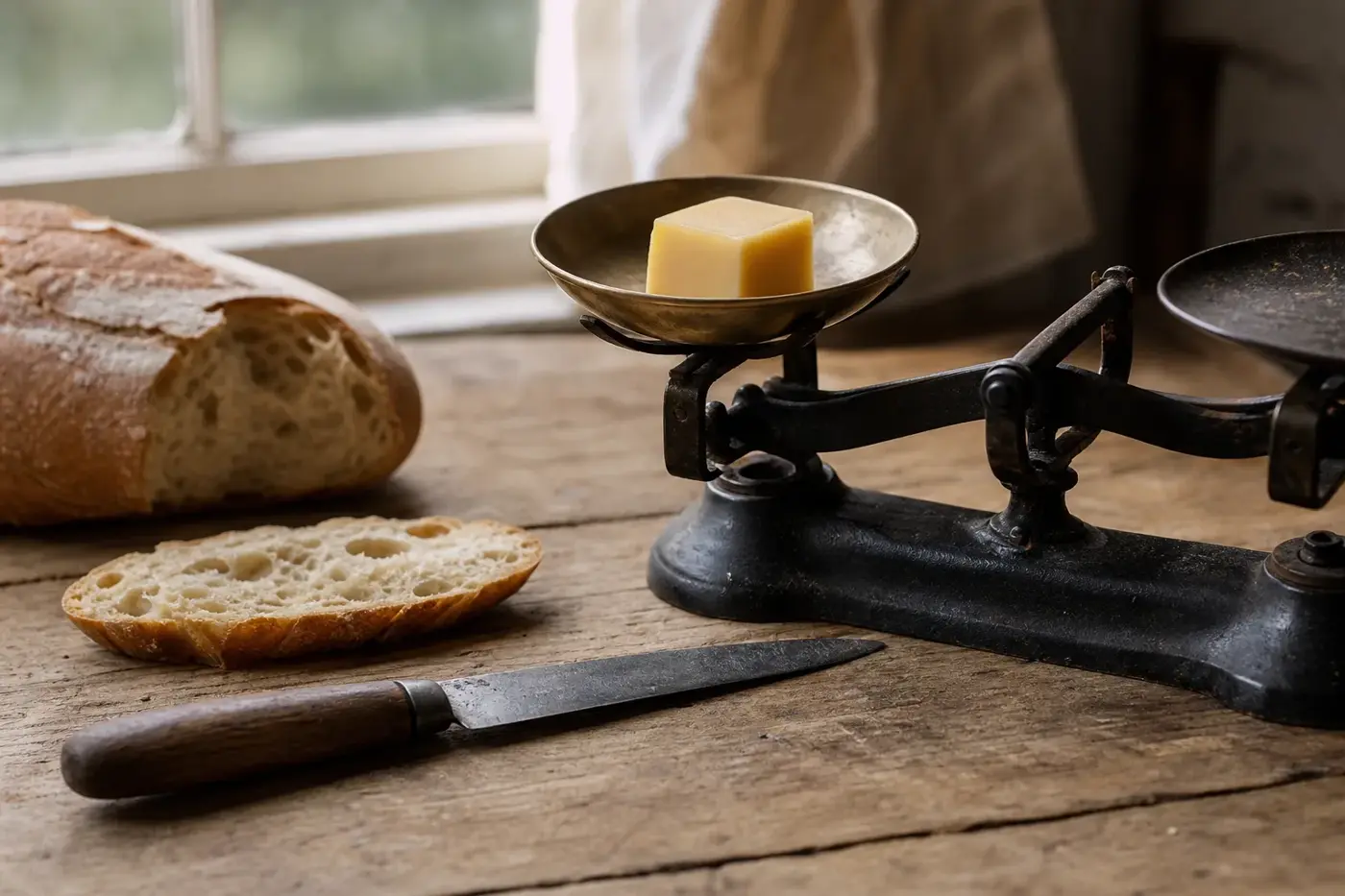
Picture a week’s cheese sitting on your kitchen table: approximately 28 g (1 oz), with no more under the ordinary allowance. You might look at it twice, in case some had gone missing. That was Britain’s starting ration on 5 May 1941, a small portion connecting your plate to milk allocation, factories and shipping.[2]
Both World Wars made cheese a strategic food, but the rules differed. The First allowed local cheese rationing; national rationing began in the Second and lasted until 8 May 1954. The route from dairy to dinner became a matter of government policy.[1][2][3]
A small food with a big wartime job
Cheese offered nourishment without taking up much space. You could carry it from home as part of a meal, too. Wartime planners valued both qualities: in a February 1941 parliamentary debate, cheese’s modest shipping requirement counted explicitly in its favour, when ships, labour and competing demands constrained supplies reaching Britain.[4]
It already had a place in the working day. In April 1941, the Ministry of Food explained why underground miners and agricultural workers deserved special consideration: they needed suitable food to take to work. Whether you could get a cooked meal mattered alongside how physically demanding your job was.[5]
The armed forces needed their share as well. The Society of Dairy Technology’s historical account identifies cheese as part of First World War service rations. Military provisioning and civilian shopping drew on the same food supply, while overseas routes faced attack.[6]
First World War milk: a glass or a cheese vat?
Before comprehensive household rationing came controls on milk. In December 1917, the government told Parliament it had increased liquid milk supplies by restricting cream use and prohibiting milk’s use in milk chocolate and similar products. It also encouraged whole milk supplies rather than conversion into butter.[7]
You can see the difficulty. Milk could fill a glass or become another food, but it could not do everything at once. Keeping households supplied with drinking milk could leave less for manufacturing, while farms and processors worked with the feed, labour and transport available.[7]
Imported cheese offered another route to your table. New Zealand’s government history dates cheese’s inclusion in Britain’s wartime bulk-purchasing arrangements to November 1915. Under this system, often called the imperial commandeer, governments organised supplies previously handled through ordinary commercial arrangements.[8]
But cheese made overseas was not necessarily cheese you could buy in Britain. New Zealand’s account describes dairy produce accumulating in cool stores as shipping grew scarce. Troops and hospitals needed ships alongside cargo, submarine attacks reduced capacity further, and supplies could stall between factory and port, or between port and British consumer.[8]
In 1918, your address shaped your allowance
British rationing arrived in stages towards the end of the First World War. Imperial War Museums records compulsory rationing beginning in early 1918. Cards, followed by books, covered meat, sugar, lard, and butter or margarine.[9]
Cheese took a different route. On 2 July 1918, the Ministry of Food told Parliament it did not consider a uniform national cheese-rationing scheme desirable. People in mining and agricultural districts consumed substantially different amounts from those elsewhere.[1]
Local food control committees could ration cheese, though. The ministry specifically authorised them to use spare spaces in the new national ration books. You might therefore face cheese rationing in one place but not another: there was no uniform national allowance.[1]
Living near cheesemakers did not guarantee first claim on their produce, either. A July 1918 parliamentary exchange about Herefordshire concerned the appointment of local cheese factors, the intermediaries handling distribution. The government explained that appointing a local factor would not determine where the cheese finally went.[10]
Before the Second World War ration, milk had to be shared
Britain needed drinking milk, manufactured dairy foods and reserves. All drew on the same raw material, while imports still depended on sea transport. In April 1941, the Ministry of Food explained that it wanted to manufacture cheese and condensed milk that Britain would normally have imported.[11]
Keeping one supply flowing could mean restricting another. In May 1943, the ministry said cheese and other milk products should be manufactured to the maximum extent permitted by plant and available labour. Where necessary, milk allowances for non-priority consumers would be reduced to maintain that output.[12]
Sending milk towards cheese vats was only the beginning. Factories needed capacity and workers, while priority and non-priority consumers had different claims on supplies. The government had to balance those demands rather than pursue cheese production regardless of every other need.[12]
If you want to follow milk’s transformation into curd and whey, explore how cheese is made. Wartime policy shaped the decisions before that process began. Which dairy would receive the milk, and what would it be allowed to make?
5 May 1941: the weekly cheese allowance arrives
National cheese rationing began on 5 May 1941, with an ordinary allowance of approximately 28 g (1 oz) per person per week. A contemporary New South Wales government market report recorded the scheme using information from its London office. Before that, it explained, retailers had restricted supplies to regular customers at their own discretion.[2]
The portion was small; the change was substantial. Instead of depending on an individual shop’s restrictions, you now had a stated weekly entitlement. The same report anticipated that greater domestic production and imports might allow an increase later.[2]
That first allowance did not stay fixed throughout rationing. In an April 1952 parliamentary answer, the Minister of Food identified 29 June 1941 as the last date on which the ordinary domestic allowance had previously stood at 1 oz weekly. What you could take home changed over time.[13]
Extra cheese: your working meal mattered
The supplementary ration depended on where and how you ate at work. In April 1941, the ministry identified underground miners and agricultural workers as the principal groups needing to carry suitable food away from home. Heavy work alone, it explicitly said, did not automatically qualify you.[5]
The contemporary Australian government report recorded a special weekly cheese ration of approximately 227 g (8 oz) for underground miners, agricultural workers and vegetarians. Seamen received approximately 113 g (4 oz). Eligibility rested on the scheme’s named categories, not simply on long working hours.[2]
Those boundaries prompted objections. Parliament heard about workers whose circumstances seemed similar but who fell outside the recognised categories. The ministry acknowledged how difficult the line was to draw, while maintaining that limited supplies restricted any extension.[5]
Making the household’s cheese last
For four people, the initial ordinary allowance meant approximately 113 g (4 oz) of cheese between them each week, based on approximately 28 g per person. You had to think across the household’s meals. The absent-minded extra slice was not much of a meal-planning strategy.[2]
Even before national cheese rationing, official food publicity had given cheese a practical role. A Ministry of Food notice published in September 1940 recommended cheese sandwiches among foods suitable for taking into an air-raid shelter. Bread made a small portion portable and ready to eat when ordinary domestic life was interrupted.[14]
That sandwich suited more than one wartime setting. You could take a meal to work or food into a shelter, while households continued preparing meals at home. Cheese could move between those settings without needing a freshly cooked dish at the moment you ate it.[5][14]
Every household’s circumstances were different. The allowance, the number sharing it and access to meals away from home all affected what remained for the family table. Parliamentary arguments over workers’ rations show how closely your domestic meal planning could depend on workplace provision.[5]
How Cheddar found its place at the centre
Cheddar came to the fore in a system organised around manufacture and distribution. The Society of Dairy Technology’s history describes the government’s emphasis on Cheddar, alongside the redirection of milk that constrained other makers. This happened over time, not through one simultaneous nationwide conversion.[6]
Cheddar was a familiar manufacturing category, supplied by both domestic producers and overseas makers. Its wartime prominence makes sense within that managed supply system. You can explore the cheese itself in the Cheddar guide; here, the story is how a production category became central to provisioning.
Even then, cheese did not have milk to itself. In 1943, the government described its objective as maximum manufacture of cheese and other milk products, within plant and labour capacity. Several products still had to share the same raw material.[12]
Behind every farmhouse cheese, a different story
For a farmhouse cheesemaker, losing access to manufacturing milk could interrupt the work on which a particular cheese depended. But the scale of that loss matters. One farm stopping cheesemaking, a regional variety losing makers and a variety ceasing production altogether are three different outcomes.
The Cheese Order 1950 gives you a picture of postwar British cheese beyond a single surviving variety. Its definition of rationed cheese named Cheddar, Cheshire, Lancashire, Derbyshire, Leicestershire, White Wensleydale and Dunlop. Those categories covered cheese whether home-produced or imported.[15]
These were the categories recognised by the order in 1950, not an account of continuous wartime production. A regional name in a postwar legal list tells a different story from an individual dairy’s uninterrupted manufacturing history. For that, the relevant detail lies in contemporary production records.
The useful questions take you closer to the maker: which farm, which variety and which years? A claim that the wars eliminated every traditional British cheese is a claim about what individual makers produced and when. Farm closures, regional losses and the disappearance of a variety are not interchangeable events.
From New Zealand’s farms to your portion
Britain’s appetite changed how New Zealand used its milk. The country’s Department of Agriculture reported that Britain requested preference for cheese production in June 1940. Where practicable, farmers supplying cream to butter factories were to switch to supplying milk to cheese factories.[16]
Approximately 1,750 suppliers changed over, representing about 84,000 cows. The department also described shortages of materials for milk cans, coolers and factory equipment. This meant much more than increasing an existing order: farm collection and processing had to be reorganised.[16]
Then came the journey to Britain. The First World War had already shown that full overseas stores could coexist with British shortages when transport failed. Your portion depended on distant farms, factory capacity, refrigerated storage and available cargo space.[8][16]
That dependence did not disappear in 1945. In April 1951, the British government warned that a strike in New Zealand might delay expected cheese arrivals. Years after the fighting ended, events along the supply chain could still affect your household’s allowance.[17]
Peace arrived before unrestricted cheese
The end of the fighting did not mean you could buy cheese freely. In April 1951, the Ministry of Food described the difficulty of accelerating deliveries from the southern dominions. Additional American supplies obtained at the end of the previous season had already been distributed through an increased ration.[17]
The following year, Parliament was again discussing a 1 oz weekly domestic ration. For households, the postwar years did not bring a steady climb towards larger allowances. Restriction could return.[13]
Cheese rationing and associated controls finally ended on 8 May 1954, as confirmed by the government’s National Food Survey report. The report also records the resumption of private imports. At home, your allowance system disappeared; behind it, the organisation of supply changed too.[3]
| Date | What it meant for your cheese |
|---|---|
| 2 July 1918 | The Ministry permits local cheese rationing, but rejects a uniform national scheme.[1] |
| 5 May 1941 | National cheese rationing begins at approximately 28 g (1 oz) per person each week.[2] |
| 5 May 1943 | The Ministry confirms maximum manufacture within plant and labour capacity.[12] |
| 8 May 1954 | Cheese rationing and associated controls end, and private imports resume.[3] |
Beyond the ration book, more cheeses return
The wars tied cheese production more closely to central milk allocation and organised distribution. That legacy lasted beyond the ration book. The 1954 National Food Survey observed a shift towards greater variety after decontrol, with cheeses outside the former ration types recovering some ground.[3]
War was also one part of a longer industrial story. The Society of Dairy Technology’s account follows continuing changes in manufacturing, retail demand and farmhouse production through subsequent decades. Later closures and later revival belong to that sequence, alongside wartime disruption.[6]
Follow the story from milk to meal and you can see how the pieces connect. Milk allocation shaped what dairies could produce, shipping shaped what importers could deliver, and rationing shaped what reached your household. Beyond those systems, the survival and revival of regional cheeses rested on particular makers and decisions, each with an individual history worth exploring.
Questions people ask
When was cheese rationed in Britain during the Second World War?
National cheese rationing began on 5 May 1941 at approximately 28 g, or 1 oz, per person per week. The allowance changed over time, and cheese rationing and associated controls ended on 8 May 1954.
Who received extra cheese during rationing?
A contemporary report recorded a special weekly ration of approximately 227 g for underground miners, agricultural workers and vegetarians. Seamen received approximately 113 g. The Ministry of Food said that heavy work alone did not automatically qualify someone for extra cheese.
Was cheese rationed during the First World War?
Cheese could be rationed locally, but there was no uniform national cheese allowance. In July 1918, the Ministry of Food said consumption differed substantially between mining and agricultural districts and other places.
Why did Cheddar become prominent during wartime?
The government emphasised Cheddar within a system of organised manufacture and distribution. Milk was redirected, constraining other makers, but these changes unfolded over time rather than through one nationwide conversion.
Did wartime controls eliminate every traditional British cheese?
The page says such claims need to be tested against records of individual makers and varieties. The Cheese Order 1950 named several rationed varieties, including Cheshire, Lancashire and White Wensleydale, but that list does not establish whether each was made continuously through the war.
Sources
- UK Parliament, Cheese, House of Commons written answer, 2 July 1918, volume 107, column 1574W. Official record.
- New South Wales government, Monthly Review of Agricultural Economics, volume 7, number 4, 1941, “Rationing of cheese in the United Kingdom”, printed page 83. Contemporary report.
- Ministry of Agriculture, Fisheries and Food, Domestic Food Consumption and Expenditure: 1954, National Food Survey Committee annual report, published 1956, paragraphs 10 and 40. Official report.
- UK Parliament, Food supplies, House of Lords debate, 18 February 1941. Contemporary debate.
- UK Parliament, Cheese rationing, House of Commons debate, 23 April 1941, volume 371, columns 151 to 154. Official record.
- Society of Dairy Technology, The Evolution of the British Cheese Industry, November 2018. Historical study.
- UK Parliament, Commons Chamber, food supplies debate, 17 December 1917. Official record.
- New Zealand Ministry for Culture and Heritage, Feeding Britain, government historical account, undated online edition. Government history.
- Imperial War Museums, First World War Galleries: Large Print Guide, online edition, 2023. Museum guide.
- UK Parliament, Cheese, House of Commons debate, 24 July 1918, volume 108, column 1810. Official record.
- UK Parliament, Supply, House of Commons debate, 30 April 1941. Official record.
- UK Parliament, Milk (Cheese Manufacture), House of Commons written answer, 5 May 1943, volume 389, column 183W. Official record.
- UK Parliament, Cheese ration, House of Commons answers, 7 April 1952. Official record.
- Ministry of Food, This Week’s Food Facts, published in the Bromley & District Times, 20 September 1940, page 6; modern transcription hosted by Bromley Historical Times. Retrieved transcription.
- Minister of Food, The Cheese Order 1950, SI 1950/1069, made 29 June 1950, operative 2 July 1950. Official published text.
- New Zealand Department of Agriculture, Annual Report for 1940-41, parliamentary paper H-29, 1941, dairy industry account. Contemporary government report.
- UK Parliament, Cheese ration, House of Commons debate, 11 April 1951. Official record.
This piece was researched through contemporary parliamentary answers, government reports and legislation, supplemented by official historical interpretation and a specialist dairy-industry history.
Last checked: November 2026
Last checked November 2026.
The editors suggest you read next
A History of Cheese: From the First Curds to Global Food
Picture cheese lying beside Bronze Age burials in China's Tarim Basin, surviving for approximately 3,500 years.