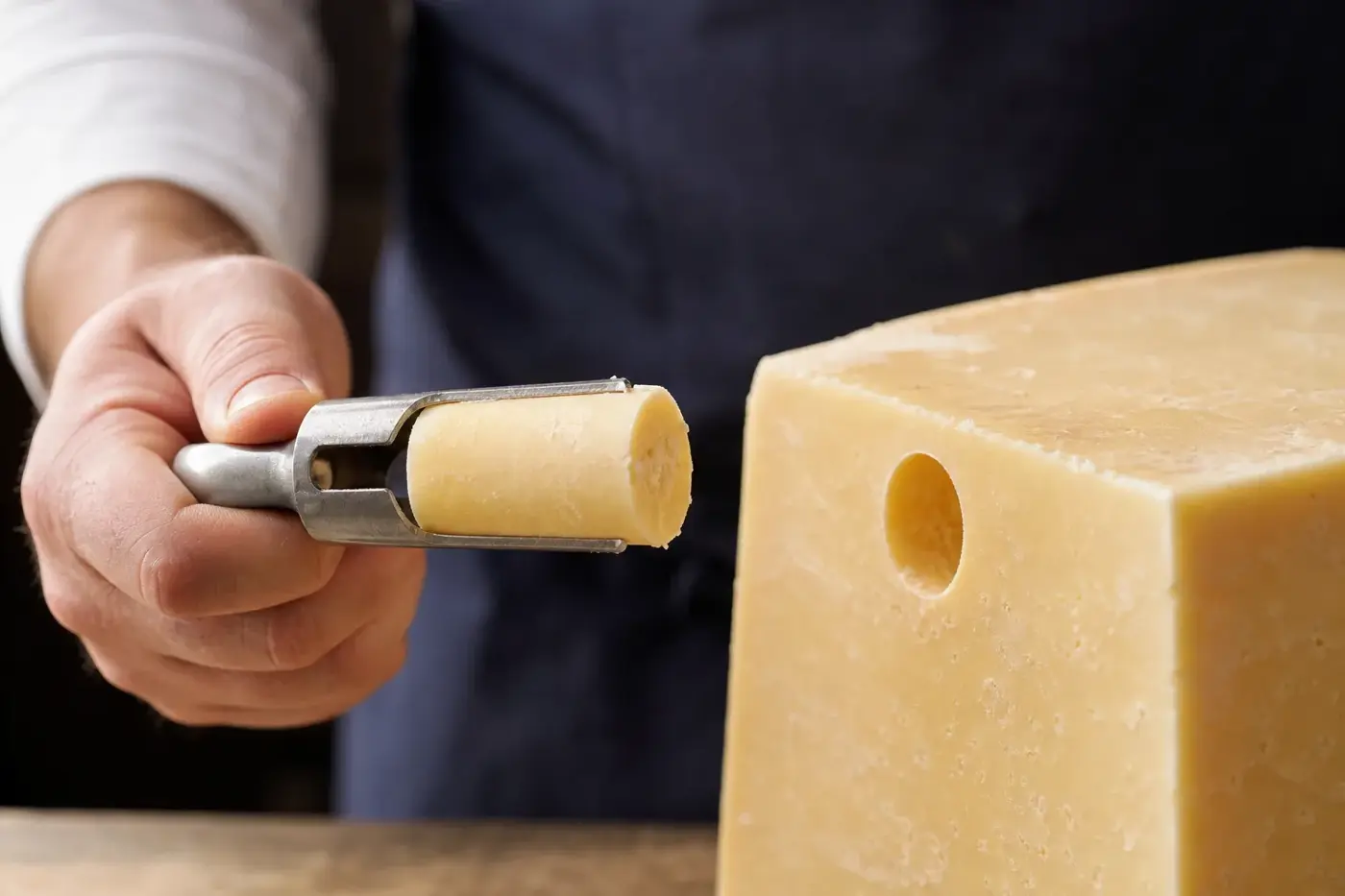
Cheesemaking Equipment Explained
A wire harp slips through set milk.
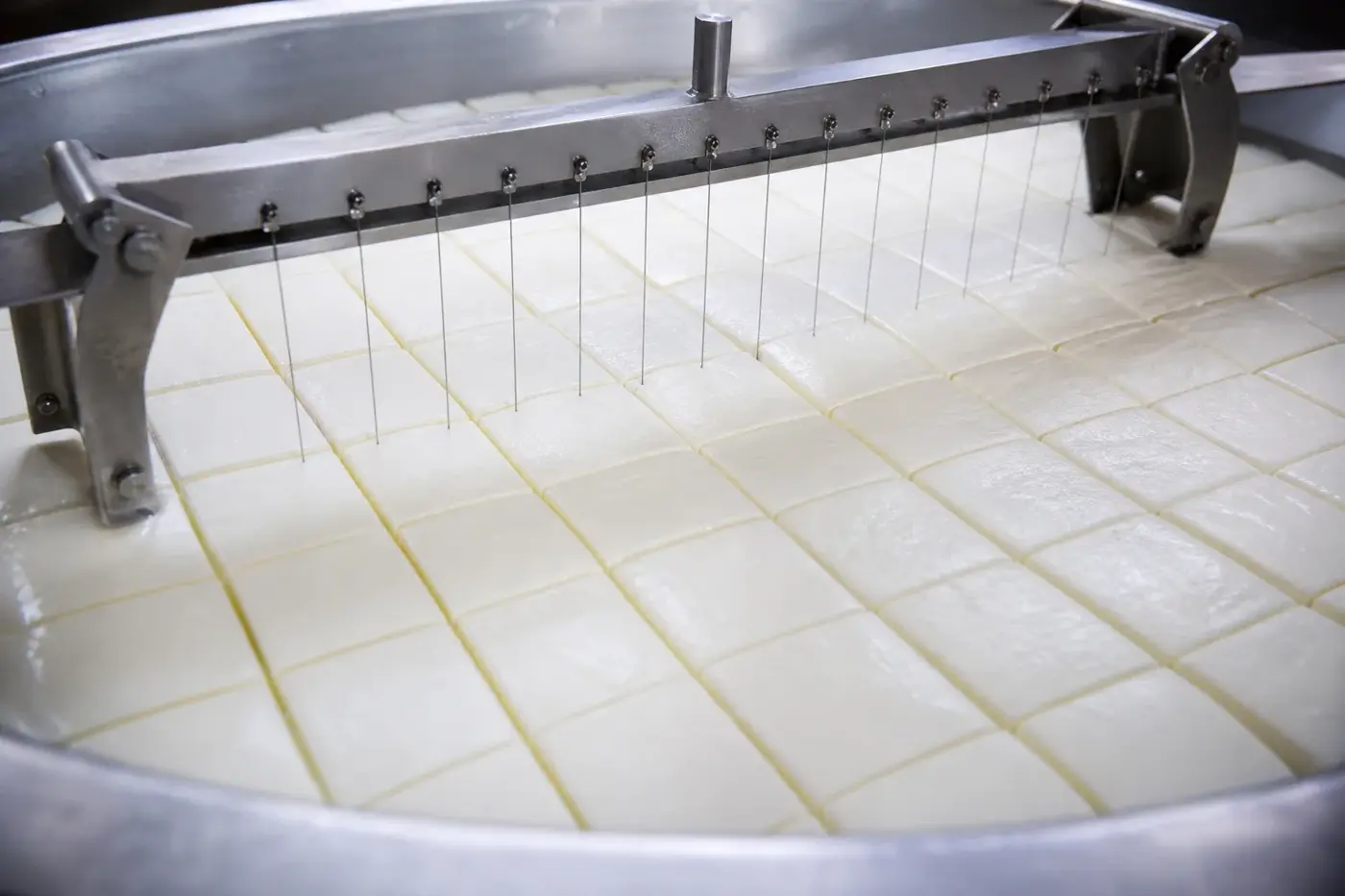
A wire harp slips through set milk. Curds part, fresh surfaces open, and whey begins to escape. Before you have anything resembling a finished cheese, the equipment is already leaving its mark. It will keep doing so until the final days of maturation.[1,2]
Follow the milk and the workspace starts to make sense. You need a vessel for heating, tools for cutting and draining, a mould for shaping, then somewhere to mature. Whether your batch fills a saucepan or a dairy vat, each piece controls heat, handling, measurement or the cheese’s surroundings. A splendid collection of gadgets is not, by itself, a cheesemaking method.[1,2]
Let the milk lead your shopping list
Before choosing equipment, walk through your make. Receiving milk needs a suitable container and a record of what arrived; cheesemaking needs controlled heat and measurements. Draining needs somewhere for whey, the liquid released from curd, to go. Maturation needs a controlled space of its own.[1,8]
| Stage | What you’ll need | What it helps you control |
|---|---|---|
| Receiving milk | Containers, scales and records | Quantity and traceability [8] |
| Heating and setting | Pot or vat, stirrer, thermometer and timer | Temperature and the order of each step [2] |
| Cutting and draining | Knife or harp, ladles, cloth and draining surface | Curd handling and whey removal [1] |
| Forming and salting | Moulds, a press where required, scales and salting equipment | Shape, consolidation and salt addition [6,7] |
| Maturing | Racks, mats and environmental controls | Conditions around your cheese [1] |
Pots and vats: a gentle start for your milk
In a jacketed vat, hot water circulates through an outer jacket. It heats the milk through the vessel wall without the two meeting. Gentle agitation spreads the heat and reduces local overheating. Once the milk sets, the maker adjusts that movement to the stage and cheese, because too much can break delicate curd pieces.[1,2]
For a small setup, choose a sturdy food-contact pot and a heat source that responds predictably. Give yourself room to stir and cut comfortably. Check that you can lift, empty and clean the vessel in your space. If you are buying for a dairy, ask about heating control, agitation settings and access for inspection.[2,8]
Thermometers, timers and pH meters: readings worth keeping
“How warm?” needs a thermometer; “how long?” needs a timer. A pH meter follows acidity, and together these tools give your batch record meaning. A temperature without a time, or a pH reading without its sampling stage, leaves the next maker with less to work with. Record what you measured, not just the number.[2,4,5]
ThermoWorks recommends assessing thermometer accuracy in a properly prepared ice bath. Compare the reading with the instrument’s stated tolerance. This does not adjust the instrument, so follow your model’s instructions for adjustment or servicing. For milk, choose an immersion probe suited to your vessel and the temperatures involved.[3]
Your pH electrode needs to suit the sample, too. Hanna’s cheese meter has a penetration-style probe designed for cheese, rather than an electrode intended only for liquids. Its calibration guidance recommends buffers bracketing the expected measurement range, fresh working portions of buffer and appropriate electrode care. Put cleaning and storage solutions on your equipment list alongside the meter.[4,5]
Knives and harps: make that first cut count
The first cut helps determine how much moisture your curd loses. Curd is the gel formed when milk coagulates, or sets; knives and wire harps divide it, opening more surface for whey to escape. Smaller pieces generally support greater moisture loss, with your intended cheese determining the cut. Big lumps and tiny fragments receive uneven treatment, so aim for consistency.[1]
For a small batch, choose a tool that reaches the bottom without putting your grip at an awkward angle. For a vat, ask how cutter geometry, speed and agitation suit the intended curd. A specialist harp earns its place when its spacing and working dimensions match the cheeses you make.[2]
Ladles, cloth and tables: give whey a way out
Before filling anything, decide where the whey will go. Ladles and scoops transfer curd; cheesecloth holds it while liquid drains through. A draining table provides support and a route for whey collection. Match your handling tool to the curd’s delicacy and its destination: a broad scoop and a narrow mould are not a promising introduction.[1,8]
Put your receiving bowl or whey container in place first. Make sure cloth, supports and collection vessels all have a workable cleaning routine. In a dairy, inspect the whole transfer route, including outlets and hoses. The draining table is only one part of it.[8,11]
This page summarises published guidance from the official sources it cites. It is not medical advice. Guidance differs between countries and changes over time, so check the current source for where you live, and ask your doctor, midwife, pharmacist or dietitian about your own circumstances.
Moulds, hoops and presses: find your cheese’s shape
Your mould shapes the cheese while allowing it to drain. A hoop is commonly an open-ended forming ring, while a press applies controlled force through a follower or lid. Tetra Pak’s pressing documentation describes moulded curd blocks covered with lids. Force and pressing time are adjusted to the cheese type.[6]
Some soft cheeses drain and consolidate under their own weight, with turning; other makes need an external press. Let your chosen method guide the purchase. If you need a press, check that the follower fits, whey can escape and the loading mechanism is stable. Ask whether a displayed setting means applied force or pressure at the cheese.[1,6]
Scales, salt and brine: measure what matters
Scales make salting a measured operation. For dry-salted curd, weigh both the curd and the salt your method requires. Choose a scale with the capacity and resolution for both jobs. In a dairy, weighing equipment may connect to a salt dispenser and mixing conveyor; Tetra Pak documents systems that meter salt against cheese weight.[7]
Brine tanks hold cheese in salt solution, but your setup needs more than a tank. The handbook recommends regular monitoring of brine composition and temperature, including salt concentration, acidity and calcium. Choose measuring equipment to match. Professional systems can also carry cheeses on racks through a brine bath, organising handling around the required brining period.[1]
Before buying, decide who will sample the brine, record results, remove residues and carry out the dairy’s specified maintenance. Leave access to empty and clean the tank. Any treatment or replacement schedule belongs within the reviewed production and hygiene plan.[8,11]
Racks and maturation rooms: make room for ripening
During ripening, racks and mats support your cheeses. Temperature, relative humidity and air movement provide conditions suited to their style and stage. The handbook describes different arrangements for surface-ripened and other cheeses, including racks and staged transfers between rooms.[1]
When specifying a space, picture the racks loaded with cheese. Ask how conditions will be measured around them, how cheeses will be turned, and how shelves and mats will be cleaned. At home, you also need a way to observe the environment. Start with the conditions your cheese method requires, then establish whether the equipment can maintain and record them.[8]
Food-contact materials: look beyond the stainless steel
“Stainless steel” and “food-contact plastic” are starting points, not complete answers. Both appear throughout dairy equipment, but a material name tells you little about a finished item’s suitability. Choose equipment documented for its intended food contact, including the food, operating temperature and cleaning conditions. Ask about seals, coatings and replacement parts as well as the main vessel.[8,11]
If you are buying in the UK, request supplier evidence against the food-contact requirements applicable where you will use the equipment. The Article 3 framework in Regulation (EC) No 1935/2004 addresses the transfer of constituents into food. That includes effects on composition and sensory characteristics.[13]
Give cleanable design just as much attention. The FSA’s MyHACCP guidance says food-contact equipment should be designed for adequate cleaning, disinfection and maintenance. Look closely at joints, valve assemblies and corners. Before buying, ask to see dismantling and reassembly demonstrated, and establish which parts need separate attention.[8]
Cleaning and sanitising: two jobs, each done properly
Detergents remove grease and dirt; disinfectants act on microorganisms and need a visibly clean surface. The Food Standards Agency makes this distinction in its guidance for food businesses in England, Wales and Northern Ireland. As at November 2026, that guidance says a combined sanitiser is used in two stages: first to clean, then reapplied for the specified disinfection contact time. Follow the product’s dilution, contact time and rinsing instructions.[9]
Food Standards Scotland’s CookSafe guidance likewise makes the cleaning method depend on equipment use and whether it can be disinfected effectively. For dishwashers, it calls for evidence of adequate heat disinfection and compliance with the machine manufacturer’s instructions. Look at the method, not just the machine. Wash programmes do not all deliver the same result.[10]
In a larger dairy, ask which parts the supplier includes in cleaning in place and which need dismantling. Whatever your scale, include cleaning equipment, chemicals and instructions in the setup. The FSA recommends a schedule setting out what needs cleaning or disinfecting, how often, and how products should be used.[9,11]
Your first pot, or plans for a whole dairy?
Start with a versatile core: a suitable pot, controllable heat, thermometer, timer, scales, a stirring tool and appropriate draining equipment. Add a mould, press, pH system or maturation controls when your selected method calls for them. Plan the complete method, including measurement and cleaning, before choosing individual tools. Your cupboard need not audition for a dairy equipment catalogue.[2,8]
A professional dairy coordinates those same jobs across a production flow. Vats feed draining and forming equipment, presses work to selected settings, and dispensers measure salt into production flows. Automation changes how the work happens. When comparing systems, ask how operators assess readings, inspect product-contact surfaces and respond when equipment or measurements fall outside the agreed process.[2,6,7,8]
If you are starting a home-based food business in England, Wales or Northern Ireland, the FSA’s startup guidance covers registration and premises requirements, including home premises. Discuss your proposed dairy activity with the local authority before fitting out the workspace. This allows layout and equipment to be considered together.[12]
Ready to follow the process behind the tools? Read how cheese is made, and turn to cheese food safety for wider handling questions. When choosing between methods, milk treatment and rennet explain two decisions that come before equipment specifications.
Questions people ask
What equipment do I need to start making cheese at home?
Start with a suitable pot, controllable heat, a thermometer, timer, scales, a stirring tool and appropriate draining equipment. Add a mould, press, pH system or maturation controls when your chosen method requires them.
Why does the size of the curd cut matter?
Cutting curd opens surfaces through which whey can escape. Smaller pieces generally support greater moisture loss, and an even cut helps avoid uneven treatment of large lumps and tiny fragments.
Do all cheeses need a press?
No. Some soft cheeses drain and consolidate under their own weight, with turning, while other makes need an external press.
How should cheesemaking equipment be cleaned and disinfected?
The Food Standards Agency says detergents remove grease and dirt, while disinfectants act on microorganisms and need a visibly clean surface. Its guidance says to use a combined sanitiser in two stages: first to clean, then reapply it for the specified disinfection contact time.
What equipment is needed to mature cheese?
Racks and mats support cheeses during ripening, while temperature, relative humidity and air movement are selected for the cheese style and stage. Check that the space can maintain and record the conditions required by the cheese method.
Sources
- Tetra Pak, Dairy Processing Handbook, Chapter 16, “Cheese”, online edition, undated. Sections on curd manufacture, drainage, pressing, brining and ripening. Manufacturer technical reference.
- Tetra Pak, Curd making, online equipment documentation, undated. Manufacturer source describing its equipment and applications.
- ThermoWorks, How to Test a Digital Thermometer for Accuracy, 2017, online version retrieved November 2026. Instrument manufacturer guidance.
- Hanna Instruments, pH Meter Calibration and Electrode Maintenance Guide, online edition, undated. Instrument manufacturer guidance.
- Hanna Instruments, Portable Cheese pH Meter, HI99165, online product documentation, undated. Product-specific electrode and calibration information.
- Tetra Pak, Pressing and acidification for cheese products, online equipment documentation, undated. Manufacturer source.
- Tetra Pak, Dry salting, online equipment documentation, undated. Manufacturer source describing weight-based salt dosing and associated equipment.
- Food Standards Agency, MyHACCP, General requirements to be considered for each prerequisite, online edition, undated.
- Food Standards Agency, Cleaning effectively in your business, official printable guidance, undated version retrieved November 2026.
- Food Standards Scotland, CookSafe: Food Safety Assurance System, web version, Section 3, cleaning and disinfection guidance, undated version retrieved November 2026.
- Tetra Pak, Dairy Processing Handbook, Chapter 22, “Cleaning of dairy equipment”, online edition, undated. Manufacturer technical reference.
- Food Standards Agency guidance republished on GOV.UK, Starting a food business, online version retrieved November 2026.
- European Parliament and Council, Regulation (EC) No 1935/2004 on materials and articles intended to come into contact with food, Article 3, consolidated document dated 27 March 2021, hosted on legislation.gov.uk. Current jurisdiction-specific verification remains an editorial requirement recorded below.
Researched through primary equipment and instrument documentation, official UK hygiene guidance and the retrieved food-contact framework text, with equipment-selection recommendations identified as editorial judgement.
Last checked: November 2026
Last checked November 2026.
The editors suggest you read next

Cheese Defects: Bitterness, Cracks, Gas and Off Flavours
Tiny pinholes appear as a cheese is pressed.