How Cheese Is Graded and Judged: Make and Post Make
Out comes a plug of Cheddar, drawn from the cheese with a trier.
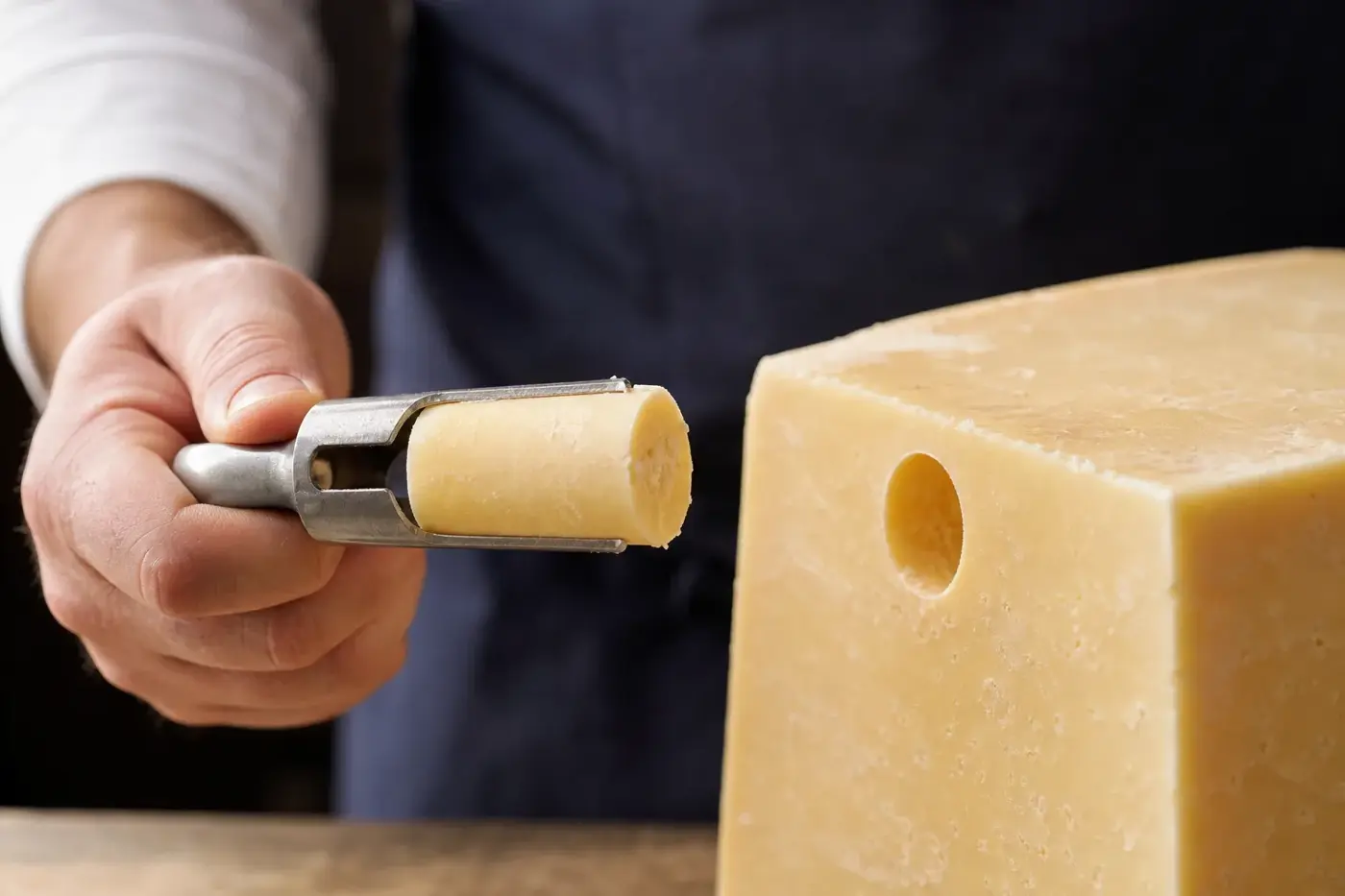
Out comes a plug of Cheddar, drawn from the cheese with a trier. You look, work a little between your fingers, smell it and taste a small piece, following the approach in Mississippi State University’s judging guidance. Corky, mealy and pasty: not the companions you hoped to meet, but each tells a different story about texture gone astray.[6]
That story began long before your first taste, with temperature, acidity and curd checks in the vat. Production records, laboratory measurements and sensory judgement follow the cheese through making, maturation and final selection. The plug is only the latest chapter.[1][2][4]
Same cheese, different questions
You can assess the same cheese several times without asking the same question twice. Routine quality control asks whether a batch is following its intended process and meeting specifications. Commercial grading compares it with a defined product standard or selection requirement. Competition judging follows an organiser’s rules, usually to identify awards within classes.[1][4][10]
The United States Department of Agriculture’s Cheddar standard shows you how exact this gets. Its U.S. Grades AA, A, B and C assess flavour, body and texture, colour, and finish and appearance according to the degree of curing. The lowest rating among those characteristics decides the final grade, so a winning flavour cannot carry everything else. This is a particular US grading system, not a worldwide cheese scale.[4]
Meet the people following your cheese
Follow a cheese from vat to maturing room and you meet several kinds of expertise. The cheesemaker compares the developing curd with the process record; laboratory staff analyse composition and microbiology. During affinage, the managed maturation of cheese, the affineur follows the rind and interior. A grader brings those observations together against the required standard or intended use.[1][3][4]
Competition panels gather another broad mix of specialists. The Guild of Fine Food describes World Cheese Awards judges drawn from technologists, graders, retailers, buyers, chefs, producers and other cheese professionals. Their job is to apply the competition’s criteria, not assemble a personal shopping list, however tempting that might be.[8][9]
Before the curd, get to know the milk
There is plenty to assess before you have any curd to touch. The University of Guelph’s cheesemaking guidance lists bacterial counts, tests for inhibitors and somatic cell counts among milk quality measurements. Each asks a different question. Counting bacteria is not the same investigation as looking for substances that could inhibit the starter culture, the microorganisms added to drive fermentation.[1]
Once that starter gets working, the journey matters as much as the destination. Makers follow the pH profile, measuring at important stages of manufacture. Lower pH means greater acidity, while the rate of change helps reveal whether fermentation is progressing as expected. Time and temperature sit beside those readings to help explain the result.[1][2]
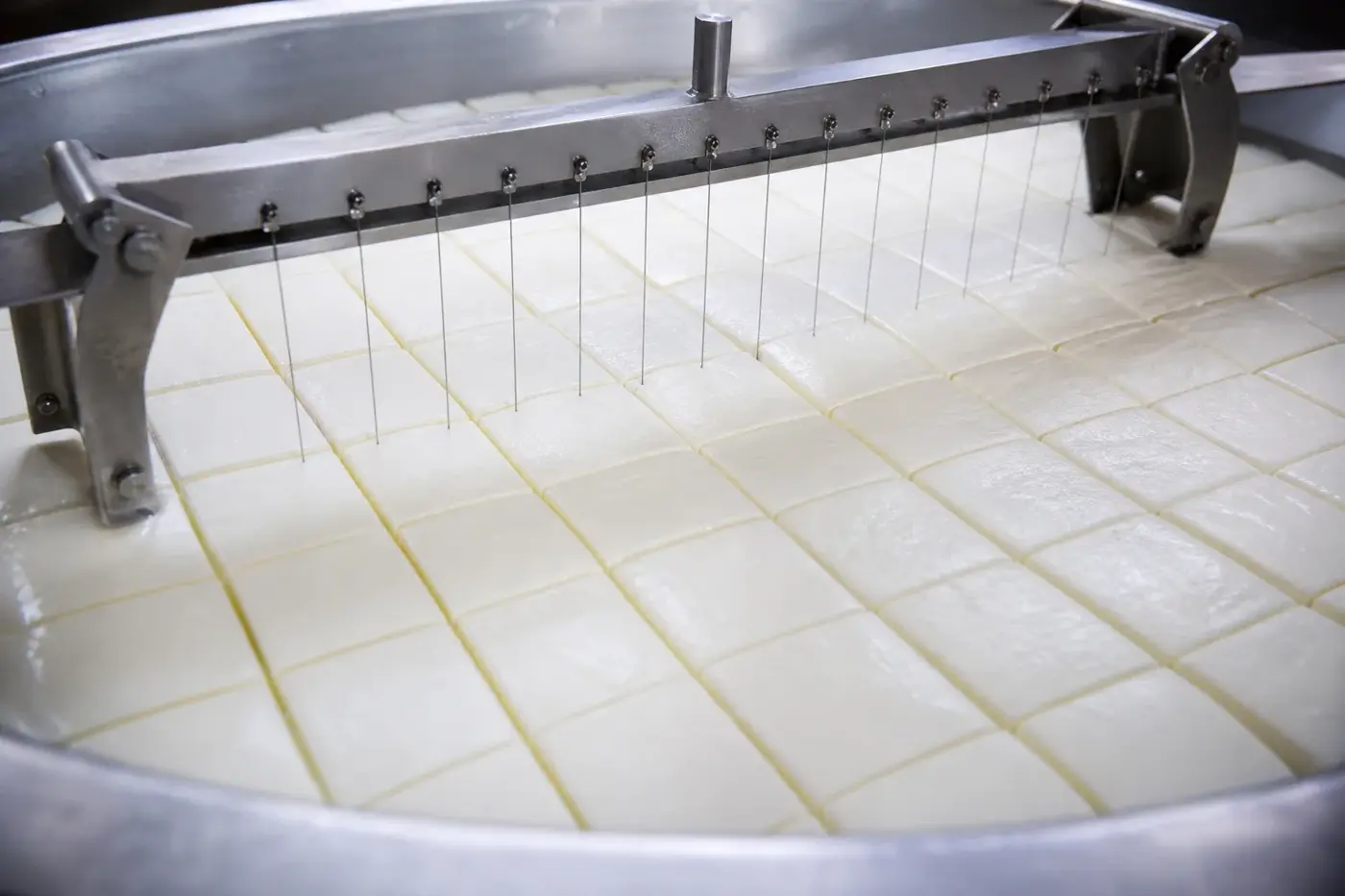
Then coagulation turns milk into a gel. For a rennet cheese, the maker checks that the gel has developed suitably before cutting it into curd, the solids retained as cheese; whey is the liquid released. Setting and acidification must suit that particular cheese. There is no universal number to impose on every vat.[2]
Want to follow the whole make? See how cheese is made from milk to cheese, then explore the coagulant’s part in rennet explained.
Tomorrow’s texture begins in the vat
The texture you judge months later owes much to water removed during the make. Guelph calls this syneresis: the curd contracts and expels whey. Acidity, cooking time and temperature all influence what happens.[2]
| Stage | What you look for | Why it matters later |
|---|---|---|
| Cutting | Curd condition and the intended cut | Establishes the particles from which whey will be removed.[2] |
| Cooking | Time, temperature and how the curd develops | Influences how much whey comes out, and how quickly.[2] |
| Draining | Acidity as the whey separates | Helps determine calcium retention and the developing structure.[2] |
| Salting | Amount, method and how salt subsequently spreads | Influences flavour and conditions for microorganisms and ripening enzymes.[1][3] |
| Pressing | Forming and consolidation, where the style needs them | Helps establish the body later assessed for openings and consistency.[2][4] |
None of these stages works alone. Guelph explains that moisture affects how much fermentable lactose remains, while acidity changes calcium retention and curd structure. If you find a texture problem later, you may need to look at how several make decisions worked together. One isolated misstep is not always the explanation.[2][3]
Give a young cheese a fair hearing
A young cheese deserves to be judged as a young cheese. You can compare its appearance, aroma and body with the intended profile before mature flavour develops. The USDA Cheddar standard does exactly that, describing acceptable characteristics separately for fresh, medium cured and aged cheese.[4]
Composition gives you another glimpse of its prospects. Guelph recommends measuring moisture, salt and pH, alongside fat and, where possible, protein. Moisture means water in the whole cheese; salt in moisture expresses salt relative to that water. Together, they describe the environment in which ripening will unfold.[1][3]
Be particular about when and where you sample. Salt needs time to spread, and surface or brine salting can leave persistent gradients. Read an early result from one position alongside the salting method and the sample’s location.[1][3]
Follow the cheese through maturation
An earlier note from the same batch gives your latest grading note something valuable: a comparison. Records need to connect every observation with the cheese, its age and the sample taken. Repeated measurements and sensory assessments show you a direction of travel, rather than a passing impression.[1][7]
Guelph recommends measuring pH during manufacture and periodically during curing. It also warns that moisture, salt and pH can differ within a cheese. Compare like sampling positions and record them. That gives you a better chance of making sense of a changing result.[1]
Ripening changes chemistry as well as feel. Guelph describes protein breakdown releasing alkaline compounds, allowing pH to rise during maturation. Those changes can be particularly marked at the surface of mould ripened cheese.[3]
Get to know the rind, then the heart
Give the outside and inside their own attention. The American Cheese Society’s sensory lexicon distinguishes rind or surface, paste or interior, texture, and flavour and aroma. Assessors examine rind thickness, evenness and surface character. Then they look through the paste for changes from the outer layer towards the centre.[5]
Texture asks more of you than “firm or soft?” Mississippi State University’s dairy judging guidance describes examining a Cheddar plug, working a portion between the fingers, smelling it and tasting a small piece. Corky, mealy and pasty each identify a different departure from the intended body. Those words help you describe precisely what is wrong.[6]
“Strong” is not much of a verdict on aroma or flavour, either. Character and intensity matter more, and both are assessed against the cheese’s style and age. Rind and paste should also make sense together. The Society’s lexicon explicitly considers the relationship between their flavours.[5]
What a trier reveals inside
A cheese trier draws out a plug, giving you access to the interior. Cheddar provides a documented example: both USDA grading standards and Mississippi State’s training guidance discuss examining a plug. Depending on the cheese’s format, an assessor may instead cut into it, as the American Cheese Society explains.[4][5][6]
Getting inside is only half the question; where you sample matters too. Mississippi State advises against taking a Cheddar trier sample near the edge. Match the sampling plan to the investigation, whether you are assessing sensory qualities, composition or microbiology, and whether you need the surface or interior.[1][6]
Keep equipment and handling hygienic. The Food Standards Agency’s published business guidance for England, Wales and Northern Ireland emphasises managing hygiene and maintaining documented food safety procedures. Professional sampling should follow the business’s validated procedure and the receiving laboratory’s instructions.[7][12]
Fault, style trait or hazard? Know the difference
Before you call something a fault, know what the cheese is meant to be. The American Cheese Society defines a defect as a departure from the expected sensory profile. A characteristic can belong in one cheese but be misplaced in another, or be acceptable at one intensity and excessive at another. Assessors therefore need an agreed style reference.[5]
Your senses cannot establish that a cheese is safe. Quality defects and food safety hazards require different decisions, and the FSA’s management guidance addresses hazards through documented identification and control.[7] For the wider distinctions, see cheese food safety and how to tell cheese styles apart.
Let the laboratory help explain the cheese
Laboratory measurements help you understand why cheeses differ. pH tracks acidity, moisture describes composition, and salt measurements help interpret ripening conditions. Microbiological testing asks different questions about organisms or indicators relevant to the product and process. Every result needs a sampling plan and interpretation suited to the cheese.[1][3][7]
The FSA’s guidance, updated in August 2026, distinguishes the microbiological legislation applying in Great Britain from that applying in Northern Ireland. Its advice on managing Listeria emphasises documented validation and food safety systems. If you are deciding a business’s testing arrangements, you need the current rules for its jurisdiction and product.[7]
Laboratory results tell you most when they sit alongside sensory observations. A moisture result can help explain a texture observation; the grader establishes how that texture actually presents in the cheese. Together, they point you towards the next investigation. One number cannot explain every fault.[1][4][6]
Take a seat in the judging room
Competition rules decide what gets rewarded and how observations become a result. At the World Championship Cheese Contest, organised by the Wisconsin Cheese Makers Association, technical judges start with a possible 100 points and deduct for defects. The organiser’s named assessment areas include flavour, body and texture, salt, colour, finish and packaging.[10]
At the World Cheese Awards, the May 2026 terms describe blind judging of flavour, rind, body, texture and appearance. Judges receive neither the entrant’s name nor the product name or country of origin. The terms also provide for results and feedback through the entrant’s company account.[8]
Read each competition’s system and weightings on their own terms. Feedback becomes especially useful when it identifies a specific characteristic you can compare with batch records and retained samples. The Wisconsin organiser makes product scores and scoresheets available through its entry system.[8][10][11]
Time to decide what happens next
All that assessment leads you to a practical decision against the intended specification: continue maturation, select for release, or reject from the intended product line. The crucial question is whether the cheese is still developing towards its target or already outside it. Safety concerns follow the business’s separate food safety procedures.[1][3][4][7]
General information only, not medical advice: follow the official guidance where you live.
Questions people ask
What is the difference between cheese grading and competition judging?
Commercial grading measures cheese against a defined product standard or selection requirement. Competition judging evaluates an entry under the organiser’s rules, usually to identify awards within classes.
How do cheesemakers check cheese before it matures?
They follow the pH profile, time and temperature during manufacture and check that the gel has developed suitably before cutting. A young cheese can also be assessed for appearance, aroma and body against its intended profile.
What is a cheese trier used for?
A trier draws out a plug so that the interior can be examined. Mississippi State University advises against taking a Cheddar trier sample near the edge.
Can tasting cheese tell you whether it is safe?
Sensory assessment cannot establish that a cheese is safe. Quality defects and food safety hazards require different decisions, and the Food Standards Agency addresses hazards through documented identification and control.
How are cheeses scored at the World Championship Cheese Contest?
Technical judges begin with a possible 100 points and deduct points for defects. The organiser names flavour, body and texture, salt, colour, finish and packaging among the assessment areas.
Sources
[1] University of Guelph. Cheese Making Technology e-Book: Milk and Cheese Analysis. Undated online edition, retrieved November 2026. Covers milk testing, composition, pH profiles and representative sampling. Source.
[2] University of Guelph. Cheese Making Technology e-Book: Process Control. Undated online edition, retrieved November 2026. Covers moisture removal, acidity, calcium retention and process profiles. Source.
[3] University of Guelph. Cheese Making Technology e-Book: Ripening and Packaging. Undated online edition, retrieved November 2026. Relevant retrieved passages concern composition, salt in moisture and pH during curing. Source.
[4] United States Department of Agriculture, Agricultural Marketing Service. United States Standards for Grades of Cheddar Cheese. Effective 1 May 1956, edition currently linked by AMS when checked in November 2026. Sections 58.2503 to 58.2505 and grading tables. Source.
[5] American Cheese Society. ACS Lexicon & Glossary. Undated online edition, retrieved November 2026. Sections on sensory evaluation, rind, interior, attributes and defects. Source.
[6] Mississippi State University Extension, Center for 4-H Youth Development. Dairy Products Judging. Undated online edition, retrieved November 2026. General judging instructions and Cheddar assessment sections. Source.
[7] Food Standards Agency. Managing food safety. Updated 21 August 2026, published on GOV.UK. Sections on management procedures, records and revised guidance for managing Listeria monocytogenes. Source.
[8] Guild of Fine Food. World Cheese Awards, Terms & Conditions. Published May 2026. Clauses 1.3 and 2.27 cover feedback accounts and blind assessment. Source.
[9] Guild of Fine Food. World Cheese Awards. Current 2026 event page, retrieved November 2026. Section titled “The judging panel”. Source.
[10] Wisconsin Cheese Makers Association. About: World Championship Cheese Contest. Undated current online edition, retrieved November 2026. Describes technical judging, the 100-point starting score and deduction categories. Source.
[11] Wisconsin Cheese Makers Association. 2026 World Championship Cheese Contest. 2026 event page, retrieved November 2026. MyEntries and results sections explain access to scoresheets. Source.
[12] GOV.UK. Food hygiene for businesses: Overview. Undated current online edition, retrieved November 2026 through the FSA’s former cleaning guidance address. Covers cleaning equipment and avoiding cross-contamination. Source.
Researched through university cheesemaking guidance, official US grading standards, published sensory training, FSA guidance and competition organisers’ own procedures.
Last checked: November 2026
Last checked November 2026.
The editors suggest you read next
Cheese Defects: Bitterness, Cracks, Gas and Off Flavours
Tiny pinholes appear as a cheese is pressed.