Codex Standards for Cheese
Picture a cheese waiting at the United States border.
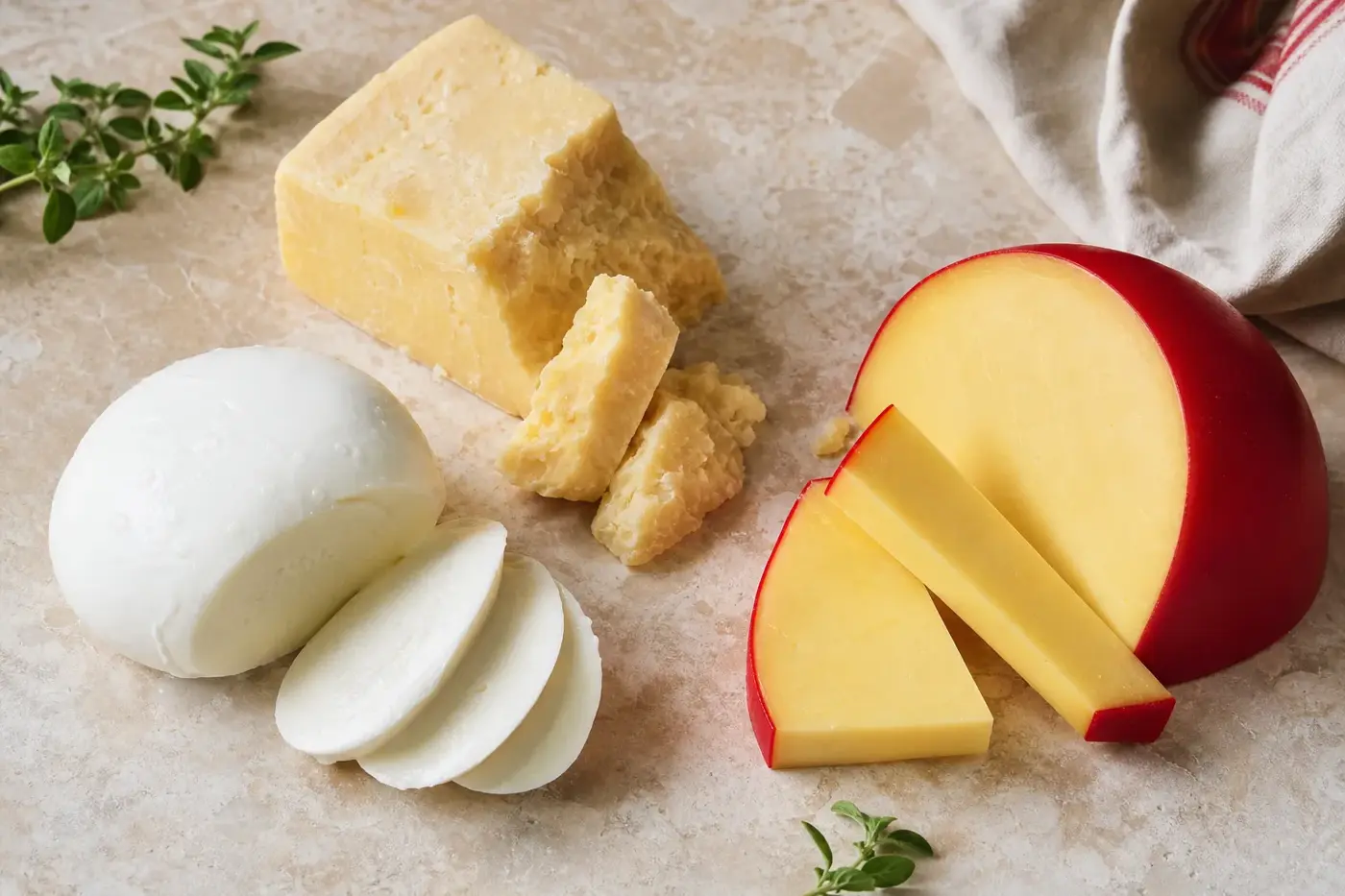
Picture a cheese waiting at the United States border. It has 40% moisture and meets the general Codex standard, yet it cannot meet the US rules for Cheddar: the maximum there is 39%. [6] That small gap makes a big difference when your cheese crosses borders.
Codex's General Standard for Cheese gives you an international reference for what a product is, alongside more specific cheese standards. But the destination country decides what you may sell there. The international rulebook matters; it is not the final word. [1,2]
Meet the people behind the food code
Behind every Codex text are people working towards two aims: protecting consumers and supporting fair practices in food trade. Codex Alimentarius means “food code”. It is a collection of international food standards, guidelines and codes of practice adopted by the Codex Alimentarius Commission. [3]
FAO, the Food and Agriculture Organization of the United Nations, and WHO, the World Health Organization, created the Commission in 1963 under their joint food standards programme. For cheese crossing borders, its texts on composition, labelling and control give everyone a shared vocabulary. [3]
There is an important division of labour. The Commission adopts the standards; governments decide how to use them in their own legal systems. Keep that distinction beside you whenever you open a Codex text. [2,3]
How an idea earns its place in Codex
A standard usually begins with a government or Codex subsidiary body submitting a discussion paper and project document. The Executive Committee reviews the proposal, then the Commission decides whether it should proceed. The Secretariat arranges preparation of a draft and sends it to members, observer organisations and relevant committees for comments and technical advice. [2]
The normal procedure has eight steps, including two rounds of comments before final adoption. Governments can question wording, examine technical implications and seek changes along the way. Once adopted, the text becomes part of Codex; revisions and amendments must follow the organisation's procedures too. [2]
When you consult a standard, note both its designation and the version you are reading. Each tells you something different. The year in the designation identifies the original standard; the amendment history tells you which version you have in front of you.
Open the cheese rulebook
The central text is the General Standard for Cheese, CXS 283-1978. It covers cheese for direct consumption and for further processing. Adopted in 1978 and revised in 1999, the edition discussed here records amendments through 2024. [1]
Its definition stretches from soft to extra-hard cheese, ripened or unripened. At its heart is coagulation, the setting of milk proteins, followed by partial whey drainage. Alternative techniques are allowed too, provided they produce comparable physical, chemical and sensory characteristics. [1]
There is a protein requirement as well. The whey protein to casein ratio must not exceed that of milk; casein is milk's principal cheese-forming protein. [1] If you would rather picture curds before contemplating clauses, start with how cheese is made.
What can go into your cheese vat?
Milk and products obtained from milk are the raw materials. Permitted ingredients include suitable starter cultures, safe and suitable enzymes, sodium chloride, potassium chloride as a salt substitute, and potable water. The definition also requires milk protein concentration, especially casein, compared with the starting milk materials. [1]
An allowed ingredient is not, on its own, proof of an acceptable cheese. An enzyme may belong to a permitted class without establishing whether the finished product has the required composition. You need to consider ingredients and composition separately.
Read each provision on its own terms. A production record may answer your ingredient question, while a laboratory result answers your composition question. For the same cheese, you may need both.
Cheddar, Mozzarella, Gouda: follow the finer details
The general standard is not always your last stop. Section 1 establishes that a specific cheese standard can replace the corresponding general provision. FAO's dairy overview lists individual standards for Cheddar, Mozzarella and Gouda, among others, alongside group standards such as those for cheeses in brine. [1,3]
Start with the general definition, then read the current individual or group standard for your product. Next, follow the texts those documents cross-reference. As you go, note which provision supplies each requirement.
That reading order gives you a traceable assessment. It also keeps the broad definition of cheese from obscuring the extra conditions attached to a particular product.
Good composition is only the beginning
A cheese can satisfy a composition requirement without answering every other question. FAO identifies food additives, contaminants, pesticide residues and veterinary drug residues as cross-cutting Codex subjects relevant to dairy products. There is also a dedicated dairy hygiene code. [3]
Give each subject its own attention. A satisfactory composition result cannot answer for all the others. [3]
| Subject | Codex reference | What to look for |
|---|---|---|
| Food additives | CXS 192-1995 [1,3] | Find your cheese category and its conditions. |
| Contaminants | CXS 193-1995 [1,3] | Identify the substance, food covered and applicable limit. |
| Dairy hygiene | CXC 57-2004 [1,3] | Follow the framework for production and handling. |
| Analysis and sampling | CXS 234-1999 [1] | Find the method for the characteristic you are measuring. |
The general cheese standard directs you to these wider provisions, including recommended methods of analysis and sampling. For your assessment, record the relevant edition, product category, numerical basis and test method together. [1]
A number needs its method. Without it, the specification is incomplete. Keep the result and the way it was obtained in the same record. [1]
Give your cheese the right name
The name on the pack and the rest of the label need separate attention. The general cheese standard cross-refers to the General Standard for the Use of Dairy Terms, CXS 206-1999, and the General Standard for the Labelling of Pre-packaged Foods, CXS 1-1985. The first addresses dairy terminology; the second supplies the broader prepackaged food labelling framework. [1]
Start with the correct product name. Then work through the applicable labelling text and the destination's legislation. Keep the product description separate from the complete label review.
If you are reading the pack as a consumer, try how to read a cheese label. For an export review, you also need the underlying rules. The label tells only part of the story.
When does the food code become law?
Codex texts are voluntary. Codex states that they need to be translated into national legislation or regulations to become enforceable. A cheesemaker's legal obligations therefore come from the applicable domestic rules, including any Codex provisions incorporated into them. [2]
Commission adoption and adoption into national law are separate events. Ask for the legal source of each requirement rather than stopping at the word “Codex”. Record the jurisdiction, the instrument and the provision being applied.
Make that distinction clear in your paperwork. Are you consulting an international reference, or meeting an enforceable requirement in the market where your cheese will be sold?
Two trade agreements, two sets of questions
Food safety measures have a particular trade framework. The World Trade Organization's Agreement on the Application of Sanitary and Phytosanitary Measures, usually called the SPS Agreement, governs sanitary measures affecting international trade. Article 3 explicitly names the Codex Alimentarius Commission among the organisations whose standards work members should support. [3,4]
For cheese, this is the framework relevant to food safety measures. Article 3.1 requires members to base sanitary measures on international standards, guidelines or recommendations where they exist, except as otherwise provided in the agreement. Measures conforming to those standards are presumed necessary and consistent with the SPS Agreement and the relevant provisions of the GATT 1994. [4]
Article 3.3 allows a higher level of protection where there is scientific justification. It also permits this as a consequence of a level of protection determined in accordance with the relevant provisions of Article 5. [4]
Then comes the Agreement on Technical Barriers to Trade, or TBT Agreement. It covers technical regulations, standards and conformity assessment outside the SPS Agreement's scope. Article 2.4 applies where technical regulations are required and relevant international standards exist, or their completion is imminent. [3,5]
Members must use those standards, or their relevant parts, as a basis for their regulations. The exception is where they would be ineffective or inappropriate for the legitimate objectives pursued. A Codex product identity or labelling provision can therefore raise a different trade question from a contaminant limit. [3,5]
Look at the measure's purpose and coverage, not simply whether it appears on a cheese label. FAO distinguishes Codex's food safety role under SPS from its reference role under TBT for other issues. Both agreements discipline government measures affecting trade, but your business must still identify and meet the destination's operative requirements. [3,4,5]
Back at the border: your Cheddar test
Return to that hypothetical cheese with 40% moisture in the whole cheese, intended for sale in the United States as Cheddar. It is stipulated to meet the general Codex standard. The example makes no assumption that it meets the individual Codex Cheddar standard, because meeting the general international standard alone is insufficient.
The US standard of identity at 21 CFR 133.113(a)(1) allows a maximum moisture content of 39% by weight. It also requires a minimum milkfat content of 50% by weight of the solids. This hypothetical cheese fails the US Cheddar moisture requirement, regardless of compliance with the broader Codex definition; the reference date for these US requirements is November 2026. [6]
Look closely at what each percentage measures. Moisture is measured against the whole cheese, while the fat requirement uses the solids left after water is excluded, commonly described as fat in dry matter. Those are different bases. Comparing them without recording the bases can send a straightforward calculation astray. [6]
| Requirement | Where it applies | Source | Reference date |
|---|---|---|---|
| General cheese reference | International Codex standard | CXS 283-1978 [1] | November 2026 |
| Cheddar composition | United States | 21 CFR 133.113(a)(1) [6] | November 2026 |
| Sanitary trade disciplines | WTO members | SPS Agreement, Article 3 [4] | November 2026 |
| Technical regulation disciplines | WTO members | TBT Agreement, Article 2.4 [5] | November 2026 |
For a real consignment, build a requirement sheet rather than relying on one conformity statement. Identify your proposed sales name and list the destination's relevant provisions. Match each provision to a production record, label check or analytical result.
Keep unresolved questions with the person responsible for regulatory clearance. They need to remain part of the assessment, not disappear between documents.
A cheese's identity is not its protected origin
A Codex product standard describes a category or variety of food. It does not settle a legally defined production area, entitlement to use a protected name or protection in a particular market. For those questions, investigate the relevant origin rules and register separately from composition.
Use Codex for the international product reference, destination legislation for market requirements, and the appropriate protection scheme for name rights. Each answers a different question about the same cheese.
For PDO, PGI and TSG, read protected names explained. Then return to the named cheese's record for its jurisdiction-specific position.
Questions people ask
What are Codex standards for cheese?
They are international references adopted by the Codex Alimentarius Commission. The General Standard for Cheese covers cheese for direct consumption and further processing, while other standards cover individual varieties and groups.
Are Codex cheese standards legally binding?
Codex texts are voluntary and must be translated into national legislation or regulations to become enforceable. Governments decide how to use them in their own legal systems.
What ingredients does the general cheese standard permit?
Milk and products obtained from milk are the raw materials. Permitted ingredients include suitable starter cultures, safe and suitable enzymes, sodium chloride, potassium chloride as a salt substitute, and potable water.
How are Codex standards created?
New work usually begins with a discussion paper and project document from a government or Codex subsidiary body. The normal procedure has eight steps, including two rounds of comments before final adoption.
Does meeting the general Codex standard mean cheese can be sold anywhere?
No. The destination country decides what may be sold there, and a specific cheese standard can replace the corresponding general provision.
Sources
[1] FAO and WHO, General Standard for Cheese, CXS 283-1978. Adopted 1978; revised 1999; amendments recorded through 2024. Sections 1 to 8 and reference notes.
[2] FAO and WHO, Codex Alimentarius, About Codex texts. Undated explanatory webpage, retrieved November 2026. Covers voluntary status, proposals, consultation and adoption.
[3] FAO, Dairy Production and Products, Codex Alimentarius. Webpage updated March 2019, retrieved November 2026. Used for institutional background, the dairy standards framework and FAO's explanation of SPS and TBT relevance.
[4] World Trade Organization, Agreement on the Application of Sanitary and Phytosanitary Measures. 1994 agreement, official online text retrieved November 2026. Articles 1 to 3 and 5.
[5] World Trade Organization, Agreement on Technical Barriers to Trade. 1994 agreement, official online text, together with the WTO Analytical Index treatment of Article 2.4, retrieved November 2026.
[6] US Food and Drug Administration, 21 CFR 133.113: Cheddar cheese, paragraph (a)(1). Electronic Code of Federal Regulations, displayed as updated to 5 November 2026; retrieved November 2026.
This piece was researched through official Codex and FAO material, WTO agreement texts and the US electronic Code of Federal Regulations, with an illustrative destination-market comparison.
Last checked: November 2026
Last checked November 2026.
The editors suggest you read next
Cheese Law Around the World: The Complete Guide
GRUYERE reached an American legal border and lost its exclusivity.