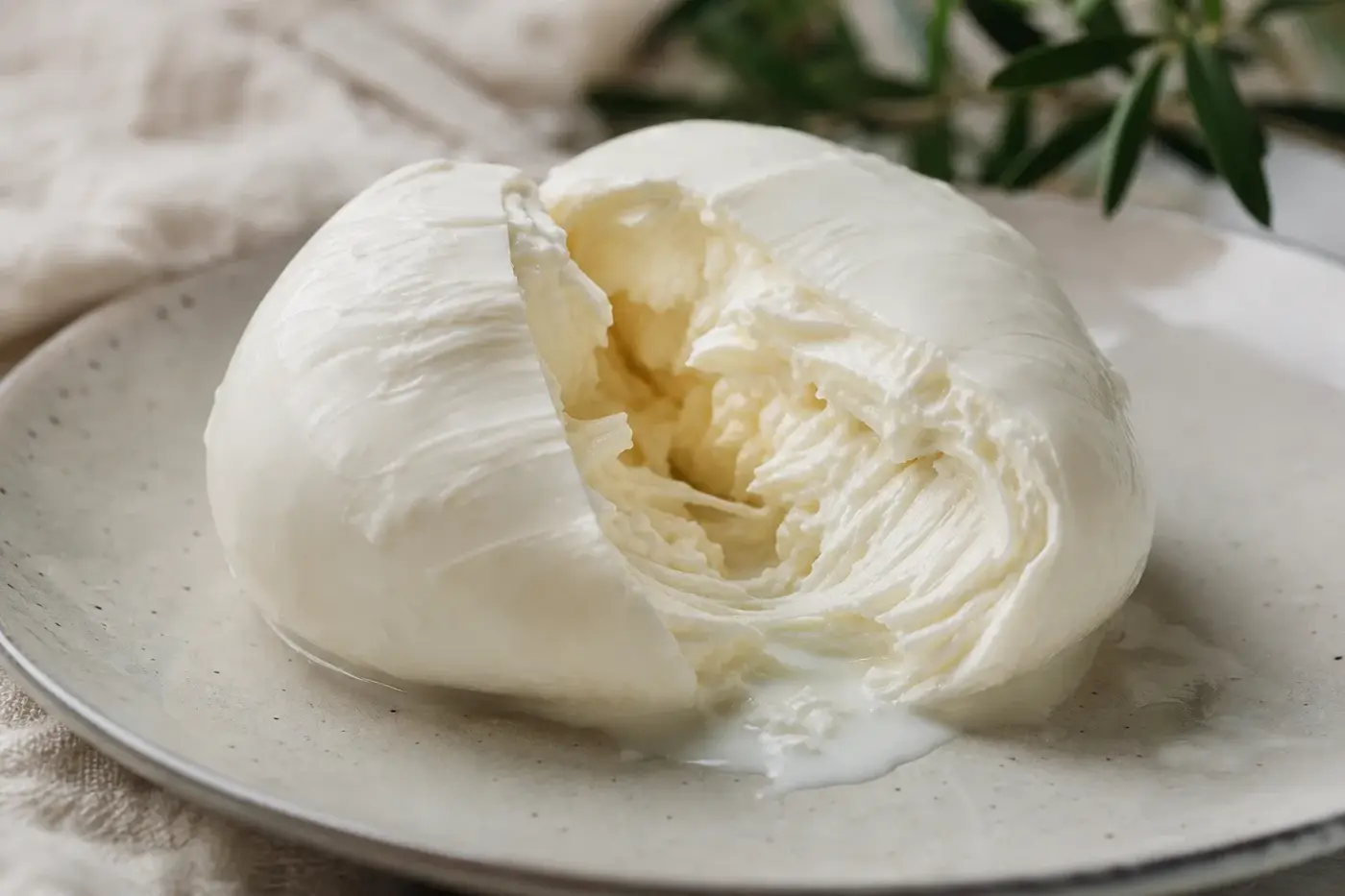
Pull apart a fresh mozzarella and watch its layers loosen. Pockets of milky liquid may appear inside: Codex describes high-moisture mozzarella as soft, while its low-moisture cousin is firm or semi-hard, ready for shredding. Same family, rather different plans for your supper. [1]
Both are unripened cheeses, made from cows' milk, buffaloes' milk or both. Fior di latte is the cows' milk version; Mozzarella di Bufala Campana has its own EU protected designation of origin (PDO). Those names carry different stories, so give the smaller print a little attention too. [1,8,20]
Meet your mozzarella at a glance
| What to look for | What it tells you |
|---|---|
| Family | Fresh pasta filata, meaning stretched-curd [1] |
| Milk | Cows' milk, buffaloes' milk or mixtures under Codex [1] |
| Rind and maturation | Rindless and unripened under Codex [1] |
| EU registered name | Mozzarella Tradizionale, registered by the European Commission as TSG-IT-0001 on 26 November 1998; reserved under Implementing Regulation (EU) 2022/1291 [2,3] |
| Great Britain | Mozzarella TSG cancelled; protection ended 4 January 2023 [5] |
| Milk treatment and coagulant | Check your product: the TSG method requires pasteurisation and bovine rennet [4] |
Pull back those milky layers
That stretched, layered structure is the family resemblance. A soft fresh ball and a firmer cheese you can shred both belong here, but moisture gives them quite different textures. Codex recognises both high-moisture and low-moisture mozzarella. [1]
Milk and moisture answer different questions. “Buffalo” tells you about the milk; “low moisture” tells you about the cheese's composition. Read both the milk declaration and the product description: mozzarella alone cannot tell you everything. [1,6]
Mozzarella Tradizionale: the tradition behind the name
Look for Mozzarella Tradizionale and you are looking at the EU's reserved name. Its traditional speciality guaranteed (TSG) registration identifies a particular traditional product and method, rather than the geographical protection of a PDO. Italy is associated with the registration, but following the specification is what counts, not making buffalo-milk cheese in a particular area. [2,3,4]
Commission Implementing Regulation (EU) 2022/1291 made that distinction explicit. It changed the registered name from Mozzarella to Mozzarella Tradizionale, reserved that compound name and entered into force on 14 August 2022. Article 2 expressly allows products outside the specification to keep using Mozzarella alone in the EU, without the TSG wording or Union symbol. [3,20]
The story reaches back to publication on 24 August 1996, then registration as the unreserved TSG Mozzarella on 26 November 1998. The name and protection arrangements changed in August 2022, when Mozzarella Tradizionale became the reserved TSG designation. In Great Britain, the old unreserved Mozzarella TSG ended on 4 January 2023; Defra's cancellation record was updated on 13 March 2023. [2,5]
Your guide to the name, November 2026
| Where you are | How the name or scheme stands | Source |
|---|---|---|
| Italy and EU | Mozzarella Tradizionale is a registered TSG; Mozzarella alone remains usable outside its specification. | [2,3] |
| Great Britain | Mozzarella TSG cancelled; protection ended 4 January 2023. | [5] |
| Northern Ireland | The relevant EU protected-name scheme applies, rather than Great Britain's cancelled entry. Mozzarella Tradizionale is the registered EU name. | [3,13] |
| Switzerland | No mozzarella entry on the domestic AOP/IGP register; EU TSG protection status unresolved here. | [10] |
| United States | Standardised food name under 21 CFR 133.155 and 133.156; name protection status unresolved here. | [6] |
| Canada | Standardised food name; CETA separately lists Mozzarella di Bufala Campana. | [7,9] |
| Australia | In negotiations for an agreement not yet in force, DFAT reports that the EU was not seeking mozzarella protection. Current protection status unresolved here. | [11] |
| New Zealand | Plain-name and TSG protection status unresolved here. Relevant treaty list: EU-NZ FTA, Annex 18-B. | [12] |
A food standard and a protected name do different jobs. The compositional standard tells manufacturers what food sold under that name must contain. A register or treaty deals with rights attached to a particular registered name, including a protected compound name. [3,6,7,9]
Buffalo or fior di latte? Let the label help
These names are not rungs on a mozzarella quality ladder. They point to a family, a reserved traditional name, a geographical designation, a milk type or a moisture category. Once you know which question each name answers, the label feels rather less like a test you forgot to revise for. [1,3,8,20]
| Name on your label | What it tells you | Milk | Definition or source |
|---|---|---|---|
| Mozzarella | The general cheese family | Cows' milk, buffaloes' milk or mixtures | Codex CXS 262-2006 [1] |
| Mozzarella Tradizionale | The EU reserved TSG name | Species not specified in the specification | Approved TSG specification [3,4] |
| Mozzarella di Bufala Campana | A separate EU PDO | Buffalo milk | EU register, PDO-IT-0014 [20] |
| Fior di latte | Cows' milk mozzarella | Cows' milk | Producer terminology; Latticini Orchidea calls it cows' mozzarella [8] |
| High-moisture mozzarella | Soft cheese that may hold pockets of liquid | As permitted by the applicable standard | Codex description [1] |
| Low-moisture mozzarella | Firmer cheese, suitable for shredding | As permitted by the applicable standard | Codex; US 21 CFR 133.156 [1,6] |
Follow the curd through its stretch
Acidify, heat, stretch, then shape: that is the pasta filata method. The curd is the solid part separated from milk, ready for its transformation. For Mozzarella Tradizionale, the specification requires a continuous cycle at one establishment, using a natural lactic starter and liquid bovine rennet, the enzyme preparation that helps set the milk. [4]
The milk arrives raw, then is pasteurised during the specified process. Here, “raw” at intake describes the incoming ingredient, not the treatment of your finished cheese. After stretching and shaping, the cheese is firmed in cold water and packaged in plain or salted water. [4]
Those are the rules for the TSG product, not every mozzarella you might bring home. For other versions, read the individual rennet declaration, especially if you are choosing cheese for someone following a vegetarian diet. [4,6]
Moisture figures: first, find your country
A moisture figure only makes sense in its national context. Codex distinguishes high-moisture and low-moisture mozzarella through descriptions and composition tables linked to fat in dry matter. It is an international reference standard; national rules set the legal requirements where your cheese is sold. [1]
In the United States, 21 CFR 133.155 puts mozzarella's moisture at more than 52% and no more than 60% of the whole cheese. Section 133.156 puts low-moisture mozzarella at more than 45% and no more than 52%. Both require at least 45% milkfat in the solids: a dry-matter measure, not fat per 100 g of cheese. Separate standards cover part-skim versions. [6]
Canada draws its categories differently. Mozzarella (Scamorza) has a maximum moisture of 52.0% and minimum milkfat of 20.0%, both measured in the whole cheese. Pizza Mozzarella allows up to 58.0% moisture and requires at least 15.0% milkfat. Read Canadian pizza mozzarella and US low-moisture mozzarella on their own labels' terms, because their standards differ. [7]
Start with supper, then choose your mozzarella
For an uncooked dish, think texture first. Do you want a soft ball that parts into moist layers, or firmer cheese that holds a neat cut? For cooking, see whether your recipe asks for fresh mozzarella, a pizza version or low-moisture cheese. Those descriptions do more useful work than mozzarella alone. [1,6,16]
Some producers spell out the oven credentials. Gruppo Grifo describes its Fior di Latte Pizzeria as fresh mozzarella with a compact structure, intended for cooking. That description belongs to this particular product, but it neatly shows why fior di latte tells you the milk type, not everything about texture or kitchen use. Your oven has questions the milk alone cannot answer. [16]
Keep your mozzarella cool and its instructions close
If you are in England, Wales or Northern Ireland, the Food Standards Agency advises keeping your fridge between 0 and 5 °C and refrigerating dairy products. Follow the pack's storage instructions, use-by date and any shorter limit after opening. Mozzarella Tradizionale's specification sets storage at 0 to 4 °C, so follow that product's lower maximum. [4,14]
Keep the packaging until you finish the cheese, so you have its handling directions to hand. Different forms and packs can have different instructions; follow those on yours. Take out only what you need during preparation and return the rest promptly: the FSA advises keeping chilled food out for the shortest possible time. [14]
For pregnancy in the UK, NHS guidance last reviewed on 15 June 2026 lists pasteurised mozzarella among the soft cheeses you can eat. Look for the milk treatment on the pack rather than assuming it from the name. Ask your midwife or another healthcare professional about your own circumstances. [15]
For pregnant people, older adults and people with weakened immune systems, US CDC guidance recommends mozzarella made with pasteurised milk rather than cheese made from raw milk. It also advises avoiding “Any type of cheese when made with (raw) unpasteurized milk”. [21]
Mozzarella is a milk product, whatever form you choose. If allergies or dietary requirements matter, read the individual pack's full ingredients and allergen information, including any added ingredients. [1,6]
General information only, not medical advice: follow the official guidance where you live.
Questions people ask
What is the difference between buffalo mozzarella and fior di latte?
Fior di latte is mozzarella made from cows' milk. Mozzarella di Bufala Campana is made from buffalo milk and has a separate EU protected designation of origin.
What is the difference between fresh and low moisture mozzarella?
High moisture mozzarella is soft and may contain pockets of liquid. Low moisture mozzarella is firmer and suitable for shredding.
Is mozzarella suitable for vegetarians?
The Mozzarella Tradizionale specification requires liquid bovine rennet. For other mozzarella, check the individual rennet declaration.
Can you eat mozzarella during pregnancy?
The NHS lists pasteurised mozzarella among the soft cheeses that can be eaten during pregnancy. Check the milk treatment on the pack and see the NHS pregnancy guidance, last reviewed on 15 June 2026. Ask your midwife or another healthcare professional about your circumstances.
How should mozzarella be stored?
The Food Standards Agency advises consumers in England, Wales and Northern Ireland to keep the fridge between 0 and 5 °C and refrigerate dairy products. Follow the pack's storage instructions, use by date and any shorter limit after opening. The Mozzarella Tradizionale specification sets storage at 0 to 4 °C.
Sources
-
FAO/WHO Codex Alimentarius Commission. Standard for Mozzarella, CXS 262-2006, adopted 2006, amended through 2023. Official standard.
-
European Commission. eAmbrosia public register, “Mozzarella Tradizionale”, TSG-IT-0001, live register accessed November 2026. Official register data.
-
European Commission. Commission Implementing Regulation (EU) 2022/1291 of 22 July 2022, OJ L 196, 25 July 2022. Official instrument.
-
European Commission. Publication of an application for approval of a non-minor amendment to the product specification for “Mozzarella”, TSG-IT-0001-AM01, OJ C 424, 8 December 2020, approved by Regulation 2022/1291. Published specification.
-
Defra. Mozzarella, Great Britain protected food and drink names register, updated 13 March 2023. Register entry and cancellation notice.
-
Canadian Food Inspection Agency. Canadian Food Compositional Standards, Volume 7, section 7.4.2, version identified in the fact sheet as modified 1 May 2025. Official standards.
-
Latticini Orchidea. Products, undated producer publication. Producer terminology.
-
Global Affairs Canada. Comprehensive Economic and Trade Agreement, Annex 20-A, official treaty text, online edition. Listed geographical indications.
-
Swiss Federal Office for Agriculture. AOP / IGP: appellations d’origine et indications géographiques, published 4 July 2025. Domestic register page.
-
Australian Department of Foreign Affairs and Trade. Dairy geographical indications, undated government publication. Common dairy names statement.
-
New Zealand Ministry of Foreign Affairs and Trade. EU-NZ Free Trade Agreement, Annex 18-B: Lists of geographical indications, agreement text. Official annex.
-
Defra. Protected geographical food and drink names: UK GI schemes, updated 8 March 2024. Territorial guidance.
-
Food Standards Agency. How to chill, freeze and defrost food safely, published 18 December 2017, current online guidance retrieved November 2026. Consumer storage guidance.
-
NHS. Foods to avoid in pregnancy, online edition retrieved November 2026. Pregnancy guidance.
-
Gruppo Grifo Agroalimentare. Fior di Latte Pizzeria, undated producer publication. Producer's cooking description.
-
US Food and Drug Administration. Use of Salt Substitutes To Reduce the Sodium Content in Standardized Foods, final rule, Federal Register document 2026-20848, published 13 October 2026. Final rule.
-
Food Standards Agency. Macroom Buffalo Cheese Products recalls Macroom Buffalo Cheese Mozzarella and Macroom Buffalo Cheese Bocconcini because of contamination with Listeria monocytogenes, FSA-PRIN-42-2026, 28 August 2026. Batch-specific notice.
-
US Food and Drug Administration. Recalls, Market Withdrawals, & Safety Alerts, live notices page, accessed November 2026. Official recall notices.
-
European Commission. Mozzarella di Bufala Campana, eAmbrosia record PDO-IT-0014, accessed November 2026; and Communication of a temporary amendment, 6 May 2020. Register record; amendment notice.
-
US Centers for Disease Control and Prevention. Preventing Listeria Infection, 31 January 2025. Official advice.
Researched through official standards, registers and agency guidance, the supplied verified fact sheet, and attributed producer descriptions.
Last checked: November 2026
Last checked November 2026.
The editors suggest you read next
Parmigiano Reggiano
Break into a wheel of Parmigiano Reggiano and flakes fall away, revealing a finely granular cheese, pale straw to straw in colour.