Comté
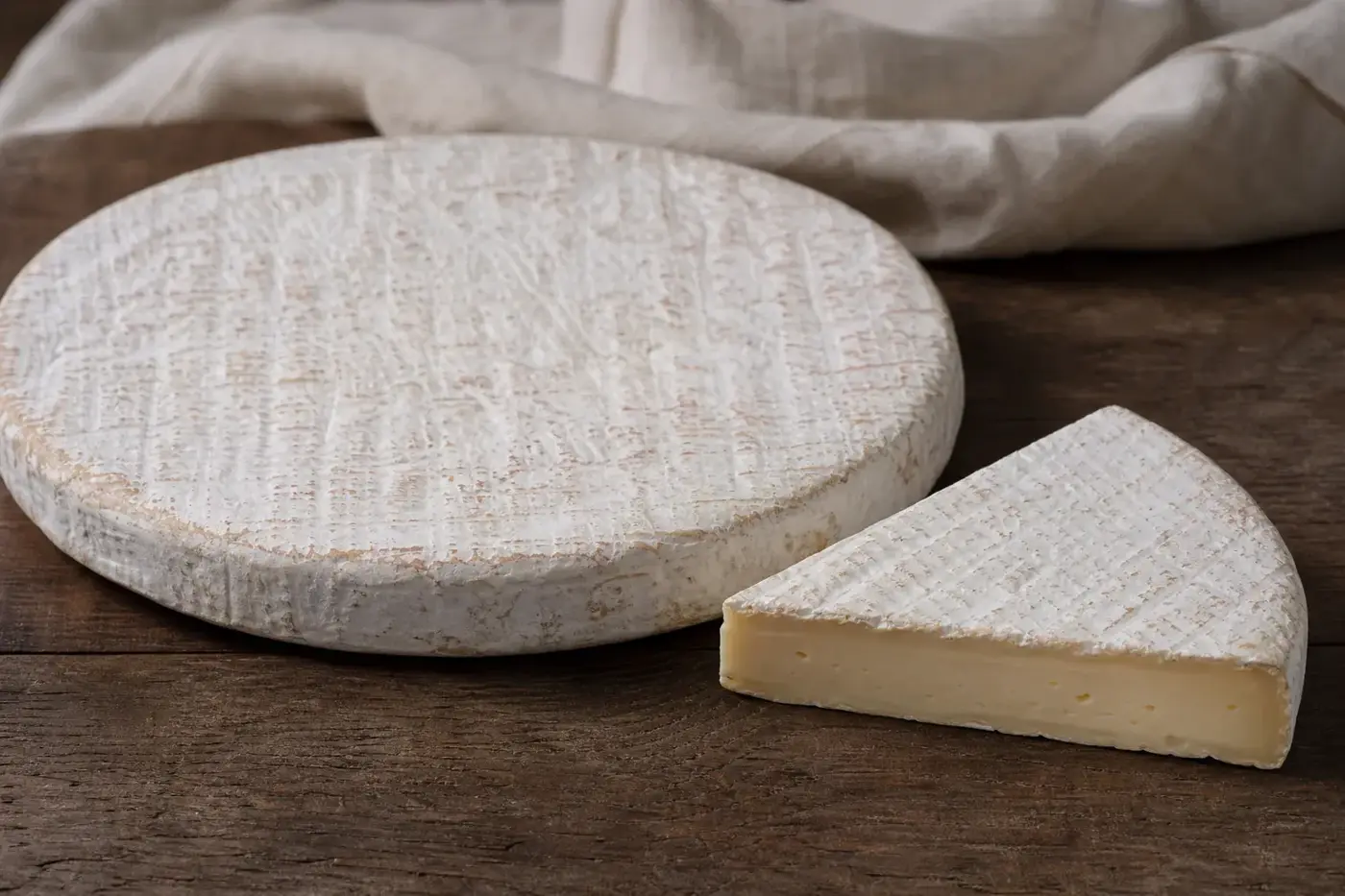
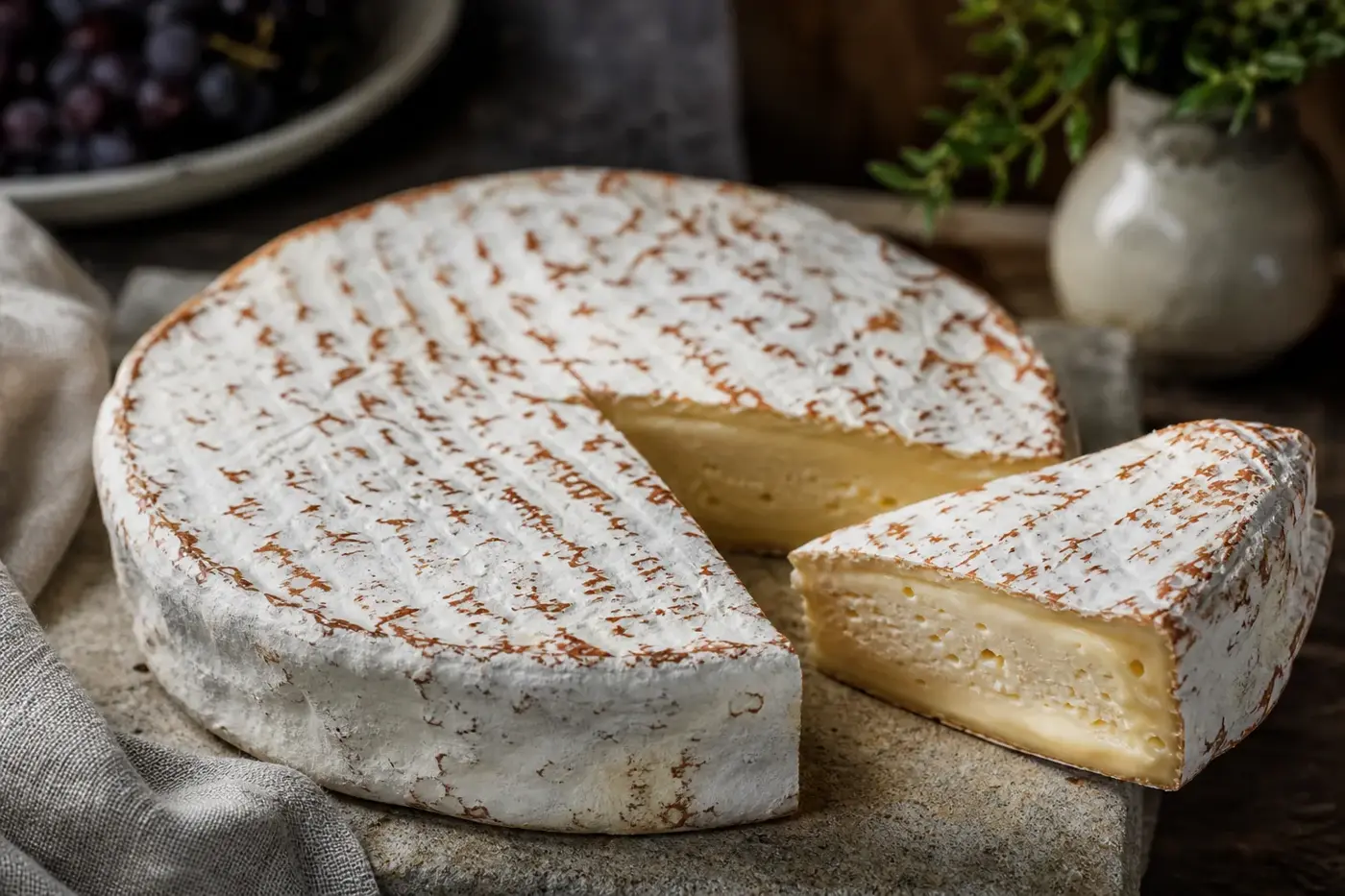
Picture a wheel of Comté at the cheese counter: 32 to 45 kg, with the Jura massif tucked into its flavours.
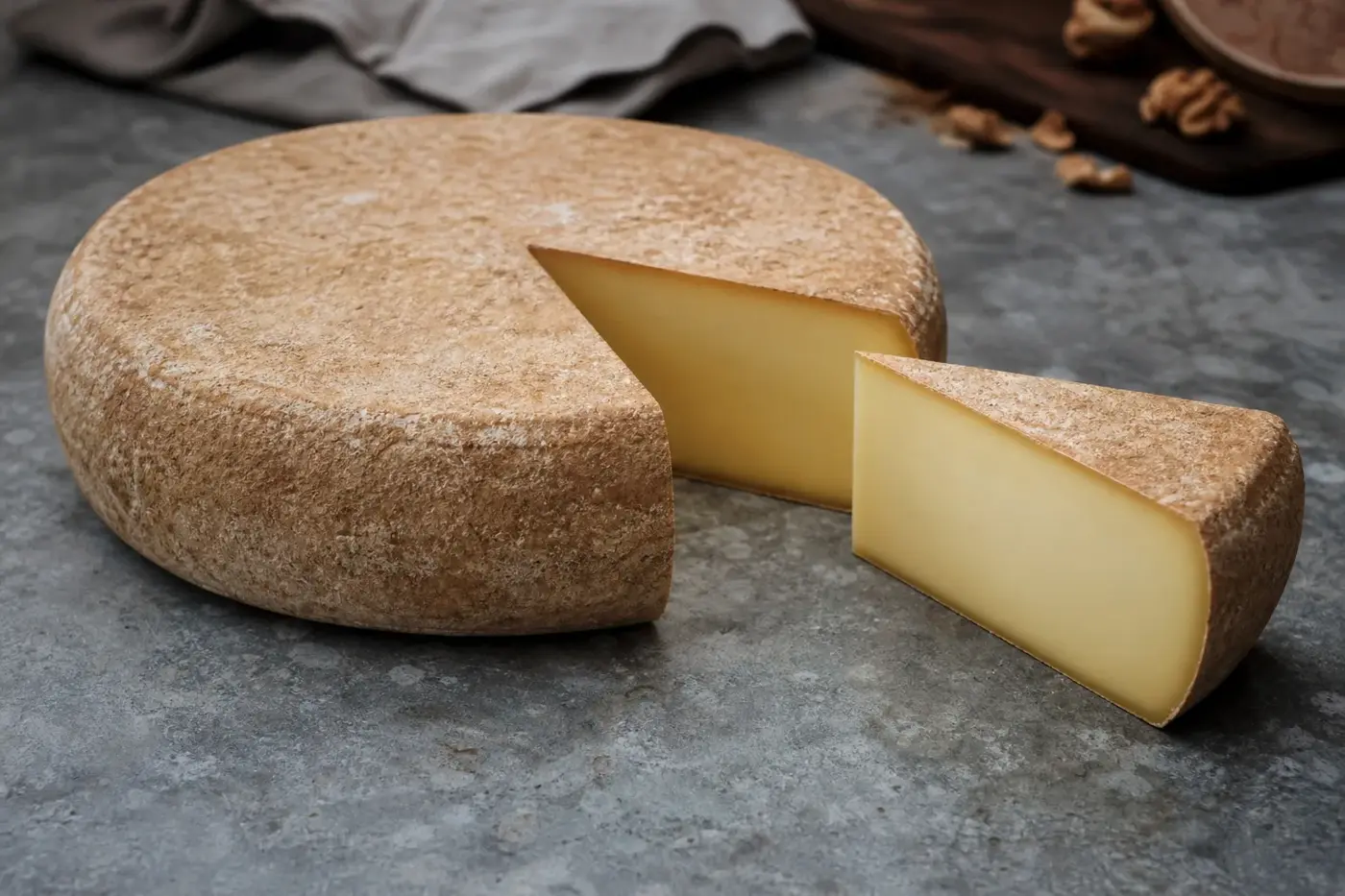
Picture a wheel of Comté at the cheese counter: 32 to 45 kg, with the Jura massif tucked into its flavours. You might find butter, hazelnut or caramel in a piece made from raw cow's milk and matured for at least 120 days. Season, local milk, the cheesemaker's decisions and life in the cellar all shape what reaches your plate.[1][2]
| The essentials | What to know |
|---|---|
| Familiar and registered name | Comté.[1][3] |
| Cheese family | Cooked, pressed cheese.[1] |
| Where it comes from | Defined communes in the Jura massif and adjoining areas of France.[1] |
| Milk | Raw cow's milk.[1] |
| Permitted breeds | Montbéliarde, French Simmental and certified crosses between them.[1] |
| Coagulant | Rennet.[1] |
| Minimum ageing | 120 days from manufacture.[1] |
| Fat in dry matter | 45 to 54 g per 100 g dry matter.[1] |
| Dry matter | At least 62 g per 100 g cheese.[1] |
| Salt | At least 0.6 g per 100 g cheese.[1] |
| Wheel weight | 32 to 45 kg.[1] |
| EU registration | 21 June 1996.[3] |
| Great Britain registration | 31 December 2020.[3] |
Meet the flavours and their makers
Hazelnut, honey, butter, caramel. Then perhaps egg yolk, vanilla or something vegetal. INAO includes all of these among Comté's frequently identified aromas, though your particular wheel may bring only some to the fore.[2]
Behind that range are three connected occupations. Milk producers supply the starting material, cheesemakers transform it, and affineurs, the maturation specialists, guide the wheels through the cellar. INAO puts this shared work at the heart of Comté production; you taste the influence of all three.[2]
“Fruity” is a useful beginning, not a complete tasting note. Research distinguishes fruit character from overall flavour intensity. Two Comtés can be equally expressive without having much else in common, rather like cheese lovers discussing their ideal lunch.[8]
Get to know the rules behind the wheel
Comté's rulebook has a history of its own. INAO's national committee approved the French specification used here on 19 November 2025; an arrêté dated 18 December 2025 homologated it. Publication followed in the Journal officiel on 7 January 2026 and the agriculture ministry's official bulletin on 8 January 2026.[1]
These are the standing production rules for Comté in France. Temporary amendments can alter some feeding rules for set periods.[1]
| From pasture to cellar | What the specification requires |
|---|---|
| Geographical boundary | Listed communes in Ain, Doubs and Jura, 13 communes in Saône-et-Loire and part of Challonges in Haute-Savoie. |
| Milk treatment | Raw cow's milk. |
| Herd | Montbéliarde, French Simmental or certified crosses; applies to all dairy cows on the farm. |
| Grazing | Required after snow melt while conditions permit; total zero grazing systems prohibited. |
| Conserved feed | Silage and other fermented feeds, including wrapped bales, prohibited throughout the year on the farm. |
| Milk collection | Collection area within a circle 25 km in diameter. |
| Cheesemaking | Open copper vats. |
| Ingredients | Milk, ferments, rennet and salt only. |
| Maturation | At least 120 days from manufacture. |
If “raw milk” and “cooked cheese” sound contradictory, follow the milk through the dairy. It enters production raw; “cooked” describes the later treatment of the curd, the coagulated milk solids. These are separate stages, so Comté is a “raw milk, cooked pressed cheese”.[1]
Step into the fruitière, where milk becomes a shared endeavour
At a fruitière, the local cheese dairy, farmers traditionally bring their milk together. INAO explains the name through the shared “fruit” of their work: pooled milk transformed into cheese. Cooperation makes a wheel possible that would far exceed the everyday output of a small household dairy.[2]
That local connection matters. The collection boundary prevents milk being gathered indiscriminately across the whole production area. The Comité Interprofessionnel de Gestion du Comté, or CIGC, argues that numerous fruitières preserve differences between local milk supplies and the cheeses made from them.[2][9]
The CIGC is the industry's interprofessional body, so this account of local character is the producers' explanation of their system. The specification sets the production requirements.[1][9]
When you reach the counter, ask about both fruitière and affineur. The first makes the cheese; the second directs its subsequent maturation. Together, those names can tell you more about your piece than age alone.[2][10]
Find out why every wheel has its own character
Begin with the season in the pasture
What cows eat changes with the season, and their milk changes too. The CIGC describes spring and summer grazing, followed by hay, aftermath hay and cereals in the colder season. It links fresh grass, rich in beta-carotene, with a more golden cheese paste.[11]
Winter Comté, in the same account, is paler. Hazelnut, vegetal or roasted nuances may come further forward. These are tendencies described by the interprofessional body, not promises that every cheese will oblige.[11]
Look for when the milk was produced, rather than when you buy the cheese. Your winter purchase may have begun with grazing-season milk, followed by months of maturation. Production date tells you where the story began; maturation age tells you how long it has developed.[10][11]
Join the researchers in dairy and cellar
In 1987, Elisabeth Guichard, Jean-Louis Berdagué and Roger Grappin studied 24 cheeses made at one dairy during winter and summer. Cheeses from each production batch underwent four different ripening treatments. This allowed the researchers to investigate season and maturation separately.[12]
They identified 103 volatile compounds. In this experiment, season had the predominant influence on their concentrations; ripening treatment mattered too, but less overall. The study involved one dairy, so it illustrates these influences rather than predicting the flavour of every Comté.[12]
A separate sensory study, published in 1997, brought a trained panel to cheeses from 20 dairies across different seasons. Researchers organised 91 descriptors into seven groups. They then identified 28 key descriptors that retained much of the useful distinction between cheeses.[8]
Their analysis separated fruitiness from flavour intensity. Remember that when you choose your piece: pronounced fruit character does not necessarily mean the strongest tasting cheese on the counter.[8]
Make room for the affineur
Affinage means managed maturation, and a cellar is more than somewhere to leave a wheel. In the CIGC's account, cheeses are turned and rubbed while the affineur chooses conditions to suit their development.[10]
Warmer cellars encourage faster development; cooler ones allow change to proceed more slowly. Even under similar ageing conditions, differences in the milk's microbial population can produce different results, the CIGC explains.[10]
Put age alongside origin and cellar treatment, rather than above them. The CIGC associates younger Comté with lactic notes and milk caramel. Its broader account of maturation takes you through citrus, dried fruit, stronger roasted notes, leather and meat-broth associations.[13]
Travel back to the first shared wheels
The story leads to “fructeries” at Déservillers and Levier. According to the CIGC, their first written reference dates to 1264 and survives in a cartulary compiled in 1319. Its historical account connects cooperation with the quantity of milk needed for large cheeses made for keeping.[14]
Protection arrived much later, in distinct stages. Three dates help you follow its development:
- 1952: appellation recognition, recorded by INAO.[2]
- 1958: the AOC decree, whose publication anniversary the CIGC dates to 17 July.[15]
- 21 June 1996: EU registration, also recorded in the Great Britain register.[3]
The 1952 recognition and the 1958 decree were separate events. Each has its place in the developing history of Comté's protection.[2][15]
Follow the Comté name across borders
PDO stands for Protected Designation of Origin, but the dairy's location is only part of the picture. The name's protection depends on where the cheese is marketed. This November 2026 picture distinguishes registration from treaty protection.[3][4][5][6][7]
| Where the cheese is marketed | How the name is protected | Official basis |
|---|---|---|
| European Union, including France | Registered PDO; registration date 21 June 1996. | EU registration date recorded by Defra.[3] |
| Great Britain | Registered PDO from 31 December 2020. | UK protected food names register.[3] |
| Northern Ireland | EU PDO protection applies. | UK guidance confirms that EU GI schemes apply in Northern Ireland.[4] |
| Switzerland | Listed for protection under the EU and Switzerland agricultural agreement. | Annex 12, Appendix 1, as replaced by Decision No 2/2022, in force from 1 January 2023.[5] |
| Canada | GI entered on 21 September 2017, file 1858594; a county-name exception applies. | CIPO list and CETA Annexes 20-A and 20-B.[6][7] |
| United States | Status unspecified here. | No official basis given here. |
| Australia | Status unspecified here. | No official basis given here. |
| New Zealand | Status unspecified here. | No official basis given here. |
Canada's exception allows “comté” to appear with food products when it refers to a county, as in “Comté du Prince-Edouard”. That qualification affects how the word may lawfully be used.[7]
Take your curiosity into the Jura
The CIGC's Routes du Comté lets you explore the connections between farms, fruitières, maturation and place. Begin with its official listings. Then contact each venue directly about booking, accessibility and the activities offered.[16]
Back at the counter, ask for four details where known: fruitière, affineur, production season and maturation age. Together, they connect your piece to the influences documented in the specification and research. They also make a better starting point for your next comparison than “that one was older”, the cheese counter's answer to judging a book by its birthday.[2][8][10][12]
Keep the milk guidance and recall details to hand
Comté is made from cow's milk.[1] The NHS's UK pregnancy guidance, last reviewed 15 June 2026, lists “pasteurised or unpasteurised hard cheeses, such as cheddar, gruyère and parmesan” as safe to eat. It does not name Comté individually.[17]
In France, ANSES advises pregnant women, young children, people over 65 and people with weakened immunity to avoid raw milk cheeses. Its advice makes an exception for cooked pressed cheeses such as Comté.
In August 2026, France's RappelConso announced a recall of Nos Régions ont du Talent Comté, lot 120525, sold by E.Leclerc Urrugne between 8 and 10 August. The notice identified a Listeria risk and told purchasers not to eat the affected cheese. It concerned that product and lot, not Comté generally.[18]
General information only, not medical advice: follow the official guidance where you live.
Questions people ask
Is Comté made from raw milk?
Yes, Comté is made from raw cow's milk. It is described as a cooked pressed cheese because the curd is cooked during cheesemaking, while the milk enters production raw.
Where is Comté made?
Comté is made in defined communes in France's Jura massif and adjoining areas. Its production area includes listed communes in Ain, Doubs and Jura, 13 communes in Saône et Loire and part of Challonges in Haute Savoie.
What does Comté taste like?
Its documented aromas include hazelnut, honey, butter, caramel, egg yolk, vanilla and vegetal notes. Each wheel may bring only some of these to the fore.
How long is Comté aged?
Comté must be matured for at least 120 days from manufacture. During maturation, an affineur guides the wheels' development, selecting cellar conditions and turning and rubbing them.
Can you eat Comté during pregnancy?
France's ANSES advises pregnant women to avoid raw milk cheeses, with an exception for cooked pressed cheeses such as Comté. See ANSES guidance on raw milk cheeses, and check the current guidance for where you live.
Sources
- Ministère de l'Agriculture and INAO, Cahier des charges de l'appellation d'origine « Comté », approved 19 November 2025, homologated 18 December 2025, official bulletin No 2026-02, 8 January 2026. Specification PDF.
- INAO, Comté, undated product profile, printable edition retrieved November 2026. Product profile.
- Department for Environment, Food & Rural Affairs, Comté, live protected food names register, published 4 January 2021. Register entry.
- Defra, Protected geographical food and drink names: UK GI schemes, live guidance, retrieved November 2026. GI schemes guidance.
- EU and Switzerland Joint Committee on Agriculture, Decision No 2/2022 amending Annex 12, 2022, Appendix 1, Comté entry. Official text.
- Canadian Intellectual Property Office, Liste des indications géographiques, live list, Comté, file 1858594, entry dated 21 September 2017. Official list.
- Global Affairs Canada, Text of the Comprehensive Economic and Trade Agreement, Annex 20, Annexes 20-A and 20-B, live treaty text. Annex 20.
- Bérodier, F., Stèvenot, C. and Schlich, P., Description of the Flavour of Comté Cheese, LWT, volume 30, issue 3, pages 298 to 304, 1997. Publisher's abstract retrieved. Research record.
- CIGC, À quoi servent toutes ces fruitières ?, undated. Fruitière explanation. Industry source.
- CIGC, Comté USA, In the Cellar (Aging Comté), undated. Maturation account. Industry source.
- CIGC, Lait d'été, lait d'hiver, quelle différence ?, undated. Seasonal account. Industry source.
- Guichard, E., Berdagué, J.-L. and Grappin, R., with Fournier, N., Affinage et qualité du Gruyère de Comté. V. Influence de l'affinage sur la teneur en composés volatils, Le Lait, volume 67, pages 319 to 338, 1987. Research paper.
- CIGC, Le Comté, plus il est vieux, meilleur il est ?, undated. Maturation and flavour account. Industry source.
- CIGC, Une tradition millénaire, undated historical account. History. Industry source.
- CIGC, Fabrication symbolique de Comté le 17 juillet !, 3 July 2018. Decree anniversary account. Industry source.
- CIGC, Les Routes du Comté, live visitor directory, retrieved November 2026. Official route directory.
- NHS, Foods to avoid in pregnancy, live guidance, retrieved November 2026. Pregnancy guidance.
- RappelConso, COMTE AOP NRT 1/8, Nos Régions ont du Talent, notice 2026-08-0224, version 1, 26 August 2026. Batch recall notice.
This piece was researched from the French specification, official protection records, published research and attributed industry accounts, without a site tasting or visit.
Last checked: November 2026
Last checked November 2026.
The editors suggest you read next