Coulommiers
Look up into the metal framework of Coulommiers’ cheese hall, built in 1887, and picture the surrounding farms bringing their cheeses to market.
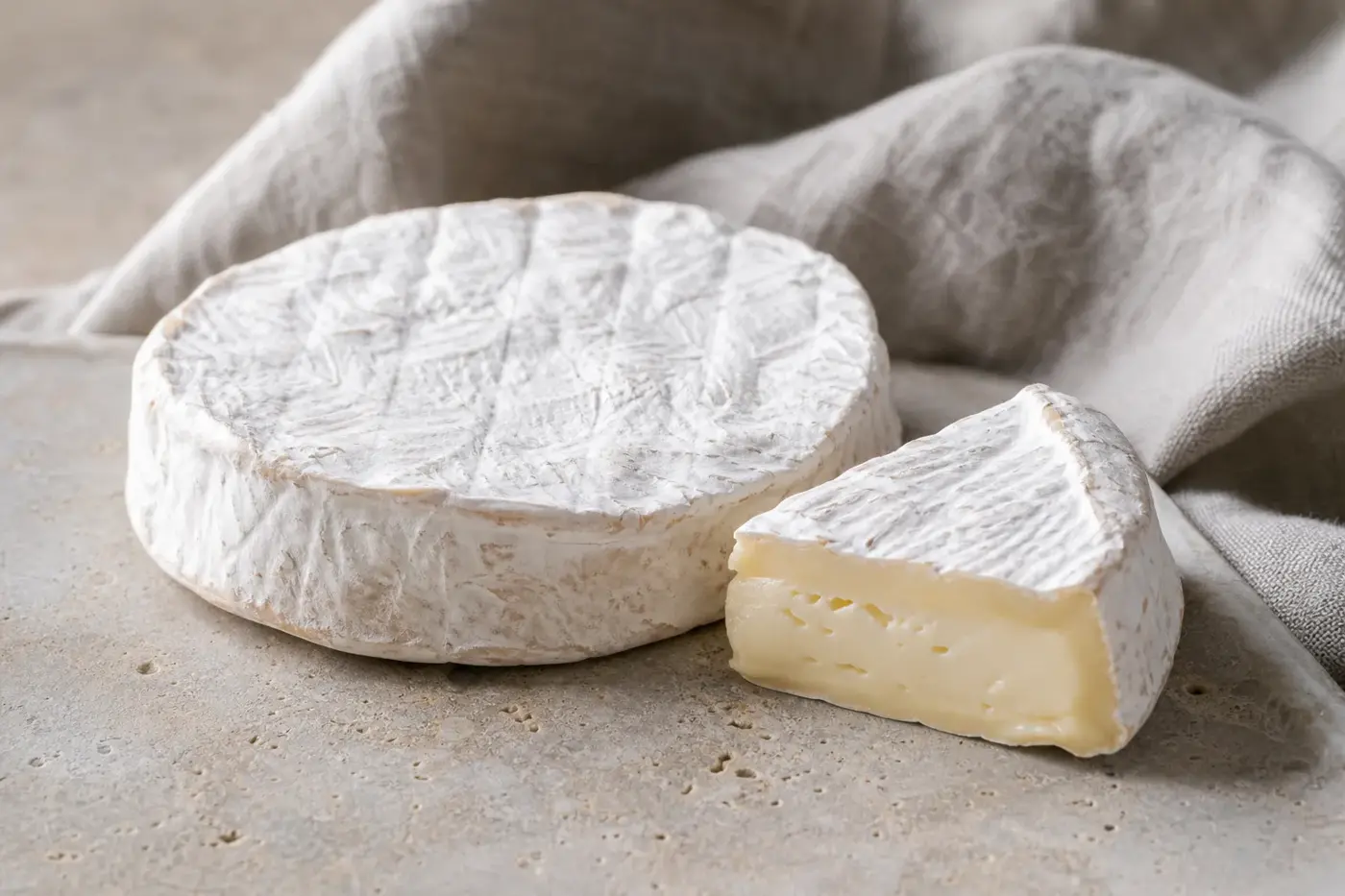
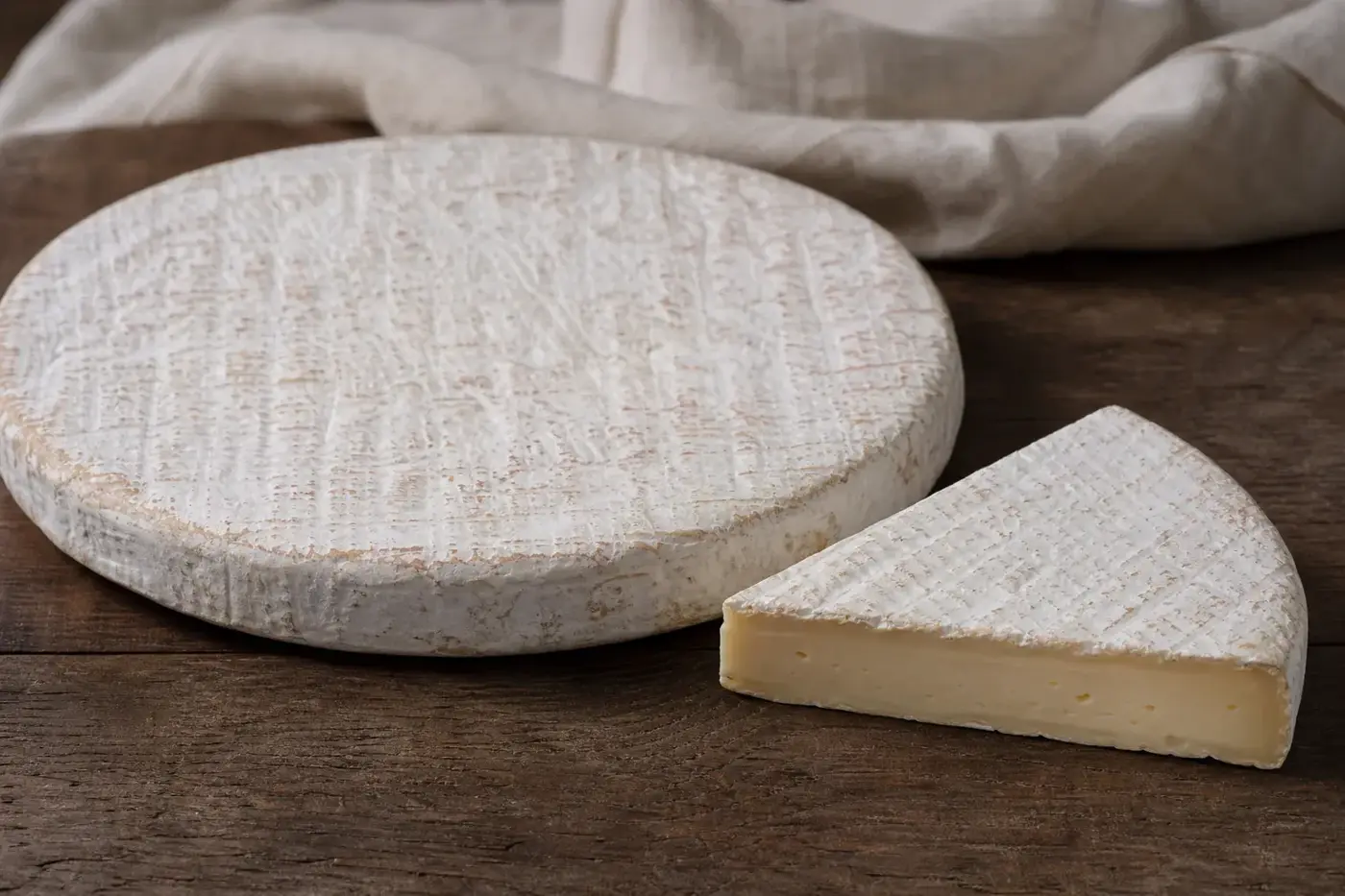
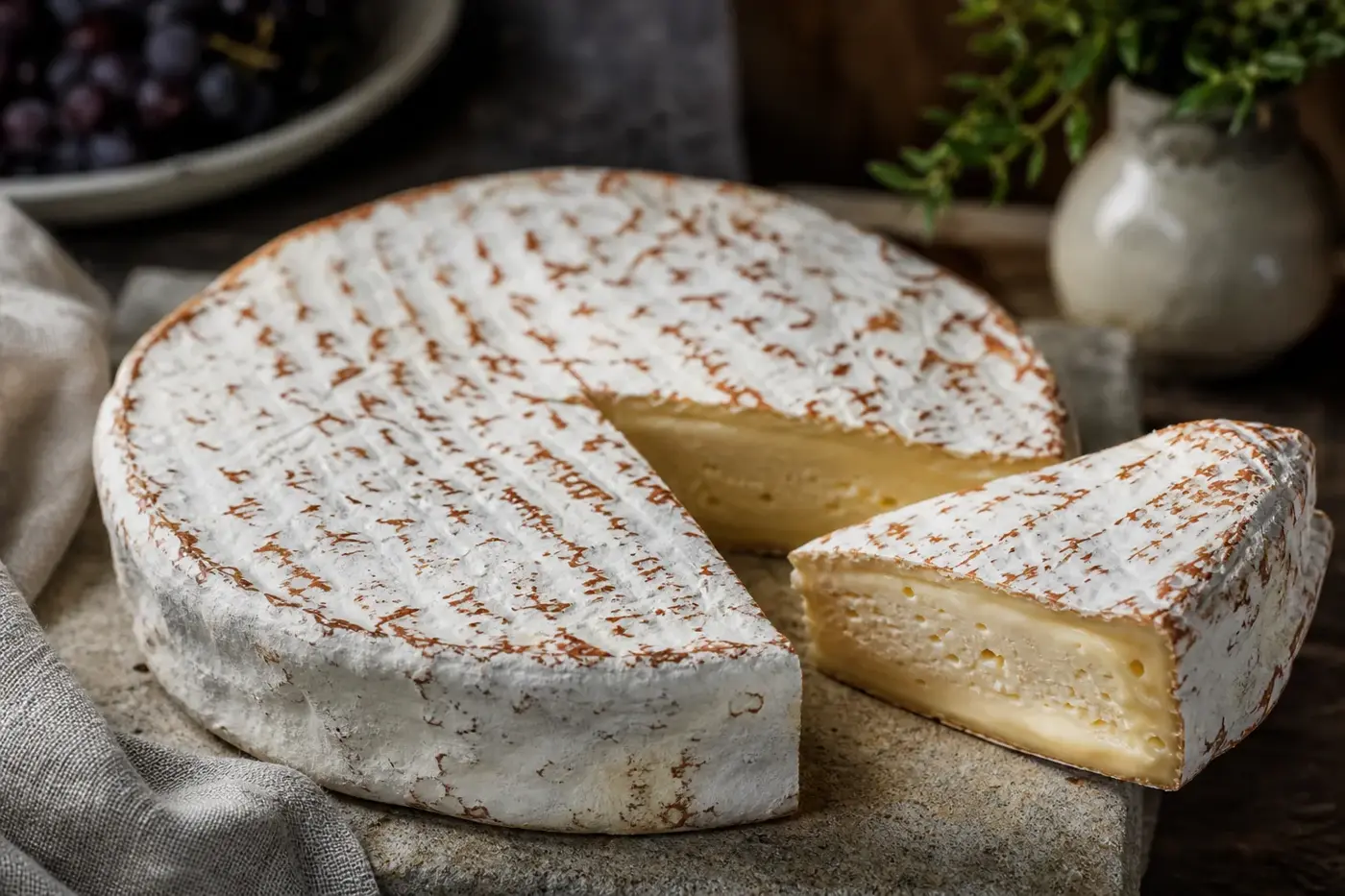
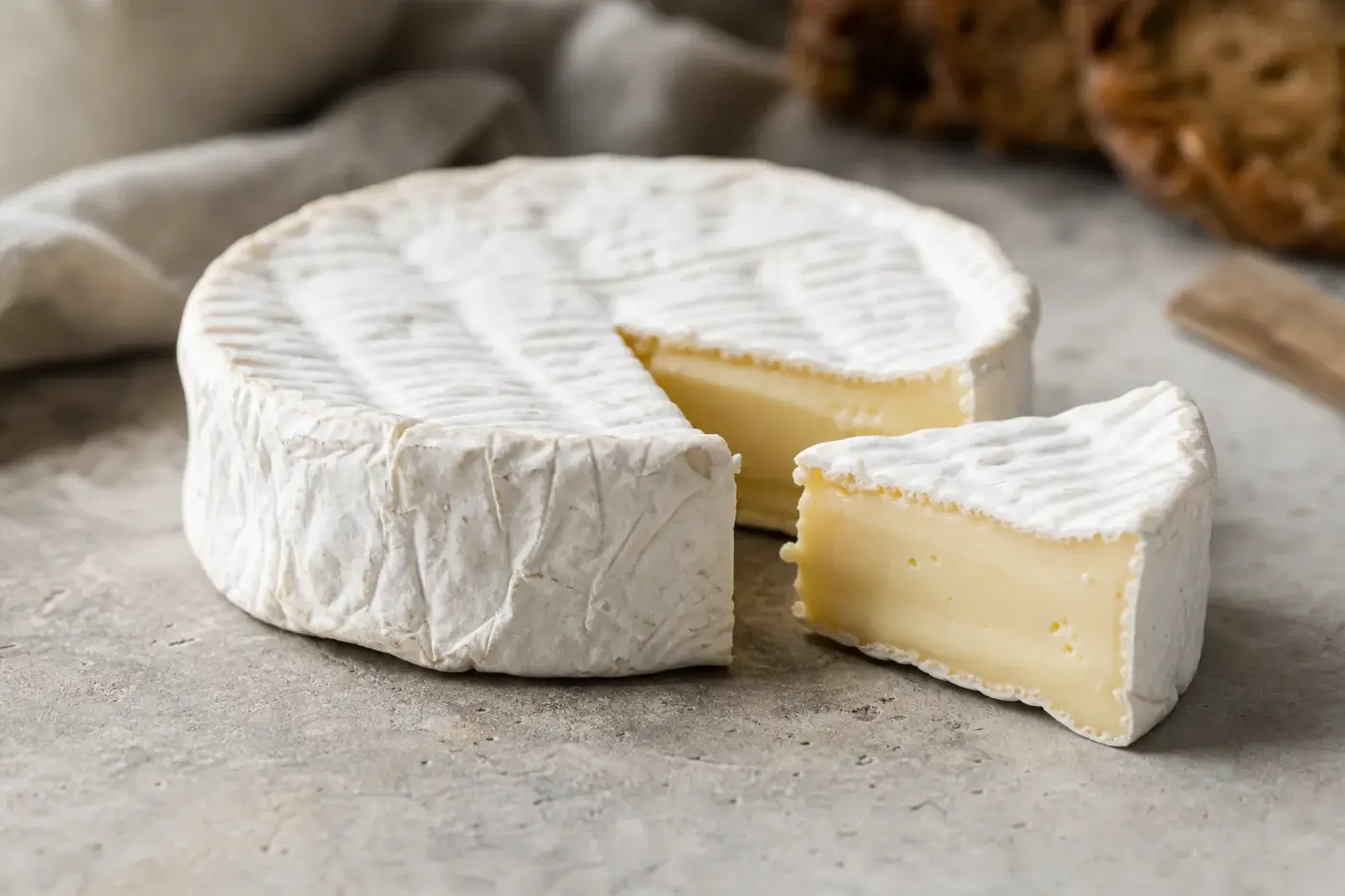
Look up into the metal framework of Coulommiers’ cheese hall, built in 1887, and picture the surrounding farms bringing their cheeses to market. Among them was the small round that carries the town’s name. Flat and made from cow’s milk, it has a white bloomy rind and a soft, pale interior. What you find beneath that rind depends on the producer, the milk treatment and how far ripening has taken it.[1][2][5]
| What you might want to know | Coulommiers |
|---|---|
| Name at the cheese counter | Coulommiers.[2] |
| Where French law defines it | Décret n° 2007-628 of 27 April 2007, Annex, Coulommiers entry.[4] |
| Traditional home | Coulommiers and the wider Brie region of France.[1][2] |
| Milk in the making | Cow’s milk; both raw and pasteurised versions are documented.[4][5][6] |
| Shape and legal diameter in France | Flat cylinder, 12.5 to 15 cm.[4] |
| One maker’s listed weight | Gillot lists a 350 g Coulommiers.[6] |
| The rind you will see | White and bloomy.[5] |
| Time spent ripening | French law requires ripening but gives no numerical minimum; Président gives three to four weeks as usual.[4][5] |
| UK pregnancy guidance, November 2026 | NHS advice covers white-rinded, mould-ripened soft cheeses.[12] |
Begin in the Brie countryside
To get to know Coulommiers, start with its countryside rather than a recipe. The town sits in Seine-et-Marne, firmly within the Brie tradition. Its own account dates the cheese’s distinctive identity to the nineteenth century, when a smaller size helped set it apart from others in the family.[1][2]
You can still find that trading past in the Halle aux Fromages. The town’s 2023 guide records that the hall was built in 1887 for surrounding farms and formerly sold Brie cheeses, including Coulommiers. The surviving metal structure recalls a working market where cheese was gathered and sold as agricultural produce.[1]
Farms, traders and a town market give the name a place you can picture. They also lead you towards Brie, that familiar word with more than one cheese, and more than one production tradition, behind it.
Follow the market history, then the older tale
The nineteenth-century identity and the dated cheese hall give you firm landmarks. Président also tells an older story: smaller cheeses were developed in the eleventh century because fragile Brie was difficult to transport. It presents this as a tale people tell, without a contemporary document to establish it.[2][5]
Even the celebration that came before the modern cheese fair has an unsettled date. The organising committee gives conflicting dates for it, rather than one clear answer.[3]
At the counter, distinguish the town’s dairy heritage from the wider commercial use of its name. Gillot, for instance, describes its Coulommiers as made with milk collected in Normandy. A familiar name on the wrapping is only the beginning of the production story.[6]
Get acquainted with the little white round
Coulommiers is small enough for you to encounter it whole, not just as a wedge. French law defines a flat cylinder measuring 12.5 to 15 cm across. Président gives a thickness of 2.5 to 3 cm, a detail from its own account rather than the statutory definition.[4][5]
The white covering is the bloomy rind, developed by ripening cultures. Beneath it is the paste, the cheesemaker’s term for the interior. Président describes this as supple and homogeneous; Réo describes its Coulommiers as supple without being runny.[5][8]
Keep that distinction in mind when you choose. Soft need not mean a puddle: Coulommiers can yield under your knife without making a bid for the edge of the plate.
This page summarises published guidance from the official sources it cites. It is not medical advice. Guidance differs between countries and changes over time, so check the current source for where you live, and ask your doctor, midwife, pharmacist or dietitian about your own circumstances.
From milk to mould, one step at a time
The making begins with cow’s milk. Graindorge lists milk, salt, cultures and rennet for its raw-milk Coulommiers. Rennet is the coagulant that helps turn liquid milk into curd, the solid material that will become the cheese.[7]
Président describes moving that curd into moulds with either a ladle or a curd distributor. Whey, the liquid portion, drains away before the cheeses are unmoulded and dry-salted. Then comes Penicillium candidum, the surface-ripening mould associated with the white bloom, followed by turning during maturation.[5]
Along the way, rind and interior develop their different characters. That white surface plays a part in ripening; it is not decoration applied to a finished cheese. You can follow the broader sequence in how cheese is made.
Raw or pasteurised? Ask the maker
You will find Coulommiers made with either raw or pasteurised milk. Gillot explicitly names raw cow’s milk for its 350 g cheese, and Graindorge lists raw milk too. Président describes a pasteurised-milk method while also acknowledging raw-milk production.[5][6][7]
Before choosing, read the individual product description. Milk treatment, ingredients and the maker’s identity tell you more about what is in your hand than the name alone. If the terms need untangling, turn to raw, thermised and pasteurised milk.
The makers describe different characters, too. Gillot says its Coulommiers gains strength as it matures, while Graindorge describes a gently woody flavour. Let those descriptions guide you towards something you might enjoy, rather than expecting every Coulommiers to taste alike.[6][7]
Taste for almond, woodland and a yielding centre
Président brings sweet almond into its description; Graindorge identifies a woody note. Réo points to the fine white bloom and the reddish ripening flora that appear towards the end of maturation. “Soft cheese” begins to sound like a rather modest introduction.[5][7][8]
Texture offers another way to choose. Réo describes a supple paste that does not flow, while Graindorge emphasises a softer, yielding interior. Gillot’s observation that flavour strengthens during maturation makes the cheese’s condition today worth a conversation at the counter.[6][7][8]
Tell the cheesemonger what you fancy: a neat slice, perhaps, or a softer piece to spread on bread. Ask about the cut face and its current maturity. A description of the texture you enjoy will take you further than simply asking for the “oldest” cheese.
Meet the Brie relatives
There is a family resemblance between Coulommiers, Brie de Meaux and Brie de Melun. Look closer, though, and their dimensions and production records differ. Both Bries have their own French and EU appellation specifications, including raw-milk requirements and minimum ripening periods.[9][10]
| How the relatives differ, November 2026 | Coulommiers | Brie de Meaux | Brie de Melun |
|---|---|---|---|
| Diameter | French legal range: 12.5 to 15 cm.[4] | 36 to 37 cm.[9] | 27 to 28 cm.[10] |
| Milk treatment | Raw and pasteurised versions documented.[5][6] | Raw cow’s milk.[9] | Raw cow’s milk.[10] |
| How the curd enters the mould | Ladle or curd distributor in Président’s account.[5] | By hand, using a Brie shovel.[9] | Hand-ladled.[10] |
| Minimum time ripening | No numerical period in the French entry.[4] | Four weeks.[9] | Five weeks.[10] |
The specifications also follow the cheeses as they mature. Brie de Meaux moves from a more brittle consistency towards suppleness. Brie de Melun ripens from the rind towards the centre.[9][10]
Choose the individual cheese for its character and your plans for it. These three names identify different products, even when the same serving idea happens to suit them all.
Give the wrapper a closer look
Coulommiers has a place in France’s national cheese definitions. Its statutory entry describes the milk, shape and composition. Geographical-indication registration is a separate matter, requiring evidence from the relevant register.[4]
Begin your label reading with the maker and milk treatment. Lait cru means raw milk; lait pasteurisé means pasteurised milk. Next, look at ingredients, storage instructions and date marking: Graindorge’s published list, for example, identifies both milk and rennet.[5][7]
If regional production matters to you, look for an explicit manufacturing origin. Gillot’s description of milk collected in Normandy shows why a familiar place-name is only the start of the enquiry.[6] You can explore the distinctions in reading a cheese label.
Buy for the occasion, then make fridge space
Tell the cheesemonger when you plan to eat your Coulommiers and which consistency you enjoy. Buying a cut portion? Ask to see the interior, using the makers’ descriptions as your guide, from a slice that holds its shape to a softer, yielding paste.
At home, refrigerate dairy products and follow the packaging instructions. Food Standards Agency guidance for England, Wales and Northern Ireland recommends a fridge temperature between 0 and 5 °C (32 to 41 °F). Use a fridge thermometer rather than relying on the control dial alone.[11]
Follow the after-opening instructions too. UK government guidance distinguishes a use-by date, which concerns safety, from a best-before date, which concerns quality. Do not eat food after its use-by date.[13] For fuller advice, see storing cheese at home.
Share the centre, and consider the rind
Cut your round into wedges so everyone gets some centre and outer edge. Put out the amount you expect to eat. That avoids repeatedly handling the whole cheese.
Keep preparation brief. The FSA guidance cited here says chilled food should spend the shortest possible time outside the fridge during preparation, with a maximum of four hours. This advice applies to England, Wales and Northern Ireland; follow the product instructions and your own country’s guidance.[11]
For the rind, look at whether your particular cheese is intended to be eaten as sold. Réo’s literature describes serving its bloomy-rind Coulommiers that way with bread.[8] Remove all wrapping before serving.
Set out bread, orchard fruit and a glass
Plain bread, a few slices of pear or apple, and water make a modest selection. Keep them separate to begin with. Taste the cheese alone, then try the combinations and decide which you prefer.
Bread is Réo’s suggested companion. Apples and pears have a local connection too: the town’s gastronomy account identifies both as established produce of the surrounding territory.[2][8] Your cheese need not be the only thing on the table with roots in the countryside.
If you are an adult of legal drinking age and choose wine, Président recommends a supple, fruity red, naming Bourgueil and Côte de Beaune. Treat this as the brand’s suggestion, keeping the cheese’s maturity in mind.[5] Offer still or sparkling water alongside it.
People who are pregnant, driving, taking medicines that interact with alcohol or recovering from alcohol dependence should not drink. Consult the NHS or the relevant national authority for advice. For a broader approach, see cheese and wine pairing.
Pregnancy: keep the official guidance to hand
In the UK, NHS pregnancy guidance says pasteurised and unpasteurised mould-ripened soft cheeses with a white coating must be thoroughly cooked. Cheese cooked until steaming hot is identified as suitable to eat. This category is treated differently from other pasteurised soft cheeses.[12]
Consult the current NHS source, dated here November 2026, and ask your midwife or doctor about your circumstances. Outside the UK, follow the official guidance where you live. The site’s cheese food safety guide provides the broader reference.
Questions people ask
What is the difference between Coulommiers and Brie?
Coulommiers shares a family resemblance with Brie de Meaux and Brie de Melun, but is smaller. French law specifies a diameter of 12.5 to 15 cm for Coulommiers, compared with 36 to 37 cm for Brie de Meaux and 27 to 28 cm for Brie de Melun.
Is Coulommiers made with raw or pasteurised milk?
Both versions are documented. Gillot and Graindorge list raw milk, while Président describes a pasteurised milk method and also acknowledges raw milk production.
What does Coulommiers taste like?
Makers describe different flavours: Président mentions sweet almond, while Graindorge identifies a woody note. Gillot says its Coulommiers gains strength as it matures.
Can you eat the rind on Coulommiers?
Check whether the particular cheese is intended to be eaten as sold. Réo describes serving its Coulommiers with its bloomy rind and bread.
Can you eat Coulommiers when pregnant?
NHS pregnancy guidance says pasteurised and unpasteurised mould ripened soft cheeses with a white coating must be thoroughly cooked, and identifies cheese cooked until steaming hot as suitable to eat. Check the current NHS pregnancy guidance and ask your midwife or doctor about your circumstances.
Sources
- Ville de Coulommiers, Guide pratique 2023, 2023, section “La place du marché et la Halle aux Fromages”, page 14. Municipal account of the hall’s construction and cheese trade.
- Ville de Coulommiers, Gastronomie, undated, retrieved November 2026. Municipal account of Coulommiers cheese, its nineteenth-century identity and local produce.
- Comité de la Foire aux Fromages et aux Vins de Coulommiers, À propos, undated, retrieved November 2026. Organiser’s chronology, specifically the entries for 1967 and 1968.
- République française, Légifrance, Décret n° 2007-628 du 27 avril 2007 relatif aux fromages et spécialités fromagères, consolidated text displayed as in force on 7 November 2026, Annex, Coulommiers entry.
- Président, Coulommiers, undated, retrieved November 2026. Commercial brand account covering dimensions, manufacturing, maturation, sensory descriptions and wine suggestions.
- Fromagerie Gillot, Gillot Bio: Coulommiers, undated, retrieved November 2026. Producer’s declaration of raw cow’s milk, Normandy sourcing, 350 g format and increasing flavour strength during maturation.
- Graindorge, Coulommiers au lait cru E.Graindorge, undated, retrieved November 2026. Producer’s ingredient declaration and sensory description.
- Fromagerie Réaux, Réo: Le Camembert à part, undated product brochure hosted by Domafrais, retrieved November 2026, Coulommiers section. Historical product literature, not evidence of current availability.
- Ministère de l’Agriculture, Cahier des charges de l’appellation d’origine protégée « Brie de Meaux », published with the official 2020 approval notice. Sections on product description, manufacture and ripening. Read alongside the temporary amendment of 11 September 2026, which changes specified feeding requirements rather than the comparison criteria used here.
- Ministère de l’Agriculture, Cahier des charges de l’appellation d’origine protégée « Brie de Melun », published with the official approval notice of 6 August 2020. Product description, moulding and section 5.2.4 on ripening.
- Food Standards Agency, How to chill, freeze and defrost food safely, published 18 December 2017, live version retrieved November 2026. Applies to England, Wales and Northern Ireland.
- NHS, Foods to avoid in pregnancy, live version retrieved November 2026, “Cheese, milk and other dairy”.
- UK Government, Understanding food labelling: Best before and use-by dates, live version retrieved November 2026.
Researched through municipal records, official French legal and specification texts, attributed producer literature and current official food guidance; serving preferences are identified as editorial opinion.
Last checked: November 2026
Last checked November 2026.
The editors suggest you read next