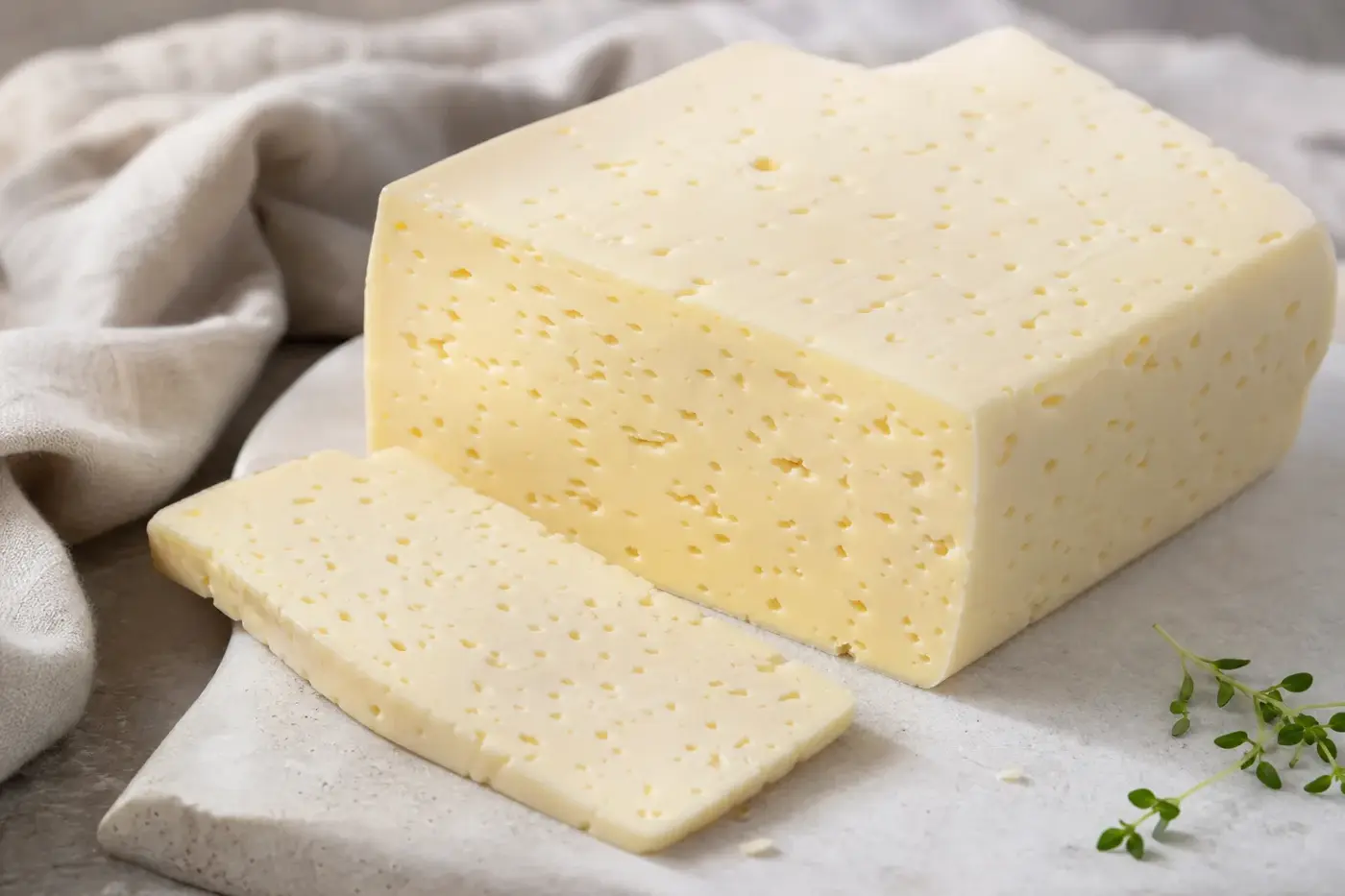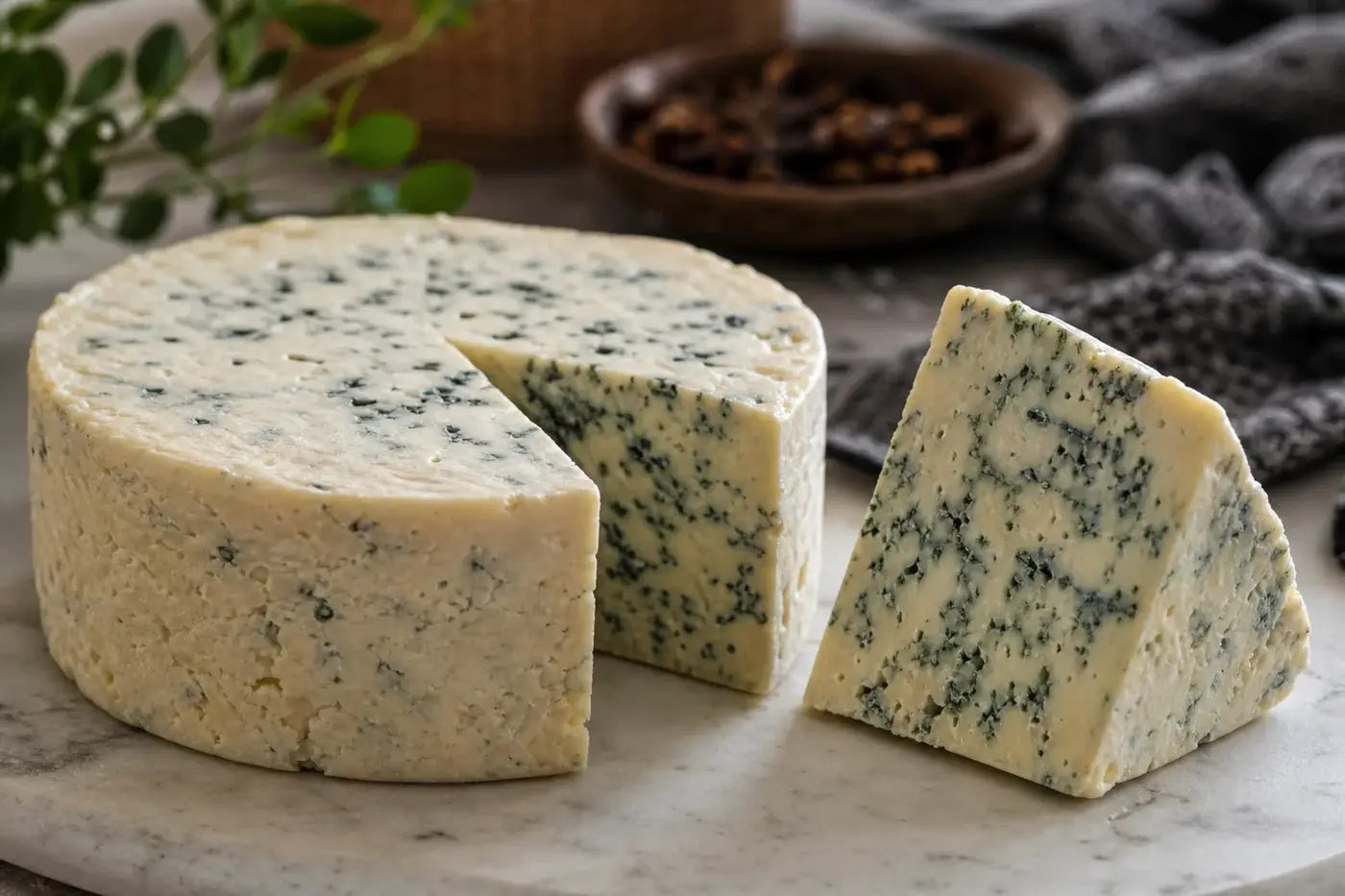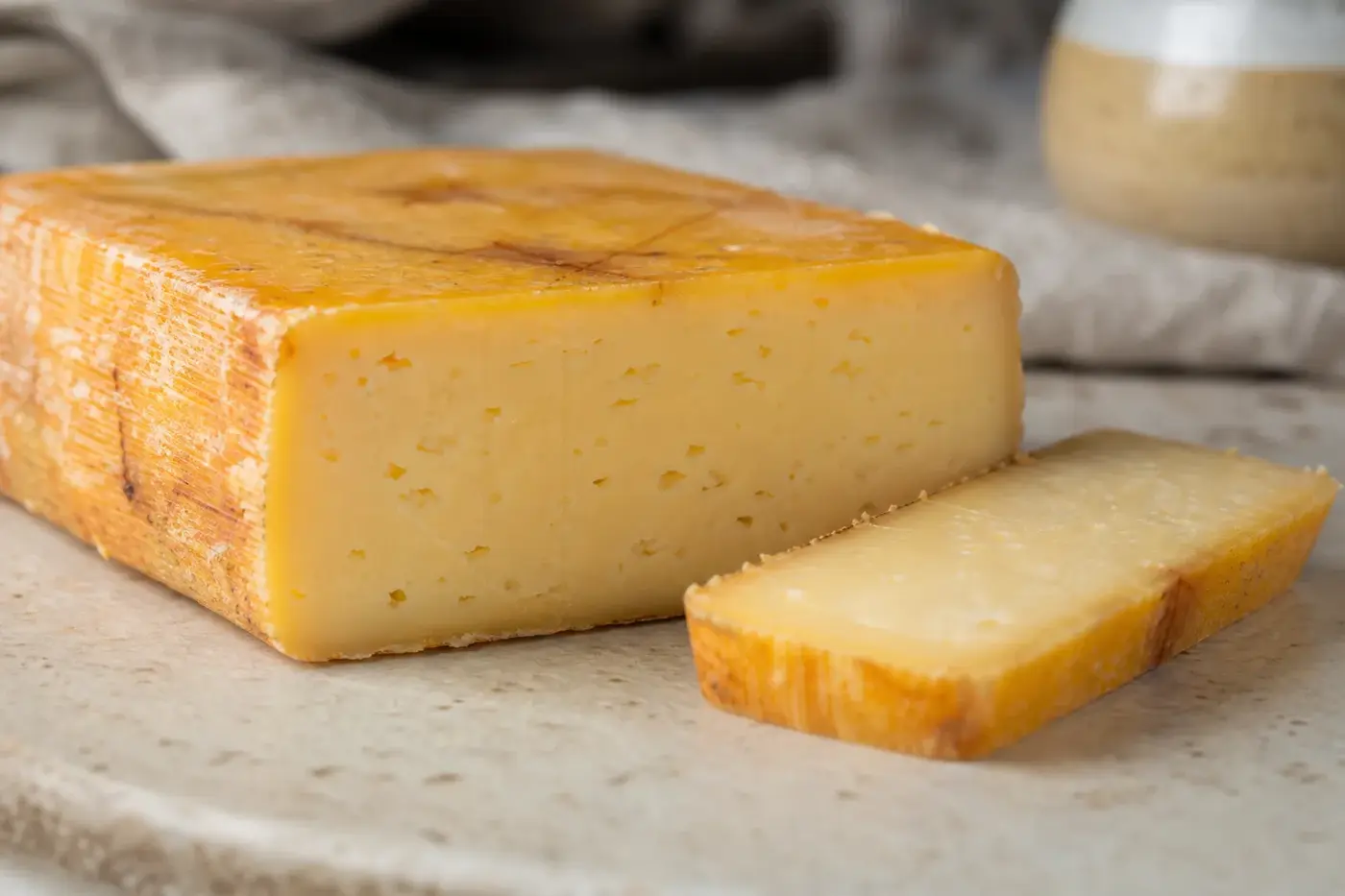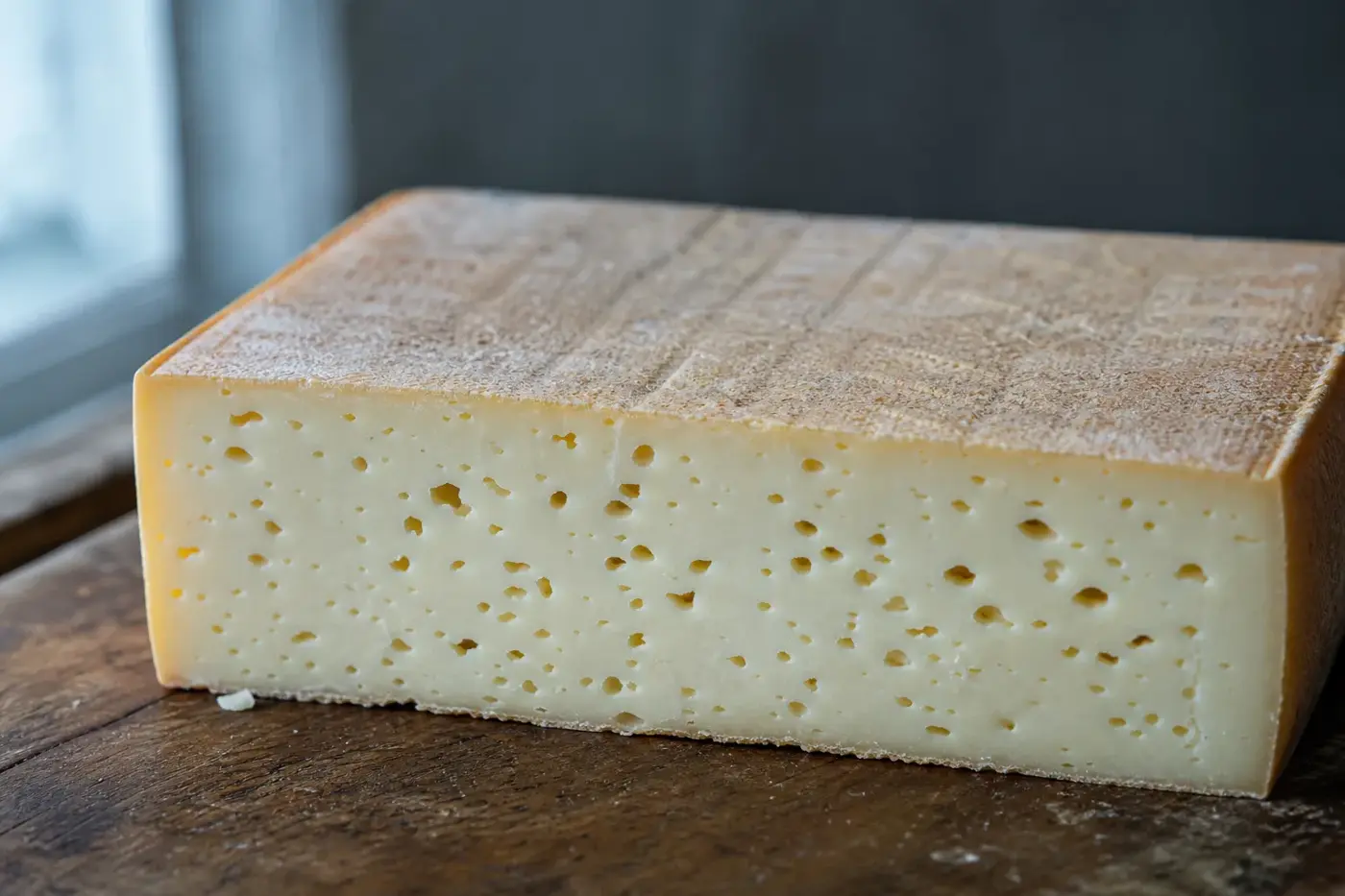
Picture Kirkeby dairy on Fyn in 1897. A dairyman returns from overseas studies, and Danbo’s Danish story begins.[1] Cut into the cheese today and you find pale paste, small round holes and a supple interior beneath a surface-ripened rind. This everyday Danish cow’s milk cheese becomes more pronounced with age, so the piece you take home matters.[1]
| Get to know Danbo | The useful details |
|---|---|
| The name you’ll find | Danbo.[2][3] |
| EU registration authority and identifier | European Commission; base reference PGI-DK-00830.[1][2] |
| EU legal status | Registered PGI under Commission Implementing Regulation (EU) 2017/1901.[2] |
| Great Britain legal status | Registered PGI; UK scheme registration dated 31 December 2020 at 23:00.[3] |
| Where it must be made | Denmark; all production stages must take place there.[1] |
| Milk and coagulant | Pasteurised cow’s milk; rennet. The cited passages do not specify the rennet’s origin.[1] |
| International reference | Codex Standard for Danbo, CXS 264-1966, revised 2007; distinct from the PGI specification.[4] |
Take a look beneath the rind
A cut face tells you more than a packet of ready-cut slices. Look for a flat square or rectangular cheese, whitish to light yellow inside, with small round holes and a firm smear-ripened rind that may be coated.[1] Here, “smear” means the cultivated ripening layer on the surface, not an instruction for your toast.
Give the inside as much attention as the rind. Those small round holes belong to Danbo’s specified appearance, and a freshly cut piece gives you a clearer view of its structure.[1] If there is one at the counter, ask to see it before choosing.
Now picture your plate. Neat sandwich slices, small pieces for a board and a piece you want to eat with its rind call for different choices. The name stays the same, but the cut and surface treatment help shape what reaches your mouth.
A Danish favourite before it had a name
Danbo’s manufacturing tradition arrived before “Danbo” did. After that dairyman’s overseas studies in 1897, the cheese developed at Kirkeby dairy on Fyn, and other dairies took up the practice. The name followed in 1952.[1] Its identity rests as much in that continuing dairy work as in the Danish name eventually chosen.
You get a glimpse of its place at the Danish table in the registration decision. The European Commission noted that, within the EU, Danbo was produced and marketed essentially in Denmark, where consumption and recognition were heavily concentrated.[2] What feels like familiar household food in one place can still need an introduction elsewhere.
For your own introduction, start with bread. You need not save Danbo for a formal cheeseboard: a simple sandwich helps you discover your preferred strength. A modest slice, without several strongly flavoured accompaniments competing for attention, lets you taste the cheese itself.
Keep that gap between making and naming in mind. Registration did not create Danbo. It protected the name of a cheese that already had an established Danish life.
What Danbo’s protected name means for you
For PGI Danbo, every production stage must take place in Denmark.[1] Start there when you read the label. Take the name, origin information and PGI identification together, rather than relying on Danish-looking packaging.
The EU registration was adopted on 18 October 2017 and published on 19 October 2017. Article 2 provided for entry into force on the twentieth day after publication, 8 November 2017.[2] The Great Britain register separately records 19 October 2017 as the original EU registration date, with its own scheme registration dated 31 December 2020 at 23:00.[3] These dates mark different stages of protection, not competing versions of one event.
The name’s international history also brought a dispute. Opponents said “Danbo” was generic, pointing partly to its Codex standard and production outside Denmark. The Commission rejected that argument for EU registration, expressly distinguishing perceptions outside the EU from its territorial assessment.[2]
For the wider picture on PGI, PDO and TSG, turn to protected names explained. At the counter, match the protected name to the relevant jurisdiction and production requirements. An importer’s address tells you who imported your cheese, not where it was made.
Into the dairy: how Danbo takes shape
Danbo’s pressed body and cultivated surface come from a deliberate sequence of dairy work. The EU specification begins with milk standardisation and pasteurisation, followed by starter cultures and rennet.[1] For Great Britain, consult the current specification too.
Next, the curd is cut, stirred, drained, heated and pressed under whey. It is then divided, moulded and pressed again, before cooling, salting and treatment with ripening cultures.[1] To make those dairy terms clearer, curd is the coagulated milk solids; whey is the liquid separated from them.
That sequence helps explain the piece you see on the counter. Danbo is formed and pressed, with a managed ripening surface, rather than simply drained into a container as a fresh cheese. You can follow the wider journey in how cheese is made.
When a detail matters to you, ask about the finished product. Naming rennet in a specification does not establish whether a particular packet is suitable for vegetarians. Ask about the rind, too: is the ripening surface intact, has it been washed before packing, and is there an additional coating? Those answers tell you far more than “it has a rind”.
Find the Danbo you’ll want another slice of
Make maturity your first question. The specification describes Danbo’s flavour as mild and slightly acidic, becoming more pronounced with age.[1] That gives you more to work with than handsome packaging or a sweeping promise such as “special”.
For your first taste, ask for a younger, milder example. Try it without mustard, pickles or chutney, then bring in bread and an accompaniment. That way, you can separate what you enjoy about the cheese from what you enjoy about the whole mouthful.
Already drawn to stronger cheeses? Ask for a more mature Danbo and invite the seller to describe its current character. “How does this piece compare with your milder Danbo?” gets you further than “Which is best?” The answer stays rooted in the cheeses you can actually take home.
Notice texture and aroma separately. A stronger eating experience need not mean a hard or crumbly cheese. Are you after a pliable slice, a more assertive aroma or a longer finish? Remembering those details will help your next purchase more than a single strength score.
Age, fat and spice: a closer look at the label
The amended EU document describes characteristic development after 2 to 4 weeks at 7 to 21 °C. Its composition provisions distinguish cheeses containing 30% to below 45%, and 45% to below 50%, fat in dry matter.[1] That last phrase is worth pausing over before you compare labels.
Fat in dry matter leaves the cheese’s water out of the calculation. To compare the fat you would eat in equal portions, use the nutrition declaration per 100 g instead. These measurements answer different questions, so keep them separate when reading a counter ticket or discussing versions with your cheesemonger.
Spiced Danbo gives you another reason to read closely. The Danish official text uses kommen, while the English version uses “cumin”.[1][5] If you want caraway, ask to see the actual ingredient declaration rather than relying on the English name alone.
For a useful first comparison, try plain and spiced Danbo at a similar stated maturity. Change age, fat level and seasoning together and you give your taste buds rather a lot of paperwork. Ask the counter to help you isolate one difference, then taste with that question in mind.
Danbo, Havarti or Esrom? Let your plate decide
Danbo, Havarti and Esrom are distinct cheeses, not interchangeable versions of “Danish cheese”. A detailed comparison needs each cheese’s relevant sources for production, texture, flavour and protection. Their shared country of origin is the beginning of the conversation, not the conclusion.
At the counter, bring that conversation back to the actual pieces in front of you. Think about how you want to serve them, then ask questions that help you choose something you will enjoy.
| Your question | What to look for |
|---|---|
| Where will you serve it? | Suitability for slicing, sandwiches or a board. |
| How assertive do you want it? | Compare the actual cheeses on offer, preferably by tasting. |
| What is on the outside? | Check the rind treatment and any coating. |
| What can the label tell you? | Look for product origin, ingredients and maturity. |
With Danbo, start from its pressed body and cultivated surface.[1] Ask the seller how the Havarti or Esrom beside it differs. A clear description of each piece gives you more help than “Danish”, especially when you are choosing for a sandwich or a small board.
Make a little room for Danbo
Try thin slices on rye bread, with cucumber or radish alongside. Start plainly, then add mustard or a pickle if you fancy something sharper. Keep those additions separate so everyone can adjust the balance without losing the cheese along the way.
For a sandwich, decide what you want to taste most: Danbo or the filling. Keep your first combination restrained with a milder piece. With a stronger example, begin with a smaller slice and add more if you want it. Build around the flavour rather than burying it beneath everything else.
A small cheeseboard can give you a useful tasting without a crowd of unrelated cheeses. Offer two Danbos of different stated maturities, label them clearly and try the milder one first. Each gets room to make its own impression, and you can follow the difference in maturity more easily.
For a drink, you might start with sparkling water or an unsweetened apple drink. Treat these as serving suggestions, rather than recorded tasting results.
Look after the piece you bring home
Follow the package instructions when storing Danbo. For England, Wales and Northern Ireland, the Food Standards Agency recommends a fridge between 0 and 5 °C.[6] Set aside your serving portion, then keep the rest covered and refrigerated.
Before eating the rind, read the maker’s instructions. At a counter, ask which part is the ripening surface and whether there is an added coating. Remove wrapping and any coatings that are not food before serving; not everything surrounding a cheese is edible rind.
Bring out only what you intend to serve. Before leaving chilled food out of the fridge, consult the Food Standards Agency guidance for England, Wales and Northern Ireland.[6] Keep the remaining cheese refrigerated.
Follow any shorter after-opening instruction on the packet, and keep the label with what remains. UK official guidance distinguishes a use-by date, which concerns safety, from a best-before date, which concerns quality. Food should not be eaten after its use-by date.[7] Keeping the label beside the cheese means those instructions stay close at hand.
For practical wrapping and fridge organisation, carry on to how to store cheese at home.
General information only, not medical advice: follow the official guidance where you live.
Questions people ask
What is Danbo cheese made from?
Danbo is a Danish cheese made from pasteurised cow’s milk. It has a pale interior with small round holes and a cultivated rind.
Where must Danbo be made?
All production stages for PGI Danbo must take place in Denmark. Danbo is registered as a PGI in both the EU and Great Britain.
What does Danbo taste like?
The specification describes Danbo as mild and slightly acidic. Its flavour becomes more pronounced with age.
Is Danbo suitable for vegetarians?
The specification names rennet, but the passages checked do not specify its origin. Ask the cheesemonger about the particular cheese if vegetarian suitability matters to you.
How should I store Danbo?
Follow the package instructions and keep the cheese covered and refrigerated. For England, Wales and Northern Ireland, the Food Standards Agency recommends a fridge between 0 and 5 °C. Check its current guidance for more information.
Sources
- European Commission, Publication of the communication of an approved standard amendment to a product specification of a geographical indication, C/2025/6707, 16 December 2025. Includes the amended Danbo single document and production-method amendments. Official document.
- European Commission, Commission Implementing Regulation (EU) 2017/1901 of 18 October 2017 entering a name in the register of protected designations of origin and protected geographical indications [Danbo (PGI)], 2017. Binding registration act.
- Department for Environment, Food & Rural Affairs, Danbo, Great Britain protected food names register, published 4 January 2021. Register entry.
- Codex Alimentarius Commission, Codex Standard for Danbo, CODEX STAN 264-1966, revision 2007, reproduced in Milk and Milk Products, first edition. Retrieved through the Brazilian public-domain document repository.
- European Commission, Offentliggørelse af meddelelsen om en godkendt standardændring af produktspecifikationen for en geografisk betegnelse, C/2025/6707, Danish edition, 16 December 2025. Danish official document.
- Food Standards Agency, How to chill, freeze and defrost food safely, published 18 December 2017, current retrieved guidance applying to England, Northern Ireland and Wales. Official guidance.
- GOV.UK, Understanding food labelling: Best before and use-by dates, current retrieved edition, publication date not displayed. Official guidance.
Researched from official registration documents, the published specification amendment, the Great Britain register and official consumer guidance, with serving suggestions identified as editorial recommendations.
Last checked: November 2026
Last checked November 2026.
The editors suggest you read next