Esrom
Bring a piece of Esrom close and the yellow-orange rind catches your eye.
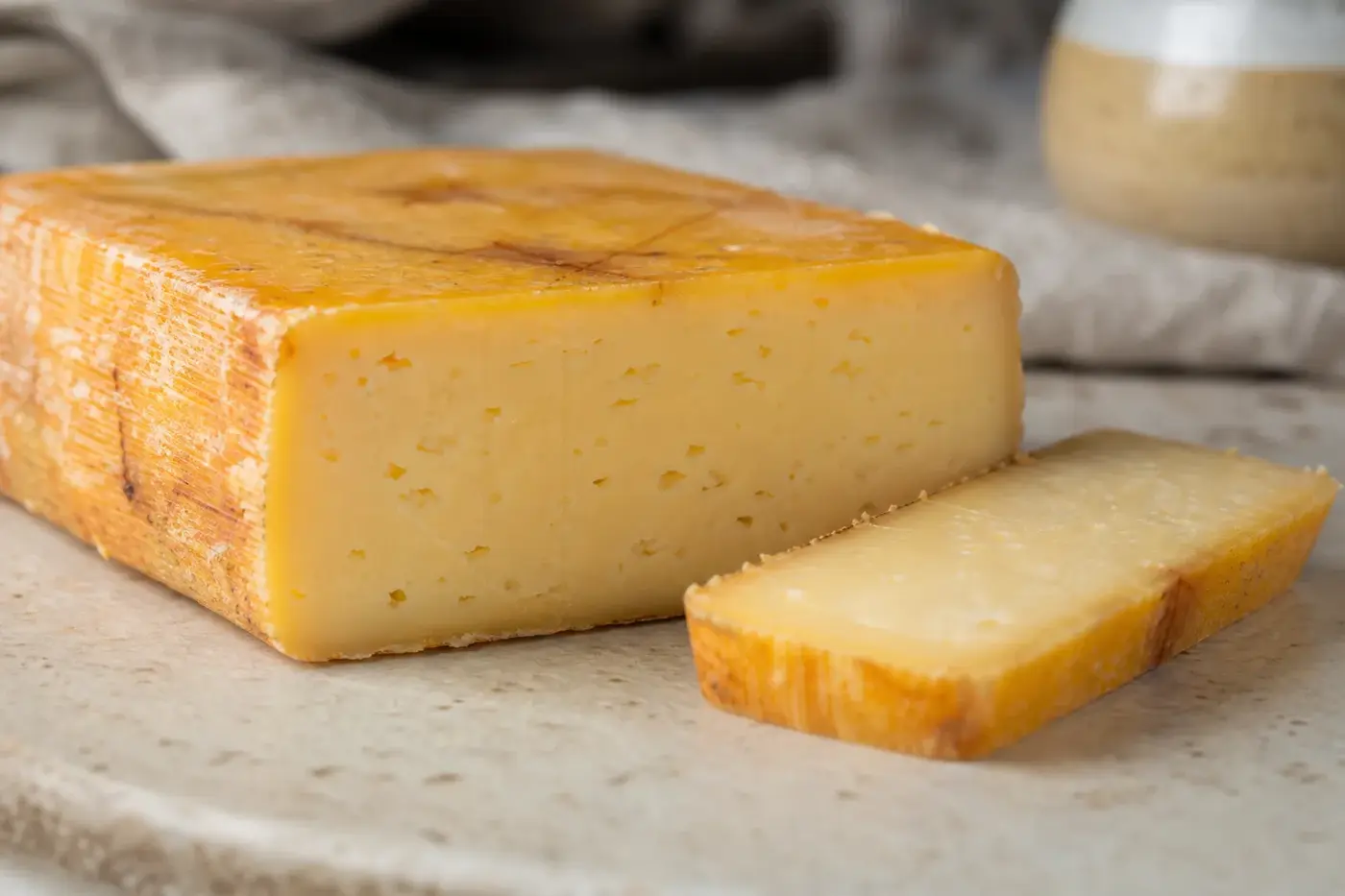
Bring a piece of Esrom close and the yellow-orange rind catches your eye. Cut into it and the mood softens: pale, supple Danish cow’s milk paste, dotted with small, irregular holes. Give it longer to ripen and that aromatic surface takes charge. The rind, you might say, has never needed an introduction. [1,2,8]
| Your quick guide | Details |
|---|---|
| Familiar and registered name | Esrom. [1,3] |
| EU identifier | PGI-DK-0329. [1] |
| EU and Northern Ireland protection | PGI; EU registration 21 June 1996. [1,3,4] |
| Great Britain protection | Registered PGI; UK scheme registration 31 December 2020. [3,4] |
| Where it must be made | Denmark, using Danish milk for every stage of production. [1] |
| Milk and treatment | Cow’s milk, pasteurised. [2] |
| What sets the milk | Rennet; source unspecified. [2] |
| How it ripens | Surface smear culture; EU minimum two weeks. [1,2] |
| How old is your piece? | Ask the seller for the cheese’s actual age. |
| What to expect from the rind | Thin, supple and edible; yellowish to orange-yellow with a brownish smear. [1] |
| Protection record date | November 2026. [1,3] |
A bold rind with a softer side
You will find Esrom in a low rectangular block, rather than a towering wheel. The EU description includes small cheeses weighing 200 to 500 g, larger formats weighing 1.3 to 2 kg and blocks of at least 2 kg. Across those specified formats, heights range from 3.5 to 7 cm. [1]
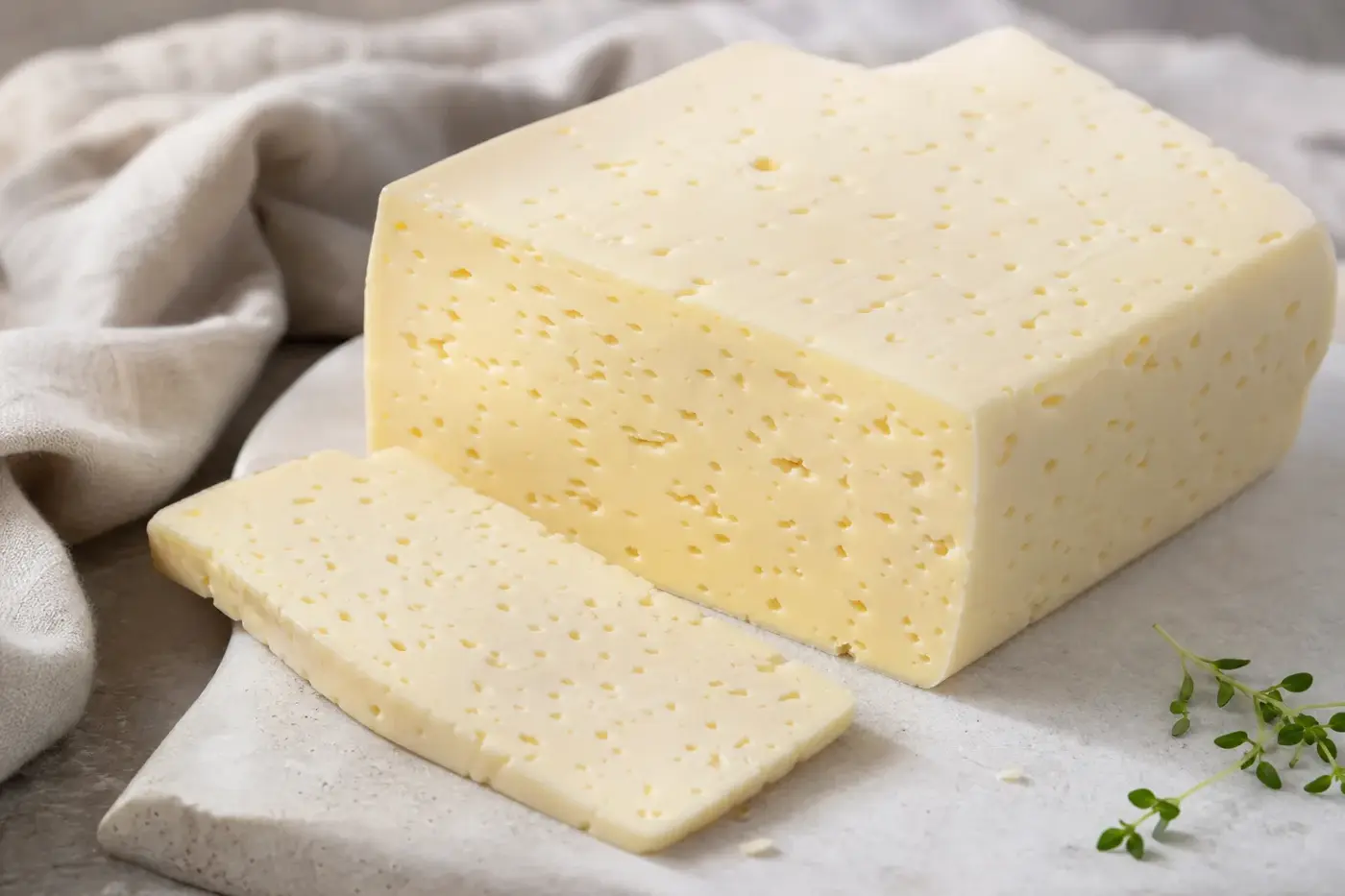
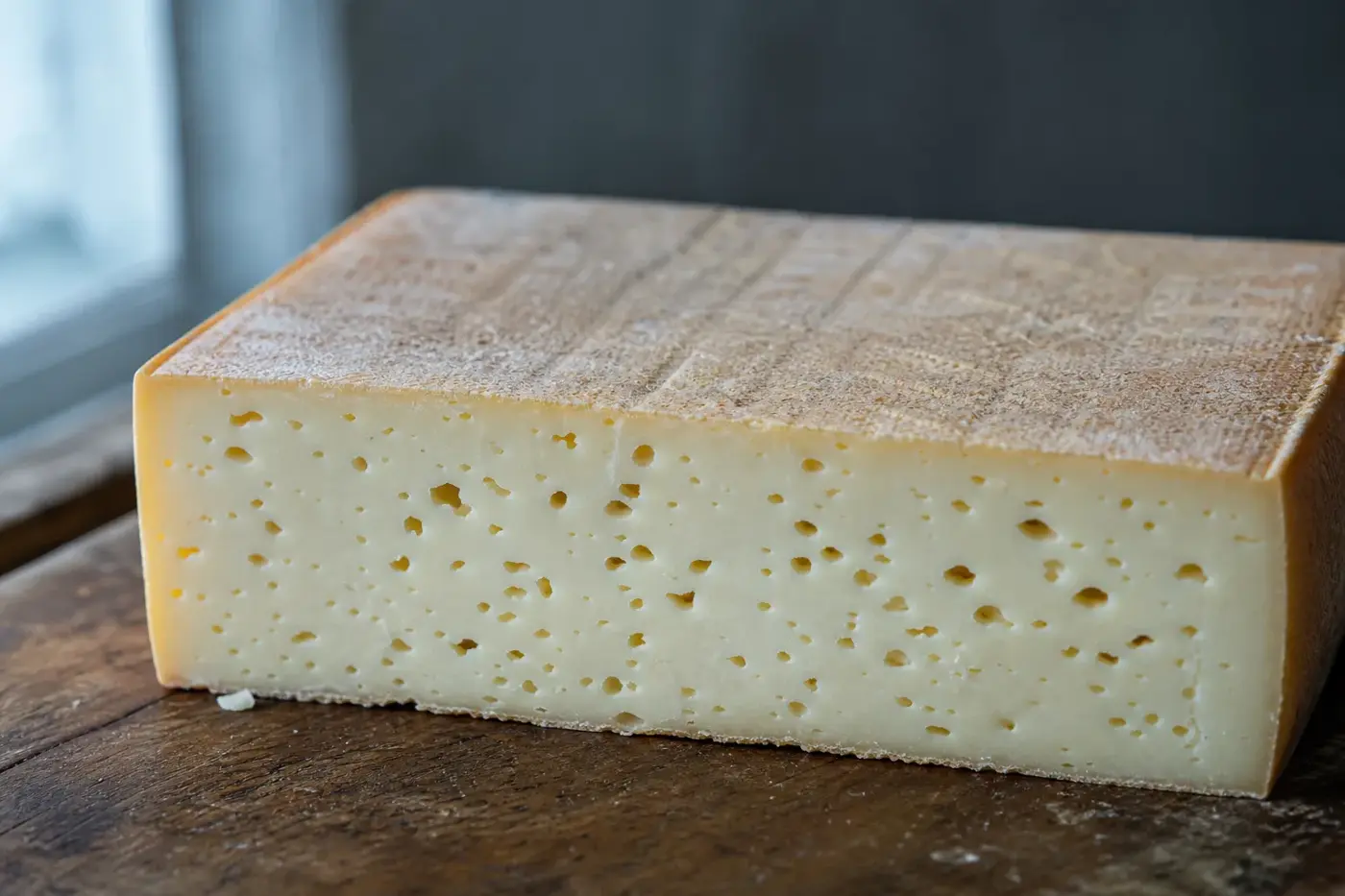
Look at the cut face and you will see yellowish to white paste, evenly dotted with holes roughly the size of rice grains. The body should be uniform, soft enough to yield but firm enough to slice. Its thin, supple rind carries an almost dry smear, described in the specification as yellowish brown to reddish brown. [6,7]
The Danish dairy industry’s Ost & Ko describes Esrom as mildly acidic and slightly rustic, with more surface-ripened sharpness than Havarti. Here is its appeal: a noticeable rind aroma around a comparatively gentle, sliceable centre. With age, the specification says, that surface-ripened smell and flavour become dominant. Older cheeses can also turn slightly greasy as the smear reforms. [1,5]
From abbey tradition to the Danish dairy
Esrom’s modern story takes you to Statens Forsøgsmejeri, the Danish state experimental dairy. The specification records further development there in the mid-1930s, followed by production at Midtsjællands Herregårdsmejeri and then other dairies. Ost & Ko dates its official naming to 1952. Development, commercial production and naming each mark a different chapter. [5,6]
An older strand leads to the abbey at Esrum in North Zealand. The protected specification attributes Esrom’s development to monks there in the twelfth and thirteenth centuries. Denmark’s scholarly reference work Lex, however, explicitly describes medieval Esrom production as undocumented. The abbey connection is an origin tradition, not an established account of production. [1,8]
You have two strands, then: the abbey association and the documented work of Danish dairy development. The manufacturing account describes a controlled, pasteurised, surface-ripened cheese. That modern process tells you more about today’s Esrom than a simple story of a rediscovered medieval recipe. [2,8]
What the protected name brings to your plate
Esrom is a protected geographical indication, or PGI, in the EU. Its name is also registered under the separate Great Britain scheme, while Northern Ireland follows the EU GI scheme. Defra records the EU registration date as 21 June 1996; UK scheme registration is dated 31 December 2020. [3,4]
A PGI connects a name with a place through a product’s quality, reputation or another characteristic. Under the general EU scheme, only one production stage may need to happen in that area. Esrom goes further: its specification requires Danish milk and every production stage to take place in Denmark. [1,9]
That gives the name a useful job at the cheese counter: connecting origin with a specified character. You are choosing a registered cheese name, not a single company’s brand. For more on that distinction, see protected names explained. [4]
This page summarises published guidance from the official sources it cites. It is not medical advice. Guidance differs between countries and changes over time, so check the current source for where you live, and ask your doctor, midwife, pharmacist or dietitian about your own circumstances.
Follow the milk into the mould
Esrom starts with Danish cow’s milk. Under the EU specification, the dairy adjusts its fat content and pasteurises it before adding starter culture and rennet. The cultures develop acidity. Rennet helps set the milk into a gel called the coagulum. [2]
The manufacturing account begins with raw milk arriving for processing, but pasteurisation is required. For the requirements applying in Great Britain, consult the applicable specification. [2]
Once firm enough, the gel is cut into curds, the solid pieces that will become cheese. These are stirred, some whey is removed and the mixture is heated. Whey is the liquid that separates from the curd. The grains then go into moulds for light pressing, followed by cooling and salting. [6,7]
This handling and pressing establish the supple, sliceable body before surface ripening builds its character. Keep that sequence in mind when you taste the yielding centre beside the more assertive rind. For the wider picture, follow how cheese is made, or explore the setting stage in rennet explained. [2]
Behind the colour and aroma of the rind
That colourful surface takes careful tending. After salting, the cheeses receive a surface smear culture and mature in high humidity. The Danish specification then requires washing, drying and packing after ripening. This cultivated microbial surface underpins Esrom’s washed-rind character. [2]
Surface bacteria help create the colour and aroma you notice. Published dairy research identifies Brevibacterium and related organisms as contributors to the sulphur compounds associated with smear-ripened cheeses. Brevibacterium linens can also contribute orange pigmentation. [10]
There is more at work here than one busy bacterium. A 2023 study used bacterial DNA sequencing to follow three batches of commercially produced smear-ripened cheese, finding changing communities during production and storage. That research helps explain the broader process. Esrom’s specification names a smear culture without prescribing a list of species. [2,10]
The EU specification sets a minimum maturation of two weeks. Ask how old your piece actually is: the specification describes flavour becoming more led by the surface as time passes. For Great Britain’s maturation requirement, consult the applicable specification. [1,2]
Esrom, Danbo or Havarti? Start with the holes
The holes give you a useful clue when comparing Esrom with Danbo. Ost & Ko describes Danbo as another smear-ripened Danish slicing cheese, but generally with round, pea-sized holes. Esrom’s are irregular and rice-sized. Both can grow more assertive with age, so a washed rind alone will not settle the matter. [5,6]
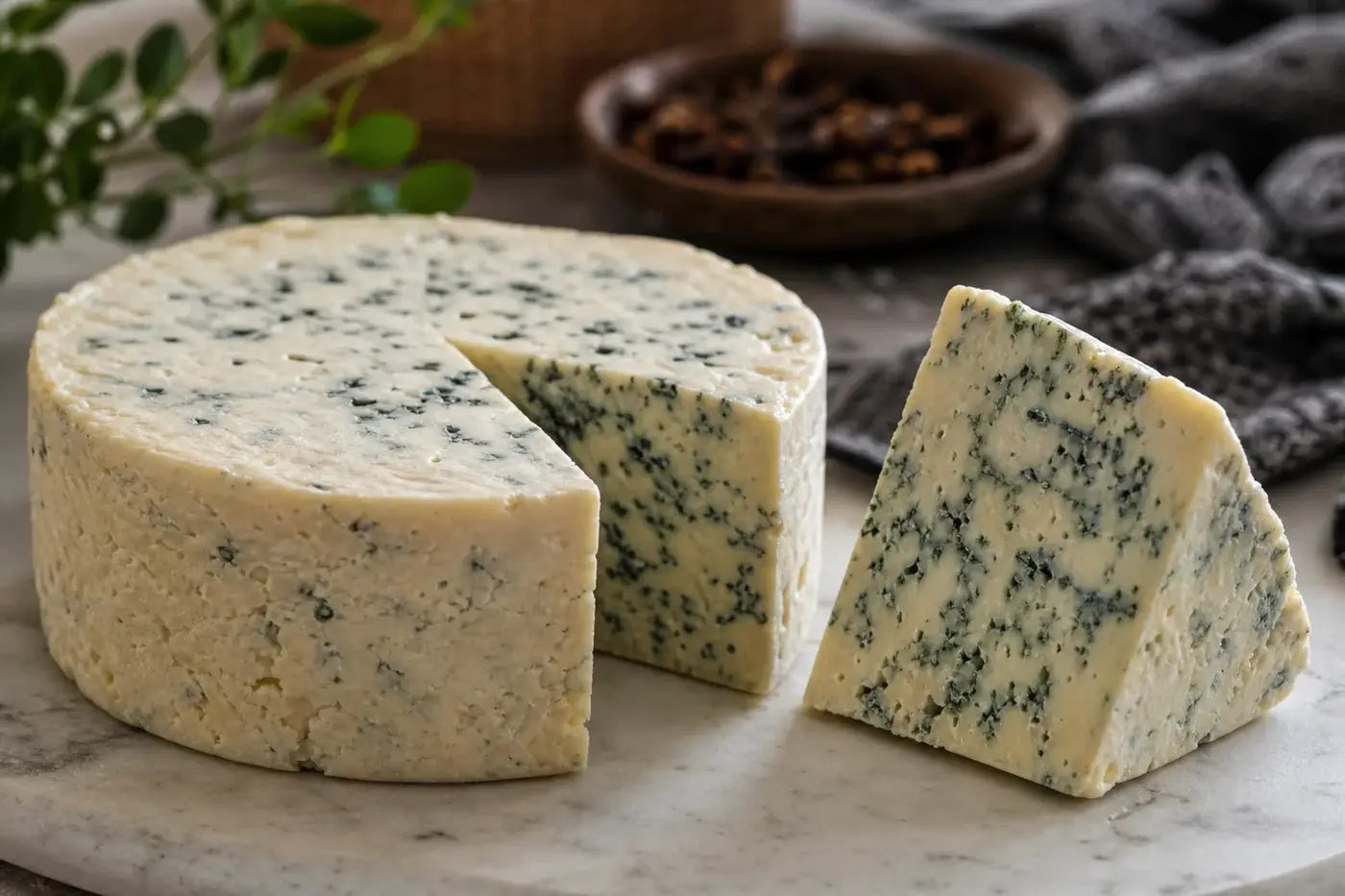
Havarti looks closer, with its many small irregular holes and sliceable body. The industry body describes Esrom as typically more acidic, with a little extra sharpness from surface ripening. Danablu is quite another sight. Blue-green mould marbles its interior, rather than Esrom’s pale, small-holed paste and coloured surface. [5]
Find the maturity that suits you
Ask the seller how mature the cheese is, and whether this batch is relatively mild or more developed. A strong aroma can belong to Esrom’s character, especially with age. You need not choose the quietest rind in the shop. Ask about flavour as well as smell, so you can find your preferred balance. [1,8]
Use the specification’s description as your visual guide: a supple rind, an even pale interior and a soft but sliceable body. Slight surface greasiness is recorded in older cheeses. If a piece falls outside that description, ask the cheesemonger to explain its condition. Read the label’s storage and date instructions before taking it home. [6,11]
Buying enough for several meals? Choose an amount you expect to finish within the maker’s instructions after opening. That way, maturity is your decision at the counter, rather than your fridge’s latest project. See how to read a cheese label. [11]
Make room for rye bread and fruit
Sweet, malty rye bread is Ost & Ko’s recommendation for Esrom, with apple relish or plum compote alongside. The bread gives those soft slices a firm base. The fruit brings a sweet-acid contrast to the surface-ripened character. Ost & Ko also notes Esrom’s usefulness in toast and gratins. [5]
For a simple plate, put thin slices on rye bread with a spoonful of one fruit accompaniment. Taste the cheese alone first, then try the combination. Suggested alcohol-free drinks follow the same thinking: water keeps your attention on the cheese, while apple juice carries the fruit pairing further. [5]
The specification describes the natural rind as edible. Leave it on for more surface character, or trim it for a gentler bite. Remove the packaging before serving, and follow any additional instructions on your particular product. [1,11]
Give your Esrom a good home
For UK home storage, the Food Standards Agency advises a fridge between 0 and 5 °C and following the packaging instructions for dairy products. Keep your Esrom refrigerated and covered between uses, protecting the cut face with its wrapping or a suitable container. Follow the producer’s instructions after opening. There is no single shelf life that applies to every Esrom. [11]
When serving in the UK, take out only the portion you plan to eat and leave the rest chilled. Follow the Food Standards Agency’s current advice on time outside refrigeration. [11]
Keep the maker’s label with any cut portion, so its date and storage directions stay close to hand. For wrapping, fridge organisation and handling different cheese styles, see how to store cheese at home. [11]
Questions people ask
What does Esrom taste like?
Ost & Ko describes Esrom as mildly acidic and slightly rustic, with a relatively gentle interior. Its surface character becomes more assertive as it ages.
Can you eat Esrom’s rind?
The specification describes the natural rind as edible. Leave it on for more surface character, or trim it for a gentler bite.
Is Esrom made with pasteurised milk?
The EU specification requires Danish cow’s milk to be pasteurised. Rennet is used to set the milk, but its source is unspecified.
How long is Esrom aged?
The EU specification requires a minimum maturation of two weeks. Typical ageing and the applicable Great Britain maturation requirement have not been verified.
How should Esrom be stored?
The Food Standards Agency advises keeping the fridge between 0 and 5 °C and following the packaging instructions for dairy products. See the agency’s current advice on time outside refrigeration.
Sources
- European Commission, “Esrom”: communication of approval of a standard amendment and single document, C/2025/6580, published 11 December 2025, amendment reference PGI-DK-0329-AM01, dated 15 September 2025. Product description, geographical area, manufacturing method and origin narrative. Official text.
- Danish Veterinary and Food Administration, Produktspecifikation for ESROM, September 2025. Sections 2 to 6, including physical characteristics, minimum maturation and manufacturing method. Product specification.
- Department for Environment, Food & Rural Affairs, Esrom, UK geographical indication register entry, published 4 January 2021, accessed November 2026. Registered name, status, protection type and registration dates. Register entry.
- Department for Environment, Food & Rural Affairs, Protected geographical food and drink names: UK GI schemes, updated 8 March 2024. Territorial scope and distinction between geographical indications and trade marks. Official guidance.
- Mejeriforeningen, Ost & Ko, Danske BGB-oste: Her er de 4 unikke oste med BGB-mærket, undated current webpage, accessed November 2026. Sections on Esrom, Danbo, Havarti and Danablu. An industry source, used with attribution for sensory descriptions, serving suggestions and its account of naming. Industry account.
- European Commission, Publication of an amendment application: “Esrom”, 2006/C 256/02, published 24 October 2006. Updated specification summary, particularly sections 4.2, 4.5 and 4.6. Read alongside the subsequent approval and current specification. Official Journal document.
- European Commission, Commission Regulation (EC) No 693/2007 of 20 June 2007 approving non-minor amendments to the specification for a name entered in the register of protected designations of origin and protected geographical indications [Esrom (PGI)], published 21 June 2007. Article 1 approves the amendments published in October 2006; Article 2 specifies entry into force. Binding regulation.
- Lex, Esrom (ost), revised 24 June 2025. Scholarly reference account distinguishing undocumented medieval attribution from modern development. Reference article.
- European Commission, Directorate-General for Agriculture and Rural Development, Geographical indications and quality schemes explained, current webpage, accessed November 2026. Definition and general production-stage requirement for PGIs. Official explanation.
- Microorganisms, Microbial Succession in the Cheese Ripening Process-Competition of the Starter Cultures and the Microbiota of the Cheese Plant Environment, volume 11, article 1735, 2023. Introduction, methods and discussion; three production batches examined using 16S rRNA gene sequencing. Research paper.
- Food Standards Agency, How to chill, freeze and defrost food safely, current GOV.UK edition, accessed November 2026. Recommendations and section 1 on refrigeration, packaging instructions and time outside refrigeration. Official UK guidance.
This piece was researched from official specifications, registration records, Danish reference and industry accounts, published microbiological research and UK food safety guidance.
Last checked: November 2026
Last checked November 2026.
The editors suggest you read next