Havarti
Your knife meets a little resistance, then a neat slice of Havarti falls away.
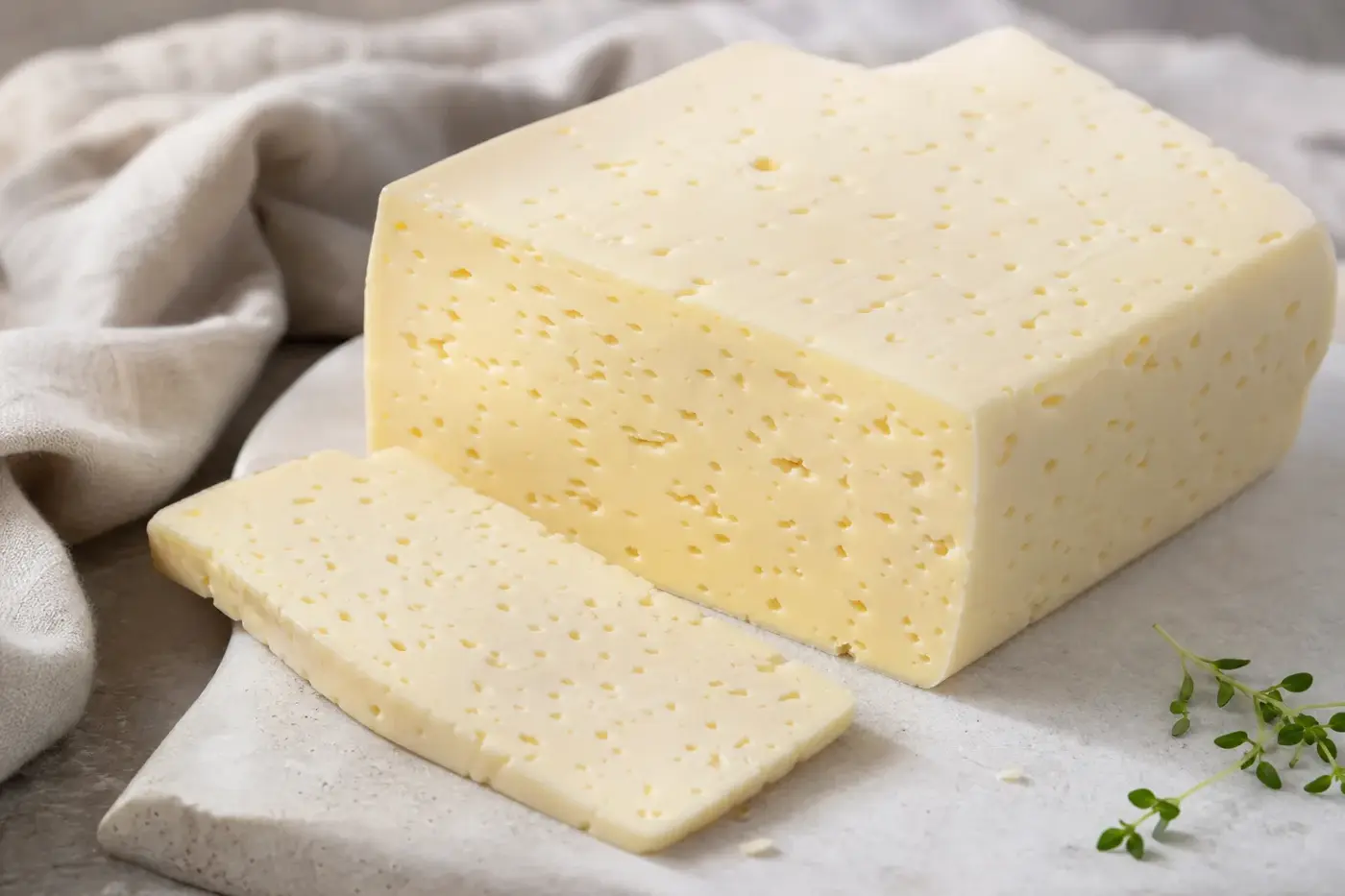
Your knife meets a little resistance, then a neat slice of Havarti falls away. Tiny, irregular eyes, the size of rice grains, dot the pale paste. This Danish cow’s milk cheese is mild and buttery, happy in a cold sandwich or a bubbling topping, though age and surface ripening give it a more pronounced character. [1,8]
| What you might want to know | The details |
|---|---|
| The name to look for | Havarti. [1,3] |
| EU registration authority and reference | European Commission; PGI-DK-00831. [1] |
| EU protection | Protected geographical indication, registered through Commission Implementing Regulation (EU) 2019/1751. [2] |
| Great Britain protection | Registered PGI; UK scheme registration dated 31 December 2020. [3] |
| Milk and how it is treated | Cow’s milk, pasteurised under the EU specification’s production method. [1] |
| What sets the milk | Rennet. [1] |
| What you’ll find on the outside | Rindless or smear-ripened; coating permitted. [1] |
| Required ripening time | Rindless: three weeks. With rind: one to two weeks of smear-ripening, then one to three weeks of further ripening. [1] |
| Ageing beyond those requirements | Depends on the product; check the producer’s declaration. [7] |
Get to know that buttery slice
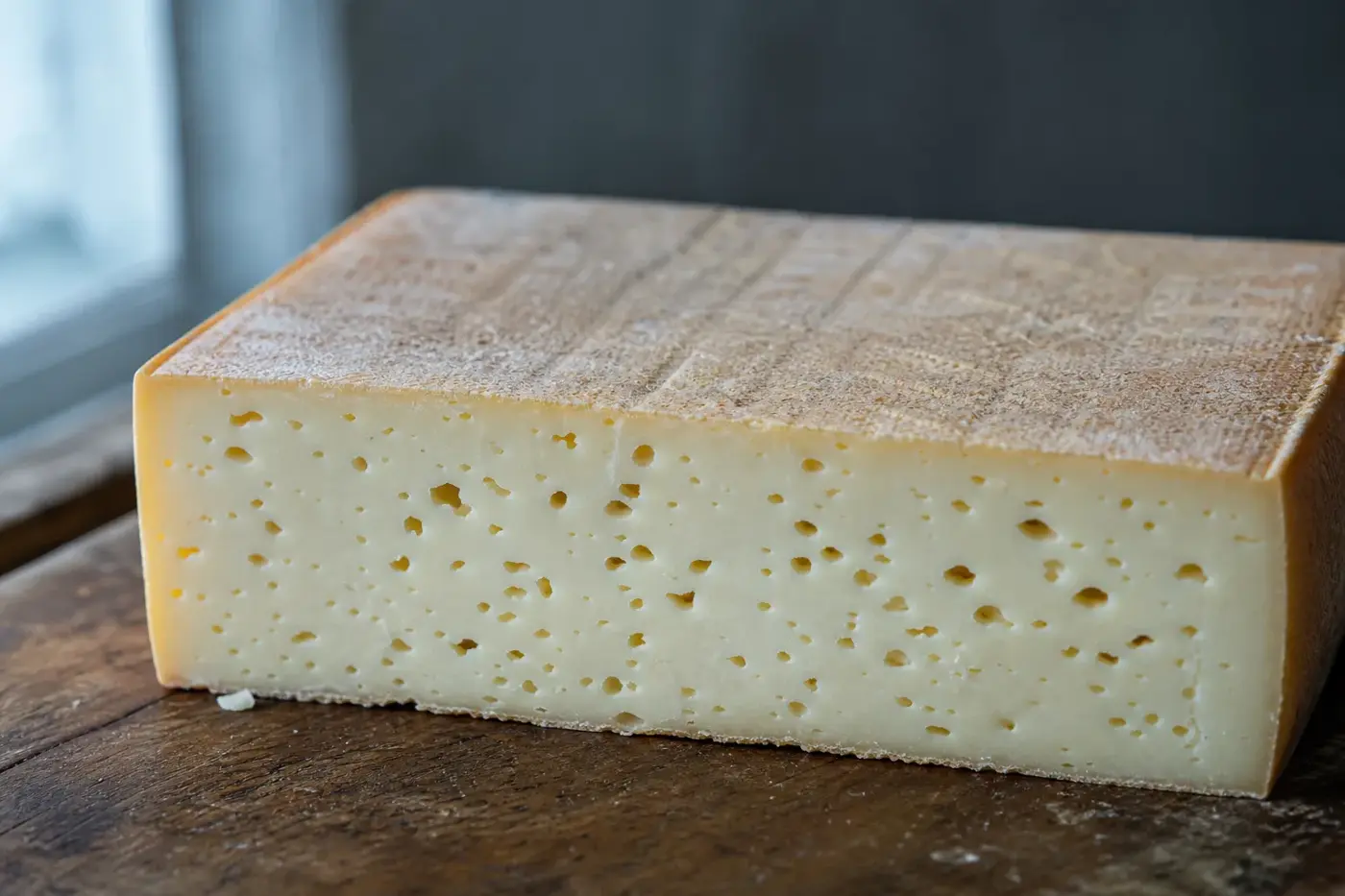
Look at Havarti’s cut face and you have its clearest calling card. The EU description specifies plentiful rice-grain-sized eyes, scattered through paste ranging from whitish or ivory to yellowish. It is soft but cuttable, with some resistance to the bite, and both round and rectangular shapes are permitted. [1]
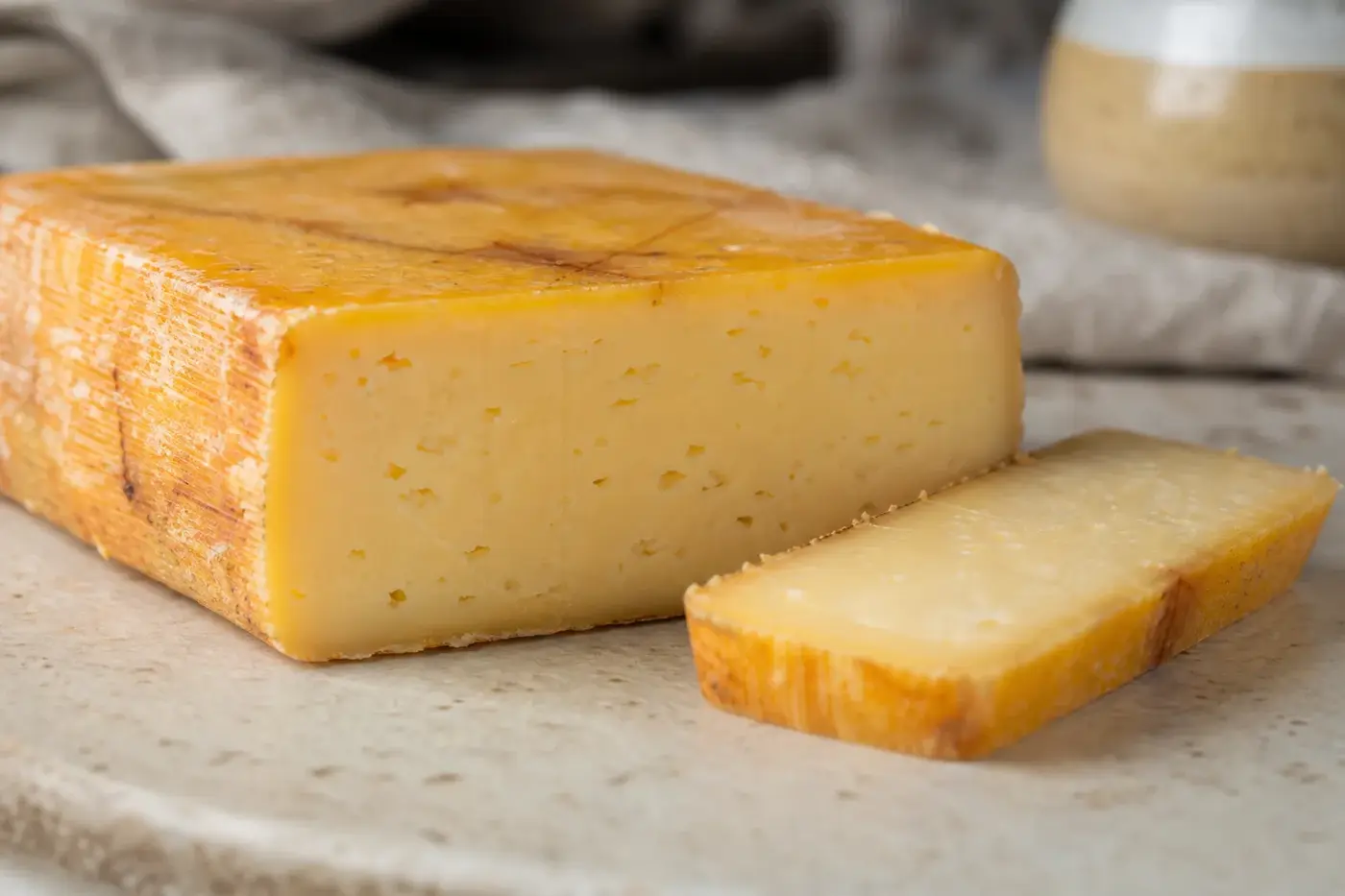
The familiar rindless block tells only part of the story. A deliberately developed surface gives you a different experience from the clean-sided cheese made for easy slicing. Give the outside a look before your attention settles entirely on the slice. [1]
The US Dairy Export Council’s reference manual describes a supple cheese with buttery flavour, a suggestion of nuts and, when young, a slight tartness. That account concerns US cheeses. Treat it as a portrait of the wider Havarti style, not the standard for Danish PGI production. [8]
At the counter, go beyond “mild or strong?” Ask whether your cheese is rindless or surface-ripened, and whether the producer gives an actual maturation period. You will learn more about your next mouthful than a broad strength description can tell you.
Meet Hanne Nielsen at Havarthigaard
In 1853, Hanne Nielsen began running the dairy at Havarthigaard as a separate enterprise. Her business was butter and an increasingly wide range of cheeses. The farm, also written Havarthigård, stood at Øverød in Denmark, and the Danish Biographical Dictionary records her particular reputation for cheesemaking and teaching. [5]
Here the story needs a careful distinction: an association is not an invention. The same scholarly biography states that the later Havarti did not originate in Nielsen’s cheesemaking. It credits her instead with developing Christian IX cheese. [5]
Havarthigaard therefore belongs to the history of Danish dairy expertise, rather than supplying a nineteenth-century recipe for today’s Havarti. Its lasting interest lies in practical knowledge taught and passed on. Behind the farm’s name, you find butter, an expanding repertoire of cheeses and Nielsen’s teaching, central to its reputation. [5]
This page summarises published guidance from the official sources it cites. It is not medical advice. Guidance differs between countries and changes over time, so check the current source for where you live, and ask your doctor, midwife, pharmacist or dietitian about your own circumstances.
Follow the milk to the mould
Under the EU production method, Havarti starts with standardised cow’s milk. Its fat content is adjusted before pasteurisation, then starter cultures and rennet are added. Rennet helps the milk set into curd, the solid material that becomes your cheese. [1]
The curd is then cut, stirred, drained of whey and heated before moulding and pressing. Whey is the liquid separated from the curd. Cooling, salting and ripening come next. [1]
Here the paths divide. Surface-ripened cheeses take a different route from those packaged for rindless maturation. That helps explain the differences in surface and intensity you encounter under the Havarti name. [1]
For the fuller picture, follow how cheese is made. You can trace milk setting, drainage, salting and maturation, with each stage put in context. It gives you the sequence without turning this into a home cheesemaking method.
Find the age you enjoy
If you want a more pronounced smell and flavour, pay attention to age. The EU description says both develop as Havarti matures. The specification sets required ripening conditions, while the producer’s declared maturation period tells you more about the particular cheese in front of you. [1]
Older does not necessarily mean harder. The US Dairy Export Council describes Havarti as becoming softer with age. “Mature” cannot tell you everything on its own, so give texture as much attention as flavour. [8]
Choose a younger, plain version when you want your cheese to sit comfortably beside other ingredients. For a mouthful led by the cheese itself, try a more mature example. Ask the cheesemonger about the cut face and finish, rather than settling for a strength number.
Where possible, compare like with like. Change the producer, fat content, surface treatment and age all at once, and discovering your favourite difference becomes a small research project. Keep the comparison simple enough to learn what you particularly enjoy.
Read the story behind the protected name
Havarti is registered as a protected geographical indication, or PGI, in the EU. Its registration instrument was adopted on 21 October 2019, published on 23 October 2019 and expressly applied from 12 May 2020. Each date marks a different legal event, although accounts of the registration commonly use the October date. [2,3]
Great Britain has a separate register, which records Havarti as registered from 31 December 2020. Defra explains the geographical split: UK schemes protect names sold in England, Scotland and Wales. EU schemes apply in Northern Ireland and the EU. [3,4]
A PGI is a shared geographical name, not one dairy’s brand. Producers using it must meet the relevant specification and verification requirements. When you see the name, those obligations are part of what sits behind the label. [4]
The protection also has borders. The EU registration instrument expressly recognises that EU law does not govern third-country territories, so registration does not settle use of the name everywhere. For the distinction between geographical protection, brands and generic usage, read protected names explained. [2]
Make room for dill, garlic or jalapeño
You do not have to stick to plain Havarti to stay within the EU specification. Herbs, spices, ramsons, garlic and jalapeños are among its permitted additions. Flavoured versions have a recognised place in the family. [1]
The ingredient list tells you what each version actually contains. Arla’s published Havarti sheet lists separate dill, caraway, jalapeño, and herb-and-spice products. Its jalapeño version includes paprika and chilli alongside dried jalapeño pieces; the herb-and-spice version includes dried onion, paprika and dill. [7]
Those declarations describe individual products, not a recipe shared by every Havarti. If this is your first encounter, start plain, then choose flavourings to suit your meal. Try dill with cucumber, or a pepper-flavoured version in a toasted sandwich. [7]
Choose an addition that works alongside whatever you plan to eat. Check the current pack for declared ingredients, coagulant information and dietary claims, because one product’s declaration cannot establish another’s composition. The guide to reading a cheese label shows you where to look.
Buy for dinner, wrap for tomorrow
Before choosing your format, picture what you will do with it. Will you mostly slice it cold, melt it, or serve it alone? A block leaves thickness and shape in your hands, while ready-cut slices save preparation.
At a counter, you have the chance to discuss maturation and surface treatment. Ask to see the cut face where possible, looking for that documented pale paste and small openings. If anything seems unfamiliar, ask the seller.
With a wrapped product, read its storage instructions before transferring it to another container. For domestic storage in England, Northern Ireland and Wales, the Food Standards Agency advises a fridge temperature between 0 and 5 °C and refrigeration for dairy products. Follow the pack’s storage instructions, date marking and directions after opening; the jurisdiction-specific recommendations here reflect November 2026. [6]
For quality, the US Dairy Export Council recommends tightly covering cut Havarti in barrier film and keeping it away from strongly aromatic foods. A close-fitting food wrap or the product’s resealable packaging is a useful starting point. The producer’s instructions still take priority. [8]
Once you have cut what you need, rewrap the remaining block rather than leaving a large cut face exposed. For the rest of your household routine, see how to store cheese at home.
Set the table for a simple tasting
For neat, even slices, cut your Havarti while it is chilled. The US Dairy Export Council specifically identifies chilled slicing as one of its useful handling characteristics. It is a small practical step before you settle down to taste. [8]
Bring out only the portion you intend to serve. Follow current Food Standards Agency guidance on chilling and preparing food in England, Northern Ireland and Wales. [6]
Keep your accompaniments simple: rye bread, crisp apple, cucumber or a small amount of pickle. Taste the cheese alone first, then add one accompaniment at a time so it stays at the centre of your tasting. Water is an uncomplicated drink alongside it; unsweetened tea is another option.
If you have chosen flavoured Havarti, begin with plain bread. That gives you a clearer impression of the added herb or spice. You can then decide whether you want that flavour running through a whole sandwich or cooked dish.
Let Havarti take care of the melting
Havarti’s kitchen appeal is less about forceful flavour than useful behaviour. The US Dairy Export Council describes it as melting very readily. Its suggested uses include sandwiches, casseroles, fondue and pizza blends. [8]
For a cold sandwich, try thin slices with cucumber and a restrained amount of mustard. If you are toasting it, spread the cheese evenly across the filling rather than piling a thick lump in the centre. Your sandwich deserves more than a cheese island.
Plain Havarti gives you the most flexible starting point when the other ingredients already include herbs or pickles. It also lends itself to cooked vegetables, a potato bake or a cheese sauce. Let the particular cheese guide what you make.
Its maturity and any added flavourings should help determine what else goes into the dish. These are ideas for you to adapt, not a fixed recipe. Start with the cheese you have, rather than expecting every Havarti to behave identically.
Carry your tasting on to Danbo and Esrom
Danbo and Esrom offer useful Danish comparisons, especially if texture and surface treatment have caught your interest. Arla describes Danbo as elastic and sliceable, with pea-sized eyes and a smear-treated surface. You have something specific to compare with your Havarti, rather than just another name to remember. [9,10]
Arla’s Esrom description emphasises a pliable body and numerous smaller openings. As it ages, surface ripening increasingly shapes its flavour. These are the producer’s published descriptions, not a reason to treat the cheeses as interchangeable. [9,10]
Let those differences guide your choice. Ask for Danbo if larger eyes and an elastic slice appeal, or explore Esrom for surface-ripened character. With Havarti, answer the first question before comparing flavour or age: is yours rindless, or has its surface been deliberately ripened?
Questions people ask
What is Havarti cheese made from?
The EU production method starts with standardised, pasteurised cow’s milk. Starter cultures and rennet are added to set the milk into curd.
Does Havarti have a rind?
Havarti can be rindless or smear ripened. The EU specification requires three weeks of ripening for rindless Havarti, while Havarti with a rind has one to two weeks of smear ripening followed by one to three weeks of further ripening.
How does Havarti change as it ages?
Its smell and flavour become more pronounced with age, according to the EU description. The US Dairy Export Council describes Havarti as becoming softer with age.
Does Havarti melt well?
The US Dairy Export Council describes Havarti as melting very readily. It recommends the cheese for sandwiches, casseroles, fondue and pizza blends.
How should Havarti be stored?
For England, Northern Ireland and Wales, the Food Standards Agency advises keeping the fridge between 0 and 5 °C and refrigerating dairy products. Check the Food Standards Agency’s current guidance and follow the pack’s storage instructions, date marking and directions after opening.
Sources
- European Commission. Publication of the communication of an approved standard amendment to a product specification of a geographical indication, C/2025/6706, 16 December 2025. Includes the Havarti amendment and single document, reference PGI-DK-00831-AM01.
- European Commission. Commission Implementing Regulation (EU) 2019/1751 of 21 October 2019 entering the name ‘Havarti’ (PGI) in the register of protected designations of origin and protected geographical indications. Official Journal L 269, 23 October 2019, Articles 1 to 3 and relevant recitals.
- Department for Environment, Food & Rural Affairs. Havarti. UK protected food names register entry, published 4 January 2021.
- Department for Environment, Food & Rural Affairs. Protected geographical food and drink names: UK GI schemes. Updated 8 March 2024.
- Dansk Biografisk Leksikon. Hanne Nielsen. Scholarly biography, published online 18 July 2011, drawing on the dictionary’s third edition and listed historical literature.
- Food Standards Agency. How to chill, freeze and defrost food safely. Published 18 December 2017; current retrieved guidance states that it applies to England, Northern Ireland and Wales.
- Arla Foods, Inc. Havarti chunks. Product information sheet, containing 2022 market references; individual product ingredient declarations and PGI statement. Commercial producer source.
- US Dairy Export Council. Reference Manual for U.S. Cheeses. Retrieved edition, publication year not verified; Havarti entry, printed page 46. Industry reference, not a Danish specification or food safety authority.
- Arla Foods. Arla Danbo. Undated producer description, retrieved November 2026.
- Arla Foods. Arla Esrom cheese. Undated producer description, retrieved November 2026.
- Food Standards Agency. Alerts. Official food and allergy alerts service, retrieved November 2026.
Researched through official legal publications, the GB register, official household guidance, Danish historical scholarship and attributed industry descriptions; practical accompaniment suggestions are editorial recommendations.
Last checked: November 2026
Last checked November 2026.
The editors suggest you read next