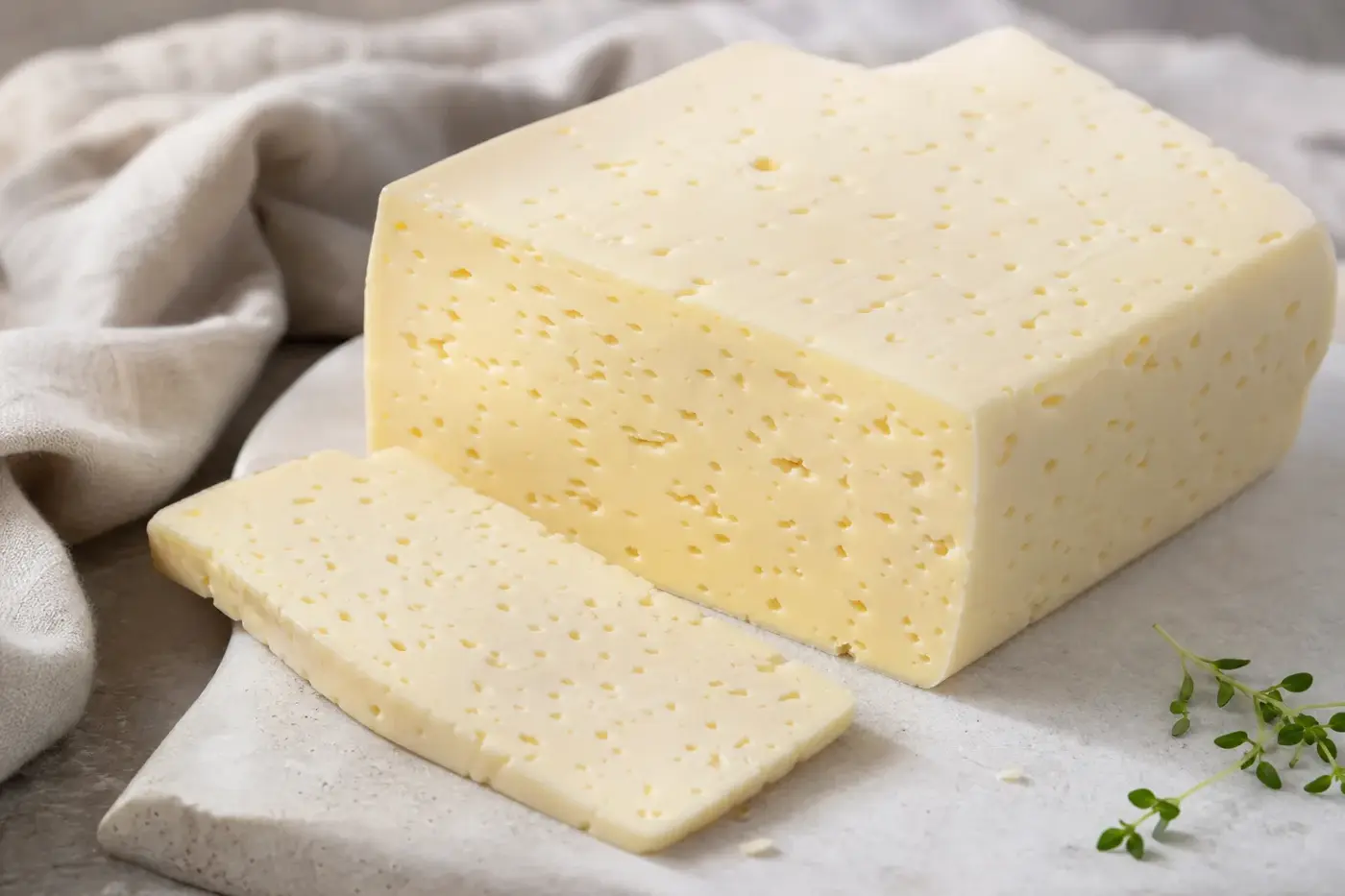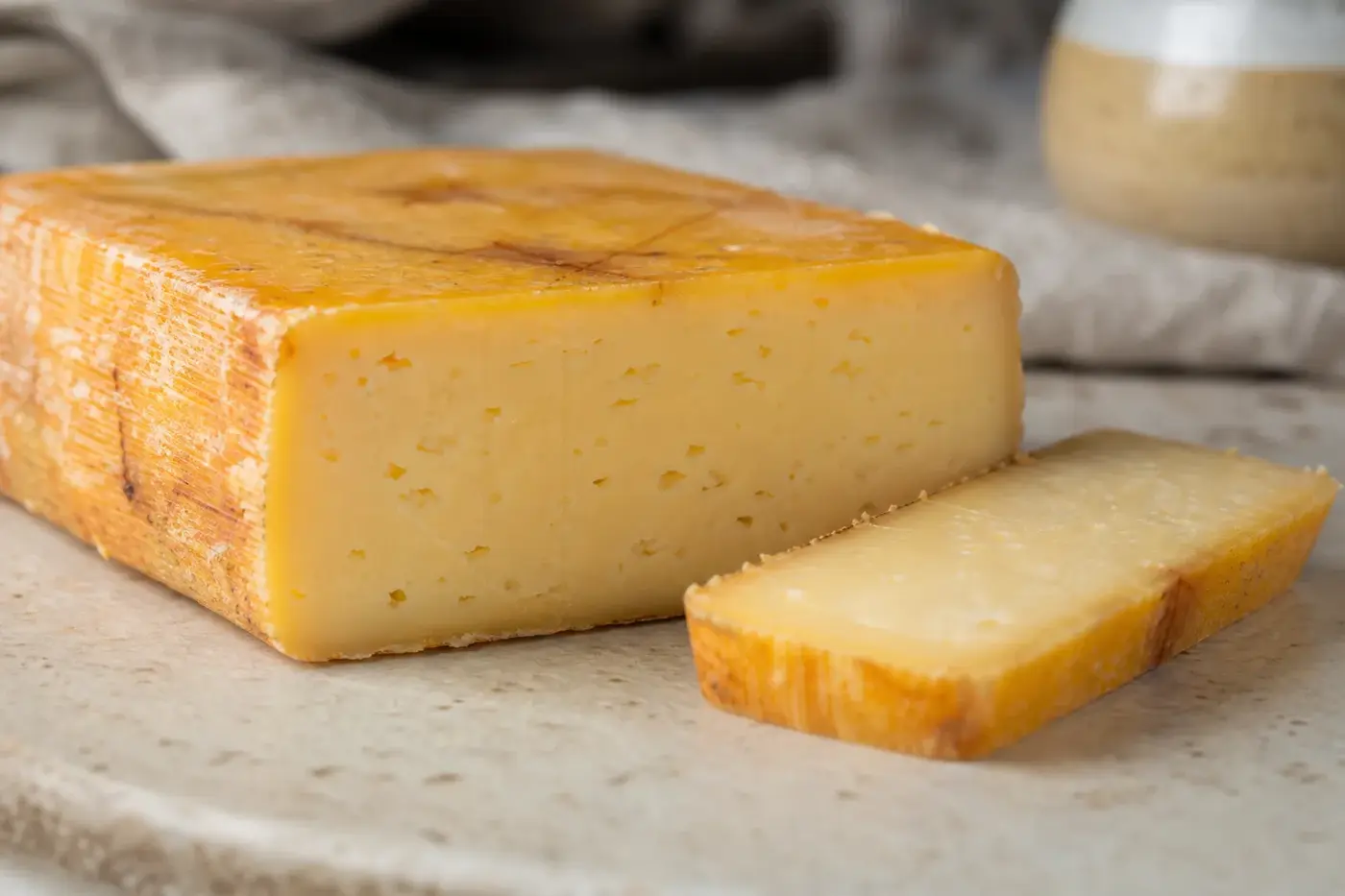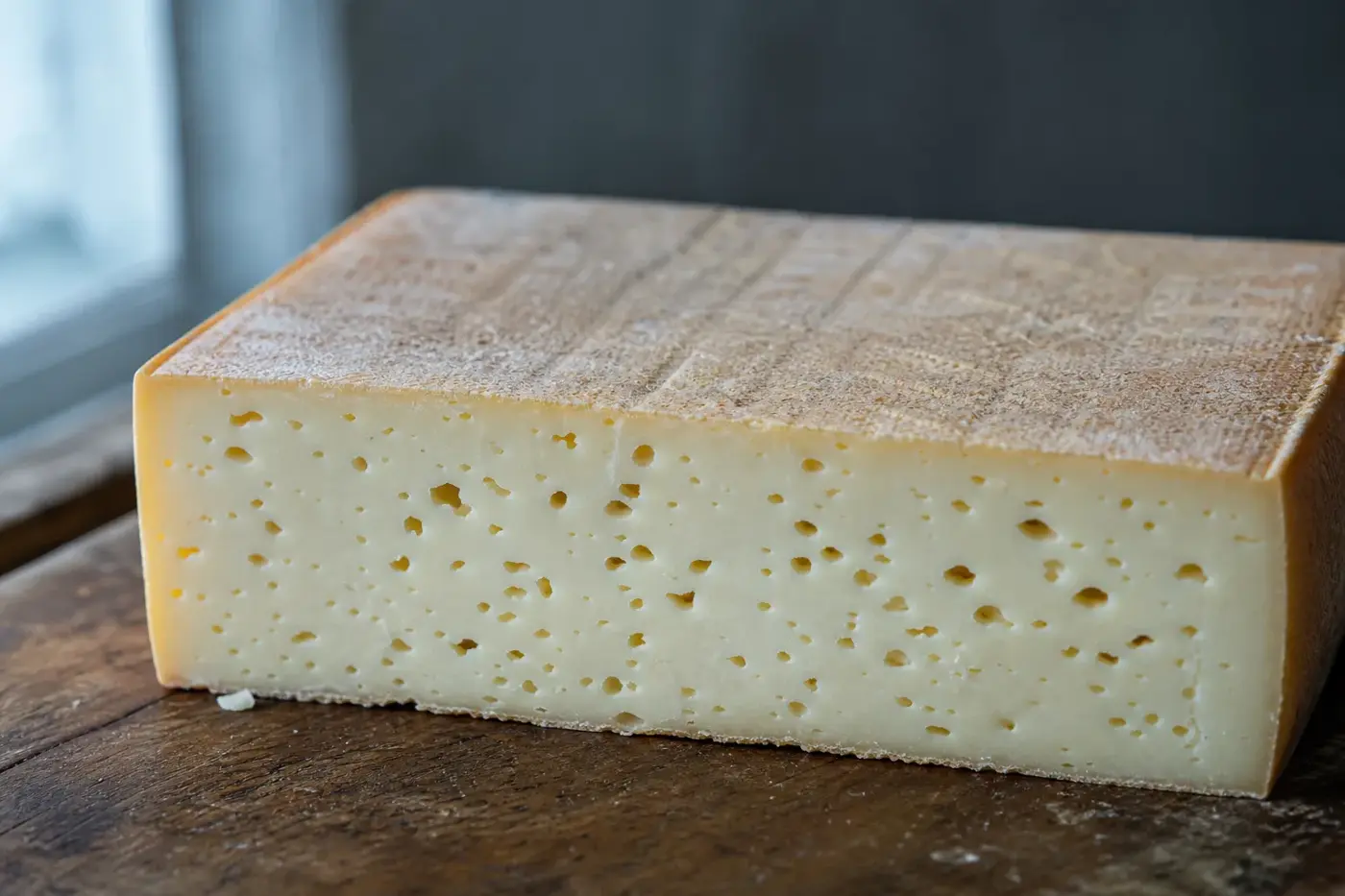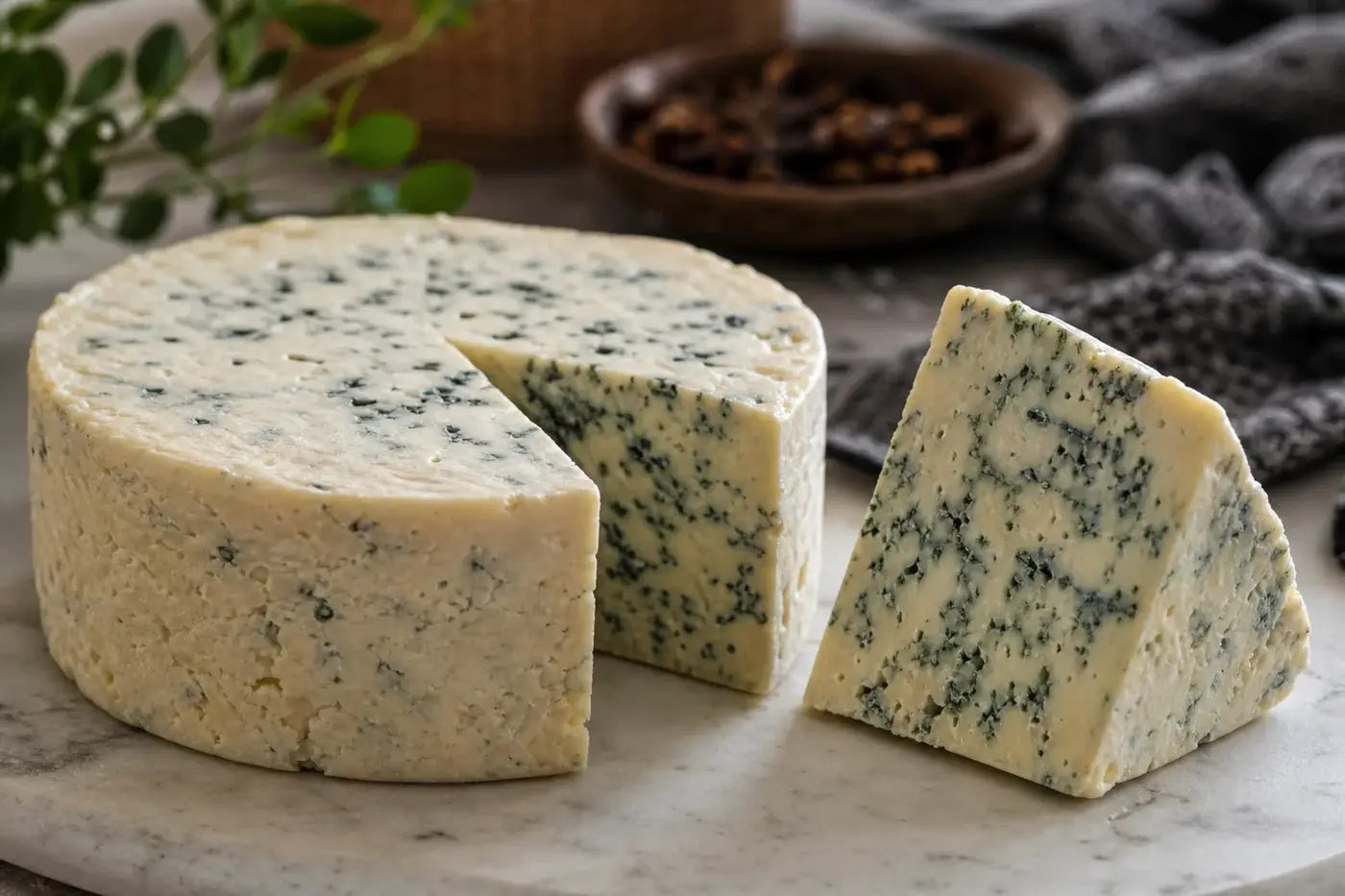
Steel needles pierce the salted cheese. Air slips in, blue-green veins begin to grow, and Danablu develops its sharp, salty bite.[1][5][6] Cut through the pale, yielding paste and you meet Denmark’s answer to French blue cheese, made with cow’s milk, homogenisation, mould and carefully introduced oxygen. Whether you reach for bread or a saucepan is your next happy decision.[1][5][6]
| What you might want to know | The detail |
|---|---|
| Familiar and registered name | Danablu; “Danish Blue Cheese” may accompany the registered name.[1] |
| EU authority and identifier | European Commission; amendment file PGI-DK-0328-AM01. Individual register record ID: Unconfirmed.[1] |
| Protection | EU: PGI, originally registered 21 June 1996. Great Britain: registered PGI from 31 December 2020. Position at November 2026.[2] |
| Northern Ireland | Covered by the EU GI scheme.[3] |
| Switzerland | Status: Unconfirmed. |
| United States | Status: Unconfirmed. |
| Production area and milk | Denmark; Danish cow’s milk.[1] |
| Milk treatment | Homogenised, then pasteurised or otherwise heat-treated, as described in the EU single document.[1] |
| Coagulant | Producer-specific rennet source: Unconfirmed.[5] |
| Ripening culture | Blue mould.[5] |
| Minimum maturation | Five weeks.[1] |
| Typical maturation | Approximately 60 days in Castello’s account.[6] |
| Allergen | Milk.[1] |
| Pregnancy guidance | UK: see NHS guidance below, as at November 2026.[10] |
Back to Funen, where Danish blue found its way
Picture Marslev dairy on Funen in the 1920s, with a cheesemaker working through experiments that helped establish Danish blue cheese. The Danish dairy industry’s Ost & ko account points to 1927 as the breakthrough, when cream enrichment met homogenised cheese milk.[4] That early twentieth-century development gave Danablu its beginnings.
France left a trace in the language, too. The official EU account records Danish rules for evaluating “Roquefort-type cheeses” taking effect on 1 January 1936. The official Danish name Danablu followed in 1952.[1]
But inspiration did not mean making the same cheese. Danish makers developed a cow’s milk blue with its own production approach, distinct from the raw sheep’s milk cheese described by Roquefort’s interprofession.[4][13] You can recognise the French influence without mistaking its Danish identity.
What the Danablu name promises you
When you buy Danablu, its EU specification promises Danish milk and every production step within Denmark.[1] Its PGI, or protected geographical indication, registers the geographical name and its connection to the cheese’s origin and characteristics. That small name carries quite a bit of geography.
It does not belong to one company. Defra explains that a GI belongs to no individual business: producers who follow the specification and meet its compliance requirements can use it.[3] The brand on your wrapper identifies the supplier’s product; Danablu identifies the registered cheese.
Great Britain has its own register, while Northern Ireland follows the EU scheme. These are separate protection jurisdictions, with the position here dating to November 2026.[2][3] For a clearer path through the wider distinctions, visit protected names explained.
Give the pale cheese a closer look
Look at a cut piece and follow the blue-green mould through its openings, cracks and piercing channels. Around it sits a white to lightly yellow paste. Ost & ko notes that the marbling may diminish towards the outside, where there is no substantial rind, only a close, somewhat firmer outer layer.[4]
Your wedge once belonged to something larger. Whole Danablu may be a flat cylinder, approximately 20 cm across and 3 kg, or a rectangular cheese approximately 30 cm long, 12 cm wide and 4 kg.[1] The piece on the shop counter gives you just part of the picture.
Give that pale paste as much attention as the blue. You want a body you can slice or spread, rather than simply the busiest possible pattern of veins. Arla describes an open structure that can crumble lightly.[5]
This page summarises published guidance from the official sources it cites. It is not medical advice. Guidance differs between countries and changes over time, so check the current source for where you live, and ask your doctor, midwife, pharmacist or dietitian about your own circumstances.
Milk, mould and the needles that let air in
Homogenisation is central to Danablu’s character. It changes how milk fat is dispersed, and Arla associates it with the cheese’s characteristic fat-derived sharpness.[5] Pasteurisation has a different role: it treats milk with heat. On your label, the two words tell you different things.
In Arla’s account, mould culture goes in before rennet, the milk-clotting preparation that turns liquid milk into curd. The curd enters moulds and drains, gradually becoming a coherent cheese.[5] Castello describes cutting the curd, draining away whey, the separated liquid, and salting before maturation.[6]
Then those steel needles get their turn. Blue mould needs oxygen, so the salted cheeses are pierced to open channels where mould can grow inside and contribute flavour.[5] Those little holes are doing rather more than decorating.
Time takes over from there. Castello describes roughly 60 days of maturation, compared with the legal minimum of five weeks.[1][6] If the wording on your pack leaves you puzzling, turn to milk treatments explained.
A creamy beginning, a sharper finish
Take a mouthful and notice how softness meets intensity. Arla describes a soft, creamy consistency with an intense, sharp taste; Castello adds salt and mild bitterness.[5][6] You get the yielding cheese first, then a blue-cheese finish that makes itself known.
The balance varies from piece to piece. Ost & ko describes both 50% and 60% fat-in-dry-matter versions, while published accounts include softer and firmer textures.[4] Fat in dry matter means fat measured after excluding water, not fat per 100 g of cheese.
Ask about the particular cheese in front of you. “Sharper”, “softer” or “more spreadable” will get you closer to your ideal piece than simply asking for the strongest blue. Your cheeseboard need not be an endurance test.
Taste it beside Roquefort, Stilton and Aura
Start with the milk when you compare Danablu and Roquefort. Danablu uses cow’s milk; Roquefort’s interprofession describes its cheese as made from raw sheep’s milk.[1][13] The blue veins suggest a family resemblance, but the textures and flavours are not interchangeable.
Blue Stilton gives you another point of comparison: method. The Stilton Cheesemakers’ Association describes smoothing and sealing the exterior before later piercing, followed by individual grading.[7] Danablu has its own production sequence and that relatively close outer layer.[4][5]
For a Nordic comparison, try Aura, a Finnish blue-cheese product sold by Valio. Its published ingredients are milk, starter culture, salt and blue-cheese culture.[8] Put a labelled example beside your Danablu and taste them together. The actual cheeses on your plate tell you more than a fixed national flavour hierarchy.
Find your favourite, then read the wrapper
Begin with the registered name, then look at milk treatment, ingredients, storage instructions and date marking. Note the maker or supplier, too. When you find a Danablu you particularly enjoy, that detail helps you find the same expression again.
If you need a vegetarian cheese, seek a product-specific answer. Read the declaration or ask the producer about the coagulant: general production accounts mention rennet without establishing its source in every Danablu.[5][6] The cheese’s name alone cannot settle that question.
Keep what the production rules permit separate from what your particular pack declares. If milk treatment or rennet information matters to you and is missing, ask before buying. For help distinguishing product details from broader descriptions, read reading a cheese label.
A simple plate, with space for the cheese
Begin with a small piece per person. You and your guests can get a feel for Danablu’s intensity before deciding whether to have more. Put out only what you expect to eat and keep the rest refrigerated.
Serve at fridge temperature, 5 °C or below.[9] For England, Wales and Northern Ireland, the FSA recommends a fridge range of 0 to 5 °C. It also advises keeping chilled food out of the fridge for the shortest possible time during preparation.[9]
For something alongside, Castello suggests apple and pear; Arla recommends honey to round out the sharper taste.[5][6] You do not need to fill every corner of the plate. Choose one contrast and let yourself taste what it brings to the cheese.
| Beside your Danablu | A good place to start |
|---|---|
| Plain bread or rye bread | Taste the cheese without another strong flavour competing. |
| Apple or pear | Try Castello’s fruit contrast to the sharper cheese.[6] |
| A little honey | Follow Arla’s suggestion to soften the impression of sharpness.[5] |
| Port | A pairing suggested by the Danish industry account.[4] |
For an alcohol-free option, try water with fresh pear, letting the fruit provide the counterpoint. Alcoholic pairings are for adults of legal drinking age; offer only a small serving and an alcohol free alternative. People who are pregnant, driving, taking medicines that interact with alcohol or recovering from alcohol dependence should not drink. Consult current NHS advice.
Give your cooking a little blue-cheese depth
Think of Danablu as seasoning as well as cheese. Arla documents dressings and sauces, while Castello suggests soups and pasta.[5][6] Add it gradually, then taste a whole mouthful before deciding whether the dish needs more.
For a dressing, start with a mild dairy base. Blend it smooth or leave small pieces of cheese, depending on the texture you want. Arla’s blue-cheese dip combines blue cheese with sour cream and mayonnaise, a useful model for carrying its flavour through a larger mixture.[14] Hold some cheese back until you have tasted the result.
For a sauce, let the other ingredients establish the dish before adjusting the cheese. A gentle background makes that blue character easier to control. Taste before adding salt, and give the different flavours room rather than asking them all to compete.
For a salad, scatter small pieces evenly so that a few large chunks do not dominate. Alternatively, carry the cheese through the dressing, as in Arla’s romaine salad with blue-cheese dressing.[15] These are cooking suggestions, not a set of tested recipes.
Keep it cold, and keep the label
Keep the original packaging and follow its storage instructions. Once you have cut the cheese, a practical approach is to cover the exposed part with clean food wrapping and place it in a clean, lidded container. Keep the label with it, so you retain the date and after-opening instructions.
In England, Wales and Northern Ireland, follow the FSA’s 0 to 5 °C fridge advice alongside the pack’s directions.[9] UK date-marking guidance makes an important distinction: a use-by date concerns safety; a best-before date concerns quality.[11] Read each according to its purpose.
Know what belongs in Danablu before judging a change. Its intended blue-green marbling is internal; the industry description excludes a greyish paste, excessive mould coverage and foreign growth in the piercing channels.[4] Blue colour alone cannot establish whether a suspect piece is suitable. Consult the official advice linked in mould on cheese.
Pregnant? Cook Danablu until steaming hot
In the UK, Danish blue must be thoroughly cooked during pregnancy, whether its milk is pasteurised or unpasteurised. NHS guidance as at November 2026 specifically includes it among soft blue-veined cheeses. It says cheese cooked until steaming hot can be eaten.[10]
Read the current NHS pregnancy guidance and ask your midwife or another healthcare professional about your circumstances. Outside the UK, consult your own country’s official advice. For broader handling questions, see cheese food safety.
Questions people ask
What does Danablu taste like?
Danablu is soft and creamy, with an intense, sharp taste. Castello also describes saltiness and mild bitterness.
Is Danablu made from pasteurised milk?
The EU specification says the Danish cow’s milk is homogenised, then pasteurised or otherwise heat treated. Check the pack or ask the producer about a particular cheese.
Is Danablu suitable for vegetarians?
The name alone does not establish whether a Danablu is vegetarian. Production accounts mention rennet without establishing its source in every cheese, so check the declaration or ask the producer.
Can I eat Danablu during pregnancy?
The NHS says Danish blue must be thoroughly cooked during pregnancy, whether made from pasteurised or unpasteurised milk, and that cheese cooked until steaming hot can be eaten. See the current NHS pregnancy guidance on foods to avoid: https://www.nhs.uk/pregnancy/keeping-well/foods-to-avoid/
How should I store Danablu?
Keep the original packaging and follow its storage instructions. For England, Wales and Northern Ireland, the FSA recommends a fridge range of 0 to 5 °C.
Sources
- European Commission, Publication of the communication of an approved standard amendment to a product specification of a geographical indication, C/2025/6673, 15 December 2025. Includes the Danablu single document, file PGI-DK-0328-AM01. Official publication.
- Department for Environment, Food & Rural Affairs, Danablu, protected food names register, published 2021, current entry retrieved November 2026. Register entry.
- Department for Environment, Food & Rural Affairs, Protected geographical food and drink names: UK GI schemes, updated 8 March 2024. Official guidance.
- Ost & ko, Danish dairy industry information, Danske BGB-oste: Her er de 4 unikke oste med BGB-mærket, undated current page, Danablu section. Industry account.
- Arla, Danablu, ingredient encyclopaedia, 7 April 2026. A commercial producer’s account of production, flavour and uses. Producer account.
- Castello, Danish Blue (PGI), undated current page. A commercial brand’s account of production, maturation and accompaniments. Brand account.
- Stilton Cheesemakers’ Association, Making Stilton, undated current page. Industry production account.
- Valio, Valio Aura blue cheese 170g, undated current product page. Product information.
- Food Standards Agency, How to chill, freeze and defrost food safely, published 18 December 2017, current text retrieved November 2026. Applies to England, Wales and Northern Ireland. Official guidance.
- NHS, Foods to avoid in pregnancy, current text retrieved November 2026. Official pregnancy guidance.
- GOV.UK, Understanding food labelling: Best before and use-by dates, current text retrieved November 2026. Official guidance.
- Food Standards Agency, Alerts, live food and allergy alert index, retrieved November 2026. Official alert index.
- Confédération Générale de Roquefort, Un fromage de brebis au lait cru, undated current page. An interprofessional account, not a regulator’s statement. Milk and production account.
- Arla, Cremet dip af blå ost, undated current recipe page. Commercial producer recipe, not independently tested by fromage.co.uk. Source recipe.
- Arla, Grillet romainesalat med blåskimmeldressing, undated current recipe page. Commercial producer recipe, not independently tested by fromage.co.uk. Source recipe.
Researched through official protection documents and public guidance, with attributed industry and producer accounts for history, production, sensory descriptions and culinary uses.
Last checked: November 2026
Last checked November 2026.
The editors suggest you read next