Emmi
Picture Lucerne on 9 February 1907: 62 dairy farming cooperatives coming together to found a milk association.
Picture Lucerne on 9 February 1907: 62 dairy farming cooperatives coming together to found a milk association. No supermarket cheese brand yet. Follow their story and you reach a listed dairy group linking Swiss cave maturation with cheese businesses overseas, drinking milk, coffee drinks and desserts. Milk producers still hold the controlling interest.[1,2,3]
| Emmi at a glance | What you need to know |
|---|---|
| Full legal name | Emmi AG.[2] |
| Home base | Lucerne, Switzerland.[2] |
| Ownership model | Listed company with a milk producer majority shareholder.[2,4] |
| Stock exchange debut | SIX Swiss Exchange; first trading on 6 December 2004.[1,2] |
| Controlling shareholder | ZMP Invest AG; 53.4% holding reported in the 2025 annual report.[2] |
| Link between ZMP Invest AG and the producer organisation | Precise relationship unspecified here.[4,5] |
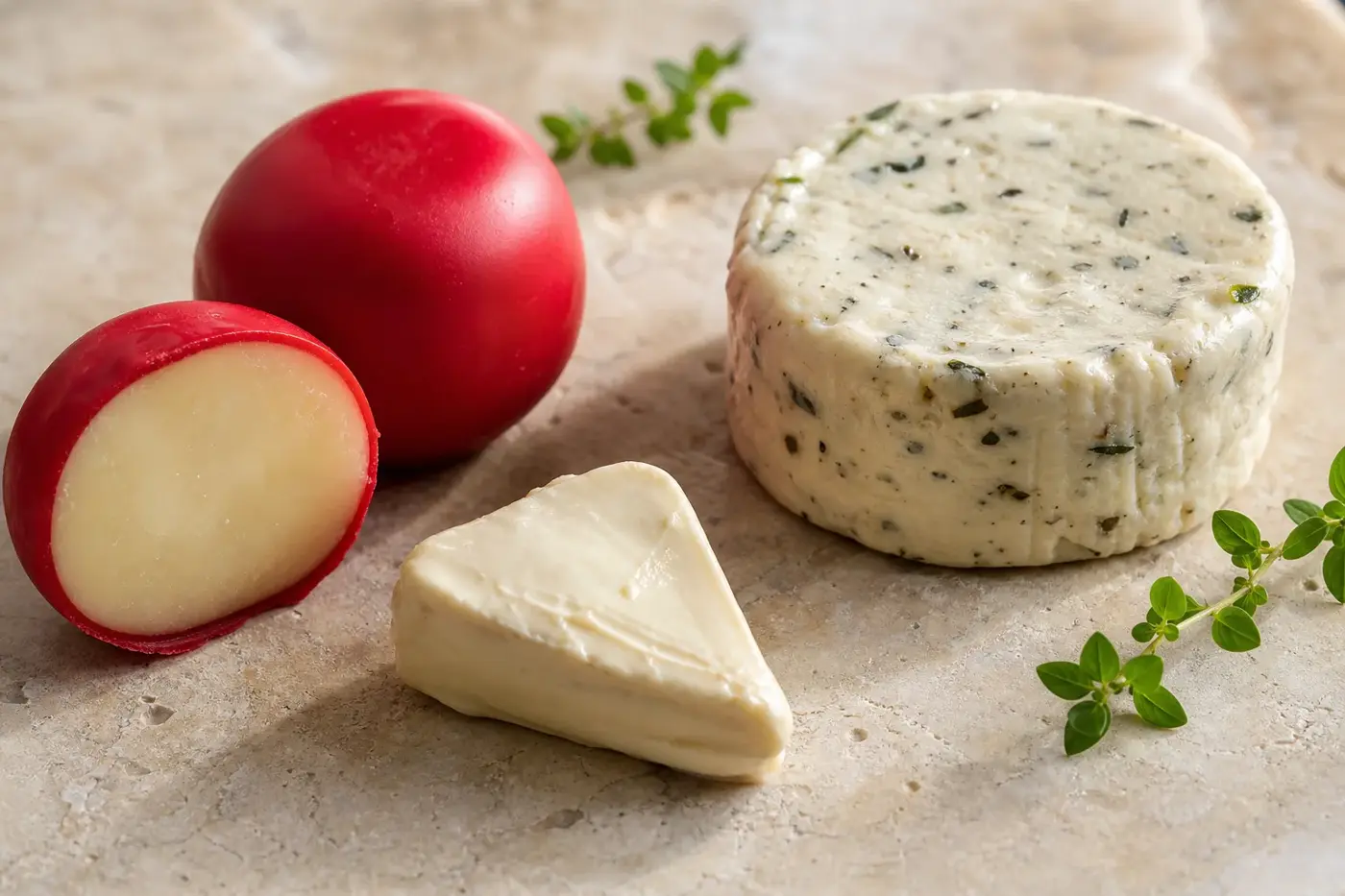
| Main cheese businesses and brands you’ll meet here | Kaltbach, Emmi Roth, Cypress Grove, Emmi Bettine and Athenos.[3,6,7] |
| Ownership reference date | Subsidiary interests at 31 December 2025; source reference point November 2026.[3] |
Start with the farmers, not the brand
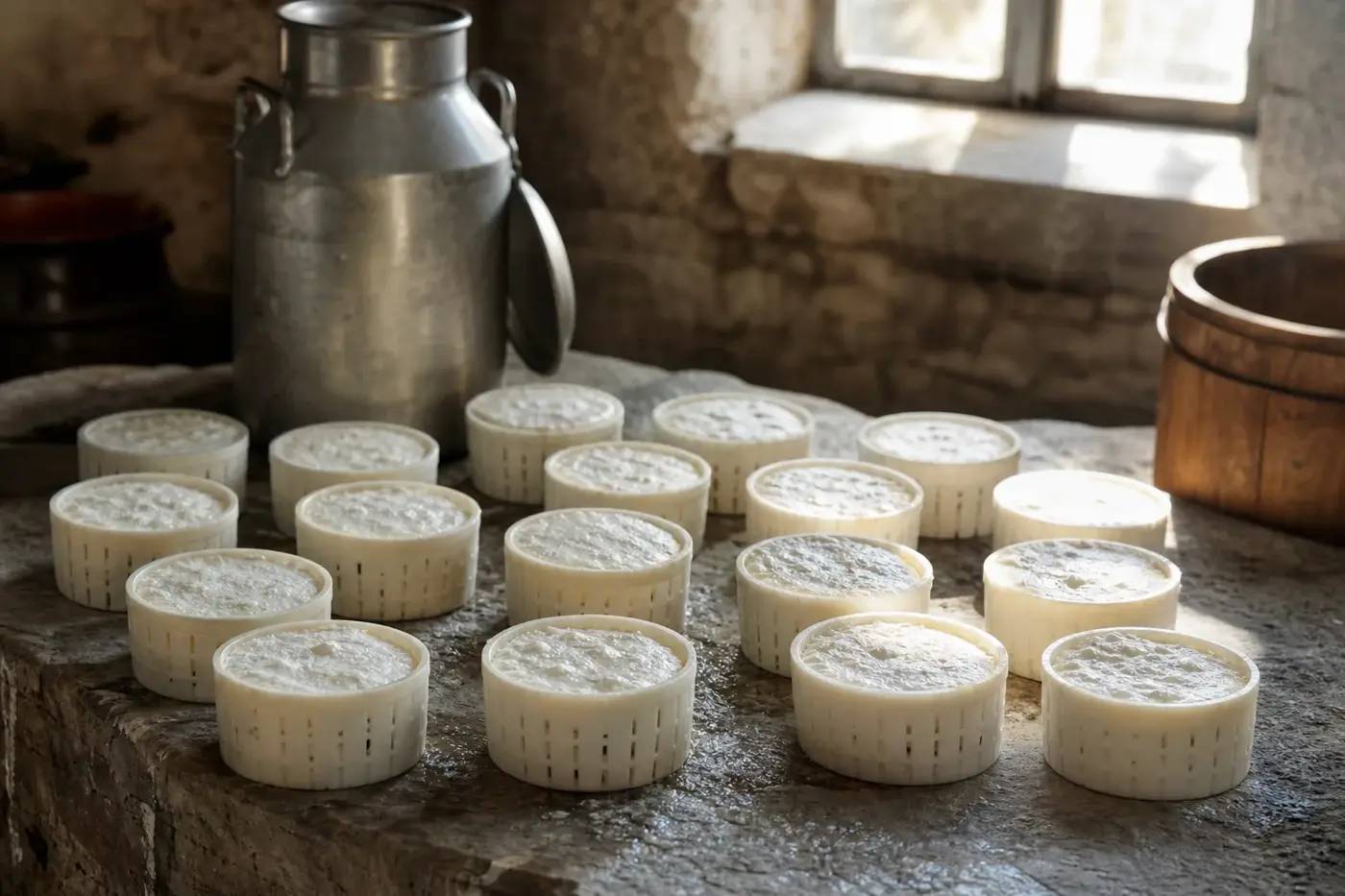
Before Emmi had a name for the cheese counter, farmers needed to organise milk collection and processing. Those 62 dairy farming cooperatives established the Central Switzerland Milk Association in Lucerne on 9 February 1907. The Emmi name first appeared on soft cheese and yoghurt in 1947, taking its name from the municipality of Emmen.[1]
Then comes another birthday. Emmi AG was established on 23 June 1993, separating association activities from commercial operations. Its shares first traded on the Swiss stock exchange on 6 December 2004.[1]
Between those milestones, cheese helped change the business. In 2002, Emmi took over Swiss Dairy Food’s cheese activities, bringing cheese manufacturing and maturation businesses into the group. International expansion later added American and Dutch dairy businesses, alongside investments in other markets.[1]
Which founding year should you remember? Think of the cooperative organisation, then the brand, then the listed company. It is a crowded birthday calendar, but each date marks a different relationship between farmers, processing businesses and customers.[1,2]
The farmers still have a say
That cooperative connection belongs to the present, not just the company history. Emmi’s 2025 annual report records ZMP Invest AG’s holding at 53.4%, a majority of the registered shares. Behind that controlling interest stands ZMP, the central Swiss milk producers’ organisation.[2,4,5]
ZMP’s work goes beyond holding an investment. It describes bringing together members’ milk supplies, organising purchasing and transport, and representing producers’ interests. That milk then goes to processing businesses to become cheese, butter, yoghurt and other products.[5]
Emmi has its own board and executive management. Shareholders exercise their rights through the listed company’s corporate governance arrangements, so producer influence comes through ownership and governance. It does not mean every supplying farmer directly manages an Emmi dairy.[2,8]
One important arrangement changed during 2025. On 7 November 2025, a shareholder group comprising ZMP Invest and two other cooperative organisations announced its dissolution; the annual report subsequently lists their holdings separately. ZMP Invest’s individual majority is distinct from that former shareholder agreement, which is no longer a continuing ownership group.[2]
There is more here than cheese
You might meet Emmi at the cheese counter, but its business stretches much further. Its 2025 annual report describes 73 production sites in 13 countries. Products reach around 90 countries through retailers, food service businesses, industrial customers and, sometimes, direct sales to consumers.[9]
Those numbers describe two different things. A country selling imported Emmi cheese need not have an Emmi factory. A production subsidiary, meanwhile, may serve its domestic market rather than export Swiss products.[9]
The 2025 accounts divide operations into Switzerland, Americas, Europe and Global Trade. Cheese represented 27.4% of group net sales in a category combining natural and processed cheese. Fresh cheese, counted separately, represented 5.5%, so keep those categories apart when comparing cheese with the group’s other activities.[3]
Coffee drinks and desserts also have substantial roles in the strategy. Emmi identifies ready-to-drink coffee, speciality cheese and desserts as selected growth areas. Dessert operations in Italy, the United States and Europe show how far the business has travelled from its original milk-processing base.[6,10]
Step into the cave at Kaltbach
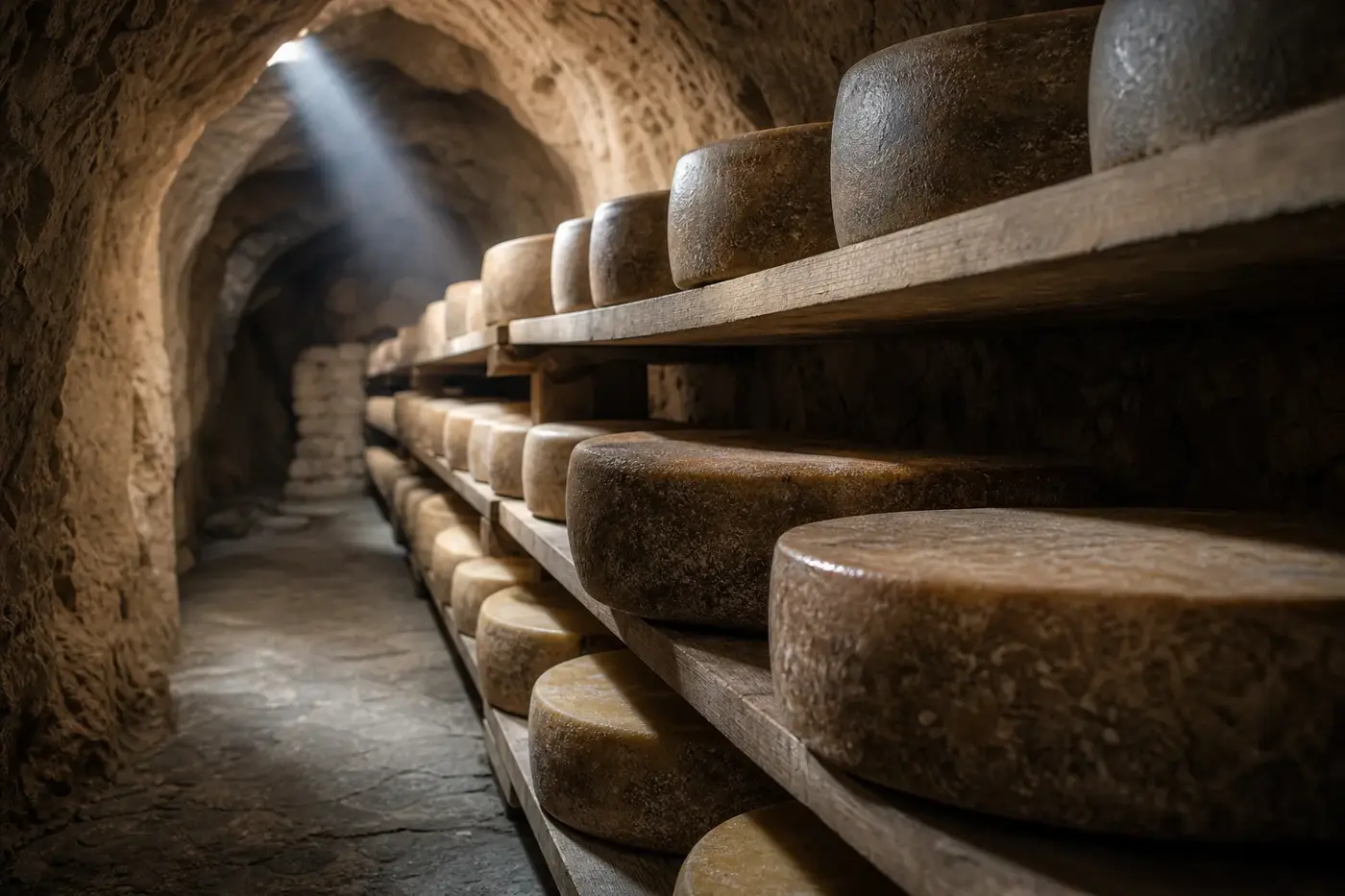
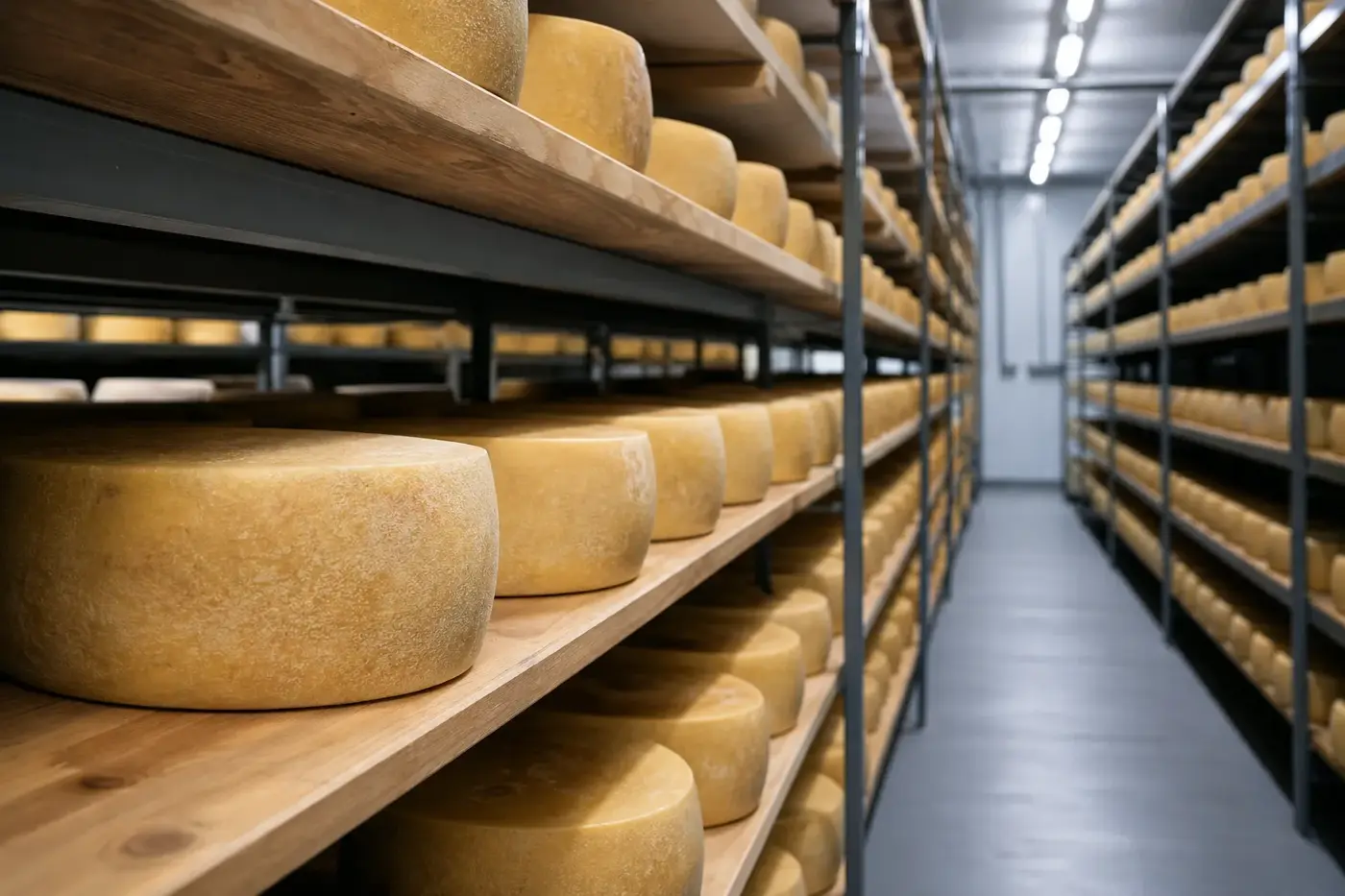
At Kaltbach, making the cheese is only the beginning. The brand centres on Swiss cheeses matured in a cave, with Emmi crediting their development to its natural climate and the attention of the maturation team. Patience, here, has a proper job description.[7]
This work is maturation, also called affinage: the managed development of cheese after manufacture. Kaltbach puts it in the foreground. The prominent business name on your cheese may belong to the people selecting and maturing it, rather than the dairy that made the wheel.[7,11]
You will find that distinction throughout Emmi’s Swiss cheese activities. Manufacturing interests, maturation operations and commercial distribution can all sit within the group. They remain separate steps, sometimes carried out by different businesses in different places.[1,3,9]
Kaltbach is a commercial brand, not a protected cheese designation. The brand identifies a particular commercial offering; a protected designation identifies cheese governed by its registered specification. Read both names together for a fuller picture of the cheese in front of you.[7,11]
Follow the cheese beyond Switzerland
Emmi’s international cheese interests bring locally established businesses together with brands sold through wider distribution networks. The ownership figures below come from its consolidated company list at 31 December 2025. They are not figures taken from acquisition announcements.[3]
| Business | Where you’ll find it | Emmi’s interest at 31 December 2025 |
|---|---|---|
| Emmi Roth USA, Inc. | United States | 100%.[3] |
| Cypress Grove Chèvre, Inc. | United States | 100%.[3] |
| Emmi Bettine B.V. | Netherlands | 100%.[3] |
These names identify legal businesses. Athenos, meanwhile, is a brand in Emmi’s international cheese portfolio. If you want to understand ownership, that distinction matters: a subsidiary owns assets and runs operations, while a brand identifies products in the market.[3,6]
Emmi describes an international model built around local expertise and adaptation to local customers. This is not simply a story of Swiss wheels travelling abroad. It also involves businesses established overseas, working with their own milk supply chains and markets.[6,9]
That gives cheese two routes to your shopping basket. Swiss products can travel through the group’s commercial network, while overseas subsidiaries can make or market products rooted in their operating regions. Group ownership connects those routes without making their origins the same.[6,9]
Give the protected name its due
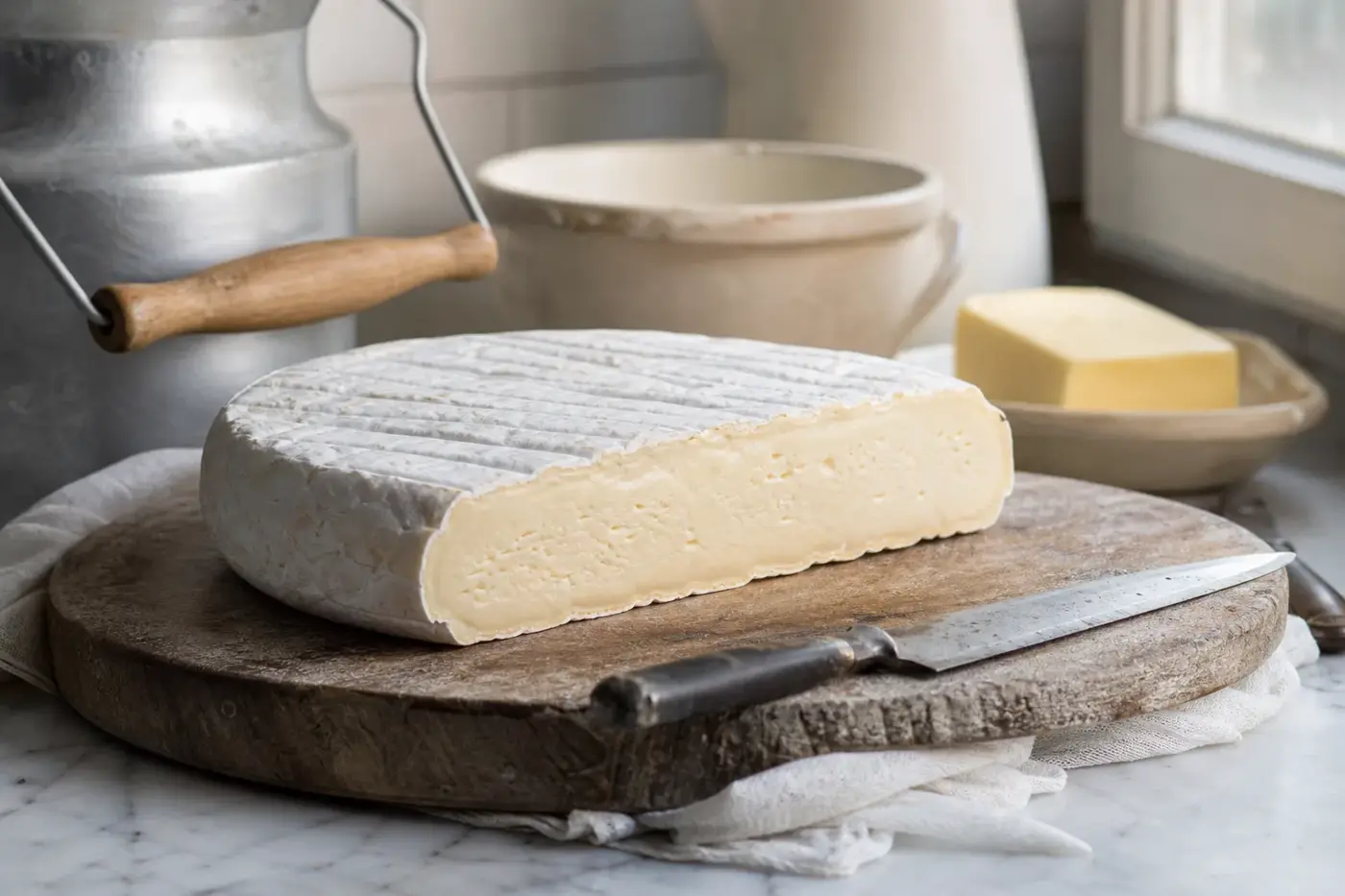
When you see Gruyère, there is a specification behind the name. It appears in the Swiss federal register as an appellation d’origine protégée, abbreviated AOP, or protected designation of origin. The official specification sets the reference for its production area, milk requirements, manufacture, maturation and identification.[11]
For an Emmi product carrying that designation, the question is whether that particular cheese complies with the specification. The company’s size, ownership and international distribution network are separate matters. You can explore the distinction through Le Gruyère and protected names.
Geography matters to legal protection, too. The scope and current legal position of the United States decision on GRUYERE remain unresolved here.[12]
Read the designation, country of manufacture and brand together. A familiar cheese word can have a different legal position across markets. Where your particular cheese was made is a separate factual question, answered by its own product information.[11,12]
Meet the maker, the maturer and the distributor
Emmi works at several points along the dairy chain. Its reporting covers milk procurement, processing, distribution and relationships with other businesses throughout that chain.[9]
On your cheese label, four descriptions answer four different questions. Keep them separate and the wording becomes much more useful:
- Made by tells you which business manufactured the cheese.
- Matured by tells you which business managed its ripening.
- Distributed by tells you which business supplied it through a market.
- Sold under tells you the commercial brand used for the product.[7,9]
One company can perform several of those roles. A group name alone, though, does not identify the dairy behind an individual cheese. Kaltbach illustrates the maturation role, while Emmi’s subsidiary list shows why a legal manufacturer can have a different name from its parent group.[3,7]
Look for explicit manufacturing information rather than assuming the biggest name on the pack made the cheese. If the product details do not identify the manufacturer, the question stays open. A distributor’s address is a useful contact, but manufacturing origin needs evidence of its own.
Follow the milk back to the farm
Emmi generally buys milk rather than producing it. A small Californian goat farm is the identified exception. Its influence on farming therefore comes mainly through supplier requirements, purchasing relationships and joint projects.[4]
In Switzerland, Emmi reports processing milk under the Sustainable Swiss Milk industry standard since the start of 2024. Outside Switzerland, its 2027 objective is milk produced to standards exceeding the local average. The definition matters: international milk must exceed conventional milk in at least one sustainability aspect.[4]
Animal welfare claims need their geographical context, too. At the Chilean business Quillayes Surlat, Emmi reports that 84 farms covered 94% of milk volume under Bienestar Animal certification at the end of 2025. It names AENOR as the certifier and describes annual farm audits; those results belong to that business’s supply chain.[4]
For climate, Emmi’s revised targets use 2023 as the baseline. They seek a 46.2% reduction in absolute Scope 1 and Scope 2 emissions by 2031. Those categories cover direct operational emissions and emissions associated with purchased energy.[13]
The 2025 results move in different directions. Emmi reports Scope 2 emissions 63% below the restated 2023 baseline, attributing much of the reduction to electricity certificates purchased by its UK dessert business. Agricultural and land-related Scope 3 emissions were around 3% above the baseline.[13]
Acquisitions and improved data changed the reporting boundary, an important detail when you compare years. Emmi restated earlier emissions figures, while some other environmental indicators exclude specified businesses. The sustainability report received limited assurance over selected information, not an audit covering every statement equally.[14]
Let the label tell you more
Start with the cheese in front of you, then work out what Emmi’s name tells you about it. That order keeps the product’s facts separate from the wider group’s identity.
- Read the product name. Separate the brand, any protected designation and the general cheese style.
- Find where it was made. Look for an explicit country of production, not merely a supplier’s postal address.
- Look at the milk information. Read the species and any stated treatment for that particular product.
- Unpick the maturation wording. Does it describe total age, a maturation location or the business responsible for ripening?
- Identify each business’s role. Distinguish manufacturer, maturer and distributor wherever the information allows.[7,9,11]
For the terminology behind the label, turn to milk treatments. For a fuller method, explore how to read a cheese label, keeping the actual pack and its market-specific wording in view.
Questions people ask
Who owns Emmi?
Emmi AG is a listed company with a milk producer majority shareholder. Its 2025 annual report records ZMP Invest AG holding 53.4% of its registered shares.
What is special about Kaltbach cheese?
Kaltbach is an Emmi brand centred on Swiss cheeses matured in a cave. Emmi attributes their development to the natural climate and the attention of its maturation team.
Which cheese businesses and brands does Emmi own?
Emmi’s cheese interests include Kaltbach, Emmi Roth, Cypress Grove, Emmi Bettine and Athenos. Athenos is a brand, while Emmi Roth, Cypress Grove and Emmi Bettine are legal businesses.
Does the Emmi name tell me who made a cheese?
Not necessarily. An Emmi group business may have matured or distributed a cheese rather than manufactured it, so look for explicit manufacturing information on the product.
Where does Emmi get its milk?
Emmi generally buys its milk from suppliers. In Switzerland, it reports processing milk under the Sustainable Swiss Milk industry standard since the start of 2024.
Sources
[1] Emmi Group, History, undated corporate chronology, retrieved November 2026.
Read at group.emmi.com
[2] Emmi AG, Annual Report 2025: Group structure and shareholders, reporting year 2025.
Read at report.emmi.com
[3] Emmi AG, Annual Report 2025: Notes to the consolidated financial statements, reporting year 2025, segment reporting and consolidated company interests.
Read at report.emmi.com
[4] Emmi AG, Annual Report 2025: Sustainable dairy, reporting year 2025.
Read at report.emmi.com
[5] Zentralschweizer Milchproduzenten, Die ZMP: organisiert im Interesse der Milchproduzenten, undated organisation website, retrieved November 2026.
Read at zmp.ch
[6] Emmi AG, Annual Report 2025: A strong international market player, reporting year 2025.
Read at report.emmi.com
[7] Emmi Kaltbach, Meisterwerke aus der Höhle, undated Swiss brand website, retrieved November 2026. Commercial source describing its own products and maturation.
Read at emmi-kaltbach.com
[8] Emmi AG, Annual Report 2025: Board of Directors, reporting year 2025.
Read at report.emmi.com
[9] Emmi AG, Annual Report 2025: We are Emmi, reporting year 2025.
Read at report.emmi.com
[10] Emmi AG, Annual Report 2025: An innovative leader in selected niches, reporting year 2025.
Read at report.emmi.com
[11] Swiss Federal Office for Agriculture, AOP / IGP: appellations d’origine et indications géographiques, Gruyère register section, and Cahier des charges pour Gruyère, specification linked from the register, retrieved November 2026. The register displays the specification document date as 27 July 2016.
Read at blw.admin.ch
Read at blw.admin.ch
[12] United States Court of Appeals for the Fourth Circuit, Interprofession du Gruyere v. U.S. Dairy Export Council, No. 22-1041, decision filed 3 March 2023. Official government-hosted opinion.
Read at govinfo.gov
[13] Emmi AG, Annual Report 2025: Reducing emissions, reporting year 2025.
Read at report.emmi.com
[14] Emmi AG, Annual Report 2025: About this report, reporting year 2025, sections 4.4 to 4.6.
Read at report.emmi.com
This piece was researched from Emmi’s corporate reporting, the milk producers’ organisation’s website, Swiss official registration material and a United States court opinion, with company descriptions attributed to their sources.
Last checked: November 2026
Last checked November 2026.
The editors suggest you read next
Who Makes the World's Cheese? The Big Dairy Groups
You pick up Galbani at the cheese counter, then pause over Kerrygold.