Picture an oval cheese in a blue box. In 1956, Caprice des Dieux began at a family dairy in Illoud, eastern France. Today, you’ll find it alongside Saint Agur and Chavroux in Savencia’s international cheese portfolio.[2,5,6] Savencia Fromage & Dairy is the dairy business behind that expansion, but the wider Savencia identity now has chocolate in the picture, too.[1,3]
| Field | The useful detail |
|---|---|
| Legal entity | SAVENCIA SA.[1] |
| Business name | Savencia Fromage & Dairy.[1] |
| Controlling shareholder | SAVENCIA Holding, 66.64% of capital at 31 December 2025.[1] |
| Stock exchange | Euronext Paris.[3] |
| Brands in the reported portfolio | Caprice des Dieux, Saint Agur, Chavroux.[5] Ownership by market: Unconfirmed. |
| Ownership reference date | November 2026.[1] |
Meet the company behind the cheese
You might recognise the cheese long before you recognise the company. The 2025 annual report names the legal entity as SAVENCIA SA and its trading name as Savencia Fromage & Dairy.[1]
In November 2026, the corporate website brings milk and cocoa together across three business segments: retail, food service and ingredients. Its history describes combining dairy and chocolate expertise under one banner in 2026. The wider holding company also presents charcuterie brands, including Bordeau Chesnel.[2,3,4]
Those dates and business boundaries matter when you look at group figures. The dairy company’s 2025 results and the broader current brand portfolio cover different ground. Keep the reporting period and scope beside each figure as you read.[2,3,4]
Back to Illoud and that blue box
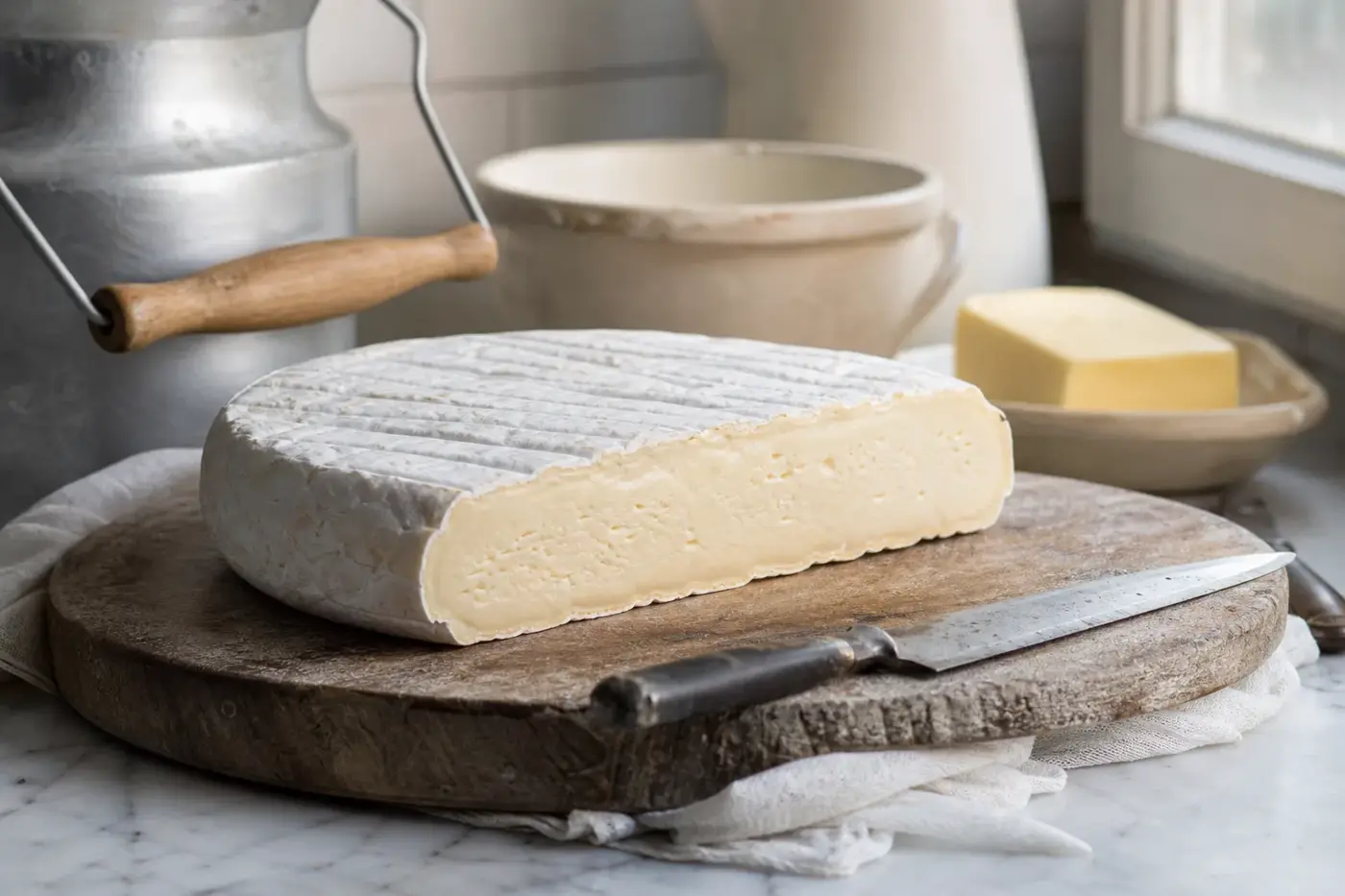
The story starts in 1956 at the family dairy in Illoud, Haute-Marne, where Caprice des Dieux was created. Its oval shape and blue box gave you something easy to recognise on the shelf. Savencia describes a soft white rind and a delicate crème fraîche flavour.[6]
Behind the business was the Bongrain family. The group’s American subsidiary records the family’s arrival in the United States in the early 1970s, followed by Alouette spreadable cheese in 1974. Expansion meant exporting French cheeses, but also making products locally for a different market.[7]
In 2015, the business took the name Savencia Fromage & Dairy. The corporate history links that change to international ambitions and a range of specialities. A new name, then, rather than a cheese business arriving out of nowhere.[2]
Who holds the reins at Savencia?
Savencia is listed on Euronext Paris, but that tells you only part of the ownership story. Its 2025 annual report records SAVENCIA Holding with 66.64% of the capital and 82.21% of net voting rights at 31 December 2025. Owning shares and controlling votes are not quite the same thing.[1,3]
A board of directors oversees the business. Specialist committees support it on audit and risks, management and remuneration, and corporate social responsibility. The published board includes independent directors and an employee shareholder representative.[8]
For you, the useful distinction is between the owners, the board and the businesses actually making the cheese. Each has a separate responsibility.[8]
French roots, a much bigger cheese cupboard
The dairy group’s 2025 accounts show how far the business reaches. The annual report records 68.3% of net sales outside France, alongside a 2.6% decline in consolidated net sales compared with 2024. Average employee headcount was 21,157.7 for 2025: a reporting measure, not a count of people at work on one particular day.[1]
You can see that reach in the names, too. Géramont, Bresso, Milkana and Burgo de Arias sit alongside the better known French brands in the current portfolio. The American subsidiary describes four manufacturing locations in the United States, plus a separate activity importing French speciality cheeses.[5,7]
A French parent company therefore tells you about ownership, not necessarily where your cheese was made. Savencia reaches consumers through retail brands, professional kitchens and ingredients supplied to other food businesses.[3,7]
Three familiar names, three separate stories
Caprice des Dieux, Saint Agur and Chavroux appear in Savencia’s current brand portfolio as of November 2026. Put them beside one another and the differences become the interesting part. A shared owner is not a tasting note: it tells you little about texture, milk or what to do with the cheese.[5]
Caprice des Dieux: get to know the cheese inside
The familiar oval cheese has a white rind and a flavour the maker describes in terms of crème fraîche. Illoud is its documented birthplace, but that does not establish where every pack is manufactured. When you choose yours, look for the product’s own origin information.[6,11]
Saint Agur: follow the blue through the range
Savencia places Saint Agur in the Monts du Velay in Haute-Loire, at the Fromagerie de Beauzac. The maker describes a blue-veined cheese with a melting texture and a fruity, pronounced flavour. Crème, Fouetté and Sauce products also belong to the range, giving you different textures and kitchen uses under the same name.[9]
Chavroux: goat’s milk is the starting point
Savencia presents Chavroux as a goat’s cheese brand, so you have a useful first clue. The exact product still matters: compare its legal food name, ingredients and milk treatment with the pack beside it. The brand names the range; the individual label tells you what you are buying.[5,11]
How more names joined the family
Savencia’s portfolio has grown through both its own product development and the arrival of existing businesses. Its branded specialities sit alongside established names brought into the group through expansion. The corporate history records taking control of Compagnie des Fromages & RichesMonts in 2020, associating that business with Le Rustique, RichesMonts and Cœur de Lion.[2]
Saint Agur gives you another angle on that story. The company locates its cheesemaking in Haute-Loire while describing a range stretching from counter cheese to spreads and sauces. Regional identity, industrial production and marketing can coexist; the useful question is which details describe the cheese and which describe the brand.[9]
Let the label lead you to the dairy
Start with an explicit manufacturing statement, such as the country in the product’s origin declaration. Keep that separate from the business contact address. UK government guidance says an address on prepacked food can identify the business marketing it or its importer, so the address alone does not locate the dairy.[11]
The oval EU identification mark needs care, too. The Food Safety Authority of Ireland explains that cheese sent elsewhere for cutting and packing can carry the approval number of that second establishment. Treat the mark as a traceability clue, not always the cheesemaker’s identity.[12]
Saint Agur’s technical sheet shows the detail beneath a familiar name. It gives product code 20001201 and the French factory identifier FR 43 025 001CE. Those identifiers can help you frame an enquiry, but start with the pack in your hand when products or markets differ.[10]
If the manufacturing site remains unclear, ask the brand, supplying the product name, barcode and batch code. Keep its answer tied to that product and market. The guide to reading a cheese label explains what else is worth comparing.[11,12]
This page summarises published guidance from the official sources it cites. It is not medical advice. Guidance differs between countries and changes over time, so check the current source for where you live, and ask your doctor, midwife, pharmacist or dietitian about your own circumstances.
Read the milk and safety details closely
A published Savencia technical sheet for Saint Agur Overseas KG lists pasteurised milk, salt, Penicillium roqueforti and lactic cultures. That describes the named product sheet, not the recipe for every Saint Agur product or every Savencia cheese. Read the current pack for the product sold where you live.[10]
In the United States, an FDA notice published on 5 November 2024 records a recall of specified Savencia Cheese USA soft-ripened cheeses because of possible Listeria contamination. It lists individual products, identifiers and dates, and now states that the recall is completed and terminated. The notice concerns those listed products.[13]
Use official notices for the country where your cheese is sold. Match the pack details rather than relying on the parent company’s name. For fuller explanations, follow milk treatments and cheese food safety. Individual products need individual attention.[10,13]
Give welfare and environmental claims a closer look
Savencia’s agricultural sourcing page states that, since the end of 2025, all eggs used across its recipes come from cage-free hens. That is a company sourcing statement about a defined ingredient from a defined date. It does not describe conditions for dairy animals, so ask which farm standard, product or supplier programme a cheese welfare claim covers.[14]
The 2025 report includes environmental and supply-chain sustainability sections, plus an external assurance report. The assurance practitioners describe a limited-assurance engagement, with less extensive procedures than reasonable assurance requires. They also explain that they do not give separate conclusions on individual elements.[1]
For a useful environmental comparison, put absolute emissions beside production volumes. Identify the baseline year, then distinguish factory impacts from farming and purchased ingredients. A dated sourcing statement tells you more than a broad adjective; a product certificate still needs its own scope and validity examined.[1,14]
Put Savencia beside other dairy groups
Arla offers a useful ownership contrast. Its 2025 reporting describes a farmer cooperative, with Castello among its global brands, while Savencia combines a stock-market listing with a controlling holding-company shareholder. Bel gives you another branded-cheese comparison, with The Laughing Cow prominent in its current publications.[1,3,15,16]
These comparisons explain business models better than a size ranking does. When you choose cheese, start with the milk, style, manufacturing origin and actual product information. A blue cheese, a fresh goat’s cheese and a white-rinded speciality deserve separate decisions, even when their brands share an owner.[5,9,10]
Find your next cheese question
- How to Tell Cheese Styles Apart: Milk, Rind, Texture and Method: explore what makes cheeses different, rather than who owns them.
- How to Read a Cheese Label: untangle the food name, origin statement and business address.
- Raw Milk, Thermised and Pasteurised Cheese: understand the milk treatment stated for your particular product.
Questions people ask
Who owns Savencia?
Savencia is listed on Euronext Paris. At 31 December 2025, SAVENCIA Holding held 66.64% of its capital and 82.21% of its net voting rights.
Which cheese brands belong to Savencia?
Its reported portfolio includes Caprice des Dieux, Saint Agur and Chavroux. Other brands in the current portfolio include Géramont, Bresso, Milkana and Burgo de Arias.
Where is Saint Agur made?
Savencia identifies Saint Agur with the Monts du Velay in Haute Loire and the Fromagerie de Beauzac. The pack remains the starting point for checking an individual product.
Is Saint Agur made with pasteurised milk?
A published technical sheet for Saint Agur Overseas KG lists pasteurised milk. That sheet does not establish the milk treatment of every Saint Agur product, so check the current pack.
Were Savencia cheeses recalled in the United States?
An FDA notice published on 5 November 2024 records a recall of specified Savencia Cheese USA soft ripened cheeses because of possible Listeria contamination. The FDA notice lists the affected products and now states that the recall is completed and terminated.
Sources
[1] SAVENCIA SA, Financial year 2025: combined shareholders' meeting, ordinary and extraordinary, convened on April 23, 2026, 2026. Management report, shareholding disclosures, workforce tables and sustainability assurance report.
[2] Savencia, History and Histoire, corporate timelines, undated current editions retrieved November 2026. The French timeline supplies the fuller wording on the 2026 dairy and chocolate combination. Company accounts of their own history.
[3] Savencia, Profile, undated current edition retrieved November 2026. Current description of activities, business segments and listing.
[4] Savencia, SAVENCIA Holding, undated current edition retrieved November 2026. Presentation of the holding company's food brands.
[5] Savencia, Brand portraits, undated current edition retrieved November 2026. Evidence of current portfolio affiliation, rather than a territorial trademark register.
[6] Savencia, Caprice des Dieux, undated brand account retrieved November 2026. Historical origin, appearance and the company's tasting description.
[7] Savencia Cheese USA, About us, undated current edition retrieved November 2026. American business history, manufacturing presence and importing activity.
[8] Savencia, Corporate governance, undated current edition retrieved November 2026. Board composition and specialist committee responsibilities.
[9] Savencia, SAINT AGUR®, French brand account, undated current edition retrieved November 2026. Production locality, the maker's sensory descriptions and product extensions.
[10] Savencia, SAINT AGUR OVERSEAS KG, technical sheet, product code 20001201, revision date not stated. Retrieved November 2026; its applicability is limited to the identified product sheet.
[11] UK Government, Food labelling: giving food information to consumers, live guidance retrieved November 2026. Sections on origin, ingredients and the food business operator's address.
[12] Food Safety Authority of Ireland, Identification Mark, live guidance retrieved November 2026. Official indexed passage explaining establishment numbers and subsequent cutting and packaging.
[13] US Food and Drug Administration, Savencia Cheese USA Announces an Expanded Voluntary Recall of Select Soft Ripened Cheeses, company announcement dated 4 November 2024, published by FDA on 5 November 2024. Current page records completion and termination.
[14] Savencia, Our Agricultural Upstream, undated current edition retrieved November 2026. “Egg Products” subsection, including the company's statement concerning sourcing since the end of 2025.
[15] Arla Foods, Annual Results Overview 2025 and Annual Report 2025, published 2026. Cooperative ownership and global brand portfolio.
[16] Bel Group, Publications, current index retrieved November 2026. Includes publications concerning The Laughing Cow and the 2025 annual report.
This desk-researched article compares corporate reporting, current brand accounts and official consumer information, keeping company statements separate from external evidence.
Last checked: November 2026
Last checked November 2026.
The editors suggest you read next
Who Makes the World's Cheese? The Big Dairy Groups
You pick up Galbani at the cheese counter, then pause over Kerrygold.