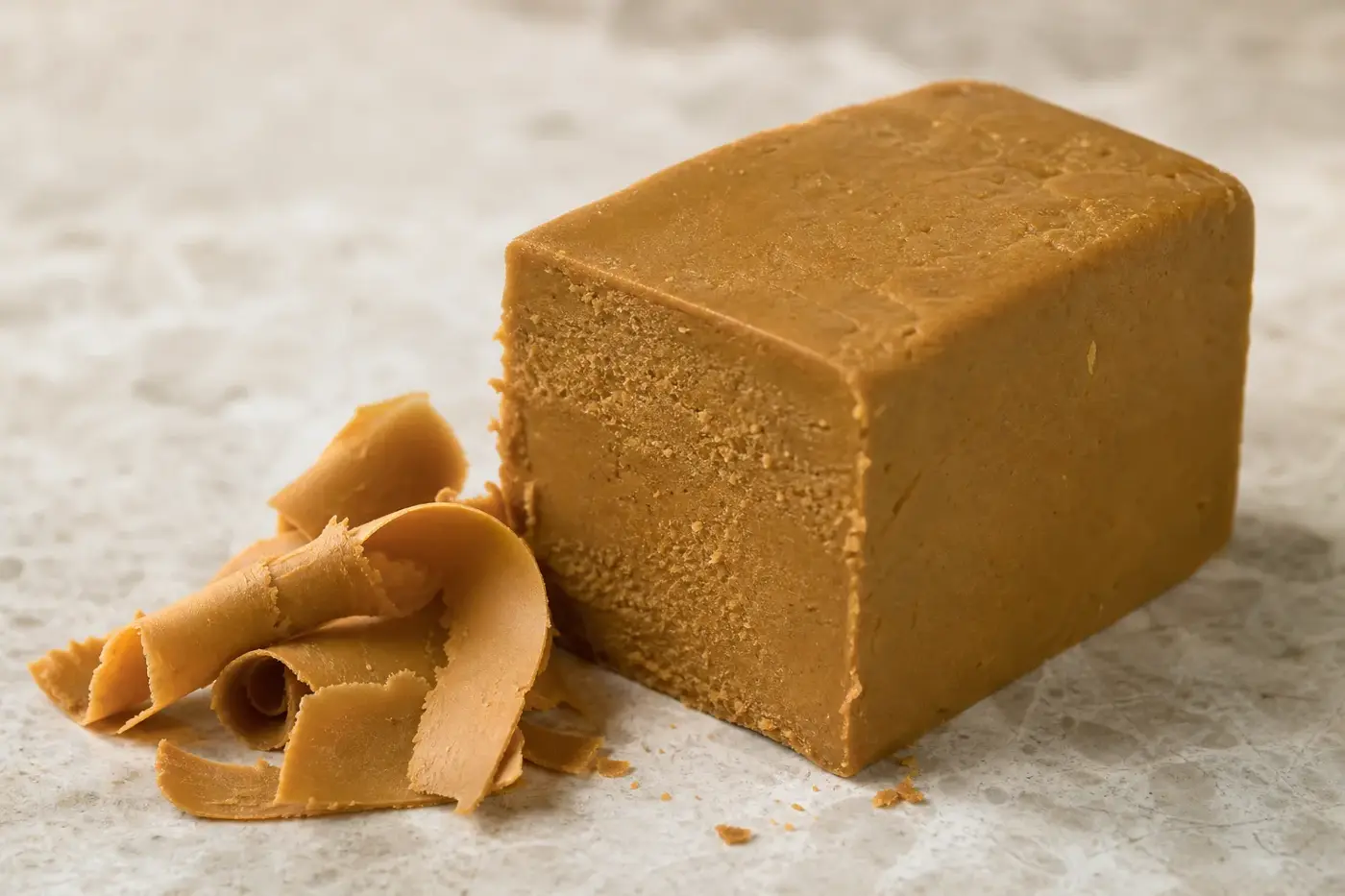
Gamalost
Long, pale threads of mould spread across a cheese in Vik, western Norway.
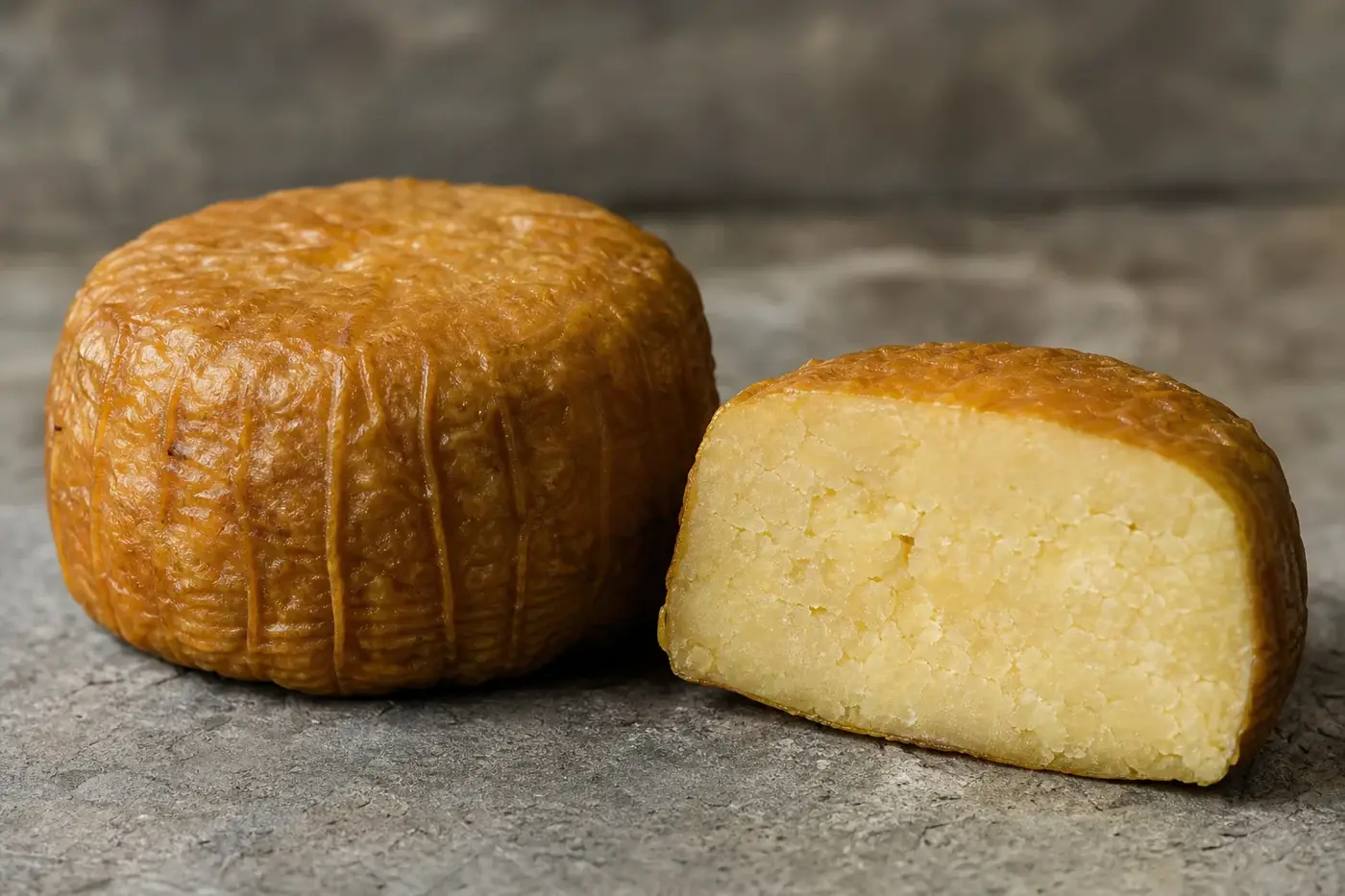
Long, pale threads of mould spread across a cheese in Vik, western Norway. Then a pair of hands gently pats them down, settling the growth against its surface. Before you taste Gamalost’s powerful character, there is this surprisingly tender bit of work.[2][6]
Made from soured skimmed cow’s milk, this pungent Norwegian cheese has a coarse texture and a deeply savoury flavour. Its name means “old cheese”, but souring, heating and mould ripening, rather than years of ageing, give it that presence. Farmhouse cheesemakers established the tradition. Today, Vik’s dairy carries it forward commercially.[1][2][6]
| What you might want to know | The useful detail |
|---|---|
| Name to look for | Gamalost; also written gammelost.[11] |
| Norwegian designation | Gamalost frå Vik; Norwegian geographical protection granted in 2006.[3][10] |
| Authority and legal identifier | Mattilsynet; regulation FOR-2006-11-14-1235. Separate register ID: not provided here.[3] |
| Current protection status | For Norway, consult the complete current consolidated instrument. For other jurisdictions, consult the relevant local register. |
| Commercial production, November 2026 | TINE Meieriet Vik, Vik in Sogn, Norway.[2] |
| Milk in the current product | Pasteurised skimmed cow’s milk.[7][10] |
| Ingredients on the label | Pasteurised skimmed milk, acidifying culture and mould culture.[7] |
| Ripening organism | Published Norwegian specification: Mucor mucedo.[3] |
| Storage for the current product | Refrigerated at 0 to 4 °C (32 to 39 °F).[7] |
| Allergen on the label | Milk.[7] |
Your first bite has plenty to say
Look closely and you will find a yellow brown outside and a yellow white core. The Norwegian specification describes Gamalost’s texture as firm. That is your first clue, rather than the whole story.[3]
Firm does not mean dry here. The Norwegian reference work Store norske leksikon describes a moist, cohesive cheese with a characteristic sharp flavour. TINE calls its current cheese firm, slightly coarse, powerful and aromatic.[1][11]
Begin with a small piece and give its texture and aroma your attention. You are looking for savoury intensity, not sweetness. Historic farmhouse cheeses followed different methods from today’s more controlled commercial process, so their descriptions reflect distinct ways of making Gamalost.[4][6]
First came butter, then a use for the milk
Gamalost’s story begins with a practical question: once you have taken the cream for butter, what happens to the milk? TINE’s historical account places Gamalost alongside pultost among the skimmed-milk cheeses developed in Norway’s household dairy economy. Cream became one food; the milk left behind became another.[5]
On farms, particularly the summer farms known as stølar, cheesemakers heated milk in large copper vessels. They wrapped the cheeses in dried sedge. Without prepared mould cultures, ripening took several weeks, according to the regional heritage service Kringom.[4]
That gives “old cheese” a little more meaning. It is a literal translation, not a modern maturity grade. The historical explanation attached to the Norwegian designation links the name to lengthy farmhouse ripening, while recording another possibility: the antiquity of the cheese itself.[3]
And the Vikings? Norway’s agriculture ministry places the secure documentary trail in the second half of the eighteenth century. The familiar Viking story concerns a possible predecessor, not an unchanged version of the cheese you can buy today.[10]
Come to Vik, where the tradition keeps working
Vik is not simply a place in Gamalost’s past. Its dairy remains a working link between western Norway’s sour-milk cheese tradition and commercial production today. TINE’s current dairy page lists Gamalost frå Vik among the facility’s products.[2]
The dairy began in 1897, according to the regional archive account. Preserved photographs show cheeses covered in ripening mould and workers handling curd. Look beyond the cheese and you see the labour that brings it into being.[4]
Pay attention to the wording when you encounter the name. Gamalost is the broader cheese name; Gamalost frå Vik is the full geographical designation. Norwegian geographical protection was granted in 2006 for cheese produced in Vik under specified conditions.[3][10]
Follow the milk: souring, heat and a different curd
Gamalost takes a different path from many familiar cheeses. An acidifying culture sours the skimmed milk, then heat helps form the curd, the solid portion separated from liquid whey. Rennet, the milk-clotting enzyme mixture used for many other cheeses, appears in neither the published method nor the current ingredient declaration.[3][7]
The Norwegian specification describes separating curd from whey and reducing it to approximately rice-grain size. That curd goes into moulds. The formed cheeses receive further heat treatment with circulating hot whey, followed by cooling and inoculation with mould culture.[3]
If you are picturing a smooth, rennet-set slicing cheese, change the picture. Here, acidified skimmed milk and thoroughly worked curd lay the foundations. Mould ripening then develops the aroma.[3][6]
For a closer look at what separates these two approaches, turn to how cheese is made. It explores the difference between acid-set and enzyme-set curds.
A pale coat, and a gentle hand
Within a few days in humid ripening conditions, long, pale fungal filaments appear on Gamalost’s surface. The Norwegian dairy industry’s educational account describes spraying the formed cheese with Mucor mucedo to start this stage. That pale growth has work to do. It is not merely dressing for the occasion.[6]
Then each cheese gets its gentle patting. The published specification describes manually stroking down the fungal growth during ripening. A Kringom archive photograph captures this handwork at Vik in 1966.[3][4]
The mould is busy beneath that striking appearance, too. Its enzymes break down proteins, releasing compounds that contribute to Gamalost’s characteristic flavour. This helps explain how a cheese with so little fat can deliver such a forceful aroma.[6]
How long before you can take a bite?
The historical accounts give more than one timescale. Farmhouse ripening without prepared cultures took several weeks, according to Kringom.[4] The 2006 specification prescribed two to three weeks under controlled ripening conditions, while the ministry’s 2006 account gave five weeks to sale readiness.[3][10]
Those timings may cover different stages of the process. Keep that distinction in mind when you compare the accounts.
| What you want to know | Where to ask |
|---|---|
| Current commercial ripening period | Ask the producer for its current ripening period. |
Little fat, plenty of protein: follow the curd
Gamalost starts lean because skimming removes much of the milk’s fat before cheesemaking begins. Separating the whey then concentrates the milk solids retained in the curd. Together, those steps explain its substantial concentration of protein.[5][6]
TINE’s product record for Gamalost frå Vik 150 g gives the figures below. If you are considering a smaller portion, the 30 g column offers a useful comparison. It is calculated from the declared values, not measured separately.[7]
| What is in your cheese | Per 100 g | Per 30 g |
|---|---|---|
| Protein | 54 g | 16.2 g |
| Fat in the whole cheese | 0.6 g | 0.18 g |
| Saturated fat | 0.4 g | 0.12 g |
| Salt | 0.05 g | 0.015 g |
Those figures tell you more than “lean” alone. The fat measurement is per 100 g of the whole cheese. That differs from fat in dry matter, which compares fat with the cheese’s solids alone.[7]
Start with flatbread and see where it takes you
Thin slices on flatbread or bread make a good introduction. The Norwegian dairy industry recommends butter, sour cream and lingonberries alongside Gamalost, and suggests fresh fruit too. Think of Norway’s bread-topping tradition, rather than a cheese saved exclusively for a separate course.[6]
For your first tasting, set out three small combinations. Your whole slice of bread need not pledge allegiance to one approach.
- Flatbread and Gamalost: try the cheese first on a simple, crisp base.
- Flatbread, butter and Gamalost: spread a thin layer of butter beneath the cheese.
- Gamalost and fruit preserves: add a little lingonberry preserve alongside, adjusting the sweetness to your taste.
These combinations draw on the documented accompaniments. Keep the slices thin while you get to know that powerful flavour. Taste the cheese alone first, with the accompaniments separate, then notice what changes when you add fat or fruit.
There is room for Gamalost beyond the bread board, too. TINE suggests using it as a seasoning in food. Begin with a small amount while you find the right balance for its aromatic character.[1]
Read the packet and make room in the fridge
Start with the exact product name and its label. TINE’s current product record lists pasteurised skimmed milk, acidifying culture and mould culture. On the cheese you buy, look for milk treatment, ingredients, storage temperature and date marking, especially if it is a different product or sold outside Norway.[7]
TINE’s documented 150 g product belongs at 0 to 4 °C (32 to 39 °F). Once opened, keep it wrapped or in a covered container. Norway’s food safety authority, Mattilsynet, advises covering unpackaged refrigerated food to prevent contamination, drying and the transfer of flavours.[7][8]
Read the packet’s date mark and any separate instructions for storage after opening. Put out what you intend to eat, then return the rest promptly to the fridge. You can find more practical guidance in storing cheese at home and reading a cheese label.
Gamalost or Brunost? Let taste settle it
If colour leads you to expect similar flavours, these two have a surprise ready. Gamalost comes from sour-milk curd and develops through mould ripening. Brunost starts with whey, usually combined with milk and cream, which is boiled down and browned.[6]
The difference reaches straight into the flavour. The dairy industry describes Brunost as sweet and caramel-like; Gamalost is sharp, aromatic and savoury, with a coarse cheese texture. Brown, it turns out, is a rather unreliable tasting note.[1][6]
Choose the experience you fancy: the sweetness of concentrated whey and milk, or the pungency of ripened sour-milk curd. Both belong to Norwegian dairy tradition. Each tells a different story about making use of milk.[5][6]
General information only, not medical advice: follow the official guidance where you live.
Questions people ask
Why is Gamalost called old cheese?
Gamalost means “old cheese”. The historical explanation attached to its Norwegian designation connects the name with lengthy farmhouse ripening, while another explanation refers to the antiquity of the cheese itself.
Is Gamalost a Viking cheese?
Norway’s agriculture ministry says the secure documentary trail begins in the second half of the eighteenth century. The story of Viking ancestry concerns a possible predecessor, rather than an unchanged version of today’s cheese.
How is Gamalost made, and does it contain rennet?
An acidifying culture sours skimmed milk, which is heated to form curd and then ripened with mould. Rennet appears in neither the published method nor the current product’s ingredient declaration.
What does Gamalost taste like, and how is it served?
Gamalost is sharp, aromatic and savoury, with a slightly coarse texture. The Norwegian dairy industry recommends it with bread or flatbread, butter, sour cream, lingonberries or fresh fruit.
How is Gamalost different from Brunost?
Gamalost is made from soured milk curd and develops through mould ripening. Brunost is made by boiling down whey, usually with milk and cream, and has a sweet, caramel flavour.
Sources
[1] TINE SA. Gamalost frå Vik. Current product page, undated, retrieved November 2026. Producer description and suggested uses.
[2] TINE SA. TINE Meieriet Vik. Current dairy page, undated, retrieved November 2026. Location and present production statement.
[3] Mattilsynet. Forskrift om vern av produktnemninga Gamalost frå Vik som beskytta geografisk nemning, 14 November 2006, reproduced in Patentstyret’s Varemerketidende, number 47, 20 November 2006, pages 128 to 130. Original specification and historical appendix.
[4] Kringom. Gamalost frå Vik Meieri. Published 7 July 1999; page updated 21 May 2025. Regional heritage account drawing on local archives, with identified historical photographs.
[5] TINE SA. Norsk tradisjonsost. Undated, retrieved November 2026. Producer’s account of butter, skimmed milk and traditional cheeses.
[6] Opplysningskontoret for Meieriprodukter. Den lille osteskolen. Undated, retrieved November 2026. Dairy industry educational account, particularly the Gamalost and Brunost sections. This is an industry source, not a regulator.
[7] TINE SA, published through Matinfo. Gamalost frå Vik® 150 g, GTIN 07038010021954. Product record updated 28 October 2025, retrieved November 2026. Ingredients, allergen, nutrition and storage data.
[8] Mattilsynet. Råd for oppbevaring av mat og drikke. Current Norwegian consumer guidance, retrieved November 2026. Refrigeration, covering food and the approximately two-hour rule.
[9] Mattilsynet. Holdbarhetsmerking. Current Norwegian guidance, retrieved November 2026. Date marking, unopened packs, storage conditions and instructions after opening.
[10] Norwegian Ministry of Agriculture and Food. Press material on geographical protection for Gamalost frå Vik, 14 November 2006. Historical production context and the dated protection announcement.
[11] Store norske leksikon. Gamalost. Entry retrieved through its search extract, November 2026. Supporting description of cylindrical format, moist texture and sharp flavour.
This piece was researched from producer product records, Norwegian official material, regional heritage records and dairy industry explanations, without a site tasting or production visit.
Last checked: November 2026
Last checked November 2026.
The editors suggest you read next
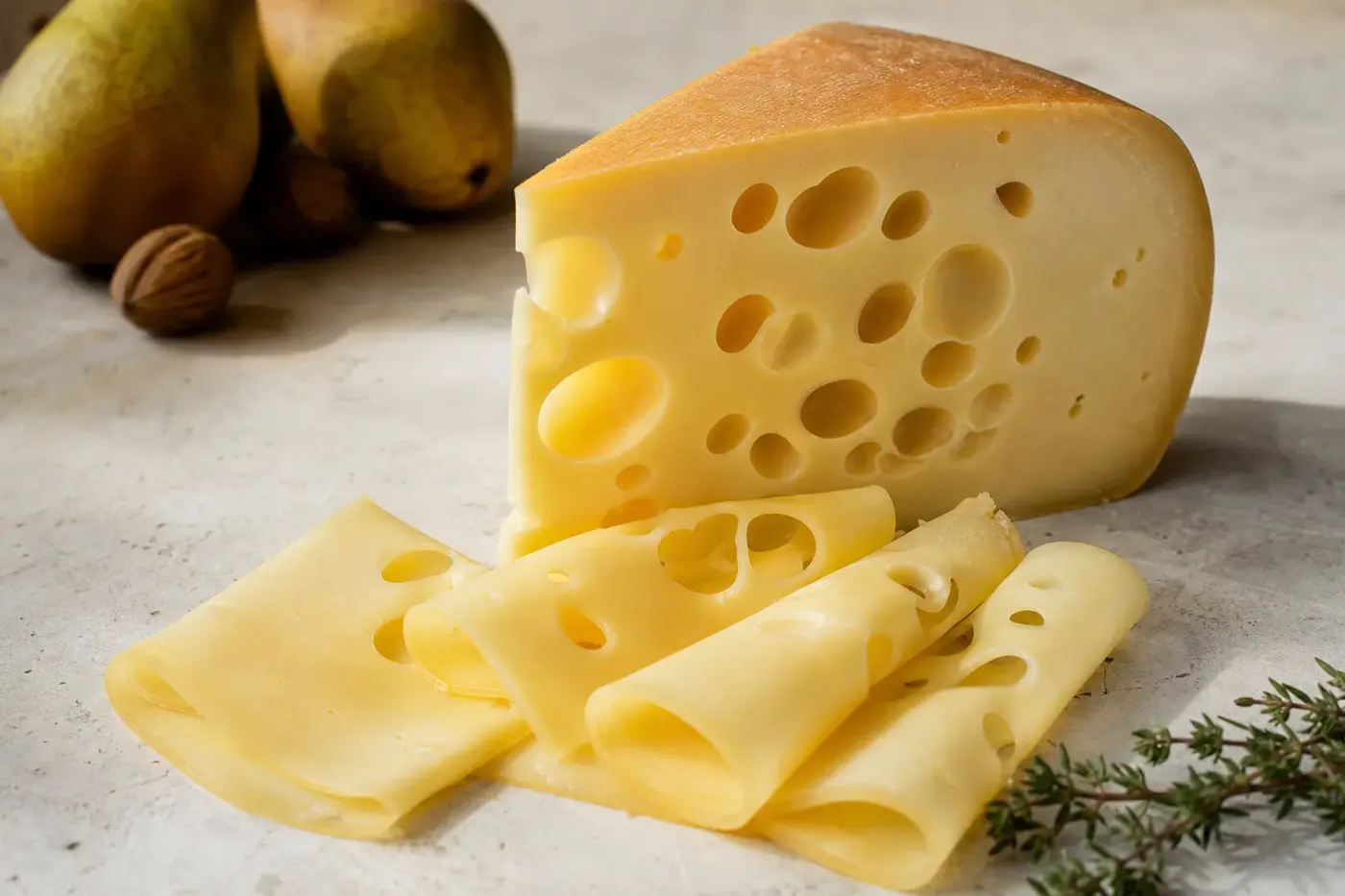
Jarlsberg
Cut into Jarlsberg and those great, rounded holes catch your eye before you take a bite.