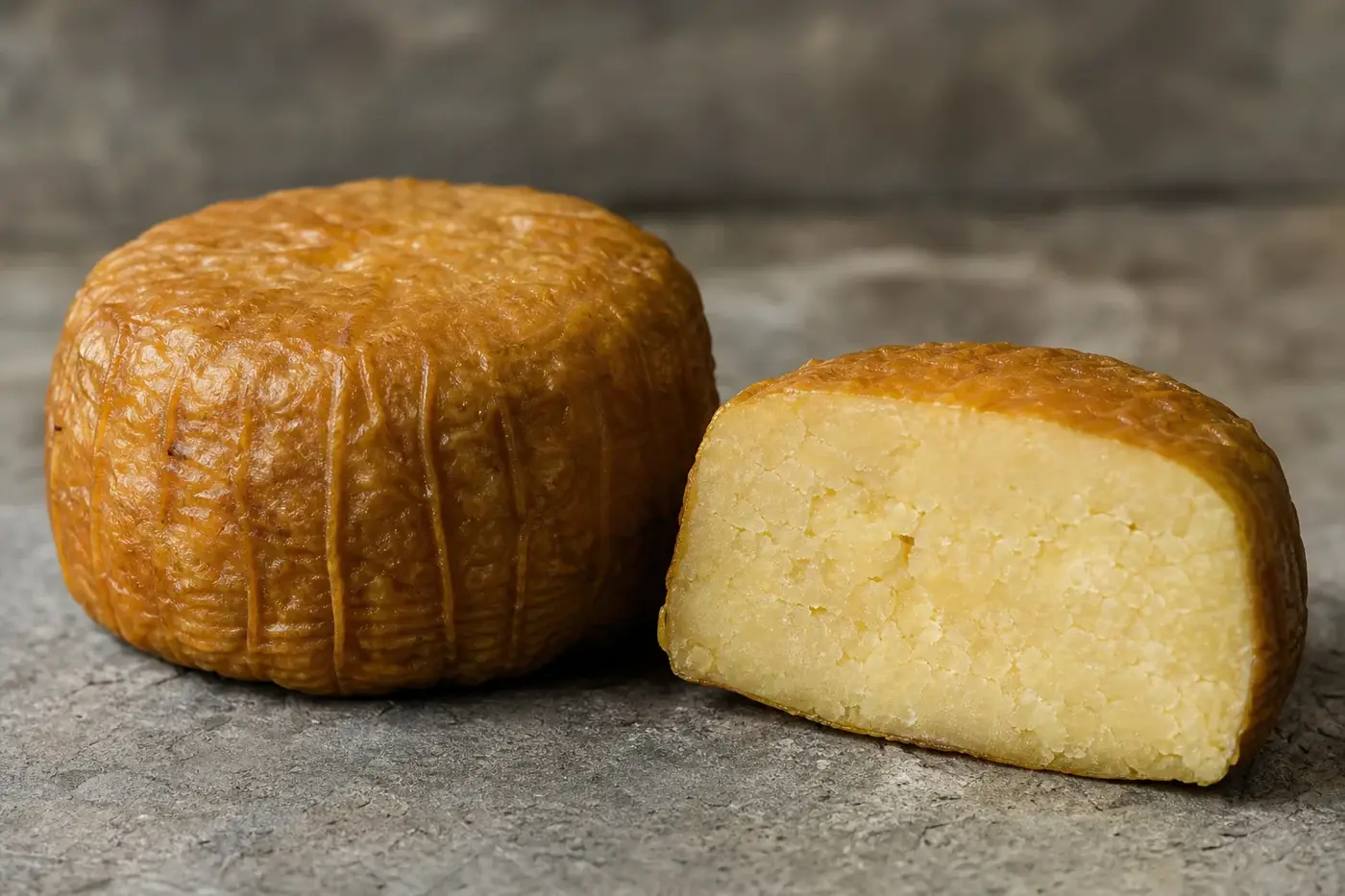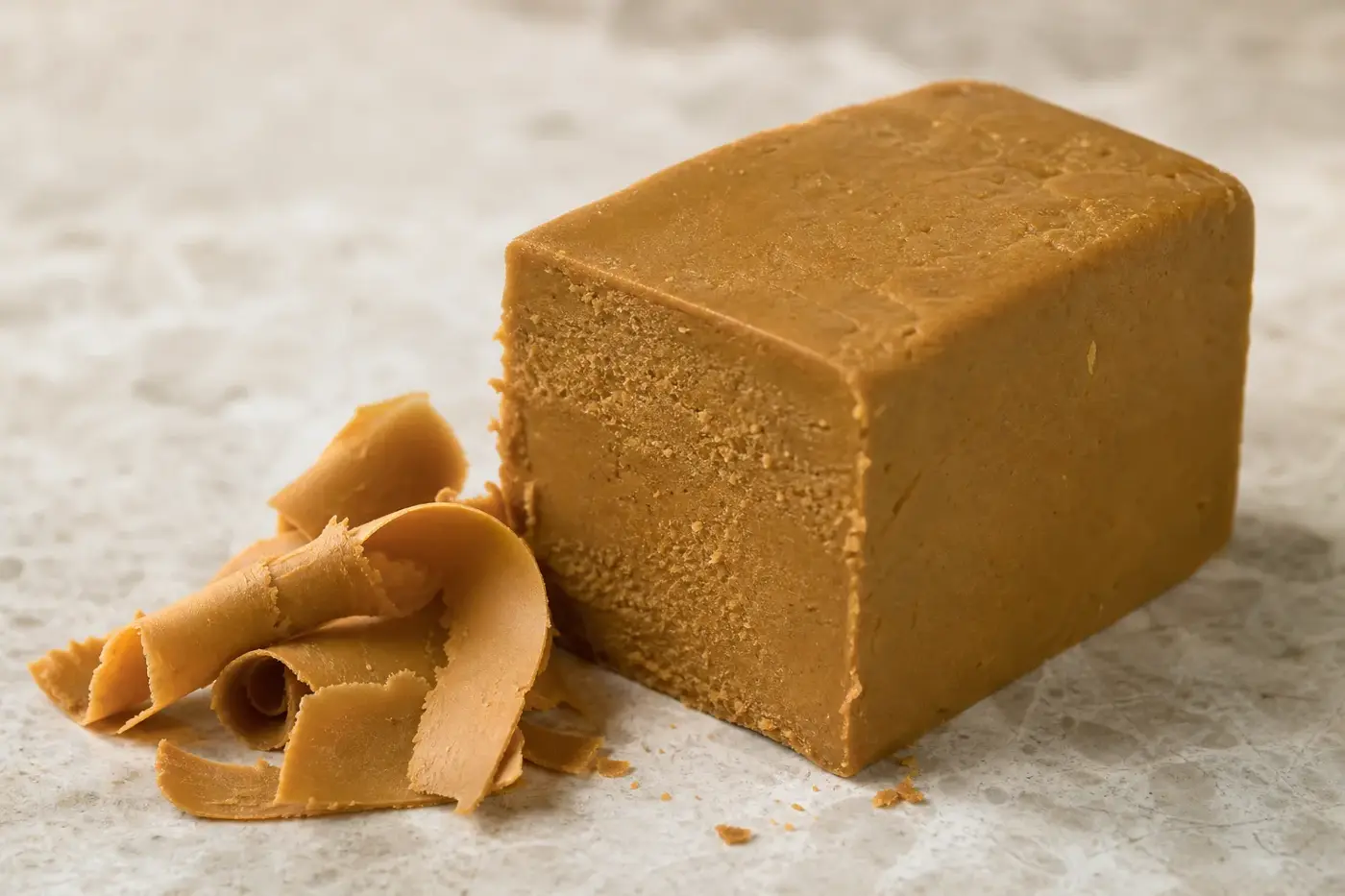
Draw a thin shaving across bread or crispbread. At Norway’s breakfast table, you meet something sweet, dense and wonderfully cooked in flavour, made from the liquid most cheesemaking leaves behind. Slowly heated, usually with milk and cream, that whey becomes a compact brown block: the transformation at the heart of Norway’s brunost family.[2]
| At a glance | What to know |
|---|---|
| The family | Norwegian brown whey cheeses.[1] |
| Home territory | Norway.[3] |
| Milk in the mix | Cow, goat or a mixture, depending on variety.[4,5] |
| How it becomes a block | Heat concentration, controlled cooling and moulding.[4] |
| Rind | No developed rind.[1,2] |
| Allergen | Milk.[6,7] |
Meet the liquid most cheeses leave behind
Brunost begins where most familiar cheeses leave off. Cheesemaking separates milk into curds, the solid material, and whey, the remaining liquid. That whey carries much of the milk’s lactose, or milk sugar, along with whey proteins and minerals. Brunost makers heat and concentrate it rather than drain it away.[2,8]
This explains why your block behaves differently from a wedge of Cheddar or Gouda. Its character comes chiefly from concentration, heating and cooling, rather than the maturation of a curd. For the broader story of coagulation, curd cutting and draining, take a look at how cheese is made.[2,4]
This page summarises published guidance from the official sources it cites. It is not medical advice. Guidance differs between countries and changes over time, so check the current source for where you live, and ask your doctor, midwife, pharmacist or dietitian about your own circumstances.
Mountain milk, winter stores and Anne Hov’s cream
For Norwegian farmers, boiling down whey helped carry summer’s milk into winter. KUBEN, the Aust-Agder museum and archive, describes these concentrated dairy foods as easier to transport from mountain farms, too. Cream became butter, curds became cheese, and whey could be drunk, cooked with or concentrated over heat. The same milk had several jobs to do.[3]
Then Anne Hov made this older tradition richer. Norway’s Directorate for Cultural Heritage links her addition of cream at Solbråsetra in Gudbrandsdalen with the development of Gudbrandsdalsost in the early 1860s. KUBEN describes the earlier product as lean whey cheese and her cream-enriched version as feitost, later developed with both cow’s and goat’s milk.[3,9]
In 1933, Hov received the King’s Medal of Merit in silver, as the heritage authority records. Her contribution was the cream-enriched development associated with Gudbrandsdalen. The Norwegian practice of concentrating whey was already much older.[3,9]
Watch the whey become your next slice
First comes a balancing act: how much whey, milk and cream will suit the intended variety? Heating evaporates water and concentrates the mixture’s dissolved and suspended solids. Traditional makers used kettles; dairy scientists describe modern continuous lines with several stages of heat exchange.[1,4]
Norway’s dairy information body, Melk.no, describes industrial evaporation under reduced pressure, followed by further concentration and browning. Once the colour and consistency are right, controlled cooling with vigorous stirring encourages small lactose crystals. The mass enters packaging supported by moulds, then cools until firm.[4]
Both stages matter when you reach for a slice. Evaporation concentrates a pourable dairy liquid. Carefully managed cooling helps turn it into something firm enough to hold a clean shaving.[4]
Follow the brown colour and the sweetness
The brown colour develops during concentration and browning. The sweetness, meanwhile, can come from the dairy ingredients themselves: evaporation concentrates the lactose already in whey. That gives brunost quite a different starting point from cheeses whose whey is drained away.[4,10]
Lactose has a say in texture, too. Cooling controls how it crystallises, so a smooth mouthful takes more than reducing the liquid to the right consistency. Concentration and controlled crystallisation work together to shape what you feel as you eat.[1]
Find your favourite: cow, goat or both
Start with the milk source when you choose brunost. Cow’s milk, goat’s milk and mixed milk varieties share the concentration method. Each gives the maker different ingredients to balance, and gives you a useful first clue to the block.[4,5]
| Variety | What goes into it | What to look for in a mouthful |
|---|---|---|
| Fløtemysost | Cow’s milk and cream | TINE: light and mild, with caramel-like flavour.[11] |
| Gudbrandsdalsost | Cow’s and goat’s milk, with whey and cream | TINE: rounded and sweet; goat’s milk adds fullness rather than a pronounced goat taste.[6] |
| Ekte geitost | Goat whey, goat’s milk and goat cream | Melk.no: sweet and caramel-like, with distinct goat’s milk character.[5] |
The family name starts the conversation; the ingredient list gets down to particulars. TINE’s published Anno 1863 Gudbrandsdalsost sheet, for example, lists whey, pasteurised goat’s milk, pasteurised cream and pasteurised milk. The maker’s Geitost page identifies that product as made from goat’s milk.[7,12]
Get to know the block on your board
Expect a compact block, brown throughout, with no developed rind. It is dense rather than crumbly and holds together neatly for slicing. The dairy science reference describes the family’s flavour as sweet, cooked and caramel-like, varying with browning, milk source and fat content.[1,2]
You will find its savoury side most readily in goat’s milk character and in sauces. Milk source does not tell the whole story, though: the maker’s description of the cooking matters, too. A darker cow’s milk brunost can have stronger cooked sweetness than a paler mixed milk version. TINE’s tasting cards, for example, call its cow’s milk Innherred dark and extra sweet.[7,11]
A thin shaving is a fine place to start
Reach for a cheese slicer, called an ostehøvel in Norwegian, and aim for a thin shaving, not a slab. TINE’s product sheet says its Anno 1863 block slices best chilled. This is one occasion when your enthusiasm for cheese need not dictate the thickness.[12]
Put the block on a stable board or plate and draw the slicer across a flat face. Lay the shaving on bread or crispbread, or fold it onto a waffle. Begin with one layer so you can judge the balance between dairy sweetness and bread.[2,13]
Try it plain before reaching for sweet accompaniments. That gives the difference between mild cow’s milk brunost and a more pronounced goat’s milk version room to register. Thin slices let you compare without a thick piece taking over the mouthful.
Let breakfast lead you to the saucepan
Keep accompaniments restrained and give the brunost room. Plain crispbread and unsweetened tea or coffee leave it as the sweet element. For contrast, try a little sharp berry preserve. You want a companion, not a disappearing act beneath the jam.
There is a savoury life for this cheese, too. Norwegian sources describe brunost as a flavouring for brown sauce, soups and stews. Treat its concentrated dairy sweetness as seasoning rather than the main ingredient: add a little to a deeply savoury sauce, taste, then decide whether it needs more.[2,13,14]
Stir in thin shavings gradually, considering sweetness and salt together. Choose cow’s milk brunost for a gentle cooked dairy note, or goat’s milk brunost for more distinct milk character. Those choices follow the published flavour descriptions, so use them as a guide to your dish, not a fixed substitution rule.[7,11]
Choose your block, then give it a good home
Choose your milk blend first, then read the ingredients for cream, additional sugar or flavourings. Melk.no notes that some varieties include extra sugar or cardamom. Plain brown whey cheese and a sweetened, flavoured version can suit quite different tastes.[4]
For storage in Norway, TINE’s Anno 1863 product sheet specifies refrigeration at 0 to 4 °C. Follow the pack instructions for the block you buy. Once opened, Melk.no advises wrapping each piece separately, keeping it away from strongly scented foods and maintaining good fridge hygiene.[12,13]
Look for unwanted growth after opening, and do not mistake the brown surface for a rind. Keep the label’s storage and date instructions with the block, and ask the maker about unexpected changes. For broader handling advice, see how to store cheese.[13]
Before your first slice: allergy, lactose and vegetarian choices
If you have a milk allergy, the milk ingredients matter, including whey proteins. TINE identifies milk as an allergen on both its Gudbrandsdalsost and Geitost pages. In Norway, Helsenorge explains that milk allergy is a reaction to milk proteins and advises a milk-free diet with individual guidance from a doctor or clinical dietitian.[6,7,15]
Lactose intolerance is a separate consideration. Helsenorge lists brunost and other whey-based products among foods that cause symptoms for many people with lactose intolerance; TINE explains that concentrating whey also concentrates its lactose. Consult those Norwegian sources alongside guidance where you live and your clinician’s advice, bearing November 2026 in mind as this page’s reference point.[10,16]
For vegetarians, the question starts before the brunost, with the cheese that supplied its whey. Rennet, the enzyme preparation used to set milk, can be animal-derived; KUBEN describes traditional calf rennet in Norwegian cheesemaking. Ask the maker which coagulant was used upstream.
These are three separate checks, not interchangeable concerns. The guides to lactose in cheese, milk allergy and lactose intolerance and rennet explain each in more detail.
Questions people ask
What is brunost made from?
Brunost starts with whey, the liquid left after milk is separated into curds and whey. The whey is heated, usually with milk and cream, until it becomes concentrated enough to form a firm block.
What does brunost taste like?
Brunost has a sweet, cooked, caramel-like flavour that varies with the milk source, browning and fat content. Fløtemysost is described as light and mild, while ekte geitost has a distinct goat’s milk character.
How do you eat brunost?
Use a cheese slicer to make thin shavings and serve them on bread, crispbread or a waffle. Brunost is also used to flavour brown sauce, soups and stews.
How should brunost be stored?
TINE specifies refrigeration at 0 to 4 °C for its Anno 1863 product, but follow the instructions on your own pack. Once opened, Melk.no advises wrapping each piece separately and keeping it away from strongly scented foods.
Can I eat brunost if I am lactose intolerant?
Helsenorge lists brunost and other whey products among foods that cause symptoms for many people with lactose intolerance. Consult Helsenorge and the guidance where you live, alongside your clinician’s advice.
Sources
- Skeie, S., Johansen, A.-G. and Abrahamsen, R. K. Brown Whey Cheese, chapter 44 in Cheese: Chemistry, Physics and Microbiology, fifth edition, Academic Press, 2025, pages 1191 to 1206. Public abstract retrieved.
- TINE. TINE Industri 2026 produktkatalog, 2026, printed page 11, “Brunost”. Producer account of manufacture, milk sources and culinary uses.
- KUBEN, Aust-Agder museum og arkiv. Hvor gammel er brunosten?, originally published 12 January 1999. Historical account of farm dairy processing and the distinction between older brunost and Gudbrandsdalsost.
- Opplysningskontoret for Meieriprodukter, Melk.no. Brunost (mysost), undated web edition retrieved November 2026. Industry information on manufacture and varieties.
- Opplysningskontoret for Meieriprodukter, Melk.no. Geitost, undated web edition retrieved November 2026. Description of goat-derived ingredients and typical character.
- TINE. TINE® Gudbrandsdalsost, undated product page retrieved November 2026. Producer’s milk-source declaration, tasting description and milk-allergen statement.
- TINE. TINE® Geitost, undated product page retrieved November 2026. Producer’s milk-source declaration, tasting description and milk-allergen statement.
- Wisconsin Center for Dairy Research. Dairy Pipeline, volume 16, number 4, December 2004, “Controlling the protean character of sweet whey powder”. Whey composition and Maillard chemistry, including discussion of the centre’s research.
- Riksantikvaren, Norwegian Directorate for Cultural Heritage. Gudbrandsdalsostens opphavssted fredet, 2011 web article retrieved November 2026. Heritage account of Solbråsetra and Anne Hov.
- TINE. Laktoseinnhold i meieriprodukter, undated web edition retrieved November 2026. Producer explanation of lactose concentration in brunost.
- TINE. Brunost smakskort, Norwegian and English tasting cards, 2025 edition. Producer descriptions of Fløtemysost, Innherred and other named products.
- TINE. TINE® Anno 1863 Gudbrandsdalsost, product sheet for article 2519, undated PDF hosted by Felleskjøpet and retrieved November 2026. Ingredients, storage temperature and chilled slicing instruction.
- Opplysningskontoret for Meieriprodukter, Melk.no. Gudbrandsdalsost, undated web edition retrieved November 2026. Industry guidance on wrapping, refrigeration, unwanted mould or yeast, and culinary uses.
- Oslo Metropolitan University, SIFO. Alt du ikke visste om brunosten, published and updated 10 March 2026. Researcher interview covering culinary uses and differences between milk sources.
- Helsenorge, with content from Oslo universitetssykehus. Allergi mot mjølk, web edition retrieved November 2026. Norwegian public health guidance, particularly “Kosthald ved mjølkeallergi”.
- Helsenorge, Helsedirektoratet and Regionalt senter for astma, allergi og overfølsomhet. Laktoseintoleranse, updated 2 May 2024, retrieved November 2026. Norwegian public health guidance on whey-based products and the distinction from milk allergy.
- TINE. Spørsmål og svar, undated web edition retrieved November 2026, “Hva slags løpe brukes i ostene deres?” Producer statement about microbial rennet.
This piece combines desk research from Norwegian heritage accounts, dairy science, producer documentation and Norwegian public health guidance.
Last checked: November 2026
Last checked November 2026.
The editors suggest you read next
Jarlsberg
Cut into Jarlsberg and those great, rounded holes catch your eye before you take a bite.