Jarlsberg
Cut into Jarlsberg and those great, rounded holes catch your eye before you take a bite.
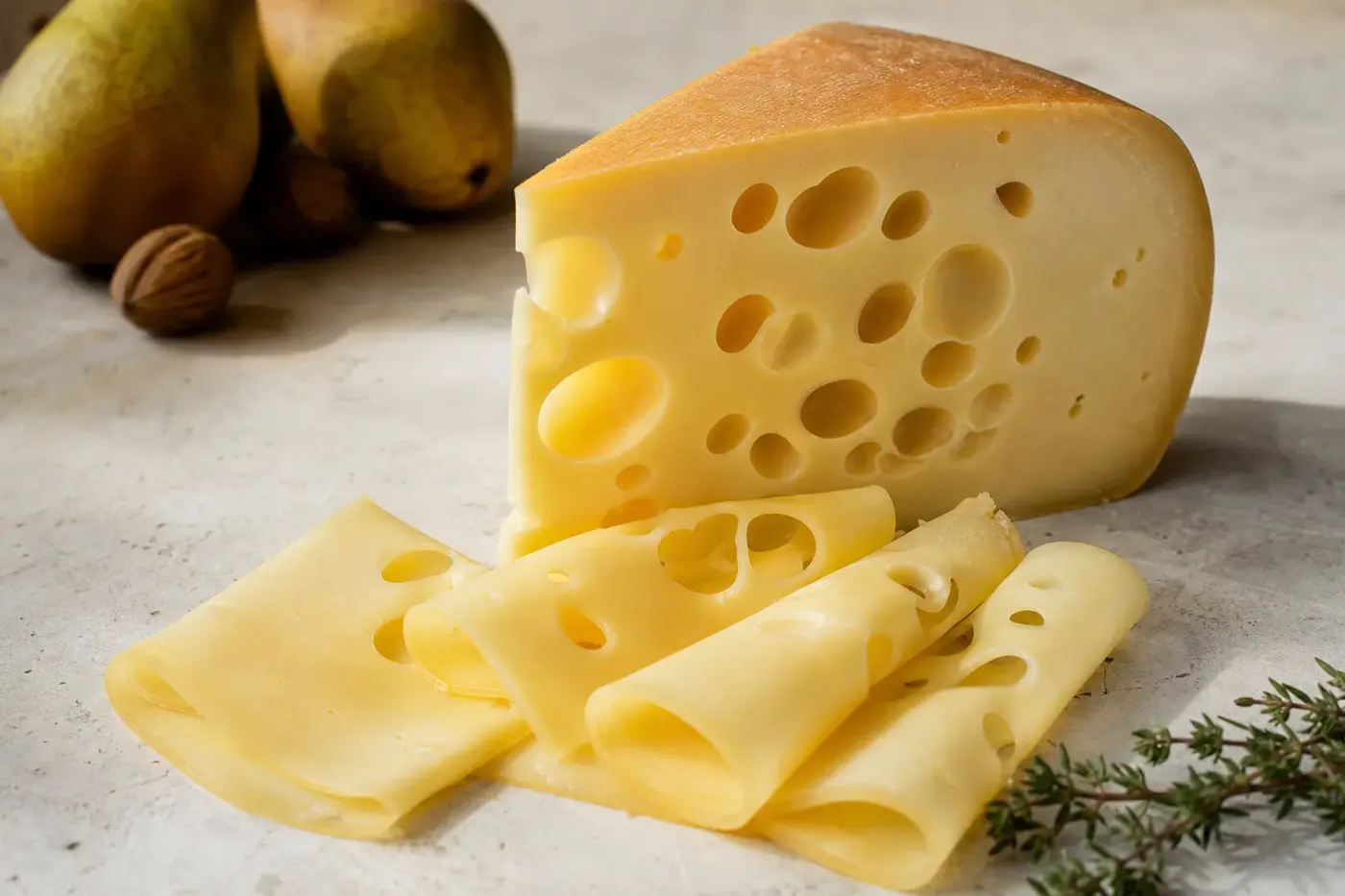
Cut into Jarlsberg and those great, rounded holes catch your eye before you take a bite. There is almost as much to admire in the gaps as in the cheese. Propionic acid bacteria make them by releasing carbon dioxide during maturation, leaving a supple, sliceable cow’s milk cheese developed in Norway. Its producer describes the flavour as sweet and nutty, ready for your sandwich or something melting in the oven.[1][4][5]
| At a glance | Your quick guide |
|---|---|
| The familiar name | Jarlsberg.[1] |
| What you’re buying | Branded cow’s milk cheese developed in Norway.[1][4] |
| UK brand owner | TINE SA, according to its UK brand statement, November 2026; effective date unconfirmed.[13] |
| Where it’s made | Norway, Ireland and the United States, according to the producer’s current account.[6] |
| UK declared ingredients | Pasteurised cow’s milk, microbial enzyme or rennet, salt and bacterial culture.[1] |
| Time to mature | Original is ready to eat after 8 to 10 weeks, according to the producer.[2] |
| The separately labelled aged version | Special Reserve, matured for at least 12 months.[3] |
| Keeping it at home | Store at 0 to 4 °C; best sliced cool.[1] |
The quiet work behind those great round eyes
Nobody beats air into the milk or cuts holes into the finished wheel. Jarlsberg’s openings, known as eyes, start with an added culture of propionic acid bacteria. The Norwegian University of Life Sciences identifies that culture as central to both the openings and the flavour you taste.[4]
Fermentation takes things from there. In Swiss-type cheeses, Propionibacterium freudenreichii can use lactate made earlier in cheesemaking, producing carbon dioxide alongside other fermentation products. Some gas stays dissolved in the cheese, some escapes, and some gathers in openings that grow into eyes.[5]
Gas alone cannot create the pattern in your slice. The cheese must yield as the openings expand. Texture, salt, temperature, composition and the movement of gas through the cheese all help determine what you see.[5]
An experimental study published in International Dairy Journal in 2023 explored that balance in semi-hard and Swiss-type model cheeses with different fat levels. Researchers used computed tomography to measure the openings. They found that composition affected gas production, dissolved gas and the volume of visible eyes. Each hole therefore reflects several cheesemaking conditions working together, not simply how much culture went into the milk.[5]
The Norwegian experiment that became Jarlsberg
Modern Jarlsberg began with another cheese entirely in mind: Gouda. Researchers at the Agricultural University of Norway, now the Norwegian University of Life Sciences, wanted to improve its eyes. Their work led somewhere rather more distinctive, to a cheese with a character of its own.[4]
The university records an early successful tasting in 1956, followed by industrial production in 1957. Dependable results took longer, with further development continuing for about a decade. Dairy technology, experimental design and statistical methods all helped turn that promising beginning into a consistent cheese.[4]
The name reaches further back. TINE’s historical account describes nineteenth-century dairies in Vestfold employing Swiss cheesemakers and making cheeses influenced by their tradition. Those associations gave the modern product its Jarlsberg name.[2]
To find your bearings in a slice, think Gouda and Emmental. The producer calls the combination “Goutaler”: Gouda provides the model of a smooth, melting cheese, while Emmental supplies the familiar reference for prominent eyes. Together, those influences explain much of Jarlsberg’s appearance and everyday appeal.[6]
Get acquainted with your first slice
A wedge shows off those rounded eyes and lets you cut slices as thick or thin as you fancy. You can also buy Jarlsberg in wheels or prepared slices. If sandwiches feature heavily in your week, the latter takes one small job off your hands.[1][2]
The producer’s tasting terms are smooth, mild, sweet and nutty. They suggest a cheese comfortable beside bread or fruit, without demanding forceful accompaniments. Your lunch needn’t come with an elaborate supporting cast.[6]
When you taste it, give texture and aroma their own moment. Does the slice bend easily? Then consider sweetness, saltiness and the finish. See whether “buttery” fits what you actually perceive, rather than using it as shorthand for every mild yellow cheese.
A yellow exterior covering, where present on a wheel or wedge, is separate from the edible paste. If the packaging does not identify it or explain how to remove it, ask the cheesemonger. When choosing your portion, give the labelled identity, condition and intended use more weight than a handsome exterior.
From the milk vat to a well-earned rest
The producer starts with pasteurised, partly skimmed cow’s milk. Cultures and rennet join the process, with rennet supplying the enzyme preparation that helps milk form curd. That curd is the solid material separated from the liquid whey.[1][2]
TINE describes cutting the firm curd, pressing it, putting it into moulds and salting the formed cheese in brine. Then comes maturation. These are the broad stages of commercial production, rather than a complete recipe or instructions for making Jarlsberg at home.[2]
Wherever your cheese is made, its culture retains a direct Norwegian connection. TINE says the culture used for Jarlsberg production comes from Norway. That includes cheese manufactured abroad.[7]
Original is ready to eat after 8 to 10 weeks, according to the producer. That is the stated production period for the standard cheese. It is not a statutory minimum ageing requirement.[2]
Special Reserve rests for at least 12 months and carries its own label. The producer says this intensifies Jarlsberg’s characteristic flavour and aroma, making a stronger cheese. Choose it when you want that more developed character, rather than assuming older will always suit your table or dish better.[3]
Jarlsberg Lite is a separate product in the global range. The producer describes it as pliable and suitable for slicing, but less suitable for cooking than Original because it contains less fat. Read the variant name before expecting one pack to melt like another.[3]
Curious about the wider journey from curd formation through draining to ripening? Follow it in how cheese is made.
Norwegian roots, with wheels made further afield
Norwegian origins do not mean every Jarlsberg wheel comes from Norway. The brand’s current account names three production countries: Norway, Ireland and the United States. If you want to know where yours was made, the place on the pack matters.[6]
TINE identifies its factory at Mogeely, County Cork, as an Irish producer of Jarlsberg. Its international business information also records production in Ireland and the United States for international markets. The Norwegian story has travelled.[8][9]
Read the origin information on your particular pack. Norwegian branding, a Norwegian recipe and a culture from Norway each tell you something different; none alone establishes the manufacturing country. Buying a portion at the counter? Ask to see the information that came with the original wheel.
Find familiar ground with Emmental, Gouda and Norvegia
Emmental is the obvious visual comparison, though Jarlsberg’s producer describes its cheese as softer and less dry. It also points to differences in cultures, production and composition. Treat this as the maker’s comparison, rather than a judgement covering every cheese sold under the Emmental name.[2]
Gouda helps you understand the texture. That connection is technological as well as historical: the brand explicitly links Jarlsberg’s smooth body and melting behaviour with the Gouda development work. You can explore the wider family in the Gouda guide.[6]
Norvegia shares some of Jarlsberg’s everyday territory in Norwegian eating. TINE’s Norvegia collection includes classic, vegetable and other toast preparations, making it another useful sandwich reference. Jarlsberg’s own description puts its prominent eyes and sweet, nutty character at the centre.[6][12]
When choosing cheese for dinner, start with the job rather than the name. Melting through a sandwich asks for something different from crumbling over a salad. Jarlsberg’s producer particularly emphasises the first role, giving you a useful place to begin.[11]
Bread, fruit and a glass of something good
Start with bread, Jarlsberg and one fresh accompaniment. The producer recommends bread, crackers, fruit and vegetables. That leaves you plenty of room to experiment without crowding a mild cheese with competing flavours.[2]
Try rye bread with apple, a plain roll with pear, or crispbread with cucumber. Choose one combination first, then adjust it to your taste. Thin slices are a useful starting point for sandwiches; small pieces let you compare the cheese with several accompaniments.
For an alcohol-free drink, try water, unsweetened tea or sparkling apple juice. Taste the cheese, then the drink, then the cheese again. There is no need to make a ceremony of it: you’re simply finding out whether you prefer the pairing or the cheese on its own.
Put out modest quantities and replenish from the fridge as needed. Food Standards Agency guidance for England, Northern Ireland and Wales says chilled food should spend the shortest possible time out of refrigeration during preparation, with a maximum of four hours. That is a handling limit, not a warming target.[10]
Put Jarlsberg to work in your kitchen
Melting is one of Jarlsberg’s principal uses. Toasties, quesadillas, lasagne, pasta and cheese bakes all appear on the UK brand site. You can use that line-up to get a sense of the dishes its producer considers suitable.[11]
A toasted sandwich is an easy place to begin. Cut slices to fit the bread and spread them across the filling, rather than piling everything into the centre. This is an everyday preparation suggestion, rather than a fromage.co.uk recipe.
For pasta or a vegetable bake, Original brings the standard mild profile. Reach for Special Reserve when you want the stronger flavour the producer describes. Plan separately for Lite, since the producer specifically warns that its lower fat content changes its suitability for cooking.[3]
Before swapping Jarlsberg into a recipe, ask what the original cheese is doing. Is it there for melting, seasoning, moisture or a distinctive aroma? Jarlsberg can be useful for melting, but it will change the dish. If another cheese’s particular character is essential, start with the recipe’s own substitution advice.
One wedge can cover both cold and cooked meals. Slice some for sandwiches and set aside a suitable portion for cooking. Follow the pack’s storage instructions and keep the rest refrigerated, rather than repeatedly leaving the whole piece on the worktop while you prepare food.[1][10]
Choose your cut, then keep it cool
Buy for the meals you have in mind. A wedge gives you flexibility for slicing and grating, while prepared slices save preparation. Before comparing packs, look at whether you’re holding Original, Special Reserve or another variant.[1][3]
For UK products, the producer specifies storage at 0 to 4 °C and says Jarlsberg is best sliced cool. The FSA’s general domestic fridge guidance for England, Northern Ireland and Wales is 0 to 5 °C. Follow the more specific product instruction on your pack.[1][10]
Once opened, close the original packaging securely or move the cheese to a suitable sealed food container. TINE advises keeping it refrigerated in sealed packaging. Look for any instructions about use after opening, rather than applying one fixed number of days to every wedge.[2]
Buying a freshly cut portion at the cheese counter? Ask for its storage and date information. For more on wrapping, refrigeration and other handling choices, turn to storing cheese at home.
This page summarises published guidance from the official sources it cites. It is not medical advice. Guidance differs between countries and changes over time, so check the current source for where you live, and ask your doctor, midwife, pharmacist or dietitian about your own circumstances.
Milk, rennet and lactose: let your pack guide you
Lactose-free does not mean milk-free. Milk remains an ingredient in Jarlsberg even when the cheese is described as lactose-free. The UK producer information lists pasteurised cow’s milk, microbial enzyme or rennet, salt and bacterial culture.[1]
That UK information declares microbial rennet as the coagulant. If rennet determines your choice, look at the particular product and market, including any vegetarian statement on the pack. Rennet explained takes you through the different sources of these enzymes.
The producer markets its UK Jarlsberg products as naturally lactose-free. Refer to the wording and information on the pack you’re buying, and consider a prepared dish separately from the cheese inside it. Bread, sauces and other additions have their own ingredient and allergen information.[1]
For the distinction between a cheese’s ingredient list and its lactose content, read lactose in cheese. Keep the current label close at hand. It is your reference for the particular product you intend to eat.
Questions people ask
Why does Jarlsberg have holes?
During maturation, propionic acid bacteria produce carbon dioxide, some of which gathers in openings that expand into eyes. No air is deliberately beaten into the milk, and the holes are not cut into the finished cheese.
Is Jarlsberg made with vegetarian rennet?
The UK producer information declares microbial rennet as the coagulant. Check the particular product and market, including any vegetarian statement on the pack.
Is Jarlsberg lactose free?
The producer markets its UK Jarlsberg products as naturally lactose free. Jarlsberg still contains cow’s milk, so refer to the information on the pack you are buying.
What is the difference between Jarlsberg Original and Special Reserve?
Original is ready to eat after 8 to 10 weeks, according to the producer. Special Reserve matures for at least 12 months and has a stronger flavour and aroma, according to the producer.
How should I store Jarlsberg?
For UK products, the producer specifies storage at 0 to 4 °C and says the cheese is best sliced cool. Once opened, keep it refrigerated in sealed packaging and check the pack for any instructions on use after opening.
Sources
- TINE, Jarlsberg. Products, UK product information, undated, retrieved November 2026. Ingredients, formats, storage and product claims. UK product information.
- TINE, Jarlsberg. Q&A, undated, retrieved November 2026. Historical account, broad production stages, Original maturation, comparisons and storage. Producer questions and answers.
- TINE, Jarlsberg. Products, global product information, undated, retrieved November 2026. Special Reserve and Lite descriptions. Global product information.
- Norwegian University of Life Sciences. Savouring Success, 10 April 2025. University account of development, cultures and industrial production. University history.
- Agroscope and collaborating researchers. The total eye volume of cheese is influenced by different fat-levels, International Dairy Journal, volume 144, article 105690, 2023. Experimental study, abstract, introduction and results.
- TINE, Jarlsberg. Our Story, undated, retrieved November 2026. Gouda and Emmental connection, sensory description and production countries. Brand history.
- TINE, Jarlsberg. Our Production, undated, retrieved November 2026. Norwegian manufacture of the culture. Production account.
- TINE Ireland. About TINE Ireland, undated, retrieved November 2026. Mogeely production site. TINE Ireland.
- TINE. TINEs subsidiaries and international activities, undated, retrieved November 2026. International production. International activities.
- Food Standards Agency. How to chill, freeze and defrost food safely, published 18 December 2017, current text retrieved November 2026. Applies to England, Northern Ireland and Wales. Official chilling guidance.
- TINE, Jarlsberg. UK, undated, retrieved November 2026. Producer’s cooking examples and melting emphasis. UK cooking collection.
- TINE. Norvegia, undated, retrieved November 2026. Product collection and toast preparations. Norvegia collection.
- TINE, Jarlsberg. Terms & Conditions, UK, undated, retrieved November 2026. Identifies TINE SA as brand property holder. Brand ownership statement.
Researched through university history, experimental dairy research, producer documentation and official food handling guidance; serving suggestions are editorial recommendations, without site tasting or cooking trials.
Last checked: November 2026
Last checked November 2026.
The editors suggest you read next