How Processed Cheese Is Made
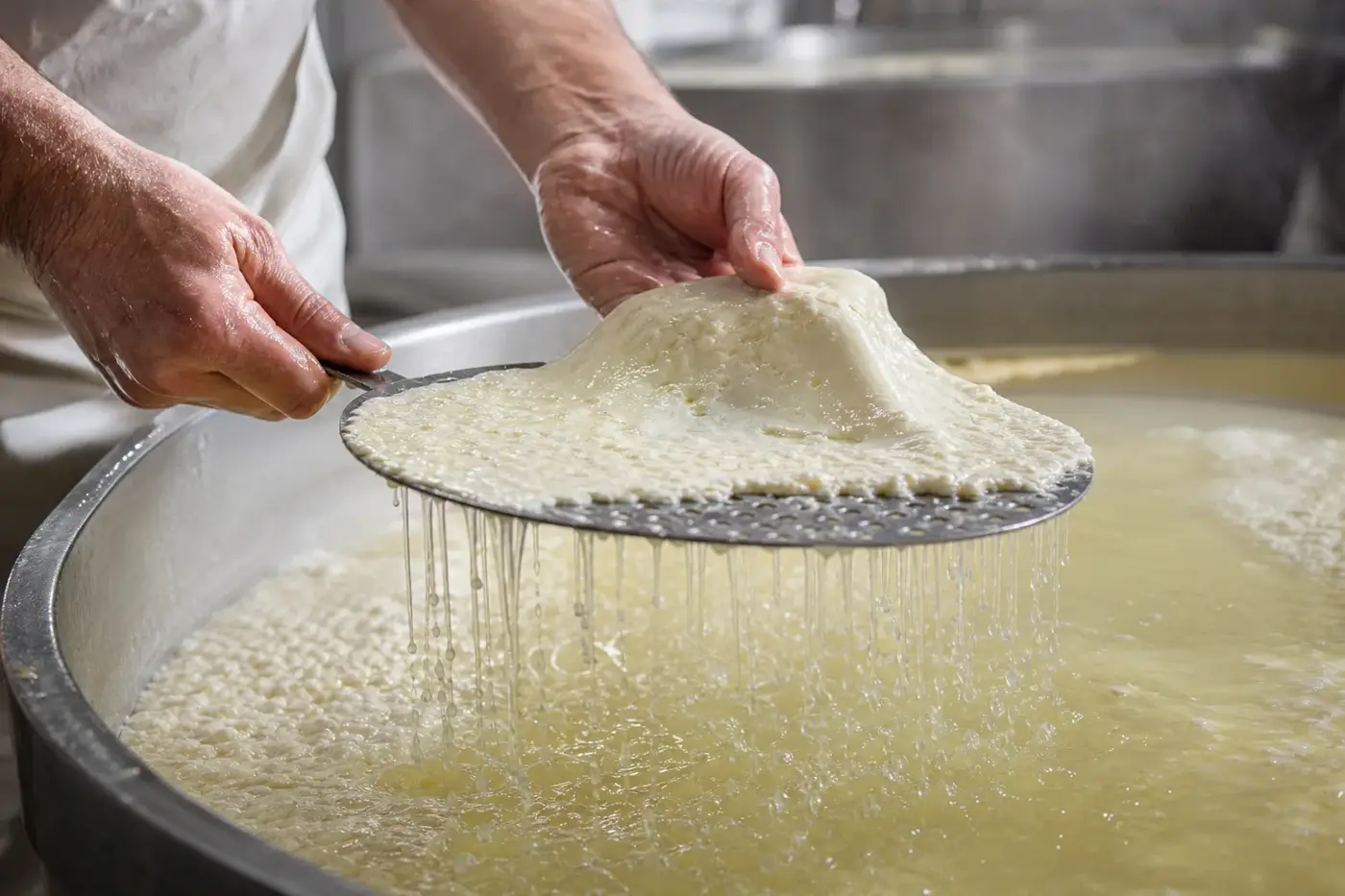
Inside the cooker, pieces of cheese soften, turn and merge as heat and mixing do their work.
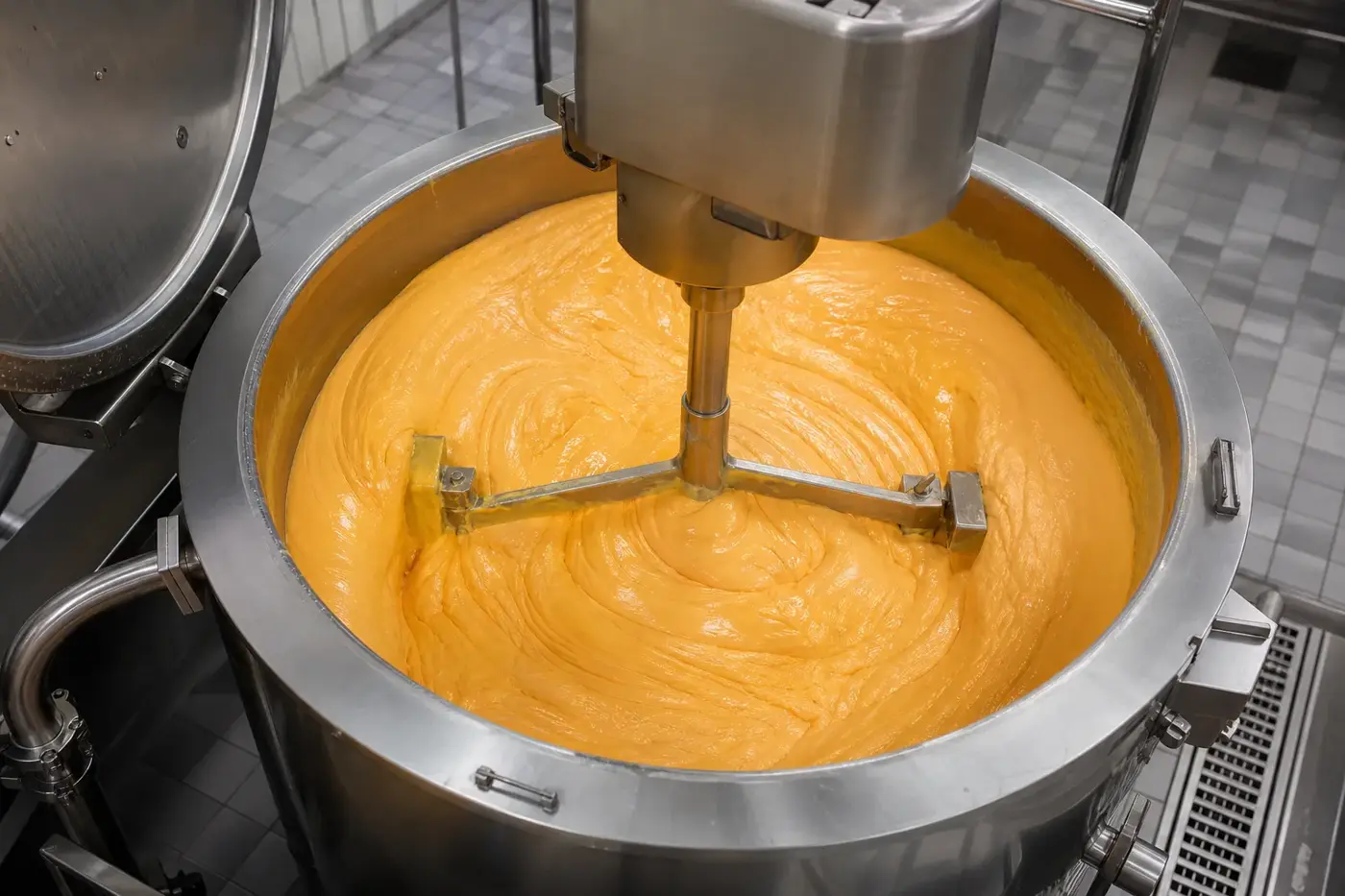
Inside the cooker, pieces of cheese soften, turn and merge as heat and mixing do their work. The smooth slice you know begins with finished cheeses, each bringing its own flavour, moisture and maturity. Makers select them, grind them, then blend them with water and emulsifying salts under heat. Citrates and phosphates change how milk proteins interact with calcium, helping them hold water and keep fat dispersed rather than gathering in an oily layer. [1, 2]
Your slice’s journey, in brief
- Makers blend cheeses of different ages and moisture levels to shape the finished product. [1]
- The recipe, heating, mixing and cooling decide whether you get a slice, block or spread. [1, 4]
- Some products are designed for ambient distribution; others need refrigeration. [4, 5]
First, bring the cheese
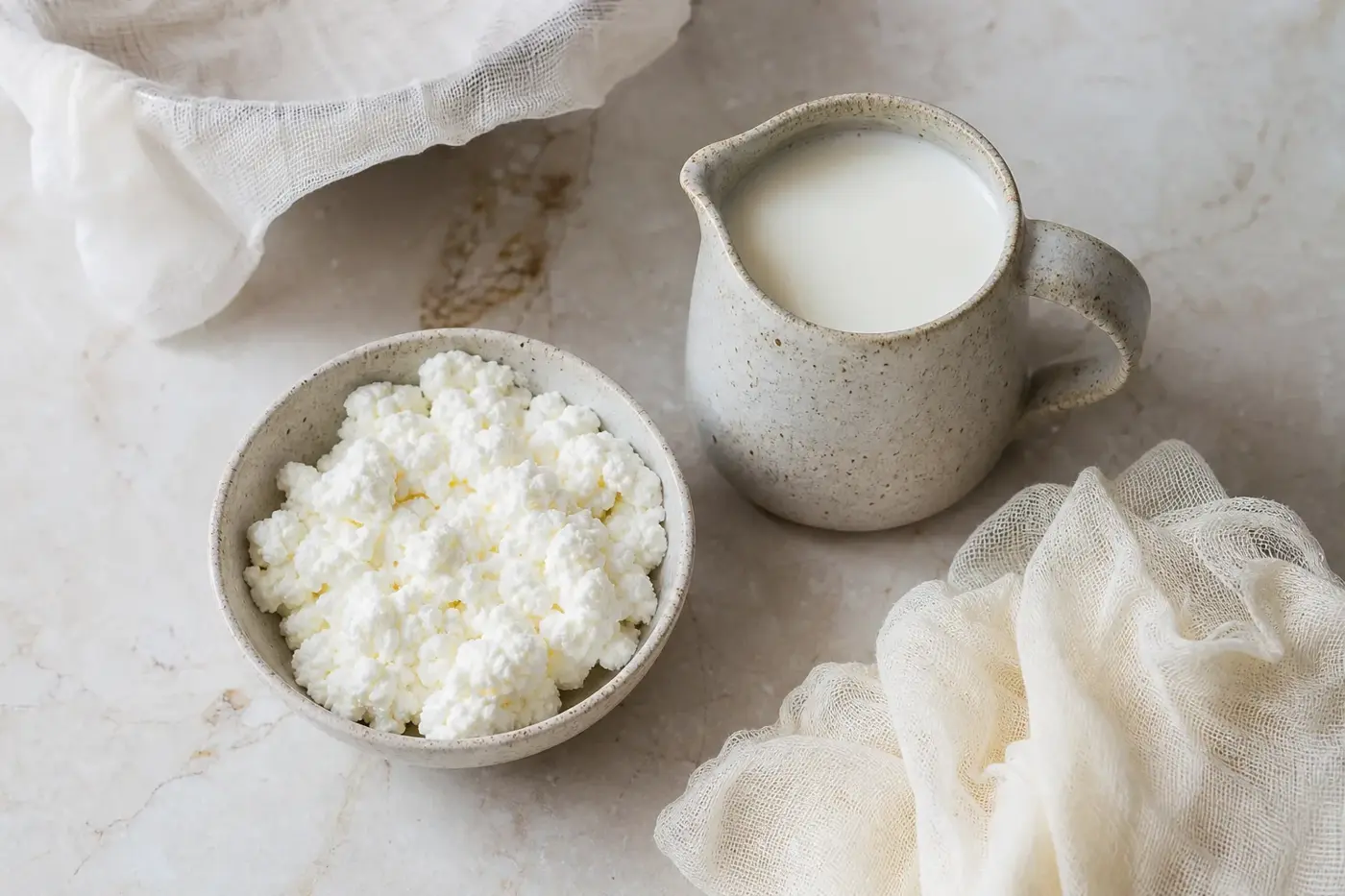
Processed cheese starts further along the cheesemaking journey than you might expect. Conventional cheesemaking begins with milk and the formation of curd, the material rich in protein that separates from liquid whey. Here, the cheese is already made, sometimes ripened, and ready for its structure to be rebuilt. The milk-to-cheese process takes you through that earlier stage. [1, 3]
You will see those starting cheeses called “natural cheese”, the technical term used to distinguish them here. It does not mean that only one product undergoes processing: both do. Processed cheese gets an additional blending and heating treatment to make its composition and behaviour consistent. [2, 3]
Plant based alternatives begin with plant ingredients, not dairy cheese. The explanation of casein and calcium below therefore does not necessarily apply to them. For those products, turn to Plant Based Cheese Alternatives.
Choosing the cheeses that belong together
The recipe begins before anything reaches the cooker. Makers choose cheeses with different flavours, moisture contents and degrees of maturity, balancing what each brings to the blend. Tetra Pak’s technical handbook describes blends of hard, rennet-made cheeses with different aromas and ages. This is deliberate formulation, not a fridge clear-out with industrial equipment. [1]
Age brings more than flavour. Ripening breaks down proteins, changing the material available to build the processed cheese network. Moisture, fat, protein and mineral composition matter too. Two blends might taste similar to you yet behave quite differently in the cooker. [2, 3]
One published manufacturing experiment gives you a feel for that precision. Researchers combined one-month-old and four-month-old mozzarella in a two-to-one ratio, alongside other dairy ingredients. That was an experimental formulation, not a standard processed cheese recipe. [2]
Getting the blocks ready for the cooker
Smaller pieces are easier to mix evenly. Tetra Pak describes scraping and washing cheese surfaces before grinding. Depending on the equipment, cheese arrives at the mixing stage as ground material, shreds or blocks that the mixer itself cuts down. [1, 4]
As heating begins, those smaller pieces help ingredients spread throughout the batch. You would still find recognisable pieces of cheese, water and other ingredients at this point. The continuous, uniform structure of the finished product has not yet formed. [2, 4]
A batch cooker and a continuous line move material through the factory in different ways. Both rely on the same essential partnership: controlled heating and mechanical mixing. [1, 5]
Water, butter and milk ingredients earn their place
Water is a carefully chosen ingredient, not an afterthought. It sets the intended moisture content, gives salts somewhere to dissolve and lets proteins hydrate. A spread needs a different balance of water and structural solids from a slice. How much goes in is a deliberate recipe decision. [2, 5]
Milk ingredients give makers more ways to adjust that balance. Milk powders contribute dairy solids, whey protein concentrate changes the protein mixture, and butter supplies milk fat. One research formulation brought cheese, butter, skimmed milk powder and whey protein concentrate together in a single product. [2]
You cannot simply swap these ingredients and expect the same result. Butter changes fat content; milk powder changes both the solids and the protein available. Equal quantities of different dairy ingredients will not necessarily give you the same texture. [2, 3]
Ordinary salt takes care of seasoning. Flavourings offer another route to the finished taste, with technical descriptions including smoked flavours, herbs, vegetables and spices. What makers use depends on the formulation and the rules where the product is sold. [1, 5, 6]
Meet the salts that hold the blend together
Much of the work falls to casein, cheese’s main structural protein. Calcium helps hold its network together. Emulsifying salts alter those calcium connections, allowing the protein structure to disperse and take up water during heating and mixing. [2, 3]
You may come across the technical phrase “sequestering calcium”. It means binding calcium into complexes that change its role in the protein network. Citrates and phosphates both do this, but differently: citrate can form soluble calcium complexes, while some phosphates also join complexes involving calcium and casein. [3]
A 2024 study explored that difference using processed cheese made with four different salts at two acidity levels. Researchers separated water-soluble extracts by centrifugation and membrane filtration, distinguishing smaller dissolved components from material associated with protein. They found different calcium distributions with citrate and phosphate salts. [3]
As casein disperses and hydrates, it becomes better at coating fat droplets. Those protein-coated droplets stay distributed through the mixture containing water, creating a stable emulsion rather than separate pools of fat and liquid. The proteins do much of the actual emulsifying. The salts make that work possible. [2]
Choosing a salt also affects acidity and the interactions between proteins. That is why manufacturers may use salt blends. One citrate or phosphate cannot simply stand in for every other. [3, 7]
Into the cooker, where the blend turns smooth
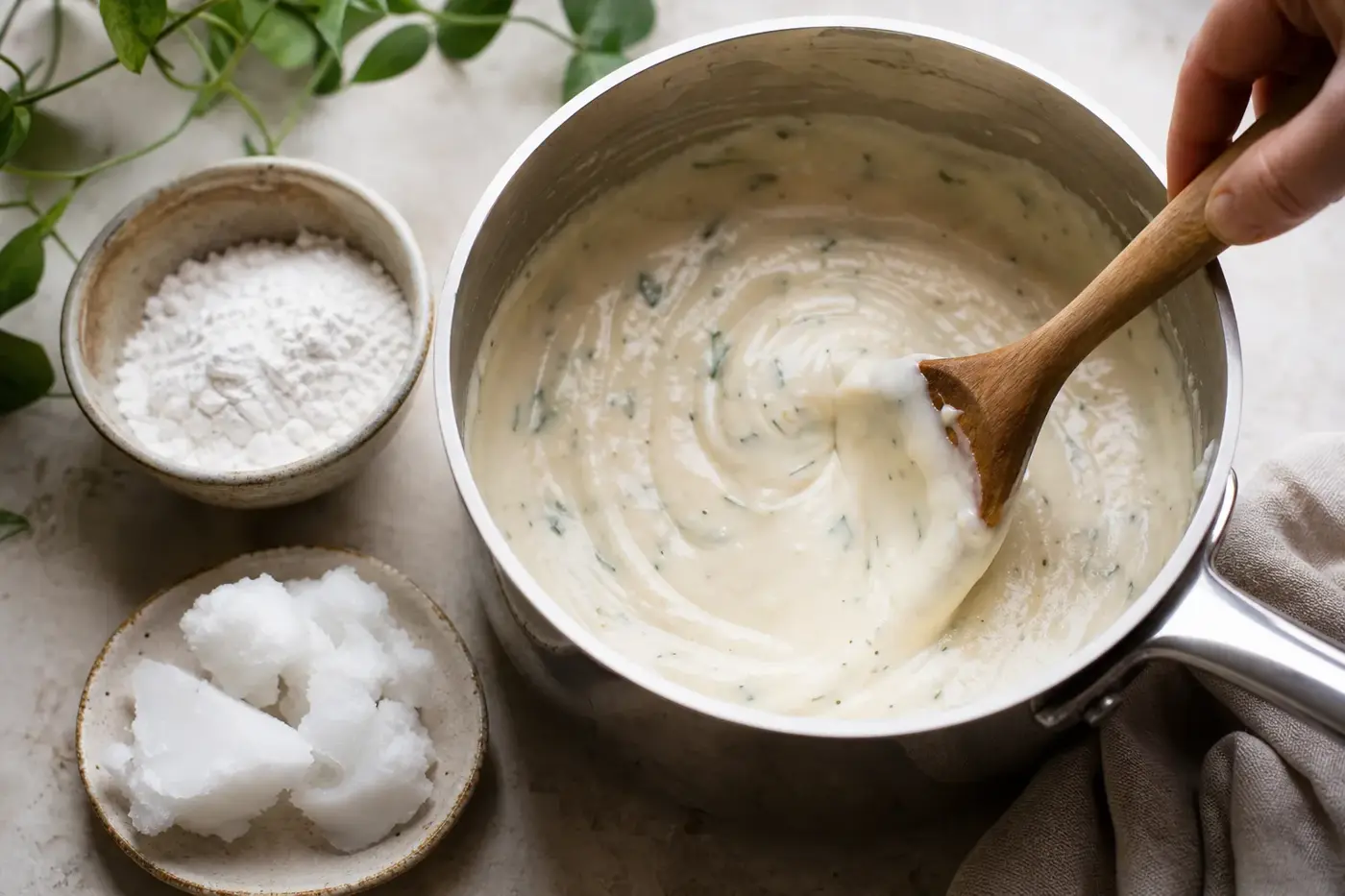
Inside the cooker, heat and moving blades or screws work on the ingredients together. Tetra Pak describes industrial processing temperatures of 70 to 95 °C (158 to 203 °F), or higher for some products. Heat arrives through the cooker walls, injected steam or both. These are equipment examples, not a universal treatment: each commercial process needs its own controlled treatment. [1, 5]
Mixing spreads the heat, limits scorching and helps the structural changes started by the salts. Cheese softens and proteins hydrate. Fat becomes dispersed throughout the mixture. [1, 2]
Equipment specialists call part of this development creaming, although it does not mean adding cream. It describes changes in protein hydration and fat emulsification; Tetra Pak’s white paper explains how shear and time at temperature influence this stage. Some lines use a separate creaming vessel. Optional homogenisation creates a finer fat dispersion and can increase firmness. [4]
Smooth is one thing, melty is another
A smooth cheese need not flow freely when you reheat it. Smoothness and melting are different qualities, however hopefully you watch your slice. By adjusting several connected variables, manufacturers can make a slice that holds together, a firm block or a spread. [4, 7, 8]
| What makers adjust | What it changes | What that means for your cheese |
|---|---|---|
| Moisture | The balance of water and structural solids | Technical descriptions distinguish firmer blocks from spreads with more moisture. [1, 5] |
| Acidity | Protein charge, dispersion and interactions | Effects on flow depended on the emulsifying salt. [7] |
| Salt type and concentration | Calcium binding and network formation | Different salts gave different hardness and emulsification results. [2, 8] |
| Mixing and heating | Hydration, fat dispersion and structure | Shear, holding and homogenisation influence consistency. [4] |
Acidity shows you how closely these choices interact. In a 2008 experiment, researchers used four salts at the same concentration and adjusted pH from 5.3 to about 5.9. Raising pH initially increased flow in all four treatments. Further increases produced different responses depending on the salt. [7]
Adding more salt is not a simple route to firmer cheese or a better melt, either. In a model-system study using calcium caseinate and butter oil, increasing emulsifying salts first increased firmness, then decreased it. The relationship depended on both salt type and concentration. [8]
Taking shape as a slice, block or spread
Once the hot mixture reaches the required consistency, it moves to forming or filling equipment. For blocks, makers can fill moulds or containers and cool the contents. For slices, they can spread or extrude the molten mixture onto chilled rolls before cutting it. [9]
Spreads enter their final containers while the mixture is still fluid enough to fill them. Packaging equipment controls portion shape and size. Cooling develops the properties that allow the finished product to be handled. [1, 9]
Cooling helps shape texture, too. Tetra Pak distinguishes rapid cooling for spreadable products from slower cooling for some blocks. The right cooling profile depends on the formulation and production line. [1]
By the time you see the finished shape, many of its defining choices have already been made. The cheeses selected, the emulsifying salts added, and the heating and mixing all leave their mark. You meet the result as a slice, block or spread. [2, 4, 9]
This page summarises published guidance from the official sources it cites. It is not medical advice. Guidance differs between countries and changes over time, so check the current source for where you live, and ask your doctor, midwife, pharmacist or dietitian about your own circumstances.
Heat does its part, but storage still matters
Heating is one part of microbial control, not the whole system. The Canadian Food Inspection Agency’s technical guidance explains that processing heat can destroy vegetative bacterial cells while viable bacterial spores remain. Alongside heat treatment, manufacturers must control factors including moisture, pH, salt, emulsifying agents and blend composition. [5]
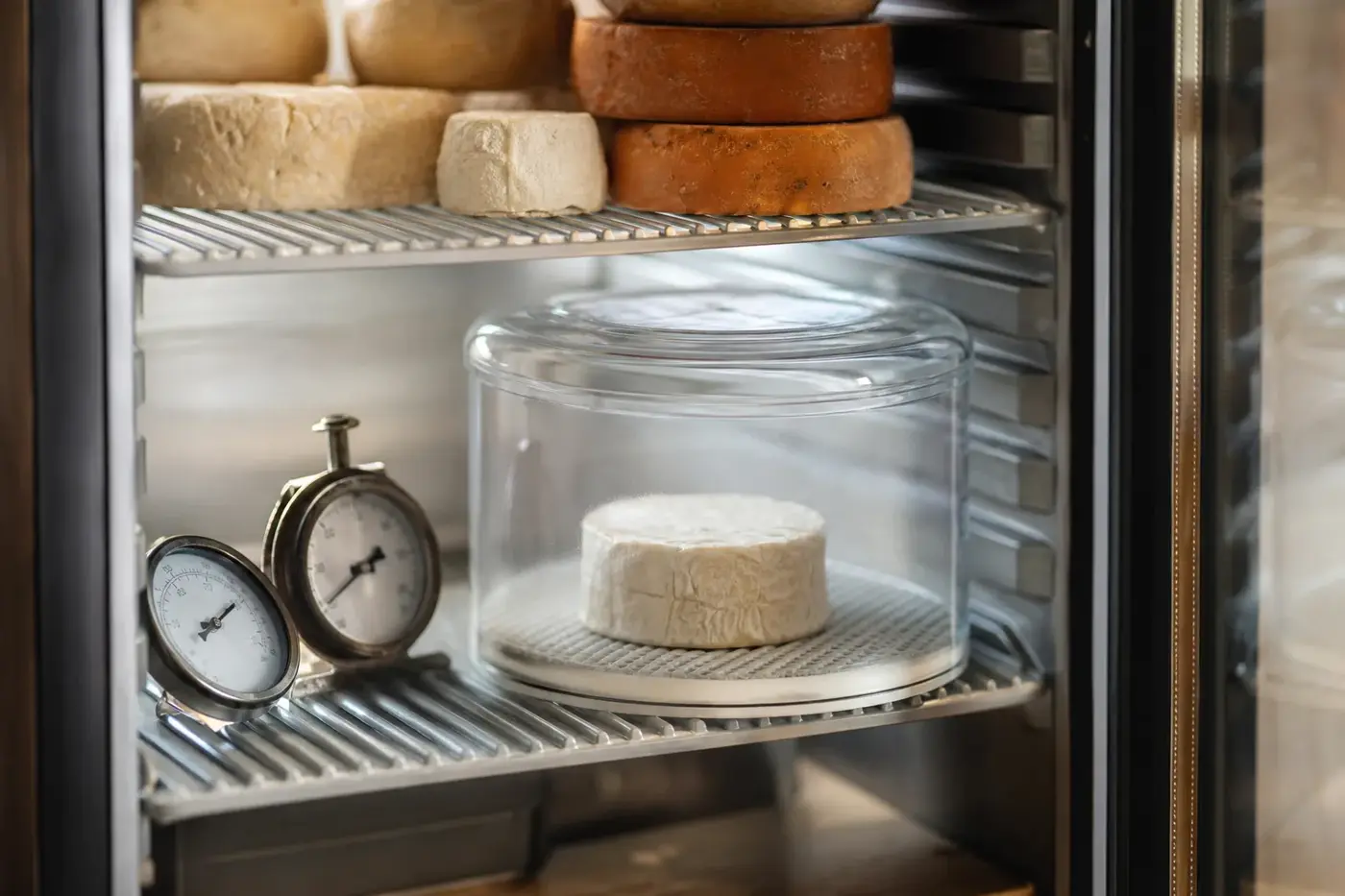
Clean equipment, controlled transfer and suitable packaging remain essential around the heat-treatment stage. Changing ingredients or processing conditions can call for a fresh safety assessment. Some products are designed for ambient distribution; others need refrigeration. Shelf life depends on the particular product and its validated process. [4, 5]
If you are in England, Wales or Northern Ireland, consult the Food Standards Agency’s current chilling and storage guidance. That includes its advice on following packaging instructions and storing food after opening. [10]
For practical storage details, turn to the home storage guide. It covers that part of looking after your cheese separately.
Read the label and meet the recipe
Pick up the pack and you can begin to see how the maker assembled the product. Start with the named food, then look at where cheese, water, butter and milk ingredients appear. UK government guidance says ingredients are listed in descending order of weight. Percentage declarations are required in specified circumstances, including when an ingredient is highlighted in the product name. [11]
Next, find the emulsifying salts: sodium citrates and different phosphates connect the label to the chemistry you have just explored. The ingredient list alone cannot reveal processing conditions or predict exact melting performance. The Food Standards Agency lists additive names and E numbers, explaining that permissions depend on the food category and applicable conditions. [6, 7]
The Food Standards Agency also distinguishes the food additive framework for England and Wales from the one applying in Northern Ireland. Check the applicable legislation for the place of sale. [6]
Finally, read the formulation alongside the storage instructions and intended use; the cheese label guide explains the wider information on the pack. For processed cheese, the revealing thread runs from the ingredients to the protein structure they help create. Follow it, and you can better understand why that slice, block or spread behaves as it does.
Questions people ask
Is processed cheese made from real cheese?
Processed cheese starts with cheese that has already been made, sometimes ripened. Makers grind and blend it with water and emulsifying salts under heat.
Why are emulsifying salts added to processed cheese?
Citrates and phosphates alter the calcium connections in the cheese protein network. This helps the proteins take up water and keep fat dispersed rather than letting it collect in an oily layer.
Why do some processed cheeses melt differently from others?
Moisture, acidity, salt type and concentration, heating and mixing all affect the finished texture. A smooth processed cheese will not necessarily flow freely when reheated.
Does processed cheese need to be kept in the fridge?
Some products are designed for ambient distribution, while others need refrigeration. In England, Wales and Northern Ireland, consult the Food Standards Agency’s current chilling and storage guidance, including its advice on following packaging instructions and storing food after opening.
What can the ingredient list tell me about processed cheese?
The list shows ingredients such as cheese, water, butter, milk ingredients and emulsifying salts in descending order of weight. It cannot reveal the processing conditions or predict exactly how the product will melt.
Sources
[1] Tetra Pak, Dairy Processing Handbook, online chapter “Cheese”, sections “Processed cheese” and “Manufacturing process”, undated online edition, retrieved November 2026.
Read at dairyprocessinghandbook.tetrapak.com
Equipment manufacturer’s technical account.
[2] American Dairy Science Association, Journal of Dairy Science, “Effect of emulsifying salts on the physicochemical properties of processed cheese made from Mozzarella”, volume 95, pages 4823 to 4830, 2012.
Read at journalofdairyscience.org
Original experimental research.
[3] Molecules, “Soluble Salts in Processed Cheese Prepared with Citrate- and Phosphate-Based Calcium Sequestering Salts”, volume 29, article 3631, 2024.
Read at pmc.ncbi.nlm.nih.gov
Original research involving Teagasc, Wageningen University and University College Cork.
[4] Tetra Pak, spreadable cheese quality white paper, section “A classic processed cheese process”, page 14, undated retrieved edition.
Read at tetrapak.com
Equipment manufacturer’s technical account, developed with NIZO.
[5] Canadian Food Inspection Agency, “Processing controls: Formulation and processing controls for processed cheeses, sweetened condensed milk and aerosol-packaged dairy products”, online guidance, retrieved November 2026.
Read at inspection.canada.ca
Used for manufacturing controls, not as UK consumer advice.
[6] Food Standards Agency, “Approved additives and E numbers”, published 25 June 2026.
Read at gov.uk
Official guidance distinguishing the additive legislation for England and Wales from that applying in Northern Ireland.
[7] Journal of Food Science, “Effects of pH on the textural properties and meltability of pasteurized process cheese made with different types of emulsifying salts”, volume 73, pages E363 to E369, 2008, abstract.
Read at pubmed.ncbi.nlm.nih.gov
Original research using flow and compression measurements.
[8] Journal of Food Science, “Emulsifying Salts Influence on Characteristics of Cheese Analogs from Calcium Caseinate”, volume 56, pages 1542 to 1547, 1991, abstract.
Read at ift.onlinelibrary.wiley.com
Original model-system research.
[9] US Dairy Export Council, Reference Manual for Cheeses from the USA, section “Other Types of Cheesemaking Procedures (Processed Cheese)”, page 34, undated retrieved edition.
Read at cheesefromtheusa.org
Industry technical reference, used for forming methods, not UK composition rules.
[10] Food Standards Agency, “How to chill, freeze and defrost food safely”, published 18 December 2017, current retrieved guidance for England, Northern Ireland and Wales.
Read at gov.uk
Sections “Chilling food” and “How to stock your fridge”.
[11] UK Government, “Food labelling and packaging: Ingredients list”, undated online guidance, retrieved November 2026.
Read at gov.uk
Sections “Ingredients list” and “Ingredient quantities”.
Researched through equipment documentation, original dairy science experiments and official food-agency guidance, synthesising how formulation and processing affect finished texture.
Last checked: November 2026
Last checked November 2026.
The editors suggest you read next