Parmigiano Reggiano
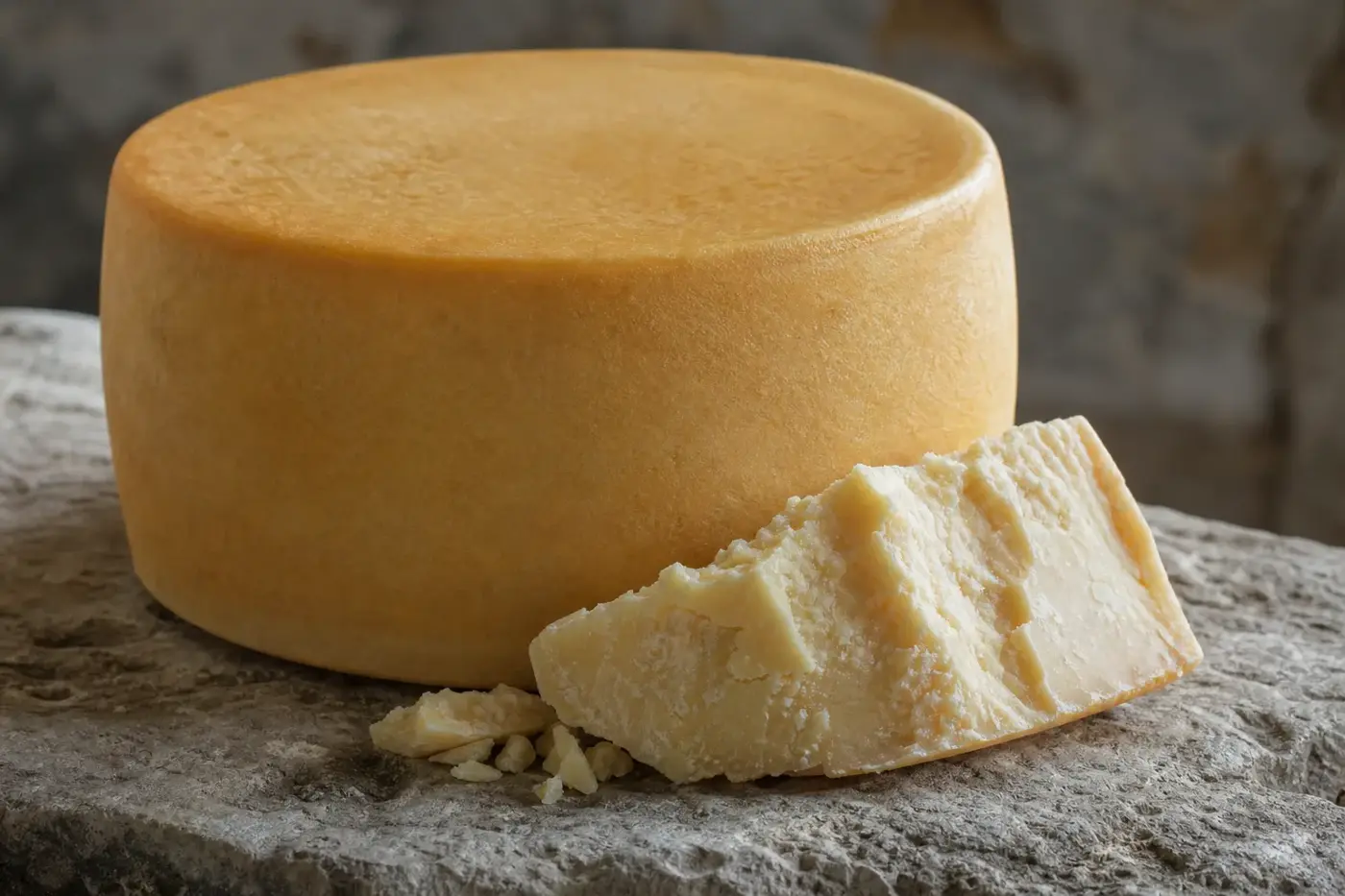
Break into a wheel of Parmigiano Reggiano and flakes fall away, revealing a finely granular cheese, pale straw to straw in colour.
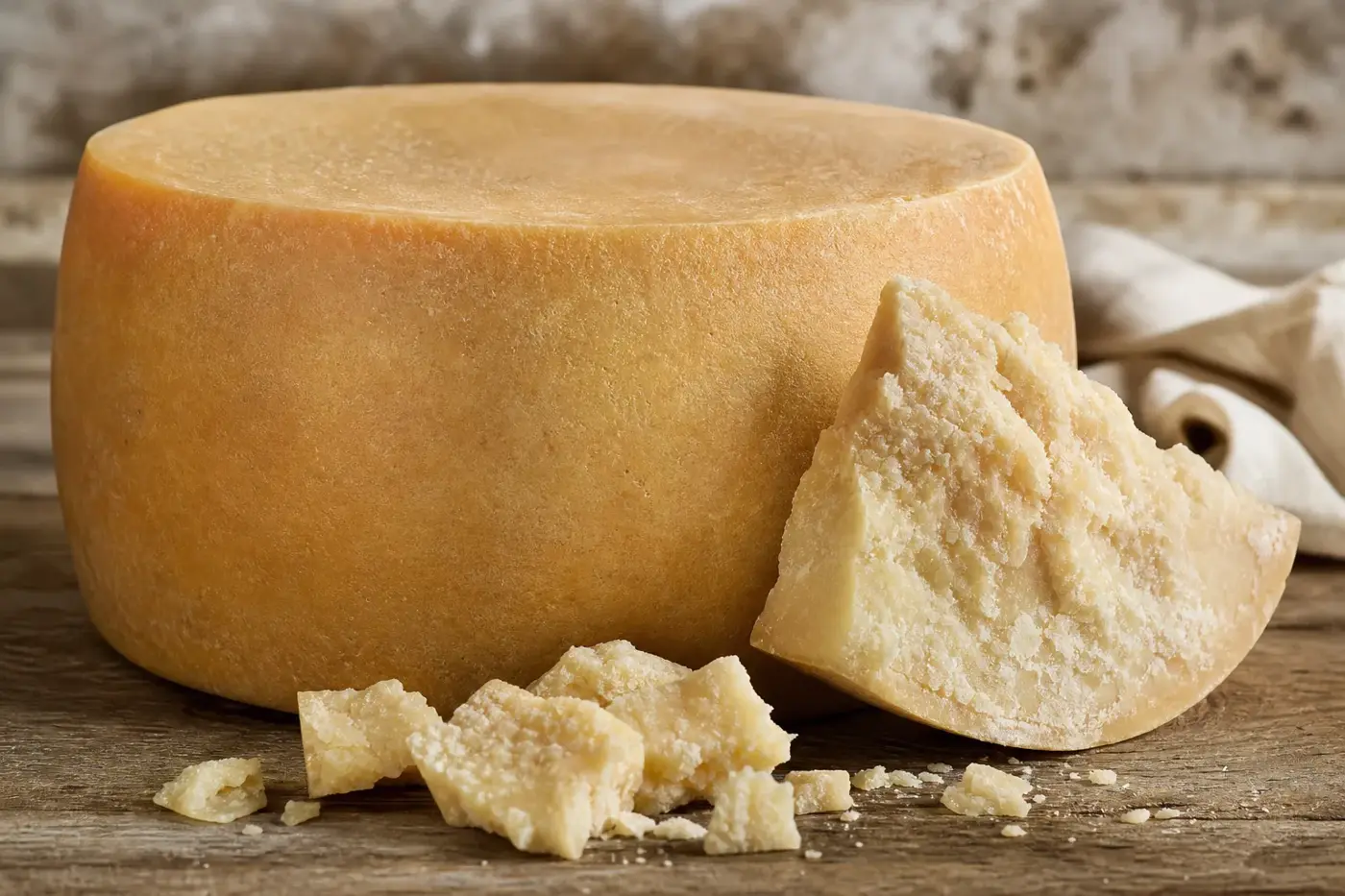
Break into a wheel of Parmigiano Reggiano and flakes fall away, revealing a finely granular cheese, pale straw to straw in colour. You can read something of its character before you taste it. Even that texture has a place in the official specification, alongside raw cows’ milk, calf rennet and at least 12 months of ageing.[2][5]
The name carries almost as much weight as the wheel. This hard Italian cheese’s EU protected designation of origin, or PDO, ties it to a defined place and method. Follow “Parmesan” abroad, though, and you enter materially different legal territory in the United States, Canada and other markets.[1][2][9][11]
| At a glance | What to know |
|---|---|
| The name to look for | Parmigiano Reggiano.[1] |
| EU registration | PDO, file PDO-IT-0016; registered 21 June 1996; status Registered as of November 2026.[1] |
| Great Britain registration | PDO; registered 31 December 2020; status Registered as of November 2026.[6] |
| Where it is made | Parma, Reggio nell’Emilia and Modena provinces; Bologna left of the Reno; Mantova right of the Po, Italy.[2] |
| Milk and treatment | Raw cows’ milk, partially skimmed by natural creaming.[2] |
| What sets the milk | Exclusively calf rennet.[2] |
| Legal minimum ageing | 12 months from moulding.[2] |
| Minimum wheel weight | 30 kg.[2] |
| Minimum fat | 32% fat in dry matter.[2] |
Give “strong and salty” a little time off
Fragrant, delicate and savoury rather than piquant. Those are the specification’s words for Parmigiano Reggiano’s flavour. Add its granular texture and flaking structure, and you get a more revealing picture than “strong” or “salty”, the usual shorthand for hard grating cheese. Your grater does not get the final word.[5]
You might also hear it called a cooked-curd cheese. This means the curd is heated during cheesemaking, not that the milk arrives pasteurised. Curd is the solid material formed when milk coagulates; whey is the liquid separated from it.[2]
So raw milk and cooked curd belong quite comfortably in the same description. Unpasteurised milk can undergo heating later in production. The specification treats the milk’s condition and the cheesemaking operations that follow as separate stages.[2]
Follow the milk from field to ageing room
Before the milk reaches the dairy, the rules are already at work. They begin with the cows’ feed, then follow the milk through vats, starter and the long wait while each wheel ages. What reaches your table starts well beyond the cheesemaking room.[2]
The Consorzio publishes the current disciplinare, or production specification, as in force from 24 April 2025. Commission Implementing Regulation (EU) 2025/661 approved the amendment on 3 April 2025 and was published on 4 April. When you compare accounts of cheesemaking, notice which version of the rules each describes.[3][4]
The rules behind every wheel
Here is what production in Italy must follow under the specification published as effective from 24 April 2025. Consider it a recipe, but not the sort that welcomes a little improvisation.[2][3]
| Part of the process | The rule | What it means for your cheese |
|---|---|---|
| Geographical area | The five provincial territories, with the river boundaries in the fact box | It comes from a defined area, not simply Italy |
| Milk | Raw cows’ milk; partial skimming by natural creaming | No pasteurisation or mechanical skimming |
| Feeding | Forage mainly from the area of origin; silage prohibited in dairy and replacement herds | The rules start with what the cows eat |
| Starter | Natural whey starter from the preceding cheesemaking | Fermentation follows a prescribed method |
| Rennet | Exclusively calf rennet | The enzymes that coagulate the milk must come from the specified source |
| Vats | Truncated-cone copper vats, producing up to two wheels each | Both the equipment and batch format are specified |
| Salting | Immersion in brine | Salt enters at a prescribed stage |
| Ageing | At least 12 months from moulding | This is the legal minimum, separate from any longer declared age |
The milk has a timetable, too. Two daily milkings are permitted, with delivery required within two hours of the end of each milking; milking and transport together must take no more than seven hours. Evening milk stands in steel tanks, giving the cream time to rise naturally before cheesemaking.[2]
For you at the table, calf rennet has a practical consequence. Rennet is the enzyme preparation that makes milk coagulate, and its required calf origin makes Parmigiano Reggiano unsuitable for vegetarians who exclude animal-derived rennet. Hard cheeses made with microbial or fermentation-produced coagulants follow a different production choice.[2]
Let the marks tell you the wheel’s story
Those dotted letters reward a closer look. Parmigiano Reggiano carries two distinct kinds of identification: origin marks applied by the dairy, and selection marks applied after examination. They tell you different parts of the story.[2]
Among the origin marks is a casein plate, or equivalent identifier, unique to that wheel. Around the curved side, called the heel, you will find dotted lettering with the dairy number, production month and year, and DOP. That last abbreviation is the Italian equivalent of PDO.[2]
After inspection by the authorised control body, the Consorzio applies the oval selection brand to first- and second-category wheels. Third-category wheels have their origin marks removed. Article 14 of the marking rules requires both the oval selection mark and the full minimum 12 months of ageing before sale under the PDO.[2]
When you examine a wheel, then, read its marks in two parts. The dairy details tell you its origin and production date. The selection mark records its passage through the prescribed grading system.[2]
When “Parmesan” went to court
On 26 February 2008, the Court of Justice found that “Parmesan” evoked the PDO Parmigiano Reggiano. In Case C-132/05, Commission v Germany, it considered the names’ visual and phonetic similarities, alongside the cheeses’ similar appearance. The resemblance mattered in more than one way.[8]
“Evocation” means bringing a protected designation to mind without necessarily using its exact wording. The Court also found that Germany had failed to establish that “Parmesan” was generic. Whether the word was technically a translation of Parmigiano Reggiano therefore became irrelevant to its reasoning.[8]
Yet the Commission still lost the infringement action. In those proceedings, the Court considered German law to provide instruments capable of protecting producers and consumers. It rejected the Commission’s argument about Germany’s obligation to act on its own initiative.[8]
The name and the alleged failure to act were different questions, with different answers. One concerned EU protection; the other concerned Germany’s conduct. Beyond that judgment, each market’s rules help explain why the two names mean different things around the world.[8][9][11][13]
What the names mean where you shop
When you see “Parmigiano Reggiano” and “parmesan”, do not assume their protection travels together. They are separate legal questions. Here is the position as of November 2026.
| Where you are | Parmigiano Reggiano | What “parmesan” means legally |
|---|---|---|
| EU, including Italy | Registered PDO since 21 June 1996.[1] | The Court recognised evocation of the PDO in C-132/05.[8] |
| Great Britain | Registered PDO since 31 December 2020.[6] | The GB scheme protects the registered name; infringement by a given use of “parmesan” depends on the facts.[7] |
| Northern Ireland | EU GI schemes apply.[7] | The EU protection framework applies to names sold there.[7] |
| United States | Name-specific protection: unconfirmed | “Parmesan and reggiano cheese” has a federal standard of identity, 21 CFR 133.165.[9] |
| Canada | GI entered on the list on 21 September 2017.[10] | Express exception under Trademarks Act section 11.18(4.1)(h).[11] |
| Australia | Current protection: unconfirmed. Future protection is committed under an agreement not yet in force.[13] | DFAT says parmesan is not a GI or a translation of the Italian GI in Australia, and Australian parmesan producers face no change.[13] |
| New Zealand | Protected under the New Zealand and EU Free Trade Agreement, which entered into force on 1 May 2024.[19] | Qualifying businesses that used “Parmesan” continuously for at least five years before 1 May 2024 may continue under specified conditions, including a visible and legible indication of geographical origin.[20] |
The US standard gives you a clear example of how production rules differ. It requires at least 10 months’ curing, permits pasteurised milk and allows suitable milk-clotting enzymes beyond calf rennet. Maximum moisture is 32% of the whole cheese; minimum milkfat is 32% of the solids.[9]
Canada draws its own distinction between the names. The full Italian name is a listed geographical indication, while “Parmesan” is expressly excepted from the relevant GI restrictions. There, the full name and shorter term give you different legal information.[10][11]
Three dates to remember, millions of wheels to picture
Three dates help you find your way through the modern documentary story. EU PDO registration arrived on 21 June 1996, the Parmesan judgment followed on 26 February 2008, and the specification version was published as effective from 24 April 2025. Think registration, judicial interpretation and production requirements: three distinct events.[1][3][8]
Then picture the scale of production. For 2025, the Consorzio reported 4.19 million wheels, up from 4.079 million in 2024, an increase of 2.7%. Its release of 26 March 2026 reported an export share of 50.5%; these are the producer organisation’s published figures for that year.[15]
Choosing raw-milk cheese: start with local guidance
If you are choosing cheese for someone in a higher-risk group, location matters. Parmigiano Reggiano is made from raw milk, and official advice on eating it differs by country.[2][16][17][18]
In UK pregnancy guidance last reviewed on 15 June 2026, the NHS says “pasteurised or unpasteurised hard cheeses, such as cheddar, gruyère and parmesan” are safe to eat. That guidance includes both types of milk, rather than treating all raw-milk cheese alike.[16]
The US CDC takes a different approach. Its guidance dated 31 January 2025 advises avoiding “Any type of cheese when made with (raw) unpasteurized milk” for people who are pregnant, newborns, people aged 65 or older and people with weakened immune systems.[17]
Health Canada's September 2026 advice for people at greater risk of food poisoning also recommends avoiding uncooked cheese made from unpasteurised milk. Follow the guidance for where you live when choosing cheese during pregnancy or for someone with weakened immunity. Ask your doctor, midwife or dietitian for advice suited to your circumstances.[16][17][18]
General information only, not medical advice: follow the official guidance where you live.
Questions people ask
Is Parmigiano Reggiano vegetarian?
Parmigiano Reggiano must be made with calf rennet. It is unsuitable for vegetarians who exclude animal derived rennet.
Is Parmigiano Reggiano made from raw milk?
Yes, it is made from raw cows’ milk. It is a cooked curd cheese, but that refers to heating the curd during cheesemaking, not pasteurising the milk.
How long is Parmigiano Reggiano aged?
The legal minimum is 12 months from moulding. A wheel must also receive the oval selection mark before it can be sold under the PDO.
Is Parmesan the same as Parmigiano Reggiano?
The legal treatment of Parmesan depends on the jurisdiction. In the EU, the Court of Justice recognised that Parmesan evokes the Parmigiano Reggiano PDO, while in Canada Parmesan is expressly excepted from the relevant geographical indication restrictions.
Can you eat Parmigiano Reggiano during pregnancy?
The NHS says pasteurised or unpasteurised hard cheeses, including parmesan, are safe to eat during pregnancy. The US CDC advises pregnant people to avoid any cheese made with raw milk, so see the NHS or CDC guidance for the relevant country.
Sources
- European Commission. eAmbrosia: Parmigiano Reggiano, live register record PDO-IT-0016, checked November 2026. Register entry.
- Consorzio del Formaggio Parmigiano Reggiano. Disciplinare di produzione della denominazione di origine protetta “Parmigiano Reggiano”, version published as effective from 24 April 2025. Production specification.
- Consorzio del Formaggio Parmigiano Reggiano. Disciplinare e normative, current publication page, checked November 2026. Specification and legislation.
- European Commission. Regolamento di esecuzione (UE) 2025/661 della Commissione del 3 aprile 2025, OJ L, 4 April 2025; official document reproduced by the Consorzio. Regulation.
- European Commission. Documento unico “Parmigiano Reggiano”, PDO-IT-0016-AM06, published 9 June 2023; document supplied on the Consorzio’s current specification page. Single document.
- Defra. Parmigiano Reggiano, GB protected food names register, published 4 January 2021; checked November 2026. GB register entry.
- Defra. Protected geographical food and drink names: UK GI schemes, updated 8 March 2024. Scheme guidance.
- Court of Justice of the European Communities. Judgment in Case C-132/05, 26 February 2008. Full judgment. See also the Court’s press release.
- US Food and Drug Administration. 21 CFR 133.165: Parmesan and reggiano cheese, eCFR text checked November 2026. Standard of identity.
- Canadian Intellectual Property Office. Parmigiano Reggiano, 1858653, GI list record, entered 21 September 2017. Canadian record.
- Canada, Department of Justice. Trademarks Act, section 11.18(4.1)(h), consolidation current to 30 September 2026. Statutory exception.
- Council of the European Union. Council Decision 2011/738/EU, 20 October 2011, OJ L 297, 16 November 2011. Decision approving the Swiss agreement. This decision was retrieved, but the appended name list was not accessible during this session.
- Australian Department of Foreign Affairs and Trade. Dairy geographical indications, Australia and EU agreement information, checked November 2026. Dairy name commitments.
-
New Zealand Ministry of Foreign Affairs and Trade. NZ-EU FTA Implementation: making a statutory declaration, undated. Full page retrieval requires confirmation. Prior user provisions.
-
Intellectual Property Office of New Zealand. Geographical indications register: Parmigiano Reggiano, record 5459, registered 1 May 2024. Register entry.
-
New Zealand Ministry of Foreign Affairs and Trade. European Union and New Zealand free trade agreement implementation: geographical indications, undated. Implementation guidance.
- Consorzio del Formaggio Parmigiano Reggiano. Dati economici 2026, press release, 26 March 2026. Production and export figures.
- NHS. Foods to avoid in pregnancy, current page checked November 2026. Pregnancy guidance.
- US Centers for Disease Control and Prevention. Preventing Listeria Infection, 31 January 2025. Listeria prevention guidance.
- Health Canada. Safer food choices for people at greater risk of food poisoning: Information sheet, 29 September 2026. Current information sheet.
Last checked: November 2026
Last checked November 2026.
The editors suggest you read next
Grana Padano
Break a piece from a wheel of Grana Padano and watch the pale interior fall into fine grains and flakes.