Pecorino Romano
Take a piece of Pecorino Romano and let the salt announce itself.
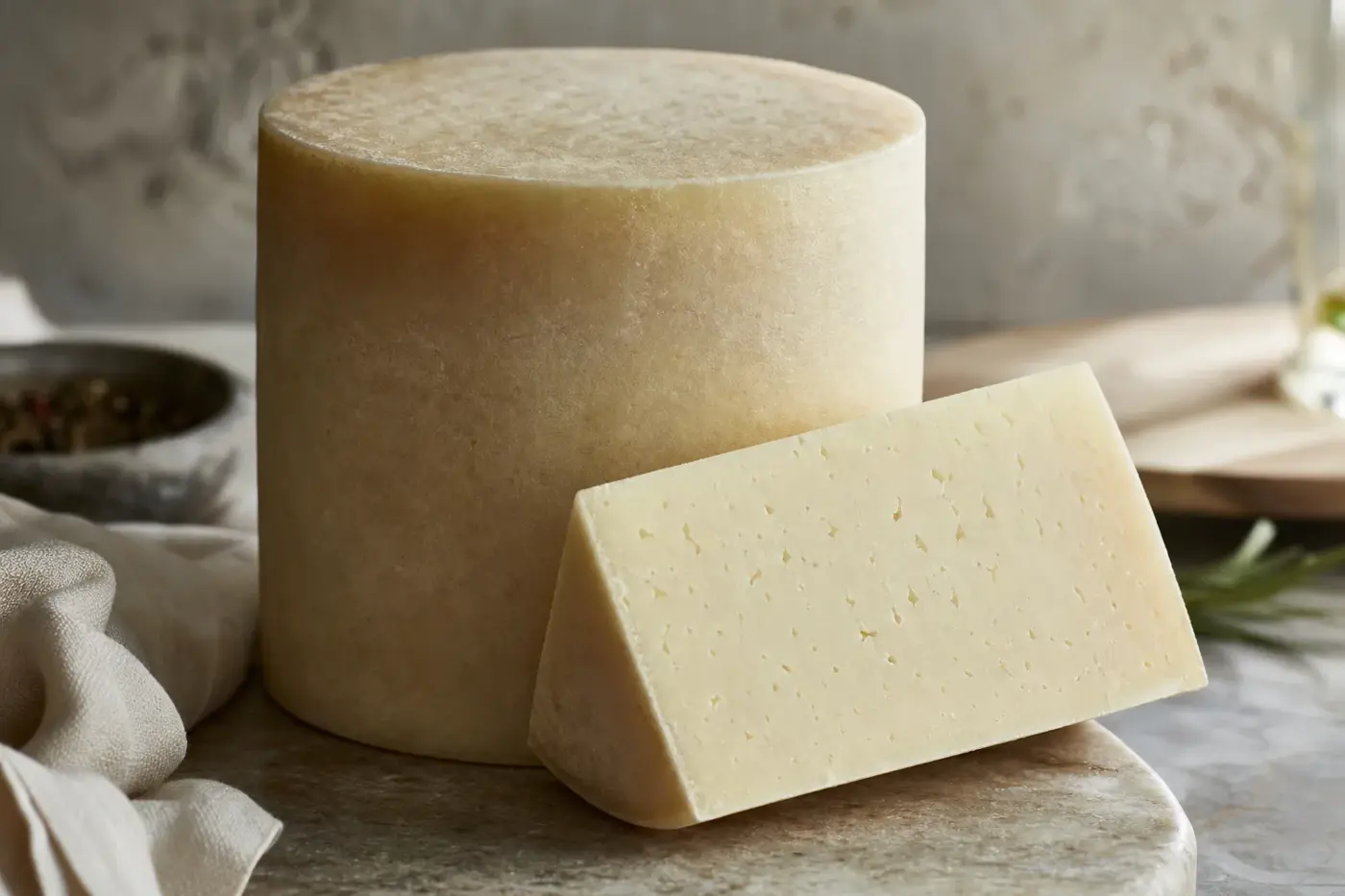
Take a piece of Pecorino Romano and let the salt announce itself. Beneath the thin, ivory to straw coloured rind, the compact, pale paste brings a savoury depth sharpened by salting and maturation.[3] Rome is in the name, but this Italian sheep’s milk cheese belongs to a wider landscape: Sardinia, Lazio and the province of Grosseto in Tuscany.[1]
It carries PDO protection in Great Britain, too.[2] Before you choose your wedge, picture its destination: the requirements distinguish cheese for the table from cheese for grating.[1][3] Your cheeseboard and your pasta may have different candidates in mind.
Your Pecorino Romano essentials, at a glance
| What to know | The useful detail |
|---|---|
| Familiar and registered name | Pecorino Romano.[2] |
| Registration authorities | Great Britain: Defra; EU: European Commission.[2][7] |
| Register IDs | Not supplied here. |
| Protection and dates | Great Britain: registered PDO, 31 December 2020. EU registration date recorded by Defra: 21 June 1996.[2] |
| Where it is made | Milk production, cheesemaking and maturation: Sardinia, Lazio and the province of Grosseto.[1] |
| Milk and rennet | Whole sheep’s milk; lamb rennet paste. For permitted milk treatments, see the dairy story below.[1][6] |
| Minimum maturation | Table cheese: five months; grating cheese: eight months.[1] |
| Typical maturation | Not supplied here. |
| Production season | October to July.[1] |
Start with the Romans, then sail to Sardinia
Fresh milk, lamb or kid rennet, baskets or moulds, pressure to release whey, then salt. Follow that familiar cheesemaking sequence through Columella’s De re rustica, book VII, chapter 8. He also describes a cheese suitable for shipment overseas.[5]
That method gives you the strongest documented connection with Roman antiquity. Today’s protected specification belongs to a much later legal framework. The ancient method and the modern rules are separate chapters, rather than one uninterrupted set of instructions.[5]
Sardinia’s regional cultural service traces the cheese’s expansion on the island to the late nineteenth century. Abundant sheep’s milk helped, as did an 1884 Rome ordinance prohibiting salting in city shop backrooms. Cheesemakers from Lazio, Tuscany and Campania moved production to Sardinia, initially working in small establishments called caselli.[4]
Roman associations and a substantial Sardinian production tradition sit comfortably together. Rome’s tourism authority identifies Sardinia as the source of the largest quantity today. For the origin of your particular wedge, read its production information: Romano is not a city address.[4][8]
Give this cheese a little room on the map
The defined area covers the whole of Sardinia and Lazio, plus Grosseto province in Tuscany. Milk production, cheesemaking and maturation must all take place within it.[1] In Great Britain, qualifying cheese made in Sardinia can carry the same PDO name as cheese made in Lazio.[2]
The boundary stretches beyond Rome, but not across all Italy. “Pecorino” refers to sheep’s milk cheeses, so you need the complete name. Italian pecorini have distinct production rules and characters; sharing a word does not make them interchangeable.[1][10][11]
For more on that geographical connection, visit protected names explained. When you are reading a cheese label, look for the full designation. It tells you which pecorino is coming home with you.
Meet the wheel behind your wedge
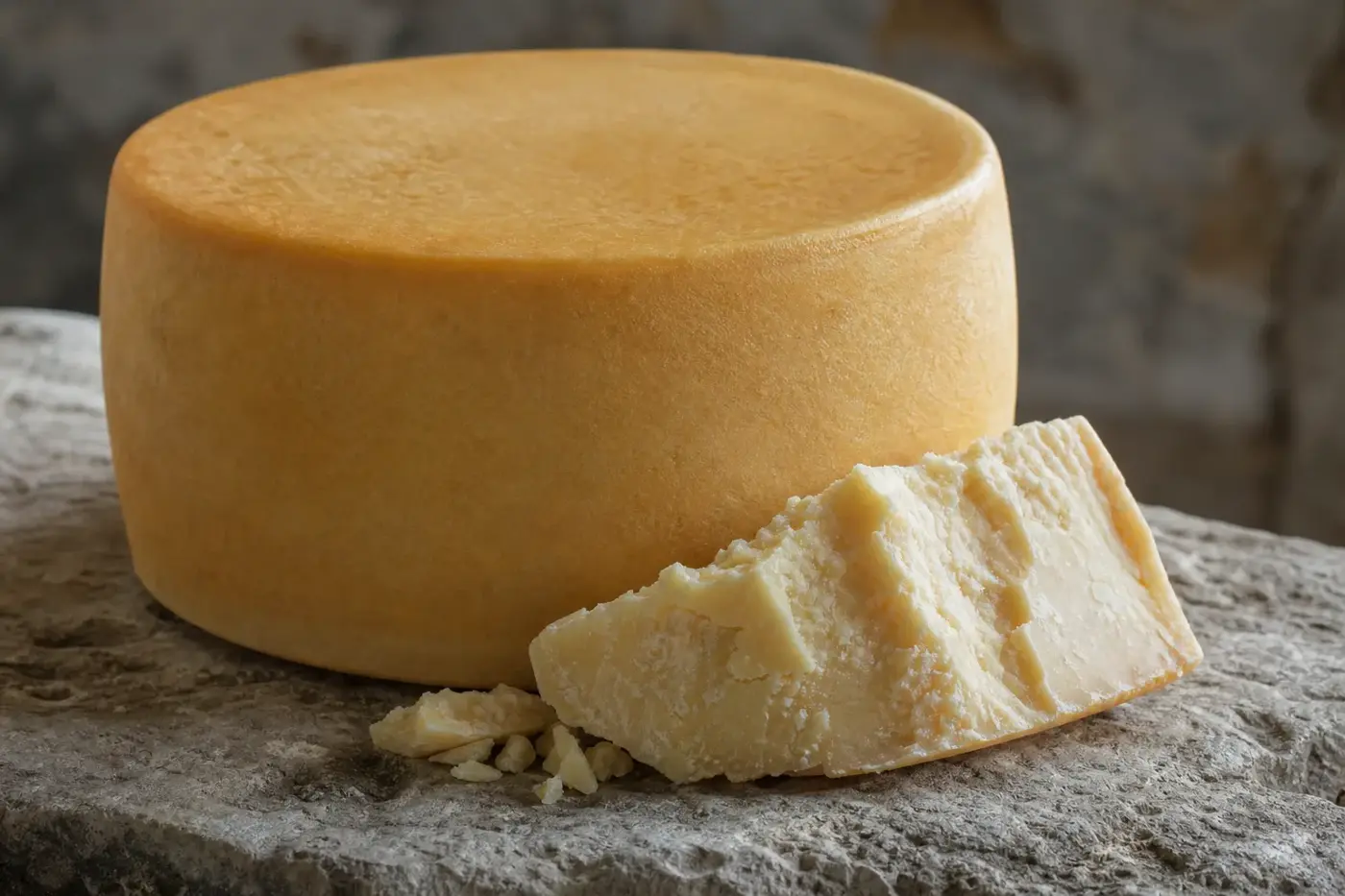
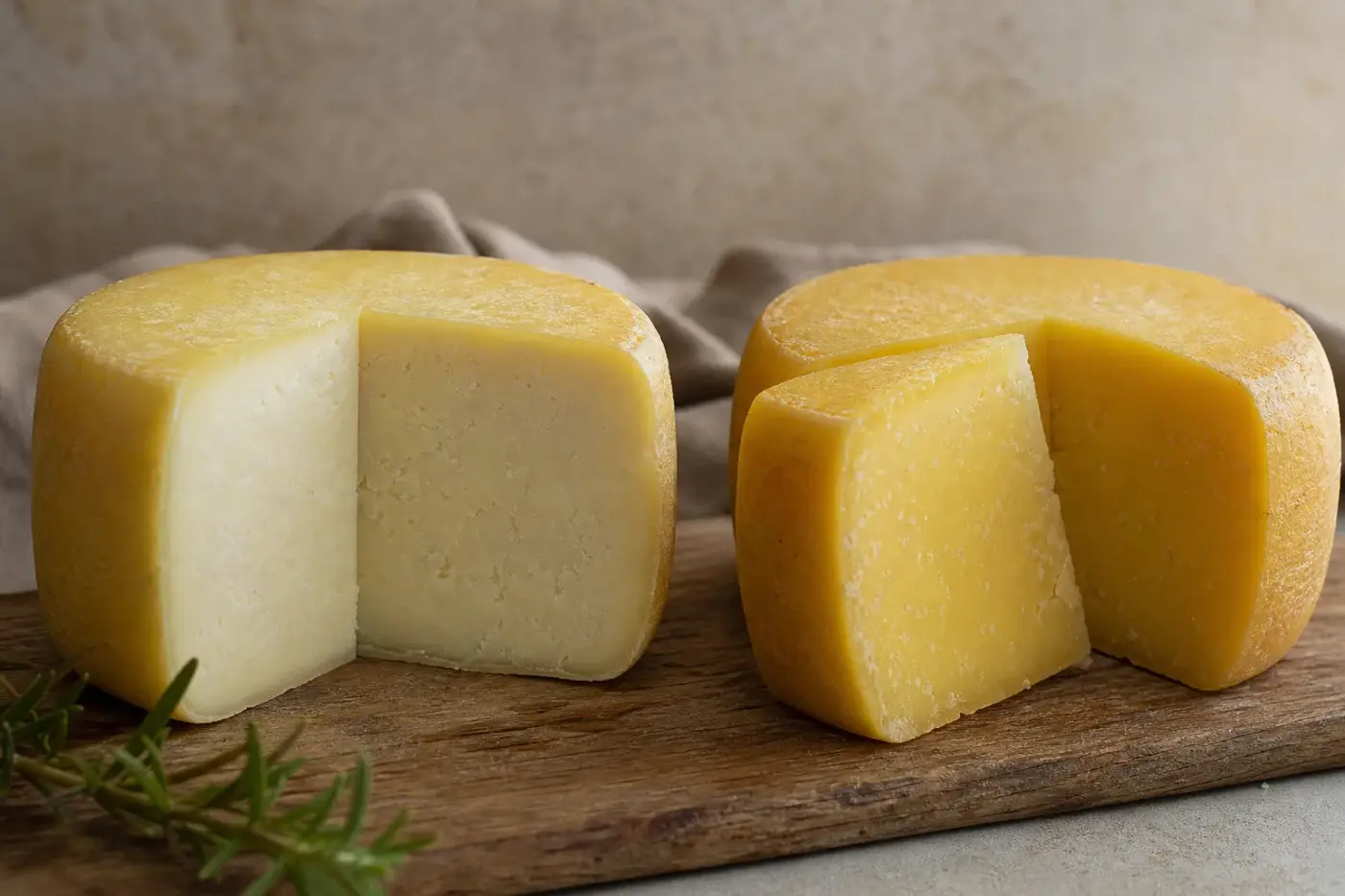
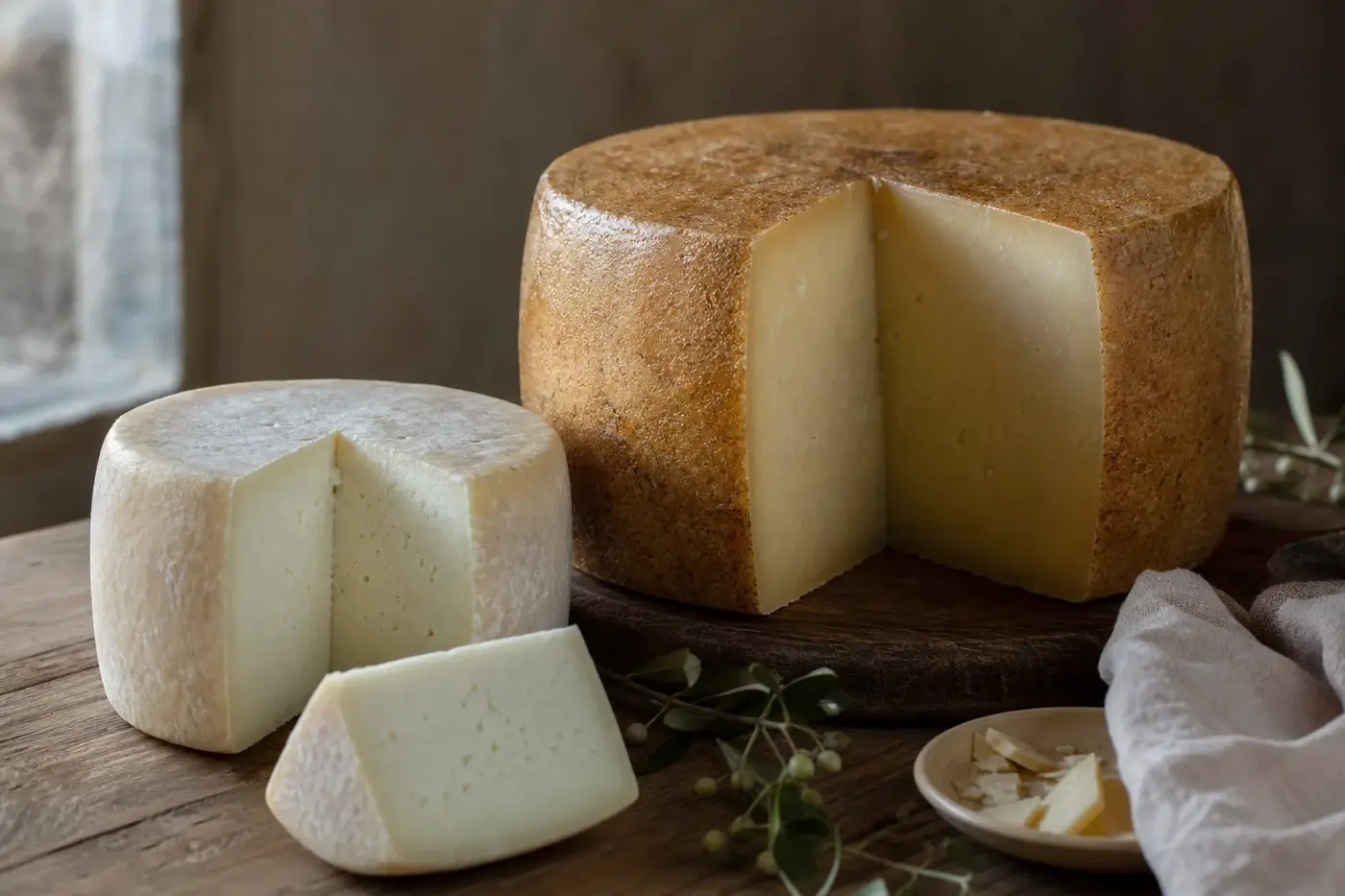
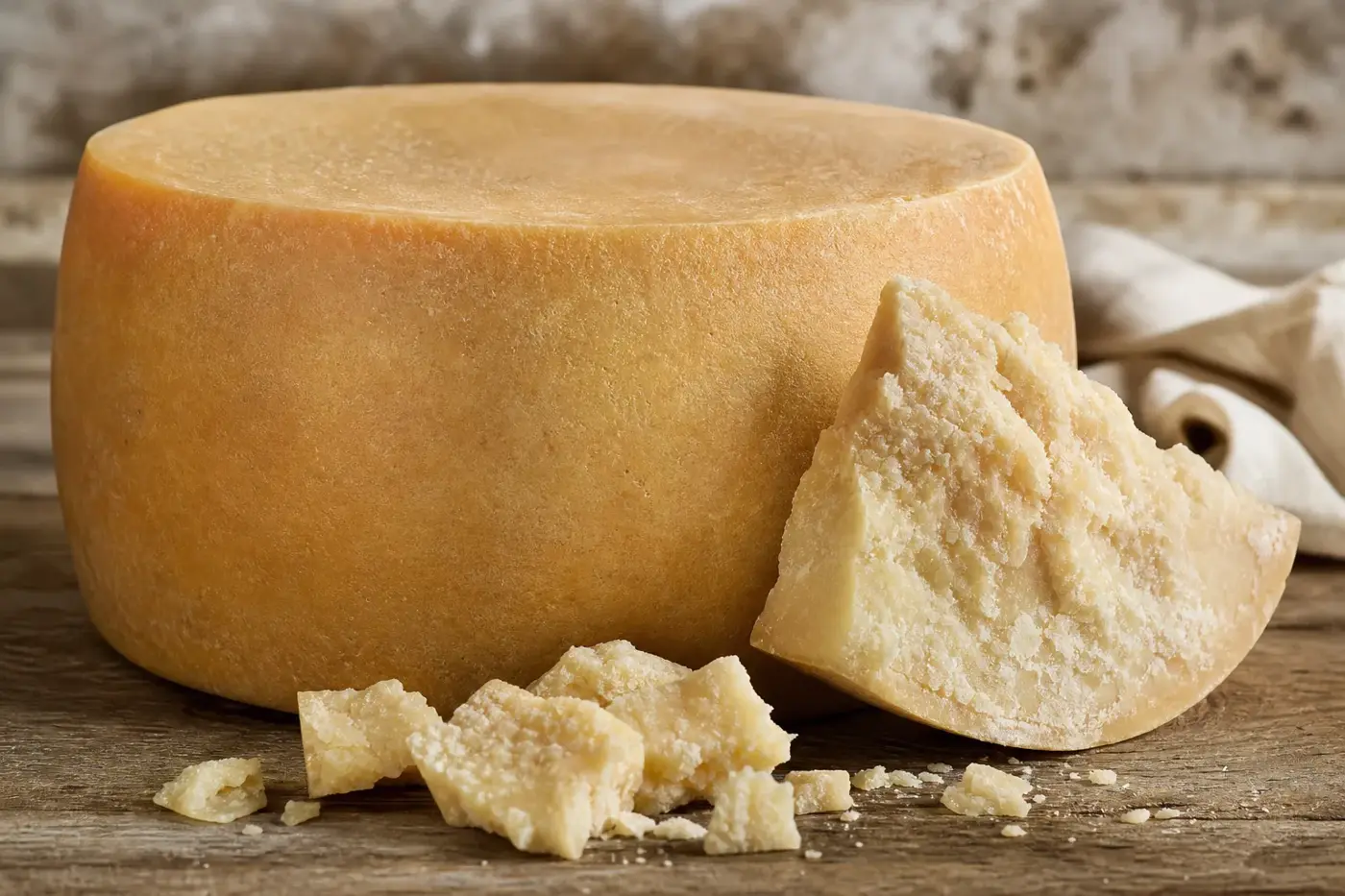
Pecorino Romano is a substantial cylinder with flat faces. The consortium gives typical dimensions of 20 to 35 kg, 25 to 35 cm across and 25 to 40 cm high. Its thin rind is ivory to straw coloured, sometimes with a neutral or black protective coating.[3]
Inside, you will find a white to pale straw paste, compact or lightly holed. A few small holes belong within its described character. That pale interior, though, cannot tell you how old the cheese is.[3]
Ask how long your piece has matured rather than judging by colour. For the rind, follow the seller’s or packer’s instructions, particularly if it carries a protective coating.[3]
Step into the dairy
Whole sheep’s milk begins the story. The consortium’s processing account describes milk used raw or given a thermising treatment, which is distinct from pasteurisation. Ask about your particular cheese rather than assuming its treatment from the name; Raw milk, thermised and pasteurised cheese explains the differences.[6]
The specification permits, but does not require, natural lactic cultures indigenous to the production area. These starter cultures support acidification: the development of acidity during cheesemaking. Lamb rennet paste sets the milk into curd, the solid gel separated from liquid whey; the lambs must be raised within the defined area.[1][7]
The curd is then broken and heated before the cheese is formed, salted and matured. Dry salting, brining or a combination of both are permitted. Cooked curd and maturation give you a hard cheese to eat in pieces or grate finely as seasoning; rennet explained takes you further into the setting agent.[1][7]
Five months for your board, eight for your grater
The consortium draws a distinction worth tasting. Table cheese is aromatic, savoury and lightly piquant; the grating type is more intensely piquant. Here, piquant means a sharp, assertive taste, not added chilli.[3]
Salt is central to the experience. When you add Pecorino Romano to a dish, you are adding seasoning as well as cheese. Give it a taste before reaching for the salt cellar.[3]
The legal minimum maturation is five months for table cheese and eight months for the grating type. When comparing pieces, ask for their actual maturation. The seller’s declared age tells you something different from the minimum required for the category.[1]
For eating in pieces, begin with the table type, especially if you prefer gentler piquancy. For pasta, choose the grating type and let its concentrated character guide your quantities. Older means a different character and use, not an automatic improvement.[3]
Read the marks, find the maker
Look for the full name Pecorino Romano and a sheep’s head inside a rounded diamond. On whole wheels, the name and identifying mark repeat around the curved side. Production information identifies the dairy, province, month and year, although your cut piece may carry only a fragment.[1]
Not enough rind to read at the counter? Ask to see the original wheel or its identifying label. With packaged portions, read the full name and product information: traceable production details tell you more about origin than the seller’s address.[1][7]
Tell the cheesemonger what you have planned: pieces for a board, shavings for vegetables or fine gratings for sauce. If tasting is offered, compare the salt and piquancy you will be bringing to the plate. A wedge suited to both slicing and freshly grating is practical; age need not make the decision for you.
Bring Rome’s favourites to your kitchen
Cacio e pepe, carbonara, gricia and amatriciana all feature Pecorino Romano in Rome’s tourism authority’s account of the city’s dishes. In cacio e pepe, cheese and pepper provide the central flavours, brought together with pasta and starchy cooking water. Carbonara and those other Roman dishes offer further reasons to keep a wedge for cooking.[8][9]
The challenge is heat, not a shortage of cheese, however persuasive that diagnosis may feel. In a 2025 laboratory study published in Physics of Fluids, researchers varied temperature and the proportions of Pecorino Romano, water and starch. Starch helped limit protein aggregation, while excessive heat encouraged the cheese to clump.[9]
For your kitchen, the principle is to control heat and water rather than simply adding more cheese when a sauce tightens. Grate finely, reserve starchy pasta water and let the liquid cool before mixing it with the cheese. Combine away from fierce direct heat, tossing and adjusting gradually with water: these are practical applications of the published experiments.[9]
Let the cheese guide the rest of your seasoning. Taste before adding finishing salt, particularly when cheese leads the sauce. Give Pecorino Romano a say in the balance before you settle it.[3]
Save a few pieces for the table
Small pieces with bread and broad beans make a simple serving associated with Rome’s spring food traditions. You need not send every last piece towards the grater.[8]
Pecorino Romano comes from sheep’s milk; Parmigiano Reggiano comes from cow’s milk. Both can be grated, but Pecorino Romano’s salty, piquant character rewards gradual additions. Take particular care when other ingredients already bring salt to your dish.[3]
Other Italian pecorini offer quite different pleasures. The Pecorino Toscano consortium describes its fresh cheese as soft, sweet-tasting and milky, with butter and hay aromas. Its aged type is semi-hard, with dried-fruit and hay notes.[10][11]
Those descriptions give you good reason to choose a named pecorino and a maturity. Sheep’s milk alone does not promise Romano’s intensity.[10][11]
Make room in the fridge, and keep the label
Follow the pack’s storage instructions and any directions from your cheesemonger. For England, Wales and Northern Ireland, the Food Standards Agency’s domestic guidance advises keeping a home fridge between 0 and 5 °C and refrigerating dairy products. November 2026 is the reference point for this guidance here.[12]
Keep the original label with its date, batch information and storage instructions. Follow any stated period for use after opening, too.[12]
Choose a size that suits your cooking plans and grate only what the dish needs. For detailed household handling, visit how to store cheese at home. If unexpected mould appears, turn to mould on cheese: when to cut and when to bin and the official advice cited there.
Follow your appetite for more
- How to Tell Cheese Styles Apart: Milk, Rind, Texture and Method: find where this hard, cooked sheep’s milk cheese sits among other styles.
- Cheese and Wine Pairing: The Complete Guide: explore pairing principles and alcohol-free alternatives.
General information only, not medical advice: follow the official guidance where you live.
Questions people ask
Where is Pecorino Romano made?
The defined area covers Sardinia, Lazio and the province of Grosseto in Tuscany. Milk production, cheesemaking and maturation must all take place within that area.
How long is Pecorino Romano aged?
The minimum maturation is five months for table cheese and eight months for grating cheese. The grating type is more intensely piquant than the table type.
Is Pecorino Romano made from raw milk?
The consortium describes milk used raw or given a thermising treatment, which is distinct from pasteurisation. Check the treatment of the particular cheese rather than inferring it from the name.
How can I stop Pecorino Romano clumping in pasta sauce?
Grate it finely, reserve starchy pasta water and let the liquid cool before mixing it with the cheese. Combine away from fierce direct heat, tossing and adjusting gradually with water.
How should I store Pecorino Romano?
Follow the pack’s storage instructions and any directions from the cheesemonger. For England, Wales and Northern Ireland, the Food Standards Agency advises refrigerating dairy products and keeping a home fridge between 0 and 5 °C. Check the agency’s current guidance.
Sources
- Italian agriculture ministry, MASAF. Disciplinare di Produzione della DOP Pecorino Romano, specification corresponding to the 2009 rules, Articles 1 to 3. Official specification PDF. Version reconciliation remains an editorial check below.
- Department for Environment, Food & Rural Affairs. Pecorino Romano, official Great Britain protected food name register entry, published 4 January 2021, accessed November 2026. Register entry.
- Consorzio per la Tutela del Formaggio Pecorino Romano. Caratteristiche, undated, accessed November 2026. Industry body’s account of appearance, taste and maturation. Characteristics.
- Regione Autonoma della Sardegna, SardegnaCultura. Pecorino Romano, undated, with bibliography including regional dairy publications and historical scholarship from 2010 and 2015. Regional cultural account.
- Columella. De re rustica, book VII, chapter 8, particularly sections 1 to 6. Latin transcription on ReadAncientTexts; underlying edition and transcription date not identified. Ancient text.
- Consorzio per la Tutela del Formaggio Pecorino Romano. Processing, undated, accessed November 2026. Milk processing account.
- MASAF. Disciplinare di produzione “Pecorino Romano” DOP, document filename dated 16 March 2026, Articles 2 to 9. Ministry specification PDF. Operative status requires the reconciliation recorded below.
- Roma Capitale, Turismo Roma. Il Pecorino romano, quel tocco di sapore in più dalle origini antiche, accessed November 2026, sections on production geography, recipes and pairings. City tourism account.
- Bartolucci and colleagues. Phase behavior of Cacio e Pepe sauce, Physics of Fluids 37, 044122, published 29 April 2025, DOI 10.1063/5.0255841. Published paper in institutional repository.
- Consorzio Tutela del Pecorino Toscano DOP. Fresh Pecorino Toscano PDO, undated, accessed November 2026. Consortium description.
- Consorzio Tutela del Pecorino Toscano DOP. Aged Pecorino Toscano PDO, undated, accessed November 2026. Consortium description.
- Food Standards Agency. How to chill, freeze and defrost food safely, published 18 December 2017, guidance applying to England, Northern Ireland and Wales, accessed November 2026, section 1. Official household guidance.
Researched through official specifications, the Great Britain register, an ancient text, regional historical accounts, attributed consortium descriptions and published experimental research.
Last checked: November 2026
Last checked November 2026.
The editors suggest you read next
Parmigiano Reggiano
Break into a wheel of Parmigiano Reggiano and flakes fall away, revealing a finely granular cheese, pale straw to straw in colour.