Grana Padano
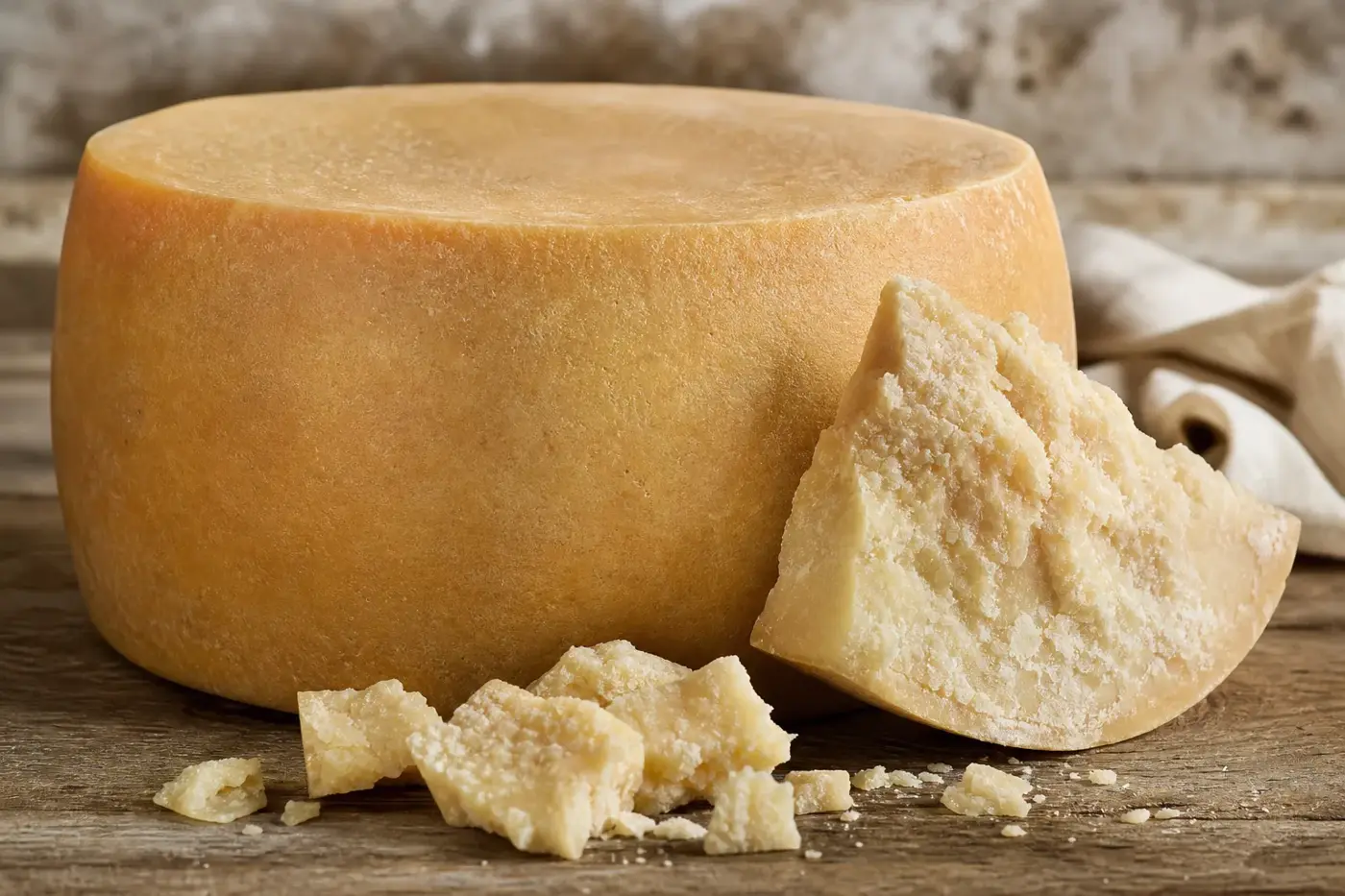
Break a piece from a wheel of Grana Padano and watch the pale interior fall into fine grains and flakes.
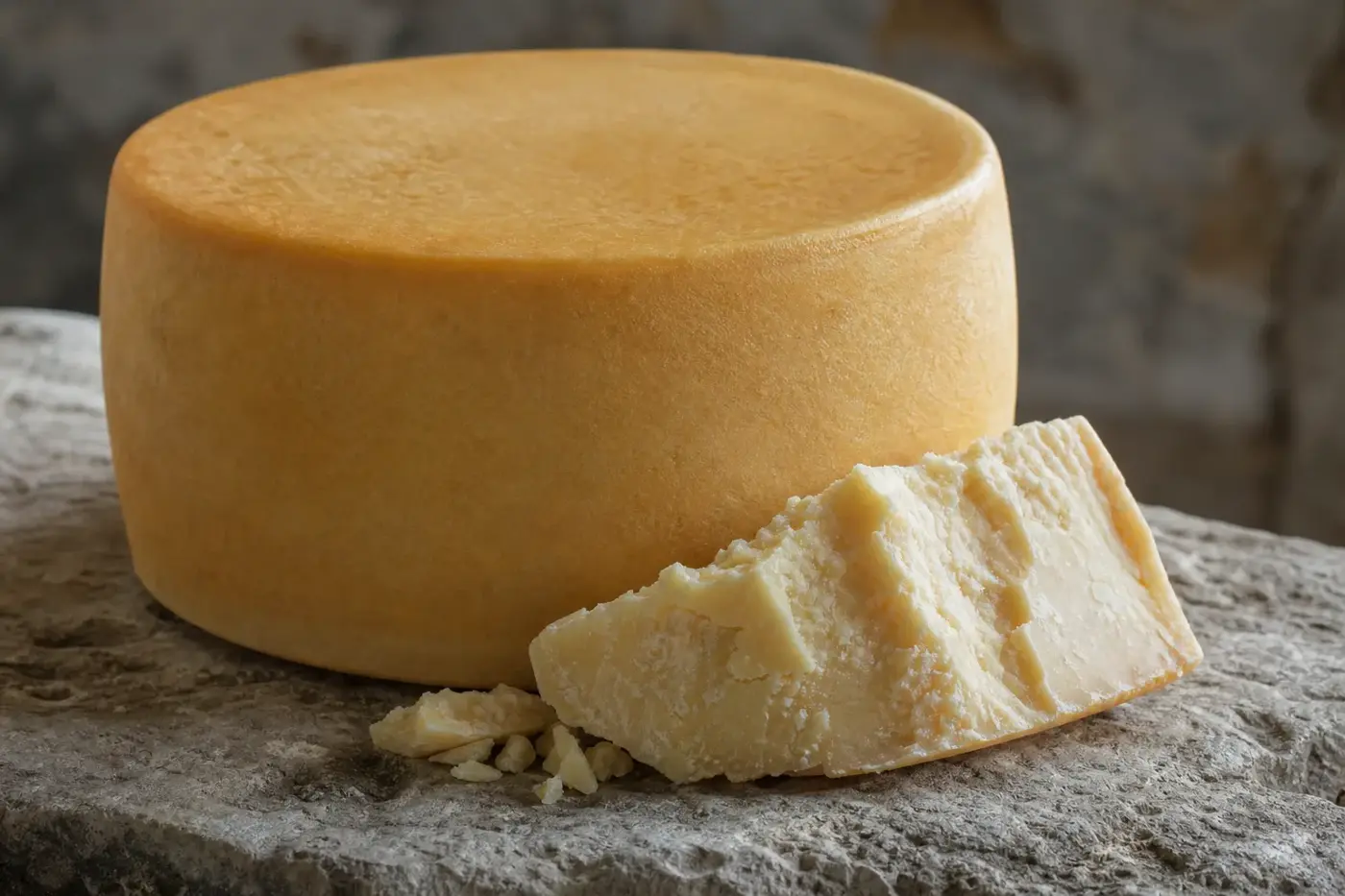
Break a piece from a wheel of Grana Padano and watch the pale interior fall into fine grains and flakes. The whole wheel can weigh 40 kg. What lands on your plate is a rather delicate introduction to something you would not casually carry home.[1][2]
That contrast is part of this hard Po Valley cheese’s charm. Raw cow’s milk, partially skimmed by letting the cream rise, meets cooking and at least nine months of maturation. Give it longer and the grain becomes more pronounced, the flavour fuller.[1][2][6][7]
| What to know | The detail |
|---|---|
| Name to look for | Grana Padano.[3][4] |
| EU registration authority and identifier | European Commission; GIview file number PDO-IT-0011.[4] |
| EU protection | Registered PDO; priority date 21 June 1996; registration date unconfirmed. Status as at November 2026.[4] |
| Great Britain protection | Registered PDO; UK scheme registration dated 31 December 2020. Status as at November 2026.[3] |
| Northern Ireland | EU geographical indication scheme applies.[12] |
| Where it comes from | Legally defined parts of northern Italy, explored below.[2] |
| Milk and coagulant | Raw cow’s milk, partially skimmed by natural creaming; calf rennet.[2][6] |
| Starter | Natural fermented whey starter.[2][6] |
| Additives and allergens | Milk; egg-derived lysozyme may be used, except in Trentingrana.[2][10] |
| Minimum maturation | Nine months from moulding.[1][2] |
| What makes it Riserva | More than 20 months and a further quality assessment.[8] |
| Minimum fat | 32% fat in dry matter.[1][2] |
Follow the milk to Chiaravalle Abbey
Begin near Milan, at Chiaravalle Abbey. The Grana Padano Protection Consortium traces the cheese’s beginnings to its Cistercian monks, whose reclaimed agricultural land meant more fodder and surplus milk. Cooking and salting a hard cheese gave that milk a future, with time for its flavour to develop.[5]
There is a gift in the story, too. The Consortium’s published origin tradition points to a letter dated 1504 recording grana sent as a gift. The account you encounter is a modern retelling of the correspondence, rather than the original letter.[5]
The protected name belongs to a much later chapter. The Consortium records its establishment in 1954. That gives the medieval cheesemaking tradition and the modern legal identity their own distinct places in the cheese’s history.[3][4][5]
A sense of place, right down to the riverbank
Grana Padano comes from specified provinces and territories in Piedmont, Lombardy, Veneto, Emilia-Romagna and Trentino-Alto Adige. “Northern Italian cheese” puts you in the right neighbourhood, but the legal map is more precise. It includes Mantua on the left bank of the Po, Bologna on the right bank of the Reno, and specified municipalities in the province of Bolzano.[2]
The boundaries are only the beginning. The specification also governs the milk, permitted ingredients, manufacturing method and finished cheese’s characteristics. Even grated Grana Padano must be grated and immediately packaged within the defined production area, without added substances.[2]
When you see Grana Padano, then, you are looking at a registered name, not simply a cheese style. Where protected, it identifies cheese governed by that specification. The EU and Great Britain keep separate registration records; Northern Ireland follows the EU geographical indication scheme.[3][4][12]
For a guide to the wider picture, visit protected names explained. It unpacks the distinction between PDO, PGI and TSG.
Take a closer look beneath the golden rind
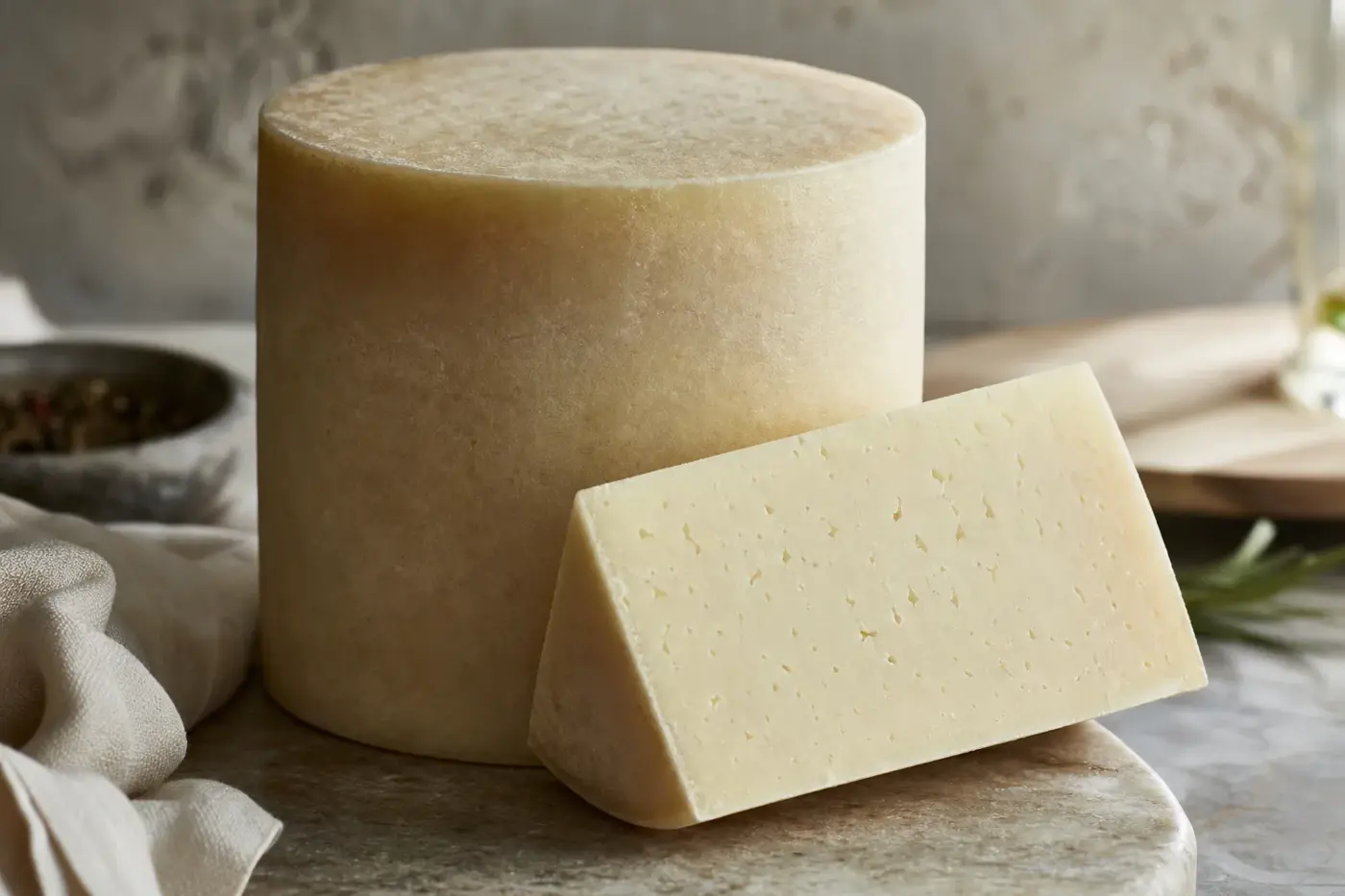
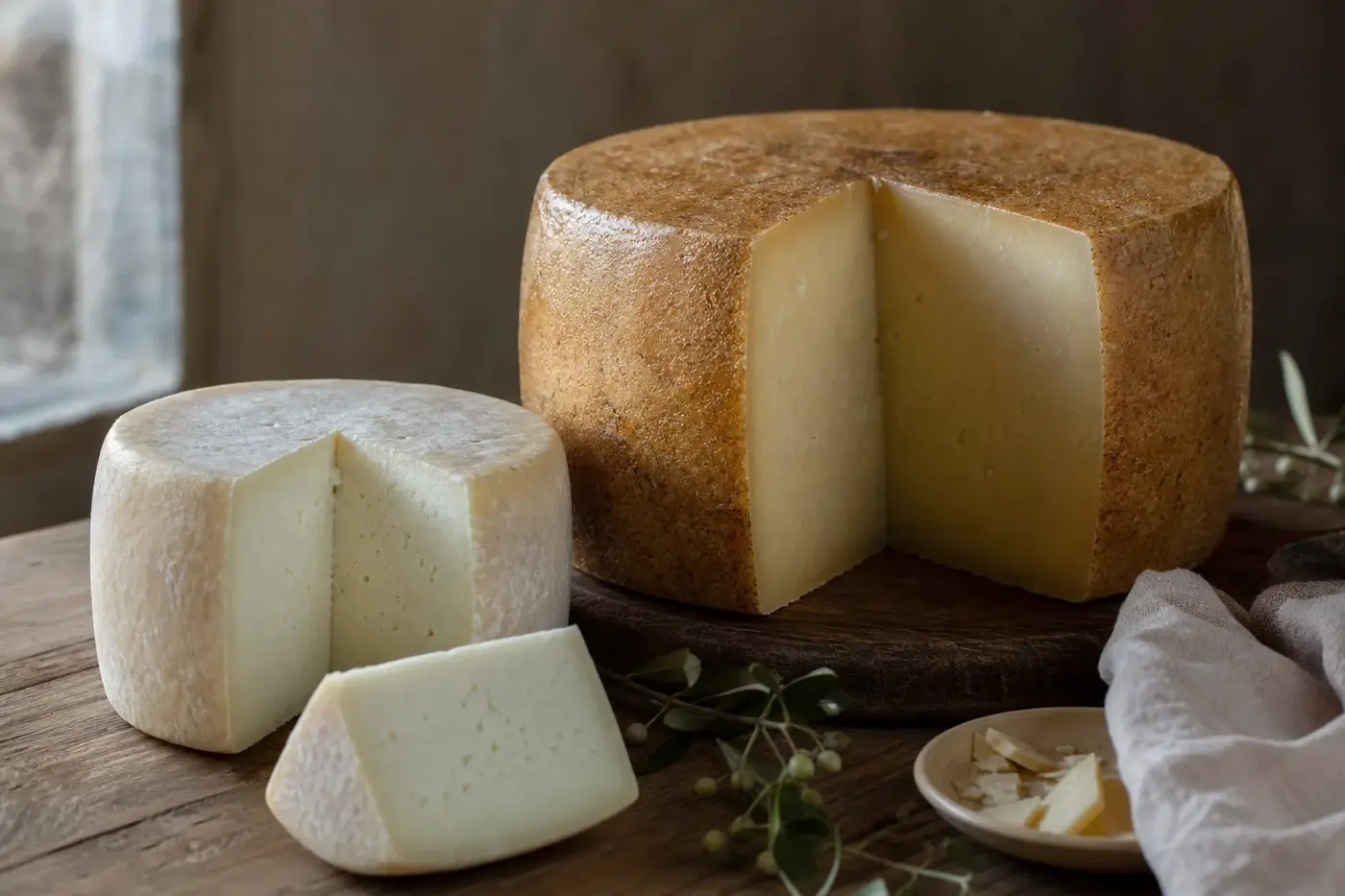
Before you break into a wheel, take in its shape. It is cylindrical, with flat faces and sides that can be almost straight or slightly convex. The specification gives a diameter of 35 to 45 cm, a side height of 18 to 25 cm and a weight of 24 to 40 kg, with qualifications for manufacturing variation and, in the 2026 text, batch weight tolerances.[1][2]
The hard, smooth rind is typically 4 to 8 mm thick. Its golden yellow or darker colour is natural; artificial colouring is excluded. Inside, you will find white to straw-coloured paste, threaded with fine grains, radial fractures and barely visible holes.[1][2]
Maturity makes itself felt when you break off a piece. The Consortium describes younger cheese as more yielding and less granular, while older examples flake more clearly and crumble more readily. Time changes the texture as surely as it deepens the flavour.[7]
Into the copper vat, out come twin wheels
The work starts with cream rising naturally from raw milk. Some is removed, leaving partially skimmed milk for the bell-shaped copper vats. The cheesemaker adds whey from the previous day’s production, whose lactic acid bacteria provide the fermented starter for the next batch.[6]
Next comes calf rennet, turning the milk into curd, the solid material destined to become cheese. With a tool called a spino, the cheesemaker breaks it into pieces the Consortium describes as rice-grain sized. These are heated to a maximum of 56 °C (133 °F).[6]
Under the whey, the grains settle and gather into a mass. The cheesemaker raises it with cloth and a lifting tool, then divides it into two portions. These are the “twin wheels”, each placed in a mould to take its shape.[6]
By now, much of the cheese’s character is already taking form. Partial skimming, finely divided curd, cooking and slow maturation all shape its prescribed identity, long before you open a mature wheel.[2][6] For a friendly guide to the terminology, visit how cheese is made.
Salt, patience and the story on the rind
The newly formed wheels enter brine, a solution of salt and water. The Consortium describes 12 to 25 days of salting, followed by drying and maturation. From moulding, the specification requires at least nine months of maturation.[1][2][6]
Look closely and the rind gives you clues to the wheel’s life. Marks impressed during moulding record origin and production information; a casein plate carries an individual identification code. The repeating diamonds containing “GRANA” and “PADANO” help you recognise portions sold with their rind.[8]
The fire-brand comes later, recording acceptance against the specification. It confirms that the cheese has the required characteristics. That is a separate task from recording where and when the young wheel was made.[8]
Riserva has a further stage to pass. After more than 20 months, it needs another assessment. An additional mark records both its extended maturation and that further quality check.[8]
Find the age that suits your appetite
How much maturity would you like on your plate? The Consortium’s tasting descriptions travel from milky flavour and a relatively yielding paste towards distinct grain, flaking and a taste that lingers. Its maturity groups give you somewhere useful to begin.[7]
| Maturity | What the Consortium describes | Where you might enjoy it |
|---|---|---|
| Nine to around 14 months | Delicate, milky flavour; less grain and lower crumbliness.[7] | A gentler table cheese or everyday grating. |
| Over 16 or 18 months | Clearer grain and flaking, with hay and dried-fruit notes.[7] | Dishes where you want a distinct cheese flavour. |
| Riserva, over 20 months | More pronounced grain, greater crumbliness and longer-lasting flavour; further assessment required.[7][8] | Small broken pieces, or dishes that give its character room. |
Choose for your meal, rather than treating age as a competition. A milder wedge and a more assertive Riserva bring different qualities to the same bowl of pasta. If the counter offers samples, taste the available maturities: a month number is useful, but it cannot eat your dinner for you.
Before you choose: rennet, egg and lysozyme
If you follow a vegetarian diet, Grana Padano is not suitable: its prescribed coagulant is calf rennet. This remains true when it is made without lysozyme. Rennet and lysozyme have different origins and different jobs.[2][6]
Lysozyme is an enzyme extracted from hen’s egg white, permitted to control unwanted fermentation. It is optional under the specification and excluded for Trentingrana.[2][10] Read the ingredients information for the particular product to find out whether it was used.
For ingredients and allergens alike, use the information on the wedge or grated pack you are choosing. Another maker’s product may differ. For more on animal rennet and other coagulants, visit rennet explained.
Meet the neighbour: Parmigiano Reggiano
Put these two cheeses side by side and you will find shared foundations. Both use raw, partially skimmed cow’s milk, natural whey starter, calf rennet and cooked curd. Their separate specifications set different production areas and rules, including minimum maturation and permitted ingredients.[2][9]
| What they share or do differently | Grana Padano | Parmigiano Reggiano |
|---|---|---|
| Minimum maturation | Nine months.[1][2] | 12 months.[9] |
| Coagulant | Calf rennet.[2] | Calf rennet.[9] |
| Lysozyme | Permitted, except in Trentingrana.[2] | No additives permitted.[9] |
| Silage in cattle feed | Permitted within its feeding rules.[10] | Prohibited.[9] |
| Geographical area | Defined territories across a wider northern Italian area.[2] | Parma, Reggio nell’Emilia, Modena and specified parts of Bologna and Mantua.[9] |
When it comes to flavour, look at the ages as well as the names. The Grana Padano Consortium describes substantial changes across its own maturity range. The Parmigiano Reggiano specification describes a fragrant, delicate and flavoursome cheese with a fine-grained, flaky paste.[7][9]
Both can come to your table in pieces or be used grated.[2][9] Before swapping one for the other, compare the actual wedges: young Grana Padano and long-matured Parmigiano Reggiano will affect a dish differently. When a recipe depends on one cheese’s particular character, keep that cheese.
You can spend more time with its neighbour in Parmigiano Reggiano. The fuller account explores the cheese in its own right.
Make room for it at your table
Across the maturities described by the Consortium, Grana Padano works as both a table cheese and a grating cheese.[7] Let your meal decide its shape. Break irregular pieces to serve alongside other foods, shave it broadly over salad, or grate it finely through pasta or risotto.
The published maturity descriptions offer a useful starting point for accompaniments. Try younger cheese with bread, ripe pear or a simple tomato salad, giving its milky character room. With older cheese, roasted squash, mushrooms or a few walnuts can accompany that more persistent flavour.[7]
These are serving suggestions drawn from those descriptions, not rules for your plate. In cooking, treat maturity as a seasoning choice: add grated cheese gradually, taste as you go, then taste again before adding the final salt. A wedge gives you the freedom to break, shave or grate it across different meals.
For an alcohol free drink, try water or unsweetened apple juice. Fresh fruit and bread make suitable accompaniments, too.
Bring home a good wedge, and keep it well
Start with the full name Grana Padano on the product information, then look for the stated maturity. If your wedge has its rind, the characteristic origin pattern gives you another identifying feature. For packaged portions, read the designation and accompanying product details.[8]
At a counter, ask which maturity you are buying. Wedges need not all be the same age, so use the answer to help you choose for the meals you have in mind.
Follow the pack’s refrigerator storage instructions, including directions after opening. The Food Standards Agency’s household guidance for England, Wales and Northern Ireland recommends a fridge temperature of 5 °C or below.[11] Keep the product information with the remaining cheese, so you have those directions to hand.
Buy a quantity that suits your intended meals, and protect the cut surface before returning the wedge to the refrigerator. For wrapping options and general refrigerator organisation, visit how to store cheese at home.
The hard rind belongs to the cheese; outer packaging does not. If you plan to cook with rind, follow the maker’s preparation instructions and first remove packaging or any non-food covering. The specification permits a controlled proportion of rind in commercially grated Grana Padano, but that manufacturing rule is separate from handling the piece in your kitchen.[2]
General information only, not medical advice: follow the official guidance where you live.
Questions people ask
What is the difference between Grana Padano and Parmigiano Reggiano?
Grana Padano matures for at least nine months, while Parmigiano Reggiano matures for at least 12 months. Their production areas and rules on ingredients and cattle feed also differ.
Is Grana Padano vegetarian?
No. Its prescribed coagulant is calf rennet, even when the cheese is made without lysozyme.
Does Grana Padano contain egg?
It may contain lysozyme, an enzyme extracted from hen’s egg white and permitted to control unwanted fermentation. Lysozyme is excluded from Trentingrana, so check the ingredients information on the particular product.
What does Riserva mean on Grana Padano?
Riserva requires more than 20 months of maturation and a further quality assessment. The Consortium describes it as more granular and crumbly, with a longer lasting flavour.
How should I store Grana Padano?
Follow the pack’s refrigerator storage instructions, including any directions after opening. The Food Standards Agency’s household guidance for England, Wales and Northern Ireland recommends a fridge temperature of 5 °C or below.
Sources
[1] Italian Ministry of Agriculture, Food Sovereignty and Forestry, Decreto 19 maggio 2026: Modifiche ordinarie al disciplinare di produzione della denominazione di origine protetta «Grana Padano», Gazzetta Ufficiale, Series General No. 120, 26 May 2026, including consolidated specification. Decree adopted 19 May 2026; published 26 May 2026; Article 2 provides entry into force the following day.
[2] Grana Padano Protection Consortium, Specification of GRANA PADANO P.D.O., October 2022 edition; also compared with the specification linked from the Great Britain register. This older English text requires reconciliation with the 2026 Italian consolidated specification before publication.
[3] Department for Environment, Food & Rural Affairs, Grana Padano, Great Britain protected food names register, published 2021, accessed November 2026.
[4] European Union Intellectual Property Office, GIview, Grana Padano, record EUGI00000012993, accessed November 2026.
[5] Grana Padano Protection Consortium, History and heritage, undated online account, accessed November 2026. An industry account, used with attribution for the origin tradition and historical chronology.
[6] Grana Padano Protection Consortium, How is Grana Padano cheese produced, undated online production account, accessed November 2026.
[7] Grana Padano Protection Consortium, Ageing, undated online maturity descriptions and serving suggestions, accessed November 2026. Sensory descriptions are attributed to the Consortium.
[8] Grana Padano Protection Consortium, How can you recognise the branding?, undated online explanation, accessed November 2026.
[9] Parmigiano Reggiano Cheese Consortium, Product specification of the protected designation of origin “Parmigiano Reggiano”, specification identified by the Consortium as in force from 24 April 2025; English file dated July 2025.
[10] Parmigiano Reggiano Cheese Consortium, Parmigiano Reggiano and Grana Padano, online comparison, accessed November 2026. A commercially interested industry source, used narrowly for its explanation of egg-derived lysozyme and feeding differences.
[11] Food Standards Agency, How to chill, freeze and defrost food safely, published 2017, current online guidance accessed November 2026; applies to England, Wales and Northern Ireland.
[12] Department for Environment, Food & Rural Affairs, Protect a geographical food or drink name, published 2020, updated 2021, accessed November 2026.
Researched through official registration records, published specifications, attributed consortium accounts and Food Standards Agency guidance, with editorial serving suggestions distinguished from recorded tasting.
Last checked: November 2026
Last checked November 2026.
The editors suggest you read next
Parmigiano Reggiano
Break into a wheel of Parmigiano Reggiano and flakes fall away, revealing a finely granular cheese, pale straw to straw in colour.