Pasteurisation and the Change in Cheese
Picture a glass of wine losing its character as contaminating microbes get to work.
Picture a glass of wine losing its character as contaminating microbes get to work. On 11 April 1865, Louis Pasteur applied for a patent to preserve it through controlled heating. That method would eventually reach the cheese vat, changing which microbes arrived alive, how cheesemakers managed fermentation and what happened during ripening. [1][2][6][7]
For cheese, the great gain was control over milk-borne hazards. The creative challenge was coaxing out character after removing part of the living population that helped shape it. If you care about what ends up on your cheese board, safer milk is only the beginning of this story. [1][2][6][7]
First, rescue the wine
Pasteur’s heating experiments began with wine, not milk. An archival exhibition from the Institut Pasteur reproduces his patent application of 11 April 1865. Controlled heating could destroy much of the contaminating microbial population while preserving the wine’s character. The ambition was protection without losing what made the drink worth drinking. [2]
His Études sur le vin, published in 1866, brought wine’s diseases, their causes and methods of preservation into one investigation. Here was the crucial connection between a fault you could notice in a drink and the microorganisms responsible. Heating could become a controlled intervention, rather than simply a way to cook or concentrate food. [2][3]
Milk brought different hazards and a new purpose. The later dairy application joined preservation to public health, treating an everyday food that could carry infection. Contemporary American government publications show pasteurisation being discussed for households and cheese factories by the early twentieth century. The journey from wine bottle to cheese vat took decades, not one moment of invention. [4][5]
City milk and a more predictable vat
Picture the moving parts behind an urban milk supply: farms, transport and crowded populations. A historical review in the Journal of Dairy Science describes early twentieth-century supplies coming from privately kept animals, local farms and urban commercial dairies. Processing capabilities were developing, and pasteurisation spread unevenly through this changing system. [4]
Tuberculosis associated with infected cattle was among the public health concerns. A 1913 United States Department of Agriculture report reproduced a Chicago ordinance adopted on 13 July 1908, with an operative date of 1 January 1909. Cheese sold in the city had to be identified as made from milk from tuberculin-tested cows or milk pasteurised under the city’s rules. Disease prevention now reached beyond drinking milk into cheese manufacture. [1]
For factories, heating offered another attraction: fewer surprises in the vat. Milk from different farms arrived with different bacterial populations and degrees of acidity, complicating the cheesemaker’s day. Heating could reduce that variability before the main fermentation began. Public health and production management were different motives, but both could make heat treatment worth the investment. [1][4]
Every cheese needed its own answer
You could not simply take a treatment for drinking milk and drop it into every cheese recipe. Cheese needs fermentation, followed by the formation, cutting and drainage of curd. That network of milk proteins holds fat while releasing liquid whey. Change milk’s biological starting point, and the cheesemaker has to reconsider what follows. [1][6][7]
The USDA’s 1913 publication, The Manufacture of Cheese of the Cheddar Type from Pasteurized Milk, tackled that practical problem. It investigated heating alongside acidity control and starter cultures. Pasteurisation belonged inside the cheesemaking process, not off to one side as a machine operation. Substantial experiments with pasteurised-milk cheese were already happening, although universal adoption remained far off. [1]
Later researchers kept comparing raw, thermised and pasteurised milk within the same cheese style. Thermisation is a less severe heat treatment than pasteurisation. A 2007 Cheddar experiment investigated all three, revealing a range of technical choices rather than a simple switch from old to new. You can explore those categories in raw, thermised and pasteurised milk. [6]
Give the heat time to work
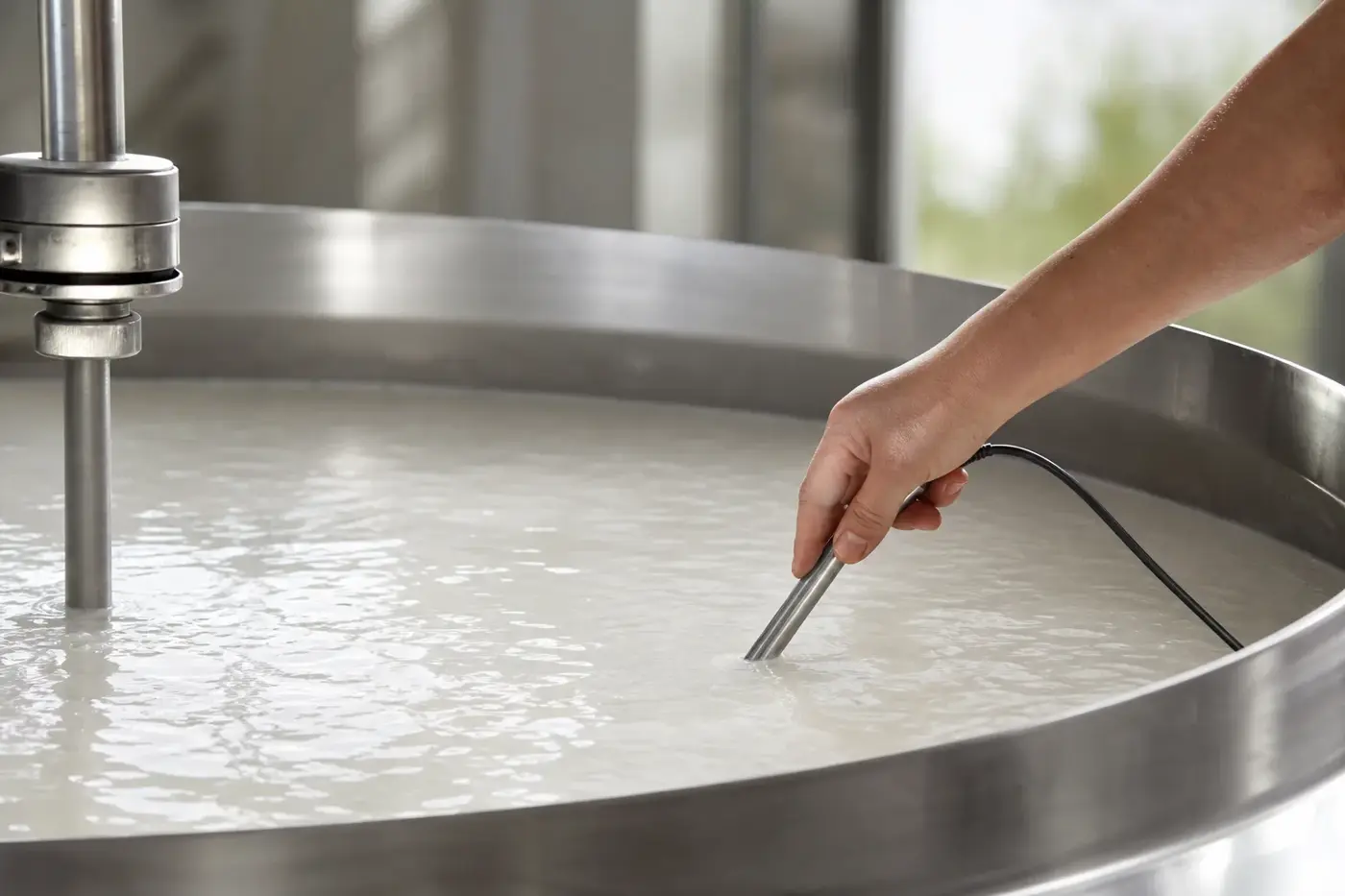
With pasteurisation, temperature and holding time work together. Briefly reaching a temperature is not the same as keeping every part of the milk there for the required period. The legal definition also allows other treatments that deliver an equivalent effect. [8]
Regulation (EC) No 853/2004, Annex III, Section IX, Chapter II, Part II, sets out these combinations. They are commercial processing requirements, not instructions for making cheese at home. [8]
| Treatment in the milk hygiene rules | Required temperature and time |
|---|---|
| High temperature, short time | At least 72 °C for 15 seconds |
| Low temperature, long time | At least 63 °C for 30 minutes |
| Equivalent treatment | Another time and temperature combination with an equivalent effect |
The same provision refers, where applicable, to a negative alkaline phosphatase reaction immediately after treatment. Phosphatase is an enzyme used to indicate how effectively milk has been heated. In Great Britain, the relevant legal framework is the assimilated version of the regulation. For Northern Ireland, the applicable framework needs separate consideration against the EU text. [8][9]
The important distinction is that pasteurised does not mean sterile. Pasteurisation reduces microbial hazards, but some microorganisms and heat-resistant biological activity can remain. Sterilisation aims for a more extensive microbiological result. Even after pasteurisation, your cheese vat is a biological system, and fermentation will deliberately populate it again. [6][10][11]
Inside the milk, the balance shifts
Effective pasteurisation destroys susceptible pathogens. It also reduces organisms that might otherwise make acid or help shape ripening. Heat does not spare a microorganism because it happens to be useful to a cheesemaker. That is the biological trade-off. [7][11]
Enzymes have a more complicated story to tell. These proteins catalyse chemical reactions: lipoprotein lipase helps release fatty acids from milk fat, while plasmin breaks down milk proteins. The FDA’s scientific account describes plasmin as comparatively heat resistant, with a substantial proportion surviving pasteurisation. If you hear that “heating destroys the enzymes”, you are missing an important part of the picture. [10]
The 2007 Cheddar study followed fat breakdown, or lipolysis, during ripening. Starter enzymes were major contributors across the experimental cheeses. Milk lipoprotein lipase contributed too, in raw-milk cheese and, to a lesser extent, thermised-milk cheese. Heating changed the balance of contributors; it did not bring ripening chemistry to a halt. [6]
Milk proteins also have physical work to do. Rennet, an enzyme preparation used to set milk, creates a protein network whose handling determines how the curd retains moisture. Historical trials with pasteurised milk investigated additions of acid and calcium chloride to help manage the altered milk. Heating, setting and drainage all had to work together. [1]
That is why a temperature suited to one dairy purpose cannot automatically serve another. The treatment must deliver its intended microbial effect while leaving milk suitable for the cheese being made. Heating belongs within the whole process, not apart from it. For the broader sequence, follow how cheese is made. [6][8]
Starter cultures set the direction
A starter culture gives fermentation a planned beginning. It is a selected population of microorganisms introduced to guide the process. In cheese, lactic acid bacteria help turn milk sugar into acid, influencing the developing curd. That deliberate introduction matters especially after pasteurisation has reduced competing organisms already in the milk. [1][7]
Think of it as a more managed beginning rather than a less predictable one. In a 1993 experiment, researchers made Cheddar from raw milk, pasteurised milk and microfiltered milk combined with pasteurised cream. Each treatment began with a different bacterial population, followed by different developments during ripening. Even the pasteurised cheeses later contained substantial populations of non-starter lactic acid bacteria. [7]
Choosing the culture is only part of getting consistent results. Milk, cultures and equipment need careful handling, and fermentation must develop as intended. A starter brings in organisms the cheesemaker wants; careless handling can bring in others. Pasteurisation changes the starting conditions, but the dairy’s subsequent work turns those conditions into cheese. [1][7][11]
Flavour is not a volume contest
The potential loss of flavour begins with biological complexity. Raw milk carries indigenous microorganisms, meaning those already present rather than deliberately added. Some help break down proteins and fat, producing compounds involved in aroma and flavour. Remove them, and you can change both the direction and pace of ripening. [6][7]
But stronger is not automatically better, however enthusiastically you pursue the most assertive cheese on the board. In the 1993 Cheddar comparison, commercial graders and a trained tasting panel judged the pasteurised and microfiltered cheeses to have high and equivalent sensory quality. The raw-milk cheese quickly developed a strong flavour that was atypical for the intended cheese, and was downgraded. That was the result for those experimental cheeses, not a verdict on every raw-milk Cheddar. [7]
The same study found the highest concentrations of free fatty acids in the raw-milk cheese. A measurable chemical difference sat beside a sensory result, but the bigger concentration was not itself the goal. A cheesemaker is chasing a particular balance and identity, not simply the greatest possible quantity of flavour-active material. More is not a tasting note. [7]
Pasteurisation offers greater control over part of the starting microbial population. Alongside it comes the challenge of choosing cultures and conditions that deliver the desired character. Raw-milk manufacture keeps more of the original microbial contribution and asks the maker to manage what comes with it. Milk treatment alone cannot tell you the maker’s skill, the quality of maturation or how good the finished cheese will be. [6][7]
This page summarises published guidance from the official sources it cites. It is not medical advice. Guidance differs between countries and changes over time, so check the current source for where you live, and ask your doctor, midwife, pharmacist or dietitian about your own circumstances.
Safety still matters after heating
Pasteurisation delivers its safety benefit through effective treatment at a particular stage. Afterwards, cheese meets equipment, workers, surfaces and a maturing environment. The CDC explains that cheese made from pasteurised milk can become contaminated during manufacture if conditions allow it. Good hygiene after heating protects what heating has achieved. [11]
This matters particularly with Listeria monocytogenes, the bacterium responsible for listeriosis. Its significance depends partly on the food and partly on the person eating it. The FSA’s blue-cheese assessment considered pasteurised and unpasteurised products, including risks to vulnerable consumers. You can read about the organism and its controls in Listeria and cheese safety. [12]
The rules behind raw-milk cheese
Raw-milk cheese can be produced and sold in England under the applicable hygiene framework. That means controls for the milk supply and processing environment, alongside the relevant food hygiene, microbiological and labelling obligations. Without pasteurisation, those other controls carry particular weight. [8][9]
FSA practice guidance for England explicitly covers unpasteurised milk-based products and the labelling of cheeses made with raw milk. It also addresses how dairy hygiene relates to a herd’s officially tuberculosis-free status. This is a regulated production route. Milk suitable for one purpose cannot simply be assumed suitable for every cheese process. [9]
Production rules and personal health guidance answer different questions. Permission to make and sell a cheese does not replace official advice if you are pregnant or otherwise at higher risk. The product matters, and so do your circumstances. [9][12][13]
Choosing cheese if you are at higher risk
Milk treatment is only part of the NHS pregnancy guidance for November 2026. Cheese category and cooking conditions matter too, as the points below show. For the full list and any changes, follow the current NHS pregnancy food guidance. [13]
| Cheese category in UK NHS pregnancy guidance | Advice for November 2026 |
|---|---|
| Hard cheeses | You can eat pasteurised or unpasteurised hard cheeses |
| Pasteurised semi-hard cheeses | Listed among foods you can eat |
| Mould ripened soft cheeses with a white outer coating | Cook until steaming hot, whether pasteurised or unpasteurised |
| Soft blue cheeses | Cook until steaming hot, whether pasteurised or unpasteurised |
| Cheese cooked until steaming hot | Included among foods you can eat |
The NHS also names specified pasteurised soft cheeses among foods you can eat. Its precautions cover other foods made with unpasteurised milk. Follow the named categories in the source, rather than carrying advice for one type of cheese across to a different product. [13]
The NHS identifies children, people who are unwell, pregnant women and older people as particularly vulnerable to food poisoning. Its dairy guidance advises these groups against unpasteurised milk or cream and some products made from them. The FSA’s blue-cheese risk assessment adds evidence concerning vulnerable consumers. For your individual circumstances, a healthcare professional can advise. [12][14]
Tradition finds more than one way forward
Pasteurisation changed the balance between inherited microbial populations and deliberately managed fermentation. Historical experiments and later comparative research trace more than one route for traditional cheesemaking: retain raw-milk processes under controls, or adapt manufacture to heated milk and selected cultures. Tradition continued through different technical choices. Each had consequences in the vat and during ripening. [1][6][7][9]
Reviving a cheese therefore takes more than choosing its milk treatment. The desired curd, fermentation and ripening character have to survive too. Research comparing treatments helps reveal which contributions have changed and which can be managed through the rest of the process. Preserving a cheese means understanding the work that gives it character. [6][7]
When you look into the vat, the useful questions are precise. What does this cheese require? What does heating change, and how will the cheesemaker manage the result? For the wider biological and practical distinctions, continue with raw, thermised and pasteurised milk.
Questions people ask
What is pasteurisation?
Pasteurisation uses controlled heating to reduce microbial hazards. Commercial requirements include heating milk to at least 72 °C for 15 seconds or at least 63 °C for 30 minutes.
Does pasteurisation make milk sterile?
No. Some microorganisms and heat resistant biological activity can remain after pasteurisation.
How does pasteurisation affect cheese flavour?
Heating reduces organisms that can help shape flavour during ripening. Cheesemakers can use selected starter cultures to guide fermentation towards the desired character.
Can raw milk cheese be sold in England?
Yes, raw milk cheese can be produced and sold under the applicable hygiene framework. Producers must meet relevant food hygiene, microbiological and labelling obligations.
What cheese does the NHS advise people can eat during pregnancy?
The NHS says pasteurised or unpasteurised hard cheeses and pasteurised semi hard cheeses can be eaten. It advises cooking soft blue cheeses and mould ripened soft cheeses with a white outer coating until steaming hot, whether pasteurised or unpasteurised. Check the current NHS pregnancy food guidance for the full list and any changes.
Sources
- United States Department of Agriculture, The Manufacture of Cheese of the Cheddar Type from Pasteurized Milk, Bureau of Animal Industry Bulletin 165, issued 30 June 1913. Contemporary experimental and policy record. Digitised publication.
- Institut Pasteur, Contrôle des fermentations et « pasteurisation », archival exhibition document, 2022. Includes a reproduction of the wine-preservation patent application dated 11 April 1865. Exhibition document.
- Wellcome Collection, catalogue record for Louis Pasteur, Etudes sur le vin : ses maladies, causes qui les provoquent, procédés nouveaux pour le conserver et pour le vieillir, 1866 edition. Collection record.
- Journal of Dairy Science, A 100-Year Review: A century of dairy processing advancements-Pasteurization, cleaning and sanitation, and sanitary equipment design, 2017. Historical synthesis, distinguished here from contemporary records. Publisher record.
- United States Department of Agriculture, The Care of Milk and Its Use in the Home, Farmers’ Bulletin 413, revised reprint with additions, 20 July 1912. University of North Texas collection record.
- Journal of Dairy Science, Lipolysis in Cheddar Cheese Made from Raw, Thermized, and Pasteurized Milks, 2007. Primary experimental research. Publisher PDF.
- University College Cork research record, McSweeney and colleagues, Contribution of the indigenous microflora to the maturation of cheddar cheese, International Dairy Journal, volume 3, issue 7, pages 613 to 634, 1993. Primary experimental research, abstract retrieved. Research record.
- Regulation (EC) No 853/2004, Annex III, Section IX, particularly Chapter II, Part II, milk heat-treatment provisions. Official text located; consolidated legal verification remains outstanding as recorded below. Official legislation entry.
- Food Standards Agency, Food Law Practice Guidance (England), retrieved edition, 2021, sections 7.4.7 to 7.4.11. Official guidance PDF.
- US Food and Drug Administration, Raw Milk Misconceptions and the Danger of Raw Milk Consumption, retrieved version, 2024. Scientific discussion of milk enzymes, particularly the plasmin system.
- US Centers for Disease Control and Prevention, How Listeria Spread: Soft Cheeses and Raw Milk, retrieved version, November 2026. Official explanation.
- Food Standards Agency, The risk to vulnerable consumers from Listeria monocytogenes in blue cheese, 2023. Official risk assessment.
- NHS, Foods to avoid in pregnancy, live version retrieved November 2026. Official pregnancy guidance.
- NHS, Dairy and alternatives in your diet, live version retrieved November 2026. Official dairy guidance.
Researched through contemporary government records, archival documentation, comparative cheesemaking experiments and official food guidance, with secondary historical synthesis identified separately.
Last checked: November 2026
Last checked November 2026.
The editors suggest you read next
A History of Cheese: From the First Curds to Global Food
Picture cheese lying beside Bronze Age burials in China's Tarim Basin, surviving for approximately 3,500 years.