Tolminc
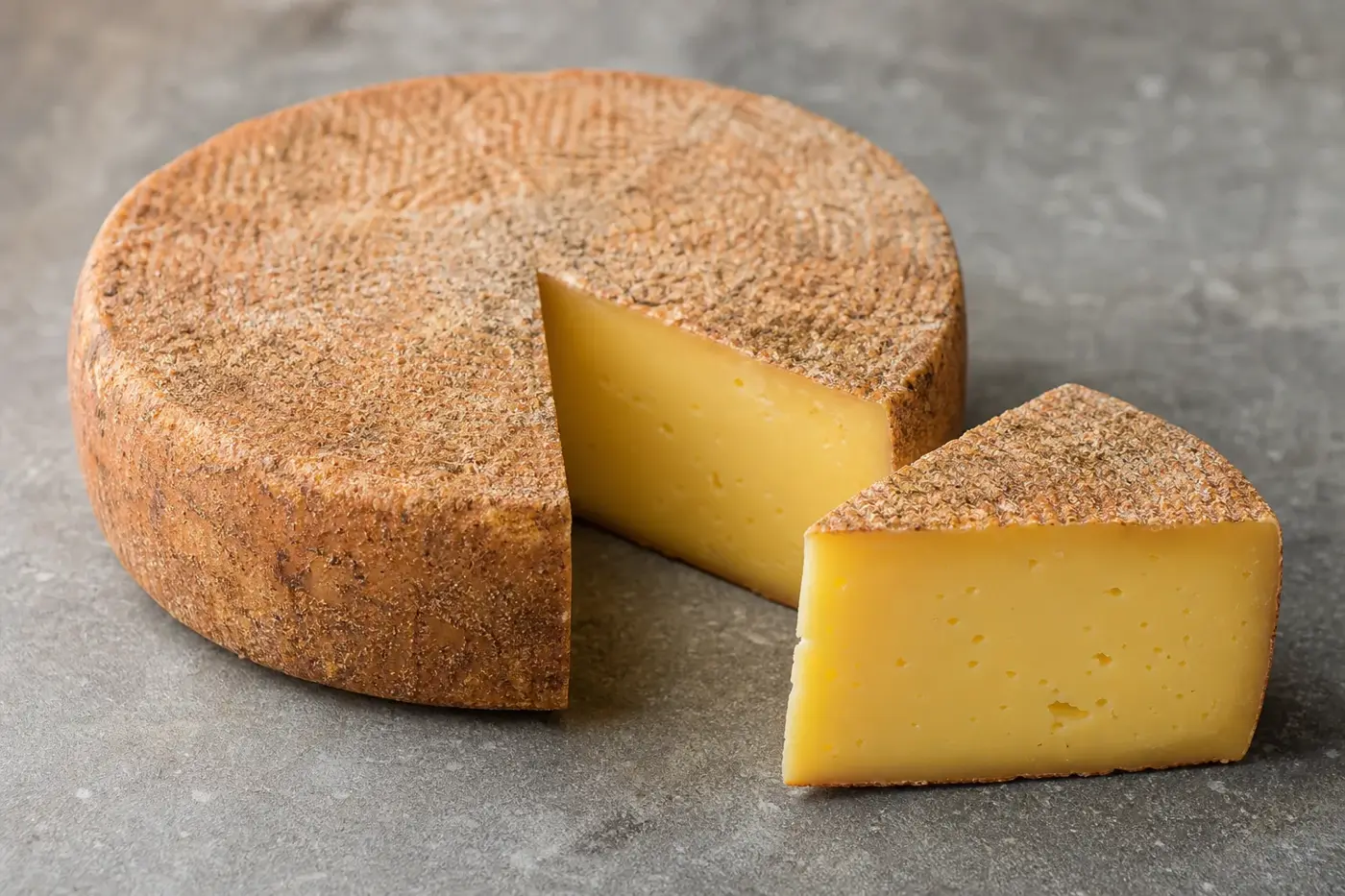
Your knife slips through a smooth, straw-coloured rind into yellow cheese that gives a little beneath the blade.
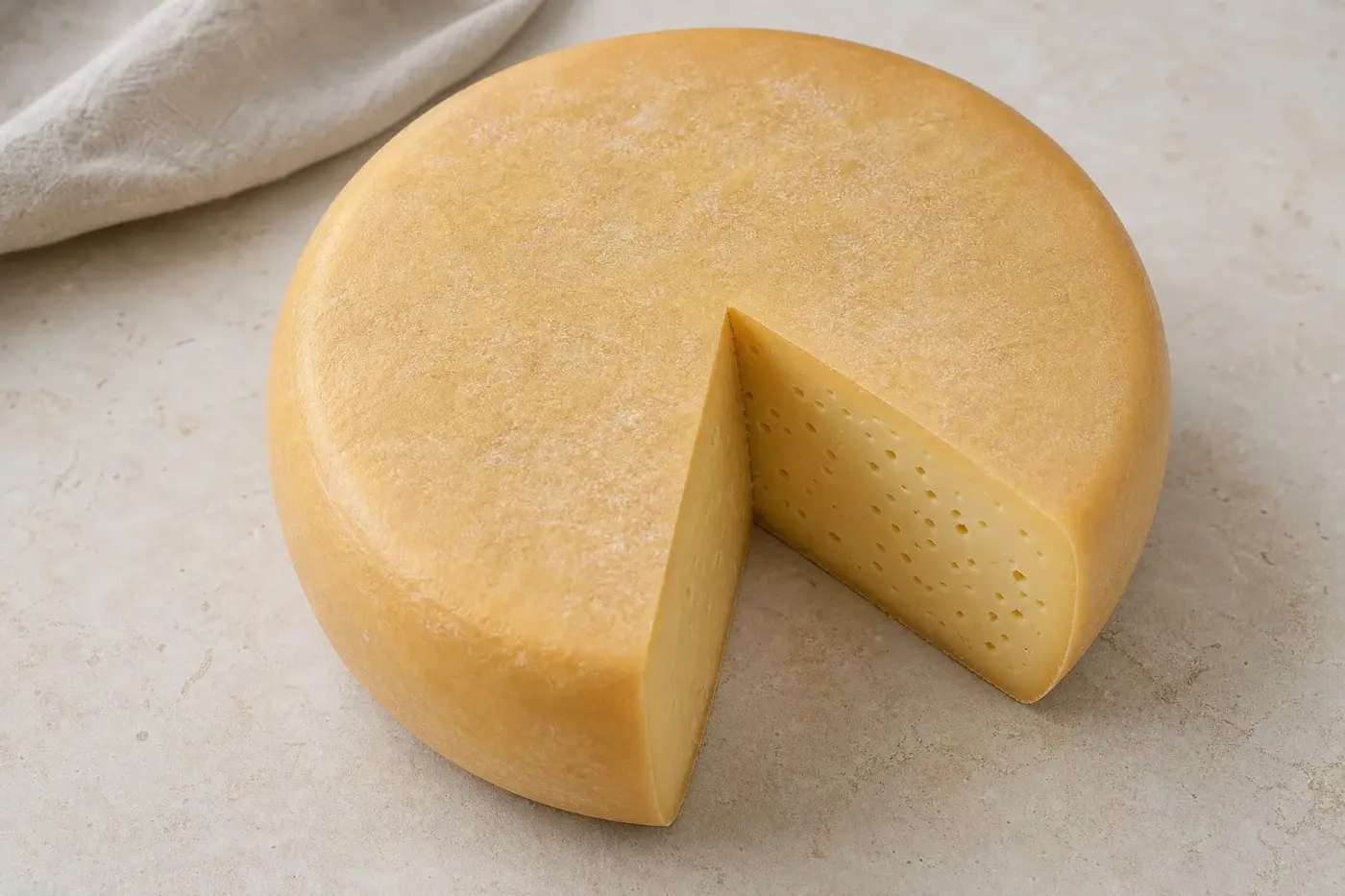
Your knife slips through a smooth, straw-coloured rind into yellow cheese that gives a little beneath the blade. Small holes, the size of lentils or peas, dot the cut face. Then Tolminc delivers its contrast: sweet and piquant, as its official specification puts it.[1]
This hard cheese brings you to the upper Soča valley of western Slovenia. Here, cattle moved with the seasons between valley farms and mountain pastures, and cheesemaking followed the herd. Raw or thermised cow’s milk carries that farming tradition into each wheel.[1]
| What to know | The detail |
|---|---|
| The name to look for | Tolminc.[1][2] |
| Registration authority and identifier | European Commission; current register identifier: Not verified. Published application reference: SL-PDO-0005-0422-29.10.2004.[1] |
| EU protection | Original PDO registration recorded by Defra in 2012; current EU register status: Not verified.[2] |
| Northern Ireland protection | Current status: Not verified. |
| Switzerland protection | Current status: Not verified. |
| US rights | Current status: Not verified. |
| Great Britain protection | Registered PDO, effective on the GB register from 31 December 2020 at 23:00; November 2026 record.[2] |
| Where it belongs | Zgornje Posočje, the upper Soča area, within specified boundaries around Kobarid, Tolmin and Bovec.[1] |
| Milk in the wheel | Raw or thermised cow’s milk; at least 80% from cows of the brown breed.[1] |
| How the milk sets | Rennet; animal or other origin unspecified in the published summary.[1] |
| Minimum maturation | At least 60 days.[1] |
| Longer maturation | A municipal publication describes two months to one year.[4] |
| The whole wheel | 3.5 to 5 kg; diameter 23 to 27 cm; height 8 to 9 cm.[1] |
| Outside and inside | Smooth, straw-coloured rind; flexible yellow paste with occasional lentil-sized or pea-sized eyes.[1] |
| Composition | At least 60% dry matter; at least 45% fat in dry matter.[1] |
| Pregnancy guidance | UK NHS advice distinguishes hard cheeses from certain soft cheeses, including soft cheeses made with pasteurised milk; November 2026 guidance.[5] |
Follow the Soča to Tolminc’s home
To find Tolminc’s home, look for Zgornje Posočje, the upper Soča area adjoining Italy. Its production territory takes in settlements around Kobarid, Tolmin and Bovec, along the Soča and its tributary valleys. The published specification summary traces the boundary settlement by settlement: “Slovenian mountain cheese” gets you close, but not quite to the right doorstep.[1]
Here, Alpine and Mediterranean influences meet. The PDO application describes humid mountain conditions, varied meadow vegetation and warmer air travelling inland along the Soča valley. You can follow that landscape into the cheese through the cows’ fodder: local vegetation feeds the animals, whose milk becomes Tolminc.[1]
There is a precise rule behind that connection. Local pasture, hay and silage must provide at least 75% of the dry matter in the cows’ daily ration. Mountain grazing matters, but conserved fodder has its place in this feeding system too.[1]
Take the uphill route with the herd
The farming year described in the PDO application followed the cattle uphill. From valley villages, they moved to lower slopes, then on to high pastures for summer grazing and cheesemaking. As the season changed, they came downhill again, connecting valley farms and mountain dairies through the work of making cheese.[1]
Those communities did not develop their hard-cheese methods alone. The same historical account records help from outside cheesemaking specialists, whose technical knowledge became part of local practice. Tolminc’s identity belongs to the people doing that work as much as to the landscape around them.[1]
The Tolminc cheese association, a producer and processor organisation, applied for EU protection. Its application gathered the region’s feeding practices, milk requirements, manufacturing method and finished cheese description into one shared specification. A living tradition acquired a written set of rules.[1]
What the protected name tells you
Defra records Tolminc’s original EU PDO registration in 2012. Its November 2026 Great Britain listing gives Tolminc registered PDO status. That register covers England, Scotland and Wales; Northern Ireland falls within the EU geographical indication system.[2][3]
PDO means protected designation of origin. For Tolminc, the published specification summary connects the name to a defined territory, locally produced milk, feeding requirements, a manufacturing method and a recognisable finished cheese. Records must link farms, milk collections, production batches and maturation.[1]
That record begins before the first curd forms. Milk for Tolminc must be collected and stored separately from other milk. Production and maturation records then establish each batch’s identity and age, giving the name on your cheese a documented chain behind it.[1]
If you want to untangle regional designations from other schemes, start with protected names explained. It helps you put the different names in context.
Meet the cows behind your cheese
At least 80% of Tolminc’s cow’s milk must come from cows of the brown breed. That requirement sits alongside the local feeding rules, rather than replacing them. Farm records support both the milk’s origin and its breed composition.[1]
The milk may be raw or thermised. The published specification summary describes thermisation at 57 to 68 °C and requires the label to tell you which treatment was used. Look at the particular wheel or piece you are buying; raw milk, thermised and pasteurised cheese explains the differences.[1]
Before cheesemaking begins, the milk ripens for at least 12 hours. Fresh milk may be added before coagulation, while this preparation develops the milk’s native microbial population and the appropriate acidity. Cheesemakers may also use locally prepared starter cultures or selected cultures to help fermentation.[1]
Watch little curds become a whole wheel
Rennet sets the milk into a gel. The cheesemaker cuts it into progressively smaller pieces, until the curd grains are about the size of hazelnuts. Those solids will become your cheese; the liquid released around them is whey.[1]
Heating and stirring come next, helping the grains shed whey and reach the required consistency. The published method specifies 44 to 48 °C. Depending on their equipment, dairies may use different arrangements to separate curd from whey and form the wheel.[1]
Pressing takes 6 to 12 hours. Turning the cheese during pressing helps drainage, distributes the remaining moisture and establishes its shape. After that, the wheel spends 24 to 48 hours in a brine bath.[1]
Then comes maturation: at least 60 days, according to the product description. The wheels are turned, wiped and cleaned as they mature. A production date or batch designation keeps each one traceable throughout these stages of protected commercial production.[1]
Get to know that yellow centre
A whole Tolminc is a substantial round wheel, yet the cheese inside should still be flexible. The official description pairs a smooth, straw-coloured rind with yellow paste. If “paste” sounds an unlikely thing to put on your plate, it simply means the cheese beneath the rind.[1]
Look at the cut face for occasional small eyes, the openings about the size of lentils or peas. A close-looking interior with a few scattered holes fits the published description. Large, regularly distributed holes are not the look that defines Tolminc.[1]
The rind develops during maturation, with turning, wiping and cleaning helping to maintain it. When you buy a cut piece, ask the seller whether that particular rind has received any treatment. Ask how to prepare it for serving, too.[1]
Find the sweet side, then the piquancy
Sweet and piquant are the official specification summary’s words for Tolminc’s flavour. It also calls for a distinctive aroma without foreign odours. As you taste, look for sweetness alongside a more pointed savoury impression, rather than sweetness alone.[1]
A publication issued by the regional development centre and published by Tolmin Municipality describes the flavour as sweet and savoury. It discusses maturation from two months to one year. It also connects a milder, milkier character with cheese whose further maturation has been slowed by refrigeration.[4]
Ask about age, then, but leave room for questions about the maker and milk treatment. Rather than automatically choosing the oldest cheese, find out what distinguishes the wheels being cut. If you are offered a taste, notice the paste’s flexibility and how its sweetness and piquancy compare with the published description.[1][4]
Give Tolminc the first bite
Start with a small piece on its own. Bring in bread and fruit separately, keeping things restrained enough for that sweet and piquant balance to come through. Your cheese deserves a moment before the chutney makes its entrance.[1]
Plain wheat bread or a lightly flavoured sourdough makes a simple starting point. Try apple or pear slices rather than strongly seasoned chutney, and serve any preserve in a separate dish so you can choose how much to add. Treat these as suggestions for exploring the cheese, rather than findings from a Tolminc tasting trial.
Begin with still water. For a more flavourful alcohol-free accompaniment, try a little apple juice alongside water, or lightly brewed tea without added flavourings. Taste the cheese before and after the drink, then keep whichever combination leaves its character clearest to you.
Serve a modest portion and replenish it as needed. The FSA guidance cited here covers England, Wales and Northern Ireland. It advises keeping chilled food out of refrigeration for the shortest possible time, with a maximum of four hours during preparation.[6]
Let your piece lead the cooking
Try a little grated Tolminc over cooked potatoes, thin slices on an open sandwich, or a scattering over polenta as a finishing cheese. These are starting points for your own cooking. They are neither site-tested recipes nor traditional Slovenian dishes.
Let the piece in front of you suggest the preparation. A flexible piece lends itself to slicing for bread; a firmer one is worth trying grated over a finished dish. Add a little, taste, then decide whether you need more cheese or further seasoning.
For your first experiment, make Tolminc the principal cheese rather than mixing it with several strongly flavoured cheeses. You will get a clearer sense of how its documented sweet and piquant character works in the finished food. There is time enough for a full cheese gathering later.[1]
Ask for the story at the counter
Look for the registered name Tolminc, the producer’s identity and the milk treatment. The published specification summary requires producer identification, the Tolminc name and logo, the relevant designation marks, and a statement identifying raw or thermised milk. Those details tell you more about the piece you are taking home.[1]
Ask when the cheese was made and how long it matured. Additional labelling may identify longer maturation, production without silage feeding, or manufacture in a mountain dairy. Each gives you a glimpse of a particular production choice within the specification.[1]
Keep the label or the seller’s written details with your cheese. If producer, packer and product information leave you puzzling over the small print, how to read a cheese label can help you make sense of it.
Keep your cut piece in good company
Follow the storage instructions supplied with your piece. If you use FSA consumer guidance for England, Wales and Northern Ireland, keep your fridge at 5 °C or below and use a fridge thermometer to check it. The agency advises refrigerating dairy products and following the packaging instructions.[6]
Protect the cut surface between servings and return the cheese promptly to refrigeration. Tolmin Municipality’s publication notes that an unprotected surface dries out in the fridge. Ask your seller how to maintain your piece’s condition, starting with the wrapping they supply.[4]
Follow the instructions for use after opening, as well as the date on the packaging. Minimum maturation governs production; storage instructions govern the finished food you have brought home. For broader handling advice, see how to store cheese at home.[1][6]
This page summarises published guidance from the official sources it cites. It is not medical advice. Guidance differs between countries and changes over time, so check the current source for where you live, and ask your doctor, midwife, pharmacist or dietitian about your own circumstances.
Choosing Tolminc during pregnancy
The UK NHS pregnancy guidance from November 2026 says you can eat hard cheeses during pregnancy whether they are made with pasteurised or unpasteurised milk. It also lists pasteurised semi hard cheeses. Soft cheeses with a white coating and soft blue cheeses have different advice, whether pasteurised or unpasteurised: cook them until steaming hot before eating.[5]
Tolminc is classified as hard in its published specification summary.[1] If you are choosing cheese during pregnancy, consult the current NHS guidance and ask your midwife or another appropriate clinician about your circumstances. If you live elsewhere, follow your own country’s official advice.
Questions people ask
Where is Tolminc made?
Tolminc comes from Zgornje Posočje, the upper Soča area of western Slovenia. Its defined production territory includes settlements around Kobarid, Tolmin and Bovec.
What does Tolminc taste like, and how long is it matured?
The official specification describes its flavour as sweet and piquant. It must mature for at least 60 days, while a Tolmin Municipality publication describes maturation from two months to one year.
Is Tolminc made with raw milk?
Tolminc may be made with raw or thermised cow’s milk. The label must state which treatment was used.
Is Tolminc suitable for vegetarians?
Tolminc is made with rennet. The published specification summary does not say whether the rennet is of animal or other origin.
Can I eat Tolminc during pregnancy?
The UK NHS says hard cheeses can be eaten during pregnancy whether made with pasteurised or unpasteurised milk, and Tolminc is classified as hard. Consult the current NHS pregnancy guidance and ask your midwife or another appropriate clinician about your circumstances.
Sources
- European Commission, Publication of an application pursuant to Article 6(2) of Council Regulation (EC) No 510/2006: Tolminc, 2011/C 185/06, Official Journal C 185, 25 June 2011, pp. 14 to 17. Published specification summary, including geographical boundaries, milk, manufacture, description and labelling.
- Department for Environment, Food & Rural Affairs, Tolminc, Great Britain protected food and drink names register, published 2021, live entry retrieved November 2026. Records registered PDO status, the GB effective registration date and the original EU registration year.
- Department for Environment, Food & Rural Affairs, Protected geographical food and drink names: UK GI schemes, updated 8 March 2024, retrieved November 2026. Explains the respective geographical scope of the GB and EU schemes.
- Posoški razvojni center, published by Tolmin Municipality, Tolminc Cheese, June 2013. Regional account of character, maturation and changes during storage.
- NHS, Foods to avoid in pregnancy, live guidance retrieved November 2026, section “Cheese, milk and other dairy”. Distinguishes hard cheeses from semi-hard, mould-ripened soft and soft blue-veined cheeses.
- Food Standards Agency, How to chill, freeze and defrost food safely, published 18 December 2017, live guidance retrieved November 2026. Applies to England, Northern Ireland and Wales.
Researched from the published EU specification summary, the GB register, a municipal publication and current official food guidance, with serving and cooking suggestions identified as editorial recommendations.
Last checked: November 2026.
Last checked November 2026.
The editors suggest you read next