Vorarlberger Alpkäse
Picture cows grazing at 1,000 to 1,800 metres in western Austria.
Picture cows grazing at 1,000 to 1,800 metres in western Austria. Up here, their milk becomes Vorarlberger Alpkäse at the Alpine holdings themselves, with none brought up from valley farms.[1][3] Raw cow’s milk, silage-free feeding and months of careful rind tending give you an ivory-coloured hard cheese, growing more piquant as time does its work.[1][3]
| What you might want to know | The detail |
|---|---|
| Familiar and registered name | Vorarlberger Alpkäse.[1] |
| EU registration authority and identifier | European Commission; PDO-AT-1413.[1] |
| EU protection | Registered PDO; original registration under Commission Regulation (EC) No 1065/97. Register status: November 2026.[1][4] |
| Great Britain protection | Registered PDO; UK scheme registration dated 31 December 2020. Register status: November 2026.[5] |
| Northern Ireland protection | Protection status unspecified. |
| Switzerland protection | Protection status unspecified. |
| United States protection | Protection status unspecified. |
| Where it is made | Recognised Alpine and intermediate-pasture holdings in Vorarlberg, Austria; production at 1,000 to 1,800 metres.[1] |
| Milk | Raw cow’s milk from the permitted Alpine holdings.[1][3] |
| Minimum maturation | Three months, within the defined geographical area.[1] |
| Wheel weight | Maximum 40 kg.[1] |
| Wheel dimensions | Dimensions unspecified. |
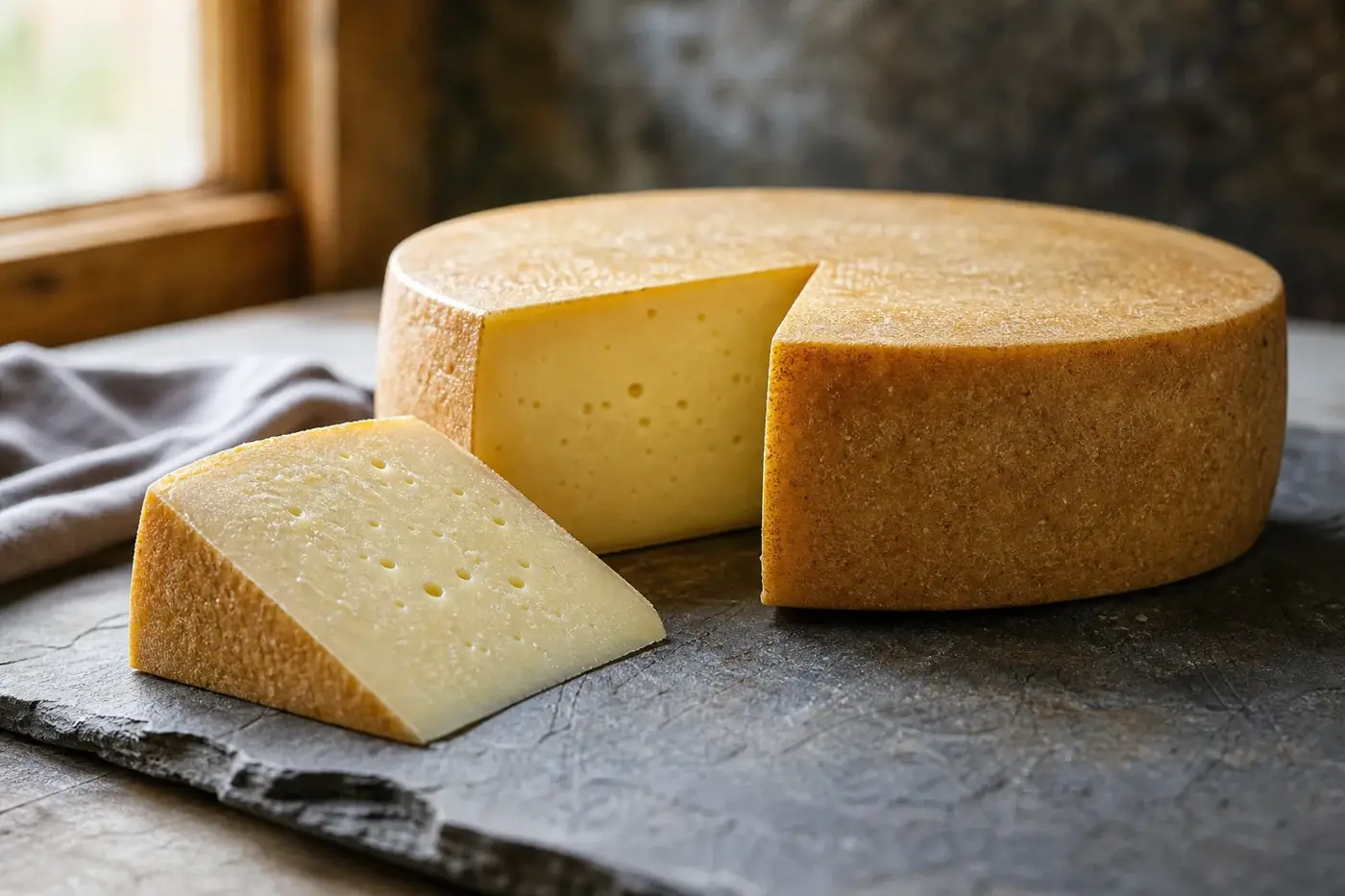
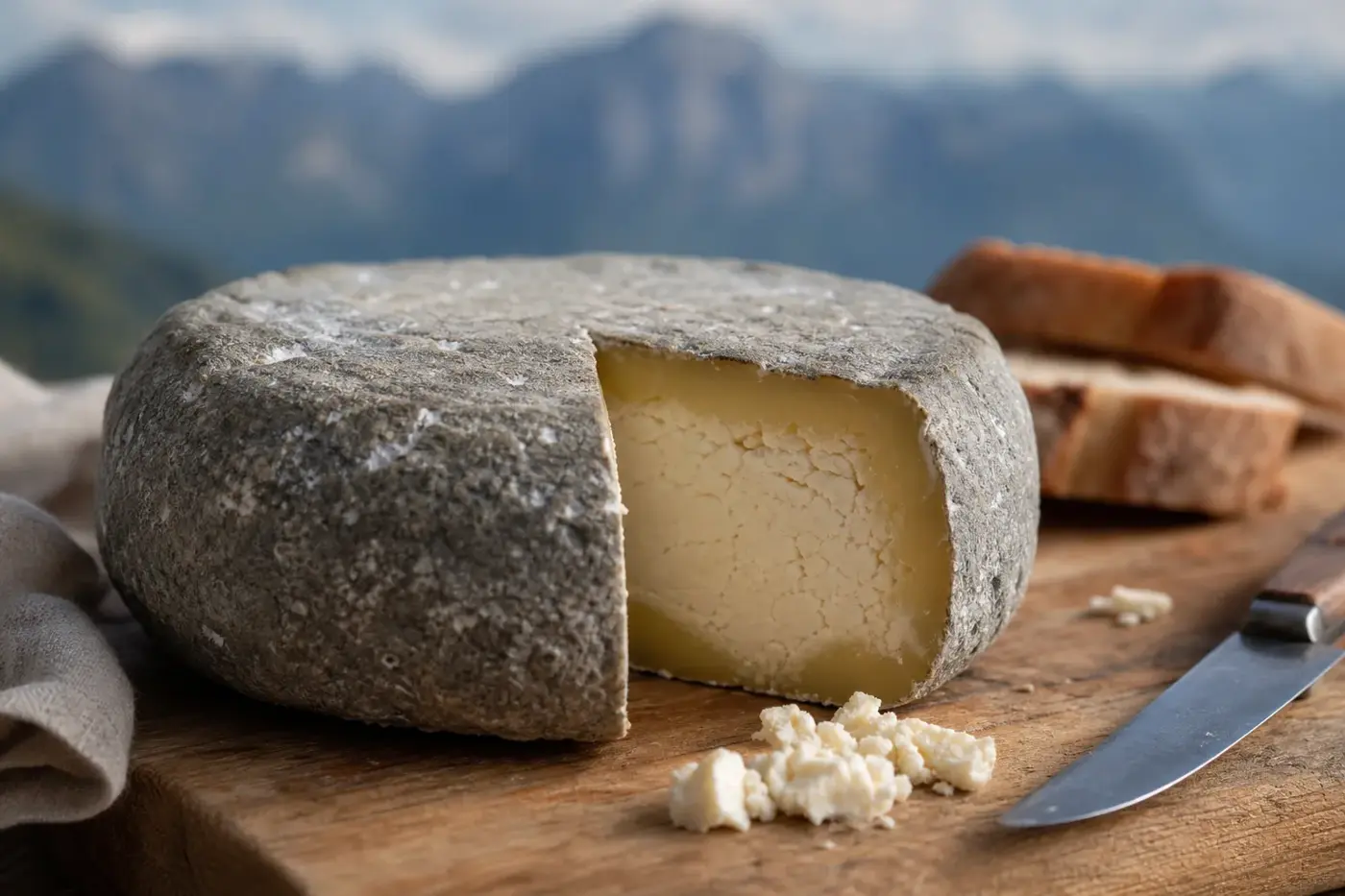
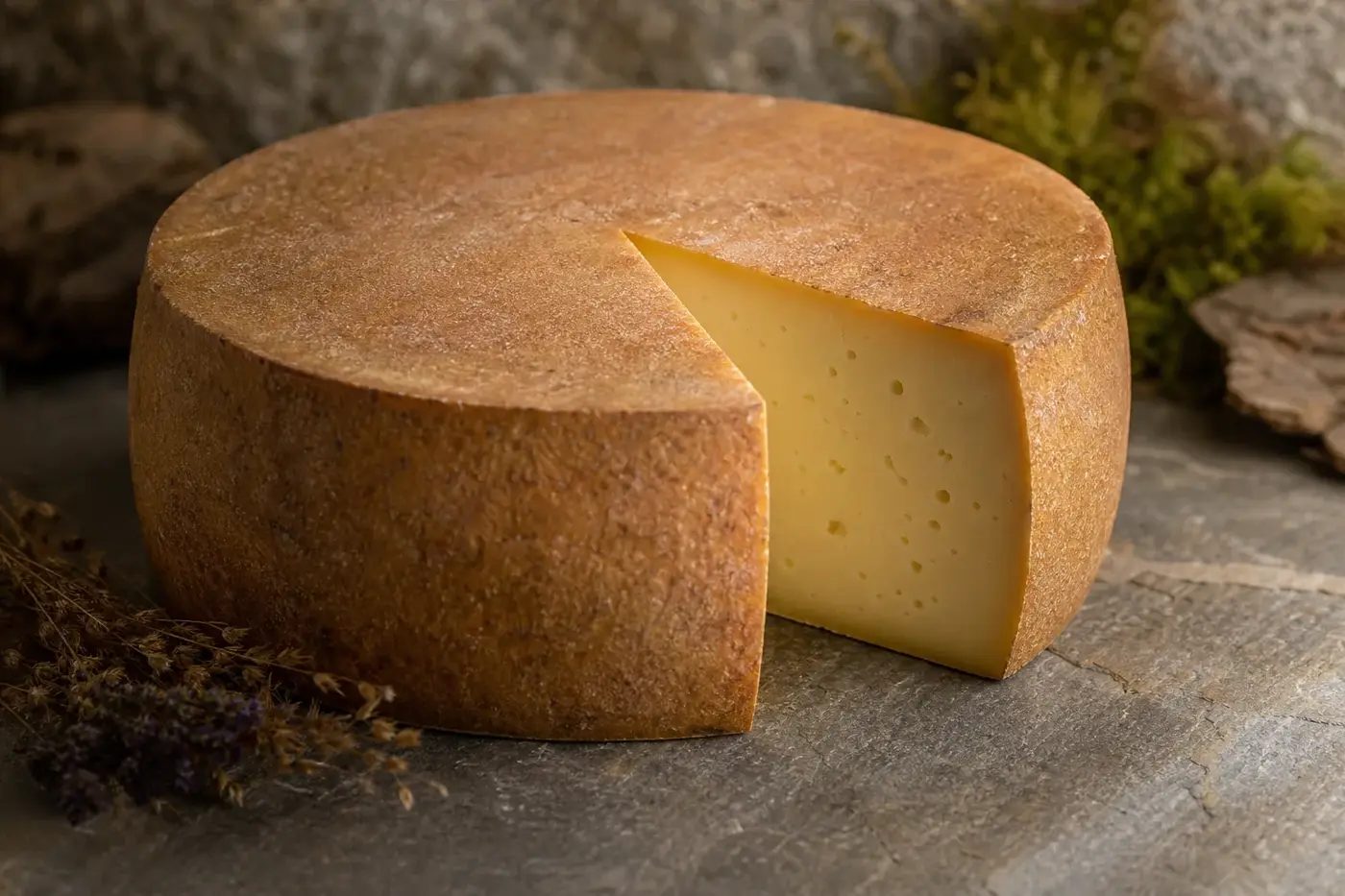
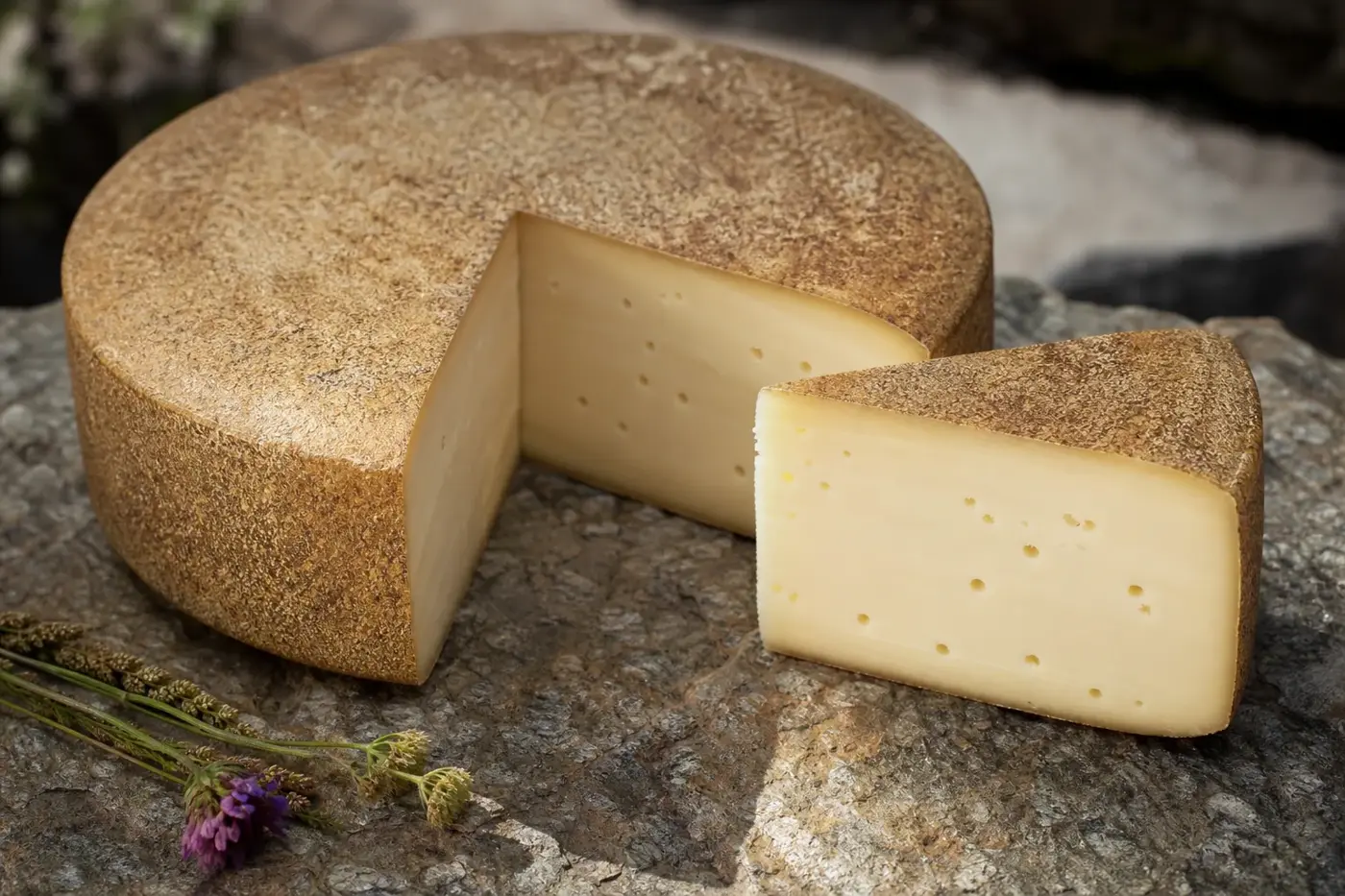
| Rind and interior | Brownish-yellow to brown granular rind; ivory paste with sparse, approximately pea-sized round holes.[1] |
Meet the mountain pasture behind the name
Linger over Alp. It means a mountain pasture and its associated seasonal farming operation. Here, grazing and cheesemaking share a home: the milk must come from the permitted Alpine holdings, never from valley farms.[3]
So “mountain cheese” tells you only half the story. Vorarlberger Alpkäse belongs to the summer movement of livestock and people between different levels of pasture. Its protected specification ties its character to Alpine vegetation, local conditions and skills kept alive in small Alpine dairies.[1]
When you taste it, look for three things. The texture may be supple or firm, the holes are few, and the flavour travels from mild towards a more pronounced, piquant finish with age. Those are the defining characteristics in the official records.[1][3]
Why this name belongs to Vorarlberg
Vorarlberger Alpkäse carries an EU protected designation of origin, or PDO. In German, you will see g.U., short for geschützte Ursprungsbezeichnung. The current specification, published by the Austrian Patent Office, requires milk production, processing and maturation to take place within the defined area.[1]
That brings you to Vorarlberg, Austria’s westernmost province. The area covers recognised Alpine holdings in the regional three-stage farming system, at 1,000 to 1,800 metres. Alongside the higher Alpine pastures are intermediate holdings called Vorsäß or Maisäß.[1]
The name also appears as a registered PDO on the Great Britain register, with that status recorded for November 2026.[5] To untangle origin protection from other schemes, take a look at protected cheese names.
Follow the cattle into summer
The cattle’s journey links valley farms, intermediate pastures and the higher Alps. Seasonal grazing sets the rhythm of the working year. Where the animals spend their summer, their milk becomes cheese.[1]
The Austrian agriculture ministry describes Vorsäß holdings as pastures with agricultural buildings, used on the journey to and from high summer grazing. Broadly, they come into use in late spring and again in autumn.[3]
Cheesemakers bring their dairy work into this seasonal world. A morning batch is only the start: preparing milk, handling curd and tending maturing wheels all demand judgement. The ministry describes knowledge of feeding, milk processing, production and maturation passed between generations and sharpened through practice.[3]
What reaches your plate belongs to a working farming system. The mountains shape both the milk’s origins and the daily work that turns it into a finished wheel.
Start with what the cows eat
Only raw cow’s milk from the recognised Alpine and intermediate-pasture holdings belongs in this cheese. The ministry’s production account excludes thermised milk, pasteurised milk and milk treated by centrifugal bacterial removal.[3] For the distinctions, turn to milk treatments explained.
The feeding rules are just as precise. Silage production and feeding are excluded from the permitted holdings, while supplementary crushed grain is allowed, including grain from outside the area. That grain may account for up to 20% of annual feed dry matter; at least 80% of the cows’ annual feed dry matter must originate within the geographical area.[1]
“Pasture-fed” gets you part of the way, but it leaves some detail out. Local grassland is fundamental, with a controlled allowance for supplementary feed. The specification explicitly connects the milk’s character with the region’s Alpine vegetation.[1]
Evening milk, morning milk and copper vats
The process begins with evening milk left for the cream to rise. In the ministry’s account, some cream comes off the following day, before the prepared milk joins fresh morning milk. Then lactic cultures and rennet go into copper cheesemaking vats.[3]
Rennet sets the milk into a gel. Cutting it produces curds, the solid particles destined to become cheese, and separates them from the liquid whey. The cheesemaker works and heats those curds, then gathers them into moulds and presses them.[3]
The ministry describes heating the curd to 51 to 54 °C, followed by pressing and two to three days in a brine bath.[3] These are commercial production details, not a kitchen recipe. For the wider sequence and its vocabulary, dip into how cheese is made.
Take a closer look at your slice
First, take in the substantial wheel, granular rind and ivory interior. The rind looks dry, its colours running from brownish-yellow to brown. Inside, the official description allows a consistency from firm enough to slice cleanly through to supple.[1]
The holes are sparse, round and approximately pea-sized. A cut face with relatively few holes is quite at home here. The specification also recognises that the strength of the cheese’s described characteristics changes as the wheel matures.[1]
At the counter, let appearance start your conversation, not finish it. Look for the exact name, the maker or supplying dairy, and the wheel’s age. A brown rind alone has only so much to tell you.
Give time and rind care their due
Three months is the minimum maturation period, not an instruction to sell every wheel at the same age.[1] The ministry describes maturation at 10 to 17 °C, in relative humidity above 80%. Throughout that time, the surfaces are regularly brushed or rubbed with salt water.[3]
That repeated attention helps make the finished cheese. The natural surface develops through handling and maturation, while the paste develops its own character inside.[3] The rind is a continuing job, not a wrapper left behind after pressing.
As the cheese ages, its flavour moves from mild towards piquant.[1][3] Texture varies too, so choose the eating experience you want rather than automatically reaching for the oldest wheel. Age is useful information, not a competitive sport: ask whether the cut before you is supple and gentle, or firmer and more assertive.
Follow the flavour from nose to mouth
Dried fruit, biscuit, malt and cream: these are the aromas described by Vorarlberg Tourismus. On the palate, the tourism organisation points to sour cream, milk, butter, white bread and almond.[6]
Those descriptions give you particular flavours to explore alongside the official account’s broader journey from mild to piquant.[1][6] They also help you separate what you smell before tasting from what emerges once the cheese is in your mouth. You need not catch everything at once.
Vorarlberg Tourismus describes a texture that starts crumbly and becomes supple in the mouth.[6] Try a small piece by itself, without bread or accompaniments, and notice whether your first impression is lactic, toasted or fruity. Follow the texture as you chew. You will have a clearer starting point for choosing accompaniments than if several strong flavours arrive together.
Alpkäse or Bergkäse? Follow the milk
Milk sourcing, place of manufacture and season separate these two cheeses. Both are Vorarlberg hard cheeses made from raw cow’s milk, each with its own EU PDO specification, with status recorded for November 2026.[1][2] Bergkäse allows milk from Alpine or valley holdings; Alpkäse belongs specifically to the seasonal Alpine system.[1][2]
| What sets them apart | Vorarlberger Alpkäse | Vorarlberger Bergkäse |
|---|---|---|
| Where the milk comes from | Permitted Alpine and intermediate-pasture holdings.[1] | Alpine or valley raw cow’s milk from Vorarlberg.[2] |
| Where the cheese is made | Recognised seasonal Alpine holdings.[1] | Dairies in Bregenzerwald, Kleinwalsertal, Großwalsertal, Leiblachtal including Pfänderstock, Walgau and Rheintal.[2] |
| When production takes place | Summer operation of the Alpine holdings.[1] | No equivalent summer-only restriction in the cited description.[2] |
| Minimum maturation | Three months.[1] | Three months.[2] |
| Maximum wheel weight | 40 kg.[1] | 40 kg.[2] |
Bergkäse has a broader production framework. It is not simply Alpkäse with a different birthday. To compare them at the counter, ask for similar maturity: a large age gap can hide the distinction in production setting.
Choose your cut and bring its details home
Ask for the exact registered name and, where available, the Alpine dairy and production season. The specification requires a consecutively numbered casein identification mark on the wheel, supporting traceability through the supply chain.[1] Your wedge may carry only part of the original surface, so the seller’s accompanying information matters.
Three questions will get you a long way: how old is this wheel, who made it, and how should you store this cut? Keep its label or wrapping information. For help separating product identity from other wording, see reading a cheese label.
For home refrigeration, the Food Standards Agency’s guidance for England, Northern Ireland and Wales recommends 0 to 5 °C and following package storage instructions. Food Standards Scotland also recommends 0 to 5 °C.[7][8] Follow the instructions for your particular cut rather than assigning every wedge the same shelf life.
Make room at the table, or in the kitchen
Begin simply, with bread and a few slices, so you can enjoy the texture and finish. Try rye bread for a firmer contrast, a plain boiled potato for something quieter, or fresh pear alongside a more piquant piece.
For an alcohol-free drink, start with water as you taste, then try unsweetened apple juice diluted with sparkling water. Treat these suggestions as comparisons, not commandments. Taste the cheese, add the accompaniment, and decide which combination keeps the qualities you enjoyed in focus.
For current advice on serving chilled food, consult the Food Standards Agency guidance for England, Northern Ireland and Wales and Food Standards Scotland guidance for Scotland.[7][8]
In the kitchen, the Austrian ministry names Käsespätzle and Walser cheese dumplings among traditional uses.[3] Try Vorarlberger Alpkäse grated over hot noodles or folded into a cheese mixture for dumplings. Taste before deciding how prominently to use it: a mild wheel and a piquant one ask for different balances.
General information only, not medical advice: follow the official guidance where you live.
Questions people ask
Where is Vorarlberger Alpkäse made?
It is made at recognised Alpine and intermediate pasture holdings in Vorarlberg, Austria. Milk production, processing and maturation must all take place within the defined area.
Is Vorarlberger Alpkäse made with raw milk?
Yes, it is made only with raw cow’s milk from permitted Alpine and intermediate pasture holdings. Silage production and feeding are excluded from those holdings.
What is the difference between Vorarlberger Alpkäse and Bergkäse?
Alpkäse belongs to the seasonal Alpine farming system and uses milk from permitted Alpine and intermediate pasture holdings. Bergkäse can use milk from Alpine or valley holdings and has no equivalent summer restriction in the cited description.
How long is Vorarlberger Alpkäse matured, and what does it taste like?
It must mature for at least three months within the defined geographical area. Its flavour moves from mild towards piquant with age.
How should I store Vorarlberger Alpkäse?
The Food Standards Agency recommends a fridge temperature of 0 to 5 °C and following package storage instructions. Food Standards Scotland also recommends 0 to 5 °C. Consult the relevant agency’s guidance and follow the instructions for your particular cut.
Sources
[1] Austrian Patent Office, Vorarlberger Alpkäse g.U.: Aktuelle Spezifikation; Aktuelles Einziges Dokument, current published dossier incorporating the 2023 amendment. Sections 3.2 to 5 of the single document and dossier identification page. Current specification.
[2] Austrian Patent Office, Vorarlberger Bergkäse g.U.: Aktuelle Spezifikation; Aktuelles Einziges Dokument, current published dossier incorporating the 2023 amendment. Sections 3.2 to 5 of the single document. Current specification.
[3] Austrian Federal Ministry of Agriculture, Forestry, Climate and Environmental Protection, Regions and Water Management, Vorarlberger Alpkäse g.U. (geschützte Ursprungsbezeichnung), traditional-food record, undated, retrieved November 2026. Sections on production, processing, maturation, appearance and uses. Ministry record.
[4] European Commission, Commission Regulation (EC) No 1065/97 of 12 June 1997 supplementing the Annex to Regulation (EC) No 1107/96, 1997, Articles 1 and 2 and Annex. Registration regulation.
[5] Department for Environment, Food and Rural Affairs, Vorarlberger Alpkäse, Great Britain protected food-name register entry, published 2021, retrieved November 2026. Register entry.
[6] Vorarlberg Tourismus, Käsespezialitäten aus Vorarlberg: Von Alpkäse bis Ziegencamembert, undated, retrieved November 2026, entry “Alpkäse”. Regional tourism promotional source; sensory descriptions are attributed to it. Published sensory account.
[7] Food Standards Agency, How to chill, freeze and defrost food safely, 2017, current retrieved text, November 2026. Applies to England, Northern Ireland and Wales. Official guidance.
[8] Food Standards Scotland, Chilling food, undated, current retrieved text, November 2026. Official guidance.
Researched through official Austrian specification dossiers, legislation, the Great Britain register, national food-safety guidance and an attributed regional sensory account.
Last checked: November 2026
Last checked November 2026.
The editors suggest you read next