Tiroler Graukäse
Cut into Tiroler Graukäse and you might find two textures sharing the same piece: a pale, crumbly centre and supple, translucent cheese where ripening has travelled further.
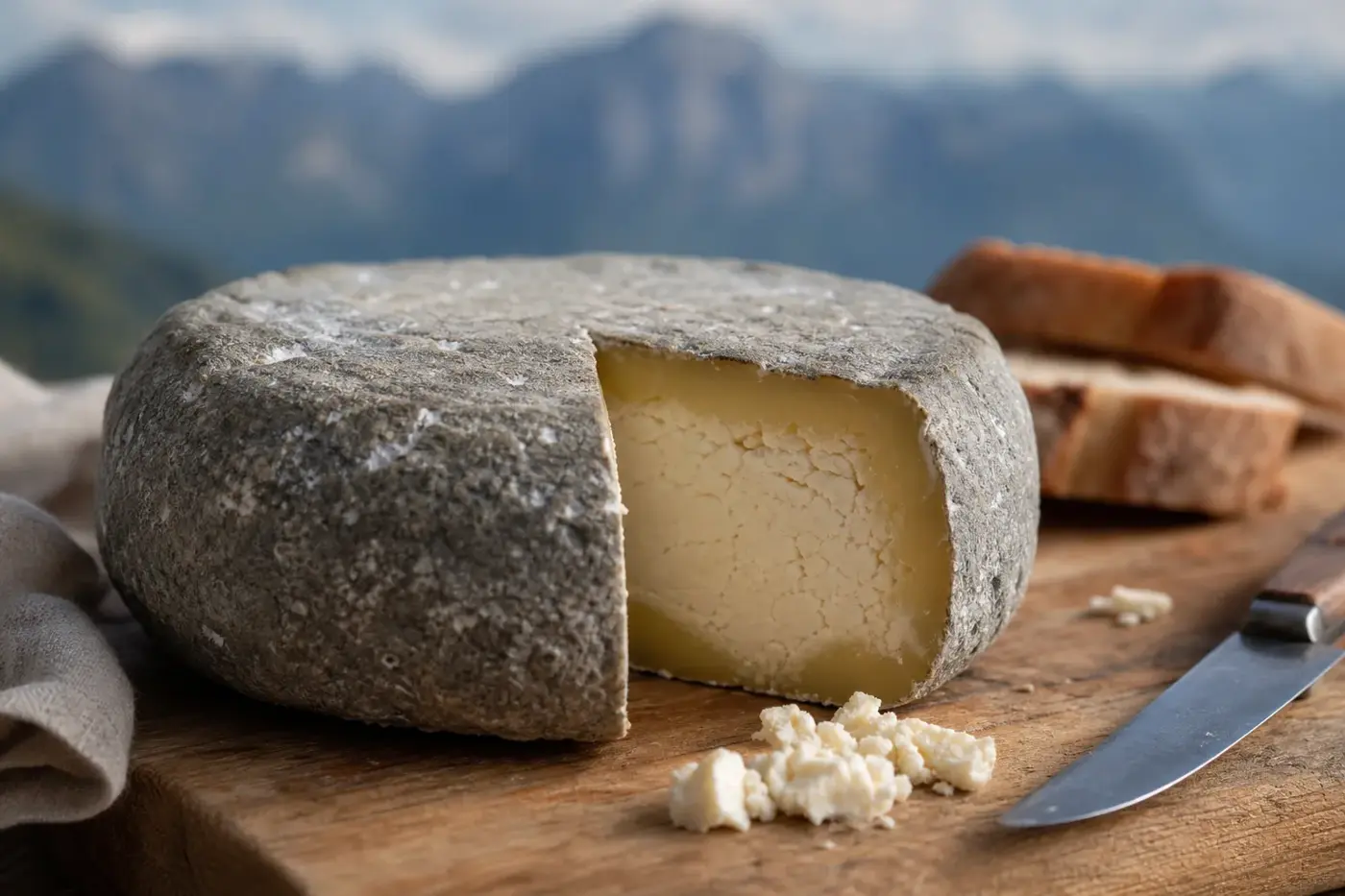
Cut into Tiroler Graukäse and you might find two textures sharing the same piece: a pale, crumbly centre and supple, translucent cheese where ripening has travelled further. Its story starts with skimmed milk left after butter making, put to work by the Alpine farmers of Austrian Tyrol. The Austrian agriculture ministry traces those resourceful beginnings through an 1879 description of Graukäse made from butter production’s remaining milk. [1]
| What you want to know | The details |
|---|---|
| The familiar and registered name | Tiroler Graukäse. [2] |
| Its cheese family | Sour-milk cheese, Sauermilchkäse. [3] |
| EU protection | Individual EU register entry: unconfirmed. |
| EU registration date | 2 July 1996, recorded in the GB register. [2] |
| Great Britain protection | Registered PDO; scheme registration dated 31 December 2020 at 23:00; register information as of November 2026. [2] |
| Where it comes from | Austrian federal state of Tyrol, including North and East Tyrol. [1] |
| The milk behind it | Skimmed cow’s milk; the Austrian ministry describes raw and pasteurised versions. [1] |
| Ingredients and allergens in your piece | Check the individual label |
The butter came first, but the milk had more to give
The cream had another destination. What remained became cheese. That practical division explains Graukäse’s lean character and its roots in a farming tradition that found a use for the milk left after butter production. [1]
If you arrive expecting the smooth richness of a full-fat mountain cheese, prepare for a different pleasure. Acidification, a paste that changes markedly as it matures and a pronounced sour-milk identity set the course. Follow the change from crumbly to supple, rather than wishing it were something else.
The geographical name matters, too. This protected product comes from Austrian Tyrol, not everywhere included in the wider historical meaning of Tyrol. Read the full name when choosing: a mountain illustration or the word “Alpine” cannot tell you whether you have found Tiroler Graukäse. [1,2]
Look for the name, not just the mountains
Tiroler Graukäse is a protected regional name, not a brand. PDO means protected designation of origin; the German abbreviation, g.U., stands for geschützte Ursprungsbezeichnung. The Austrian Patent Office lists the cheese among Austria’s PDO foods under the EU geographical-indications framework. [4]
You can think of “Graukäse” as the wider cheese family encountered in regional food culture. “Tiroler Graukäse” is the registered name, protected together with its production requirements. If you want this particular regional product, that is the name to seek. [2,3,4]
Great Britain’s register records Tiroler Graukäse as a registered PDO. It gives 2 July 1996 as the original EU registration date and 31 December 2020 at 23:00 as the UK-scheme registration date. Publication of the register page followed on 4 January 2021, a separate event. [2]
If you would like to untangle protected origin from other quality schemes, start with protected names explained.
This page summarises published guidance from the official sources it cites. It is not medical advice. Guidance differs between countries and changes over time, so check the current source for where you live, and ask your doctor, midwife, pharmacist or dietitian about your own circumstances.
Follow the milk from sour curd to mould
Here, starter cultures do the acidifying work, rather than added rennet. In the ministry’s account, the sour curd is heated and separated from its whey. Salt and pepper follow, before the curd is pressed into moulds. [1]
Curd is the coagulated milk material that becomes your cheese; whey is the liquid separated from it. Graukäse reaches that curd through acidification. Many other cheeses take a rennet-led route instead.
If you are curious about how milk becomes cheese, this is a revealing place to start. Milk treatment, coagulation and maturation are separate stages. Each answers its own question: how was the milk handled, how did its proteins form a curd, and what happened to that curd afterwards?
Keep those questions separate at the counter. Ask whether your particular cheese uses raw or pasteurised milk, rather than assuming every example receives the same treatment. For help with the vocabulary, turn to raw, thermised and pasteurised cheese.
Let the cut face tell its story
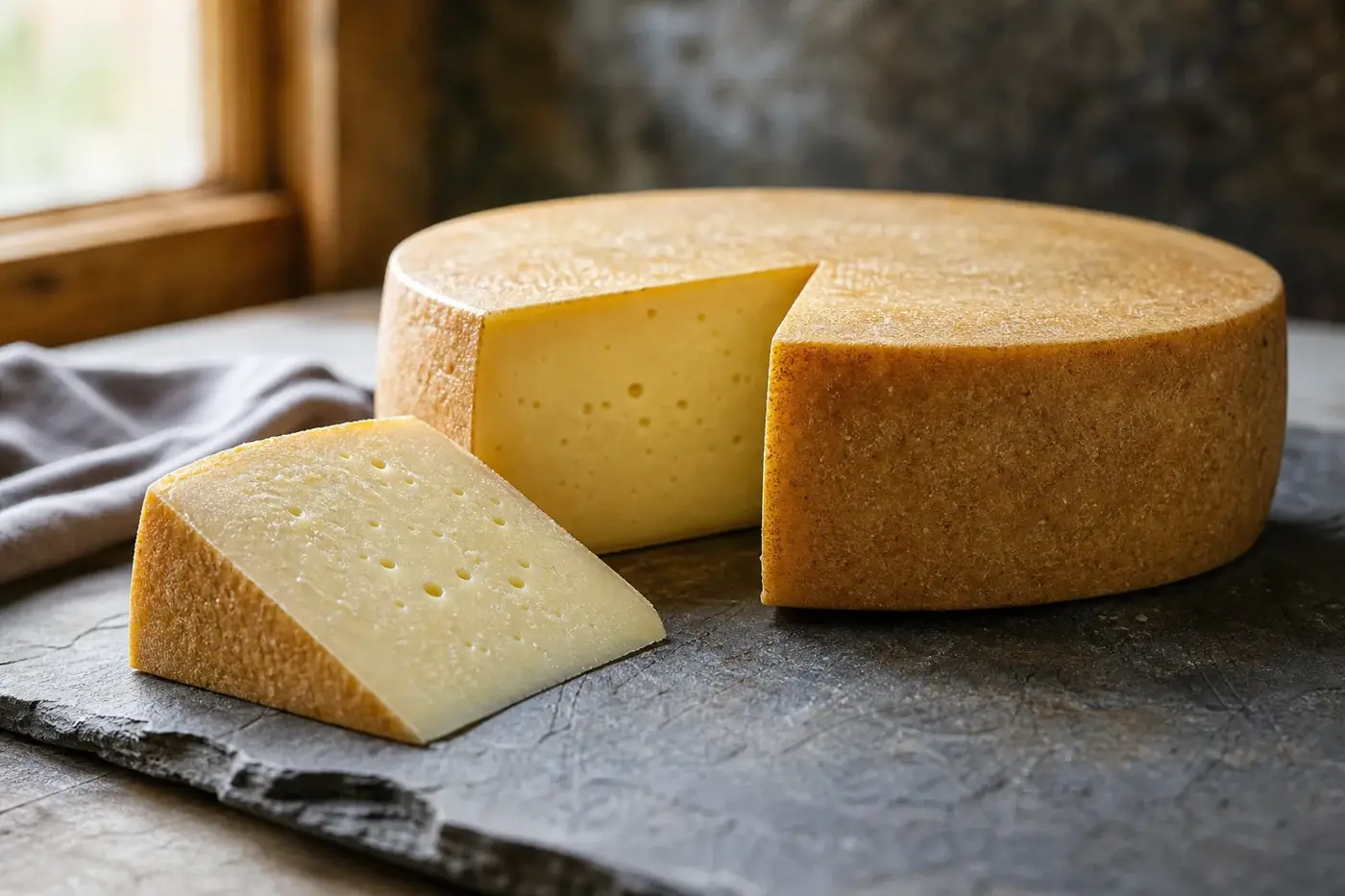
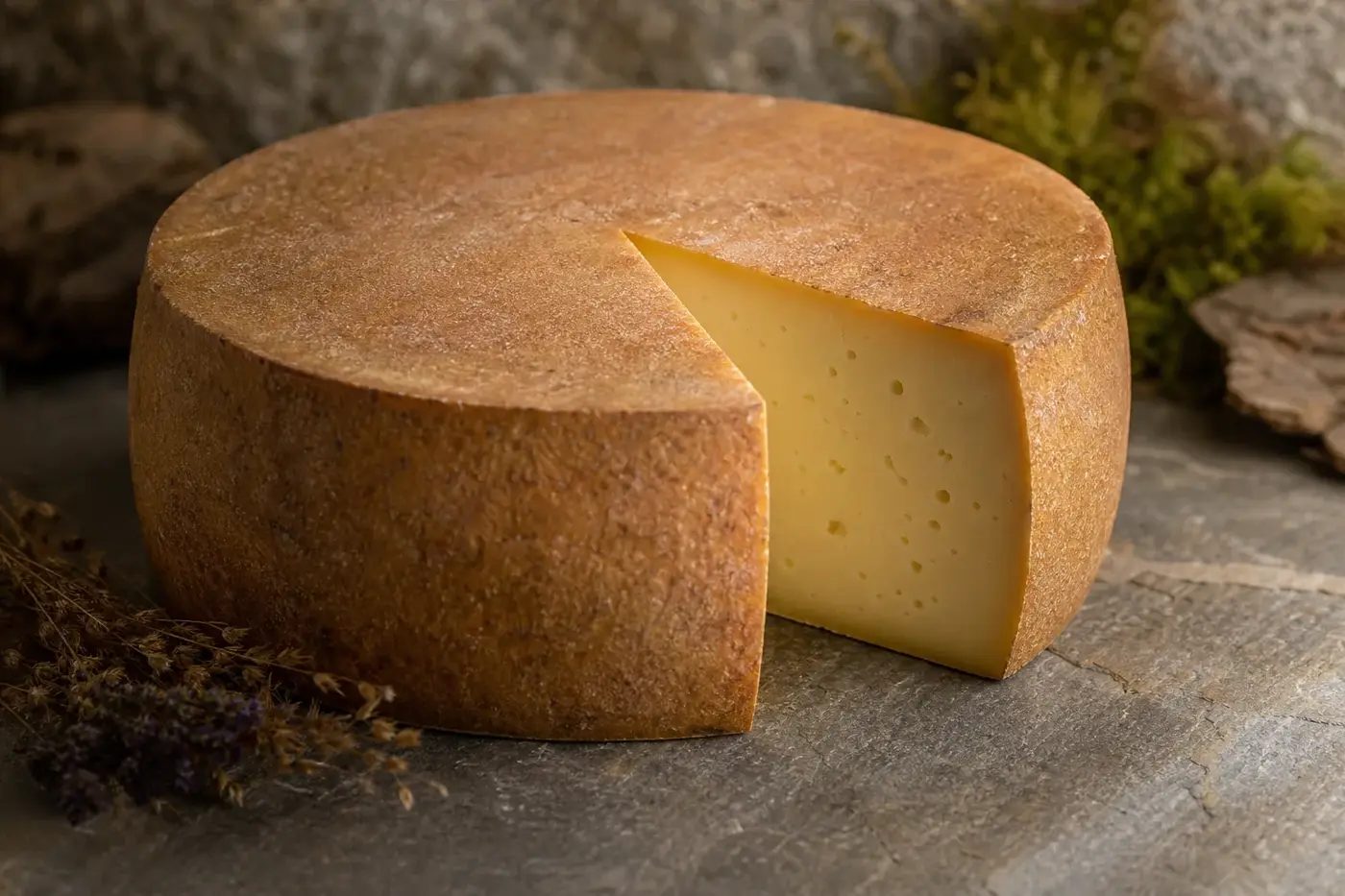
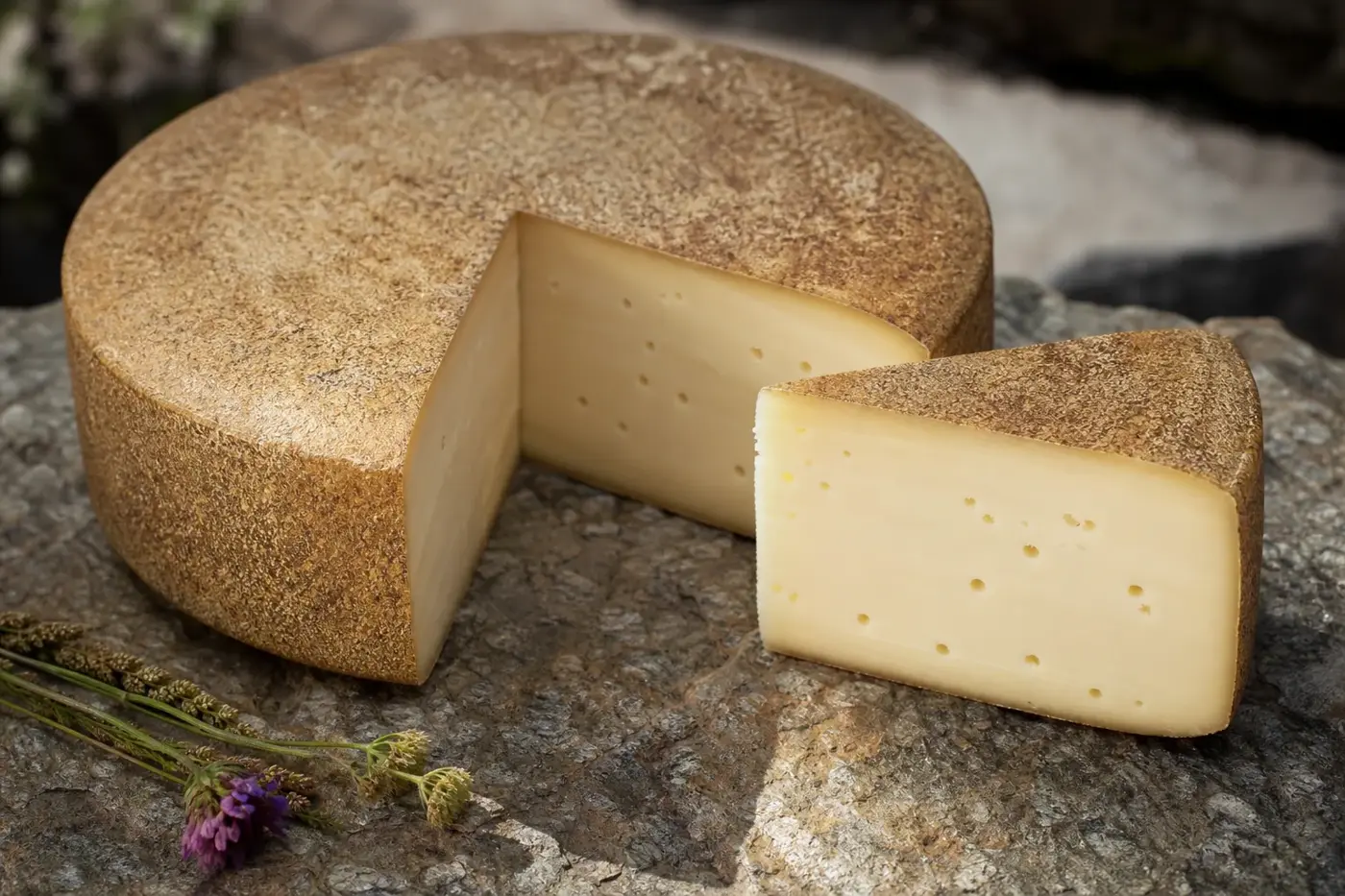
The ministry describes a thin blue-grey to green-grey surface marked by map-like cracks. Tiroler Graukäse comes in wheel and elongated forms. Inside, young paste can be crumbly with a white centre, while mature areas become yellowish and translucent. [1]
A cut face tells you much more than “soft” or “firm”. Let your eye travel from the centre towards the outside. Is most of your piece still pale and crumbly, or has translucence spread further through the paste?
The Austrian hay-milk industry organisation ARGE Heumilch describes an uneven texture, ranging from crumbly to elastic and soft. Those contrasts within a single piece are part of its published description. You need not expect every mouthful to feel alike. [5]
Tell your cheesemonger which texture appeals to you. “A crumbly centre” or “more developed and supple” gives them more to work with than “the oldest piece”. Age is not a competition, even at a cheese counter.
Taste your way from centre to surface
As yeasts and moulds work from the surface towards the centre, grey or grey-green growth can develop. The ministry connects increasing maturity with a more supple paste and a stronger, sharper flavour. [1]
ARGE Heumilch gives your nose and palate plenty to explore. Its aromatic vocabulary includes yeast, sour cream, hay, pepper and malt; its flavour associations include buttermilk, dried fruit, honey and white bread. Use these as reference points when you taste, rather than a checklist to complete. [5]
For your first mouthful, leave the onion and vinegar alone. If your piece has a pale centre and a more translucent area, try each in turn. Notice the changing texture and sour-milk character before the dressing gets a say.
Choose maturity to suit how you want to eat the cheese. Crumbly and supple pieces offer different pleasures, so age alone is a poor instruction at the counter. Describe the texture you fancy, rather than asking for greater maturity without a purpose.
A lean cheese, with two ways to measure fat
Graukäse’s low fat content begins with skimmed milk. ARGE Heumilch’s illustrated example reports 2% fat in dry matter and less than 1% fat in the whole cheese. These figures describe that example, not an established legal limit for every Tiroler Graukäse. [5]
The two measurements answer different questions. Fat in dry matter expresses fat as a proportion of the cheese with its water excluded. A nutrition panel’s grams of fat per 100 g describes the food you actually eat, water included.
For the product in front of you, use its own nutrition panel. Consider what you put beside it, too. Butter or oil changes the composition of your serving, even though the cheese itself began with skimmed milk.
Set the table for Graukäse mit Musik
Finely sliced onion, vinegar and oil: here is a documented way to serve Graukäse, with beer alongside. Austria’s protected origin association records the combination. It gives you a straightforward place to begin. [3]
Arrange pieces large enough to keep their texture, then go lightly with the onion and dressing at first. Taste before adding more vinegar. You are choosing how much sharpness you want beside the cheese, not giving it somewhere to hide.
Keep a little cheese plain for anyone meeting it for the first time. You get a useful comparison into the bargain. One mouthful introduces the cheese itself; the next reveals what the onion and dressing bring.
The ministry also records buttered farmhouse bread, cheese soups, pressed cheese dumplings and Zillertaler Krapfen among its culinary uses. [1] If you are cooking, follow a complete, attributed recipe suited to the dish. Swapping another cheese by weight alone may not give you the same behaviour.
Bring bread, then give your drink some thought
Farmhouse bread gives the cheese a base and catches some of the dressing. Keep the arrangement simple. You still want to appreciate the texture of the cheese.
Beer is a documented regional accompaniment. [3] For your pairing, choose a small serving with restrained bitterness. Leave room for the cheese and any vinegar dressing, rather than allowing the drink to take over.
Water is useful too, particularly if you are comparing different parts of the paste. Alcohol-free beer is another option when you want a beer-style accompaniment. Check the label for the alcohol content relevant to your circumstances.
Alcoholic suggestions are for adults of legal drinking age. The NHS advises avoiding alcohol during pregnancy. [6] Do not drink if you are driving, taking medicines that interact with alcohol, or recovering from alcohol dependence.
Five useful questions for the cheese counter
Begin with the registered name, then ask about milk treatment and maturity. Shape and surface colour tell you only part of the story. A label and a clear conversation will take you further than assumptions based on appearance.
Take these five prompts to the counter:
- Find the name: look for Tiroler Graukäse and the relevant PDO identification. [2,4]
- Ask about the milk: establish what this particular product declares about its treatment.
- Describe your ideal texture: crumbly-centred or more supple.
- Keep the useful details: retain the label, storage instructions and date information.
- Plan your serving: choose a portion for the occasion, rather than prolonged display.
Once you get your cheese home, keep its label as your practical reference. The guide to reading a cheese label explains how to distinguish the food’s name, ingredients, storage instructions and date marking.
Keep it chilled, and pay attention to dates
If you follow Food Standards Agency guidance in England, Wales and Northern Ireland, your fridge should be between 0 and 5 °C (32 to 41 °F). Keep dairy products refrigerated and follow the packaging instructions. The FSA advises leaving chilled food out for the shortest possible time, with a maximum of four hours during preparation. [7]
Put out only what you intend to eat and leave the rest refrigerated. Follow your product’s instructions. Keep its time out of the fridge as short as possible, in line with FSA advice. [7]
A use-by date concerns safety; a best-before date concerns quality. UK official guidance says not to eat food after its use-by date, even if it looks or smells acceptable. Follow any instructions about how soon to consume it after opening, too. [8]
Surface mould can develop as this cheese matures, so ask the seller what is normal for your particular product. Follow its storage instructions. Follow any recall notice covering the affected product and batch. [9]
For the broader handling essentials, read storing cheese at home.
Pregnancy: start with the milk and the guidance
During pregnancy, consult the NHS guidance on milk and cheese, reviewed on 15 June 2026; the guidance referenced here is from November 2026. It distinguishes between cheese types and milk treatments. This includes an exception for unpasteurised hard cheeses. [6]
That NHS page does not name Tiroler Graukäse individually. Establish your product’s milk treatment and, if its classification is unclear, consult the current guidance with your midwife or doctor. Pasteurisation and a protected name tell you different things, so consider both rather than treating either as an answer to the other.
Graukäse and Bergkäse: two Tyrolean paths
Tiroler Bergkäse takes a different route. The Austrian ministry describes it as a raw cow’s milk mountain cheese made with calf rennet. Tiroler Graukäse, by contrast, starts with the acidification of skimmed milk. [1,10]
At the counter or in your kitchen, remember the distinction: sour-milk cheese versus rennet-set mountain cheese. Shared Tyrolean origins do not make them interchangeable. If your recipe names one, establish the texture and flavour it contributes before substituting the other.
Questions people ask
What is Tiroler Graukäse?
Tiroler Graukäse is a sour milk cheese made from skimmed cow’s milk. The protected product comes from Austrian Tyrol, including North and East Tyrol.
What does Tiroler Graukäse taste and feel like?
Its flavour becomes stronger and sharper as it matures. A young cheese can have a crumbly white centre, while mature areas become supple, yellowish and translucent.
Is Tiroler Graukäse made with raw milk or rennet?
The Austrian ministry describes both raw and pasteurised versions. Starter cultures drive the acidification rather than added rennet.
How is Tiroler Graukäse served?
A documented serving combines Graukäse with finely sliced onion, vinegar and oil, with beer alongside. The ministry also records uses in cheese soups, pressed cheese dumplings and Zillertaler Krapfen.
Can I eat Tiroler Graukäse during pregnancy?
The NHS guidance distinguishes between cheese types and milk treatments, including an exception for unpasteurised hard cheeses, but does not name Tiroler Graukäse individually. Check the current NHS guidance and, if the cheese’s classification is unclear, consult your midwife or doctor.
Sources
[1] Austrian Federal Ministry of Agriculture, Forestry, Climate and Environmental Protection, Regions and Water Management. Tiroler Graukäse g.U. (geschützte Ursprungsbezeichnung). Traditional Foods register, entry 4; online account with references accessed by its authors in June 2026.
Read at bmluk.gv.at
[2] Department for Environment, Food & Rural Affairs. Tiroler Graukäse. Protected food-name register entry, published 4 January 2021; status checked November 2026.
Read at gov.uk
[3] Serviceverein geschützte Herkunftsbezeichnungen für Lebensmittel. Tiroler Graukäse g.U. Undated industry-association account; checked November 2026.
Read at svgh.at
[4] Austrian Patent Office. Geographical Indications. Official overview of Austrian geographical indications under Regulation (EU) 2024/1143; checked November 2026.
Read at patentamt.at
[5] ARGE Heumilch. Die neue Käse-Sprache. August 2023 revision, Tiroler Graukäse entry, printed pages 70 to 71. Industry sensory descriptions and illustrative product profile.
Read at heumilch.com
[6] NHS. Foods to avoid in pregnancy. Reviewed 15 June 2026; checked November 2026.
Read at nhs.uk
[7] Food Standards Agency. How to chill, freeze and defrost food safely. Published 18 December 2017; current retrieved guidance checked November 2026. Applies to England, Northern Ireland and Wales.
Read at gov.uk
[8] UK Government. Understanding food labelling: Best before and use-by dates. Current online guidance; checked November 2026.
Read at gov.uk
[9] Austrian Agency for Health and Food Safety and Food Standards Agency. Produktwarnungen & Produktrückrufe and Alerts. Live notice indexes accessed November 2026.
Read at ages.at
Read at alerts.food.gov.uk
[10] Austrian Federal Ministry of Agriculture, Forestry, Climate and Environmental Protection, Regions and Water Management. Tiroler Bergkäse g.U. (geschützte Ursprungsbezeichnung). Traditional Foods register, entry 3; checked November 2026.
Read at bmluk.gv.at
This desk-researched draft combines official origin records, attributed industry sensory descriptions and published UK handling guidance; outstanding specification checks are recorded below.
Last checked: November 2026
Last checked November 2026.
The editors suggest you read next