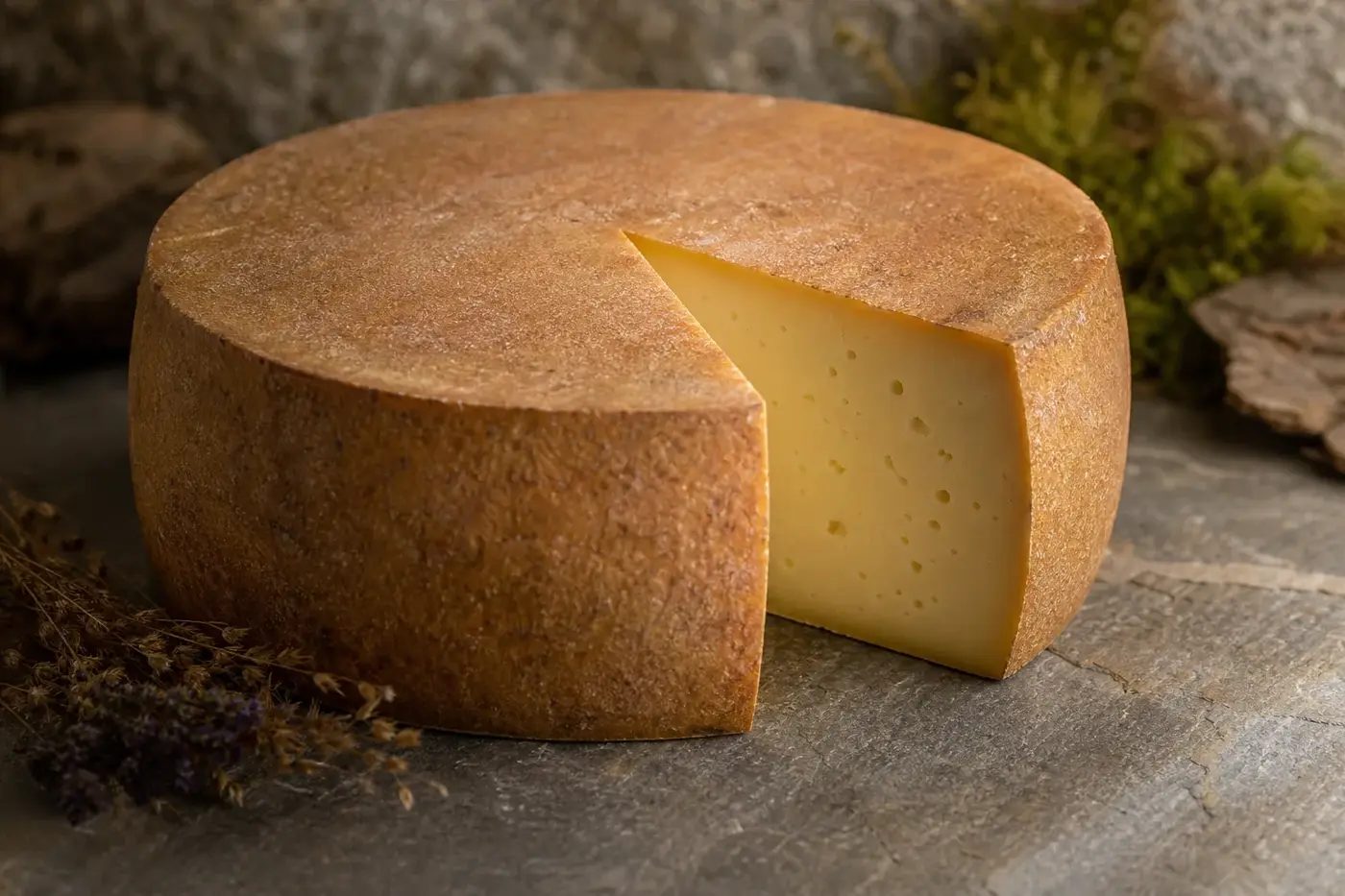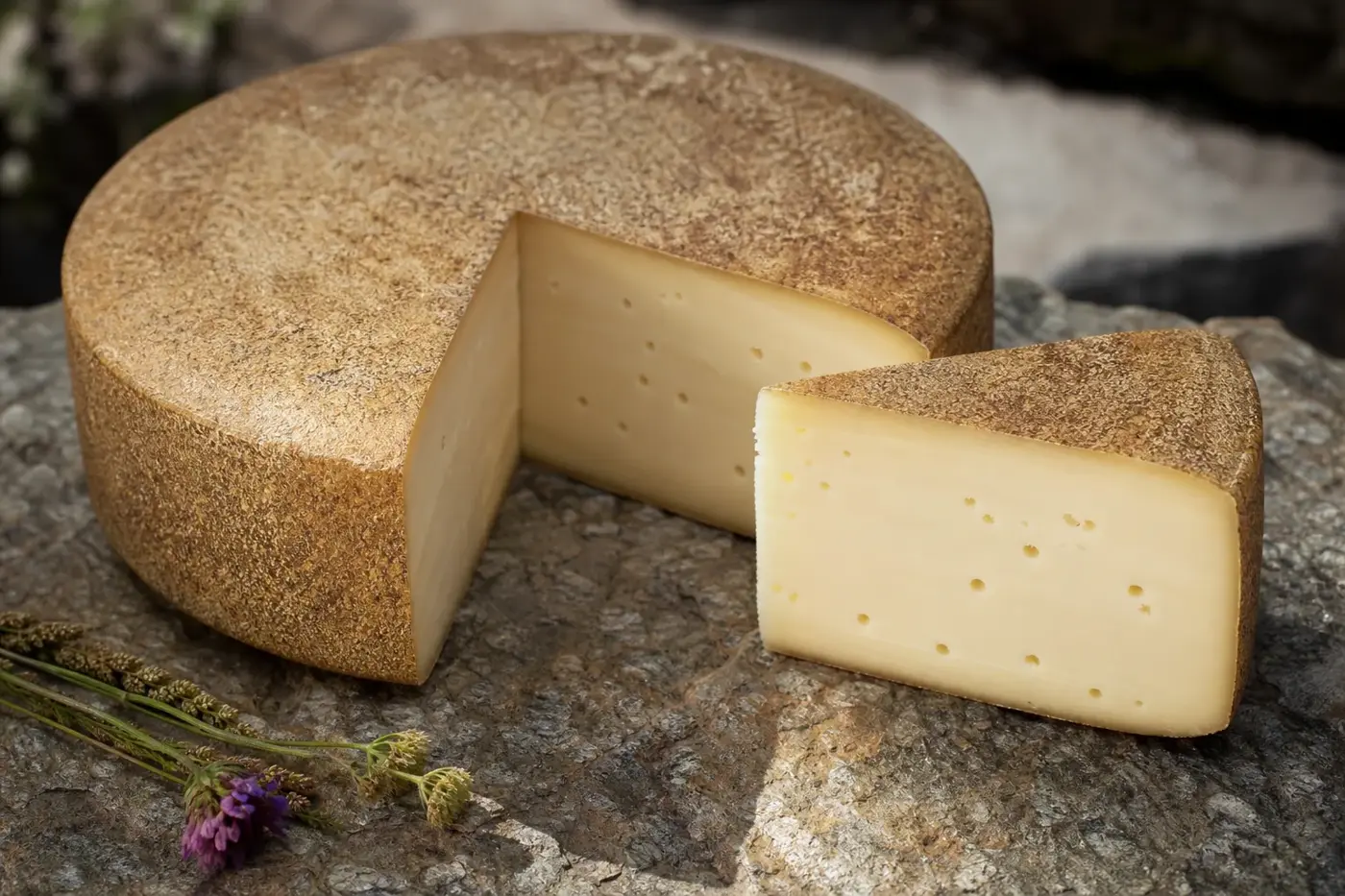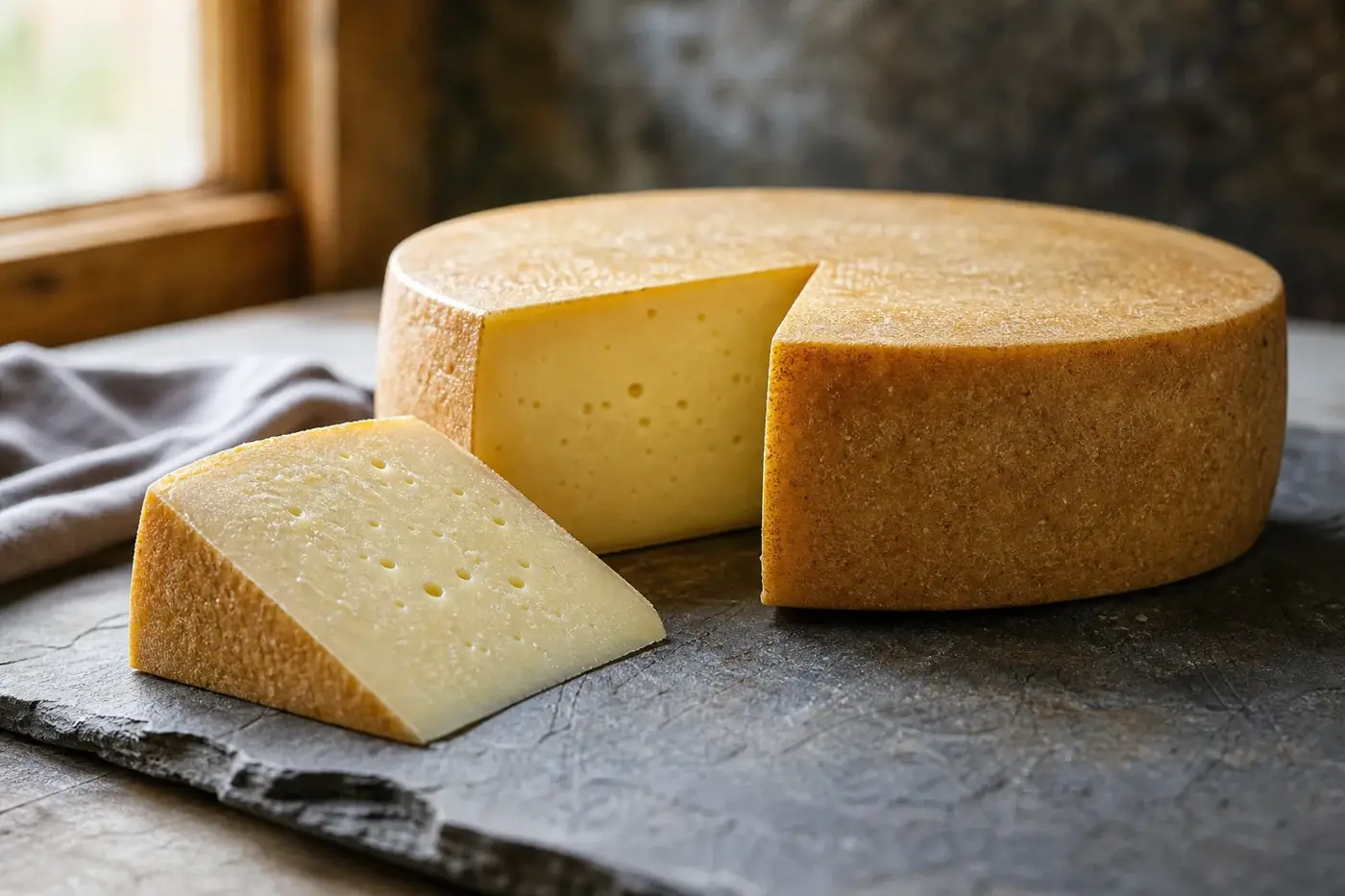
Salt water meets a brush. A broad wheel gets another careful rub. At least twice a week during maturation, Vorarlberger Bergkäse receives this attention, helping its granular brown rind develop around an ivory to pale-yellow interior. Growing older here comes with a rather thorough grooming routine. [4][5]
Cut yourself a piece and you meet a firm Austrian mountain cheese, made from raw cow’s milk, that becomes more pronounced and savoury with age. Behind it are grassland farming and the judgement of local cheesemakers. Its name is registered as a PDO in the EU and Great Britain. [1][4][5][12]
| What you might want to know | The detail |
|---|---|
| Name to look for | Vorarlberger Bergkäse. [1] |
| EU registration authority and identifier | European Commission; PDO-AT-1419, recorded in GIview as registered. November 2026 status. [1] |
| EU legal instrument | Registered under Commission Regulation (EC) No 1065/97; specification amendment approved by Commission Implementing Regulation (EU) 2023/1691. [3] |
| Great Britain protection | Registered PDO; UK scheme registration dated 31 December 2020. November 2026 status. [12] |
| Northern Ireland protection | Status unconfirmed. |
| Switzerland protection | Status unconfirmed. |
| United States protection | Status unconfirmed. |
| Milk in the wheel | Raw cow’s milk from Vorarlberg. [2] |
| What sets the milk | Calf rennet, an animal-derived enzyme preparation. [4] |
| Minimum maturation | Three months. [4] |
| One producer’s maturation range | Vorarlberg Milch lists four to ten months for its products. [7] |
| Size of a whole wheel | Round wheels weighing 7 to 40 kg, with a side height of 8 to 12 cm. [2] |
| Rind and interior | Brownish-yellow to brown granular rind; ivory to pale-yellow paste with sparse, roughly pea-sized holes. [5] |
Follow your cheese back to Vorarlberg
Follow the milk and you stay within one defined area. Bregenzerwald, Kleinwalsertal, Großwalsertal, Leiblachtal (Pfänderstock), Walgau and Rheintal all belong to this cheese’s territory in the Austrian province of Vorarlberg. The specification requires raw material production, processing and maturation to happen there. Where the milk begins matters just as much as where the wheel takes shape and ages. [2]
Valley dairies have their place in this mountain farming story, too. Bergkäse can use eligible alpine or valley milk, drawing on the region’s wider dairy network. The Austrian agriculture ministry describes small-scale farming and local cheesemaking, with full-fat cheesemaking techniques developing during the eighteenth century. Its account puts the cheesemaker’s judgement at the heart of the work, particularly during ripening. [5]
That gives you something useful to ask about at the counter. The region provides the framework. The dairy and maturation time help explain the particular piece waiting for you.
Good grass, good hay and exacting milk rules
Everything begins with raw cow’s milk from Vorarlberg. Thermised milk, which receives a heat treatment less intensive than pasteurisation, is excluded. So are pasteurised milk and milk treated by centrifugal bacterial removal. You can explore the differences in raw milk and heat treatments. [2][4]
Grass and hay underpin the feeding system. Silage, meaning fermented fodder, is prohibited, and that rule extends beyond the milking cows. A farm feeding silage to young cattle cannot supply milk for this cheese either. [2]
Supplementary crushed grain from outside the area is allowed, within precise limits. At least 70% of the lactating cows’ annual feed dry matter must come from within the geographical area. Outside grain may supply up to 30% of annual dry matter, with a corresponding limit for the individual ration. The published explanation links this allowance to mountain grassland’s limited suitability for growing cereals. [2]
These are the EU production requirements for Vorarlberger Bergkäse PDO; consult the Great Britain specification separately. To understand how the name, specification and territory fit together, turn to protected cheese names.
Take a closer look beneath the rind
Ask to see a cut face. The brownish-yellow to brown granular rind surrounds ivory to pale-yellow paste, dotted with sparse, roughly pea-sized holes. You are not looking for a dense pattern of large openings. This is a firm cheese that you can slice, though it can be supple too. [2][5]
Whole wheels are broad and substantial, with relatively shallow sides for their width. Their natural rind may retain a smear or become drier. Before you have tasted anything, you already have differences to explore. [2][5]
Let that view inside start a conversation with your cheesemonger. Do you want neat sandwich slices, small pieces for a board, or something to grate into dinner? Texture becomes much easier to discuss when you have supper in mind.
From the milk vat to a pressed wheel
Calf rennet sets the partially skimmed raw milk into a gel. Whey or lactic acid bacterial cultures help acidify it. The dairy’s cultures have their roots in traditional bacterial cultures maintained and propagated for cheesemaking. [4]
Next comes the cheese harp, cutting the set milk into curd, the solid material that will become cheese. Whey is the liquid released around it. Further working and heating drive out more whey, with the specified heating stage reaching 51 to 54 °C. The curd goes into moulds and is pressed into wheels; how cheese is made guides you through the wider process. [4]
Then the wheels take a salt bath. They spend two to three days in brine before maturation begins. Milk preparation, curd handling, pressing and salting all help build the finished cheese’s compact body. [4]
That heating of the curd is part of cheesemaking. The specification still identifies the starting material as raw milk. [4]
A fine rind takes time and attention
Every wheel must mature for at least three months, at 10 to 15 °C and relative humidity above 80%. Throughout that time, it must be brushed or rubbed with salt water at least twice weekly. The months matter, but so does everything that happens during them. [4]
The Austrian agriculture ministry describes cheesemakers deciding when wheels need turning, brushing and rubbing. Observation and experience guide those decisions as the rind develops. This is still cheesemaking, even when the wheel appears to be sitting quietly. [5]
When you reach the counter, ask for the age in months. It tells you more than “well matured” and gives you a clearer basis for comparison. Then you can connect that time and attention with what you taste.
Find the age that suits your taste
Vorarlberger Bergkäse grows sharper with age. Its official description calls it savoury or spicy, with characteristics that vary in strength through maturation. Firmness and suppleness both belong within its documented character. [2][5]
Vorarlberg Milch offers a more detailed aromatic picture for its own cheese: walnut, citrus, malt and honey. Read those as the producer’s tasting notes, not a compulsory checklist for every wheel carrying the name. Your slice is not sitting an exam. [7]
To explore what age brings, ask to taste two maturities from the same dairy. Begin with the younger piece, then compare the older one for sharpness, aroma, resistance to your teeth and length of finish. Keeping the maker constant gives you a clearer comparison than tasting several unrelated cheeses.
Let your plans have the final say. For sandwiches, concentrate on the texture you want in a slice. For a cheese board, consider how its intensity will sit alongside the other cheeses. The oldest piece is not automatically the right piece for your plate.
Bergkäse or Alpkäse? Follow the milk
Vorarlberger Alpkäse is made on recognised alpine and intermediate-pasture holdings during summer grazing. Its specification places production at elevations of 1,000 to 1,800 metres and forbids bringing in milk from valley farms. Later maturation may happen in regional cellars at lower elevations within its area. [6]
Vorarlberger Bergkäse can draw on the broader alpine or valley milk supply described above. Ask where each cheese was made and, for Alpkäse, which summer’s production you are tasting. Those answers tell you more than treating the names as different settings on a strength dial. [2][6]
Looks alone will not settle the question. Both specifications describe hard cow’s milk cheeses with sparse round holes, matured for at least three months. Read the full name on the label before choosing. [4][6]
Choose your piece and bring it home
Start with the complete name, then ask about the dairy and age. If you choose a prepacked piece, keep its label with the cheese so storage directions and batch information stay to hand. For help making sense of those details, see reading a cheese label.
For home storage in England, Wales and Northern Ireland, the Food Standards Agency advises a fridge temperature of 5 °C or below and following packaging instructions for dairy products. Cover your cut piece as the supplier directs. Buy a quantity that fits what you plan to eat. [8]
Bring out only the portion you intend to serve. As a serving suggestion, let it briefly lose its refrigerator chill while you prepare bread and accompaniments. For the United States, the FDA advises no more than two hours at room temperature for foods requiring refrigeration, reduced to one hour above approximately 32 °C (90 °F). Preparation and display time count together. [9]
To cut a wedge, rest it securely on its broad face and make manageable slices across it. For a tasting plate, include pieces from the centre and nearer the rind. Ask your supplier whether the rind on your particular piece is intended to be eaten.
Make a little room on your plate
Begin with bread and one accompaniment, giving yourself room to notice the cheese. Vorarlberg Milch recommends sourdough with its six-month and ten-month cheeses. It suggests fig accompaniments for the younger example and dried dates for the older one. [7]
You could also try sourdough with a few pieces of fresh pear or apple. Look for contrast, rather than several sweet preserves competing for your attention. Keep accompaniments alongside the cheese so everyone can taste it plain before choosing what to add.
For drinks, Vorarlberg Milch suggests Blaufränkisch with its six-month cheese and Bock beer with its ten-month example. The corresponding alcohol-free suggestions are a herbal soft drink and red grape juice. [7]
Alcoholic options are for adults of legal drinking age; offer small servings and an alcohol-free choice alongside. People who are pregnant, driving, taking medicines that interact with alcohol, or recovering from alcohol dependence should not drink.
In the kitchen, try grating the cheese through hot spätzle, scattering it over potatoes or tucking it into a savoury bread filling. Adjust the quantity to your piece’s intensity, and taste before adding more salt. Keep a little uncooked cheese aside, too. You can compare its flavour before and after cooking.
General information only, not medical advice: follow the official guidance where you live.
Questions people ask
Where is Vorarlberger Bergkäse made?
Its milk is produced, processed and matured within a defined area of the Austrian province of Vorarlberg. The area includes Bregenzerwald, Kleinwalsertal, Großwalsertal, Leiblachtal, Walgau and Rheintal.
Is Vorarlberger Bergkäse vegetarian?
It is made with calf rennet, an enzyme preparation derived from animals. The rennet sets the raw cow’s milk.
How long is Vorarlberger Bergkäse matured?
The minimum maturation period is three months. Vorarlberg Milch lists four to ten months for its products.
What is the difference between Vorarlberger Bergkäse and Alpkäse?
Bergkäse can use eligible alpine or valley milk. Alpkäse is made on recognised alpine and intermediate pasture holdings during summer grazing, and its specification prohibits milk from valley farms.
How should I store Vorarlberger Bergkäse?
For England, Wales and Northern Ireland, the Food Standards Agency advises a fridge temperature of 5 °C or below and following packaging instructions for dairy products. See the Food Standards Agency guidance for more information.
Sources
- European Union Intellectual Property Office and participating authorities, GIview: Vorarlberger Bergkäse, file PDO-AT-1419, live register record retrieved November 2026.
- European Commission, Publication of an application for approval of an amendment to a product specification: Vorarlberger Bergkäse, 2023/C 156/08, including the single document, Official Journal C 156, 3 May 2023, pp. 45 to 55.
- European Commission, Commission Implementing Regulation (EU) 2023/1691 of 30 August 2023 approving a non-minor amendment to the specification for Vorarlberger Bergkäse (PDO), Official Journal L 219, 6 September 2023, p. 7.
- Austrian Patent Office, Vorarlberger Bergkäse: amendment application and specification, file VbgBergkaese_Antrag2.pdf, specification sections 4.4 and 4.5, associated with the amendment approved in 2023.
- Austrian Federal Ministry of Agriculture, Vorarlberger Bergkäse g.U., traditional foods record, undated live edition retrieved November 2026.
- Austrian Patent Office, Vorarlberger Alpkäse: single document and specification, file VorarlbergerAlpkaese.pdf, sections 4.2 to 4.5, live edition retrieved November 2026.
- Vorarlberg Milch eGen, Vorarlberger Bergkäse, product description, tasting notes and food-pairing suggestions, undated live edition retrieved November 2026. This is a commercial producer’s account of its own products.
- Food Standards Agency, How to chill, freeze and defrost food safely, published 18 December 2017, live edition retrieved November 2026; applies to England, Northern Ireland and Wales.
- US Food and Drug Administration, Are You Storing Food Safely?, live edition retrieved November 2026, “Storage Basics”.
- AGES, Produktwarnungen & Produktrückrufe, Austrian product-warning and recall index, retrieved November 2026.
- Food Standards Agency, Alerts, live food and allergy alert index, retrieved November 2026.
- Department for Environment, Food & Rural Affairs, Vorarlberger Bergkäse, Great Britain protected food-name register, published 4 January 2021, live entry retrieved November 2026.
Researched from official protection records, published specifications and national food-safety guidance, with producer tasting notes distinguished from editorial serving suggestions.
Last checked: November 2026
Last checked November 2026.
The editors suggest you read next
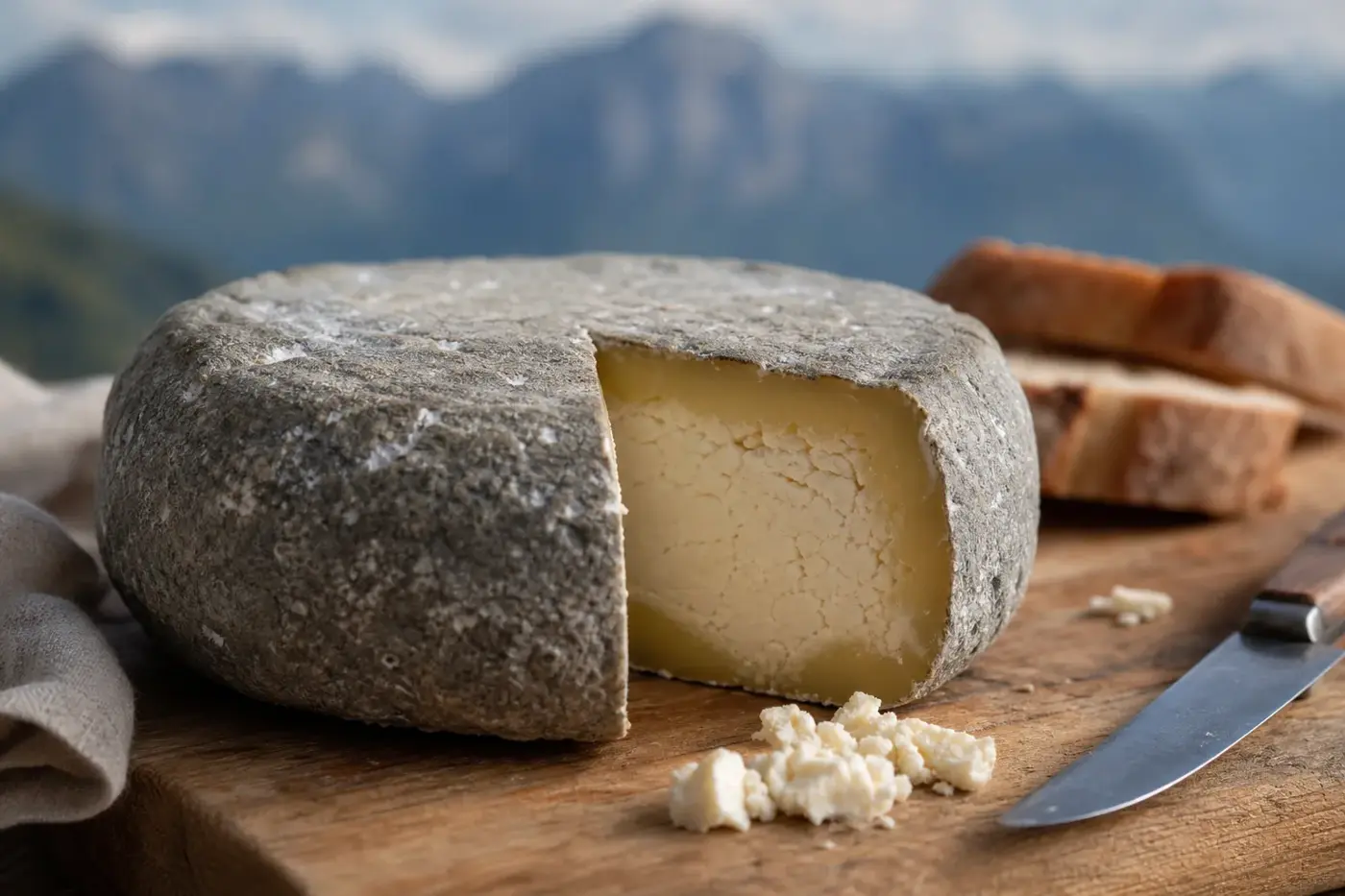
Tiroler Graukäse
Cut into Tiroler Graukäse and you might find two textures sharing the same piece: a pale, crumbly centre and supple, translucent cheese where ripening has travelled further.