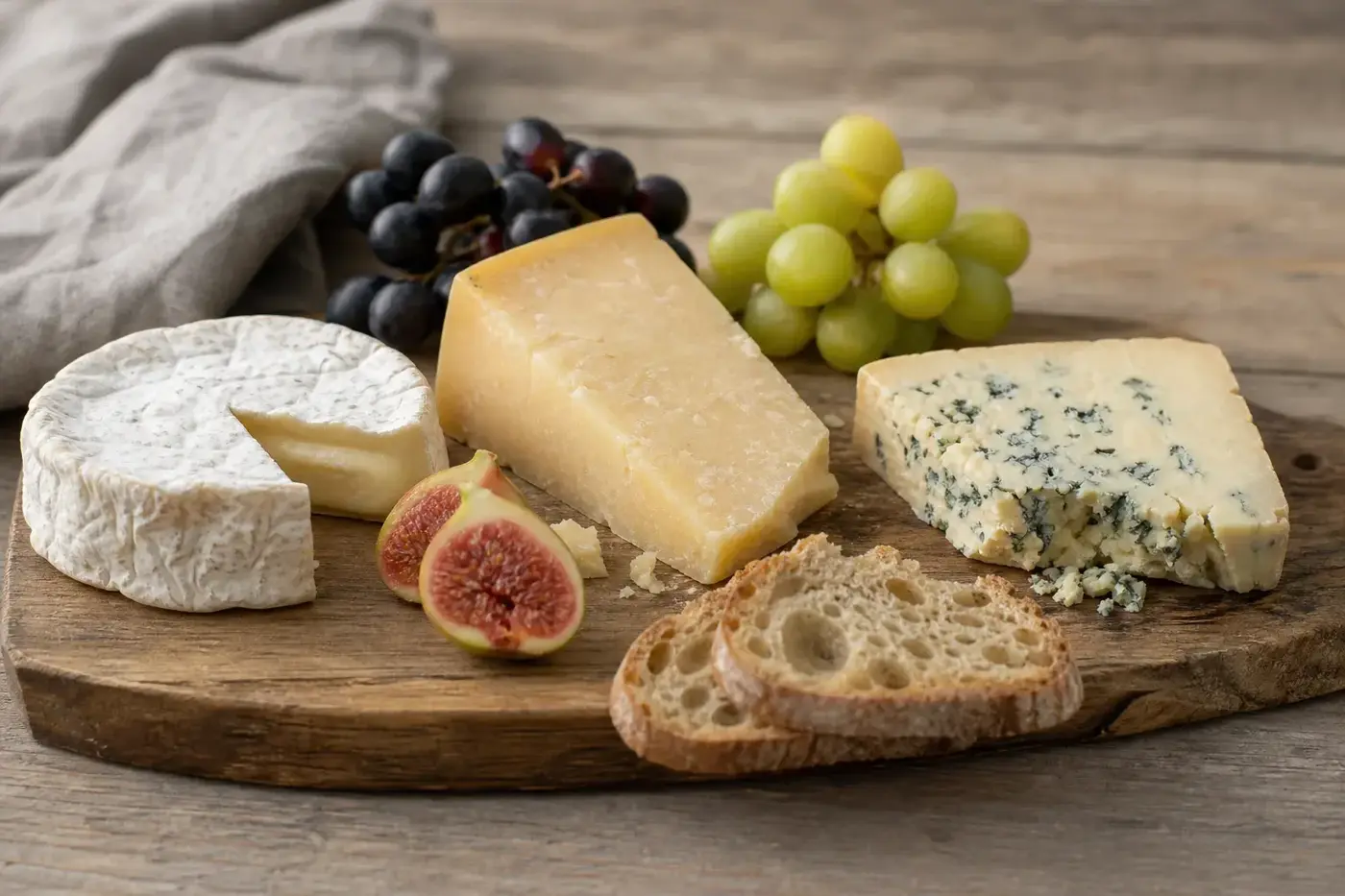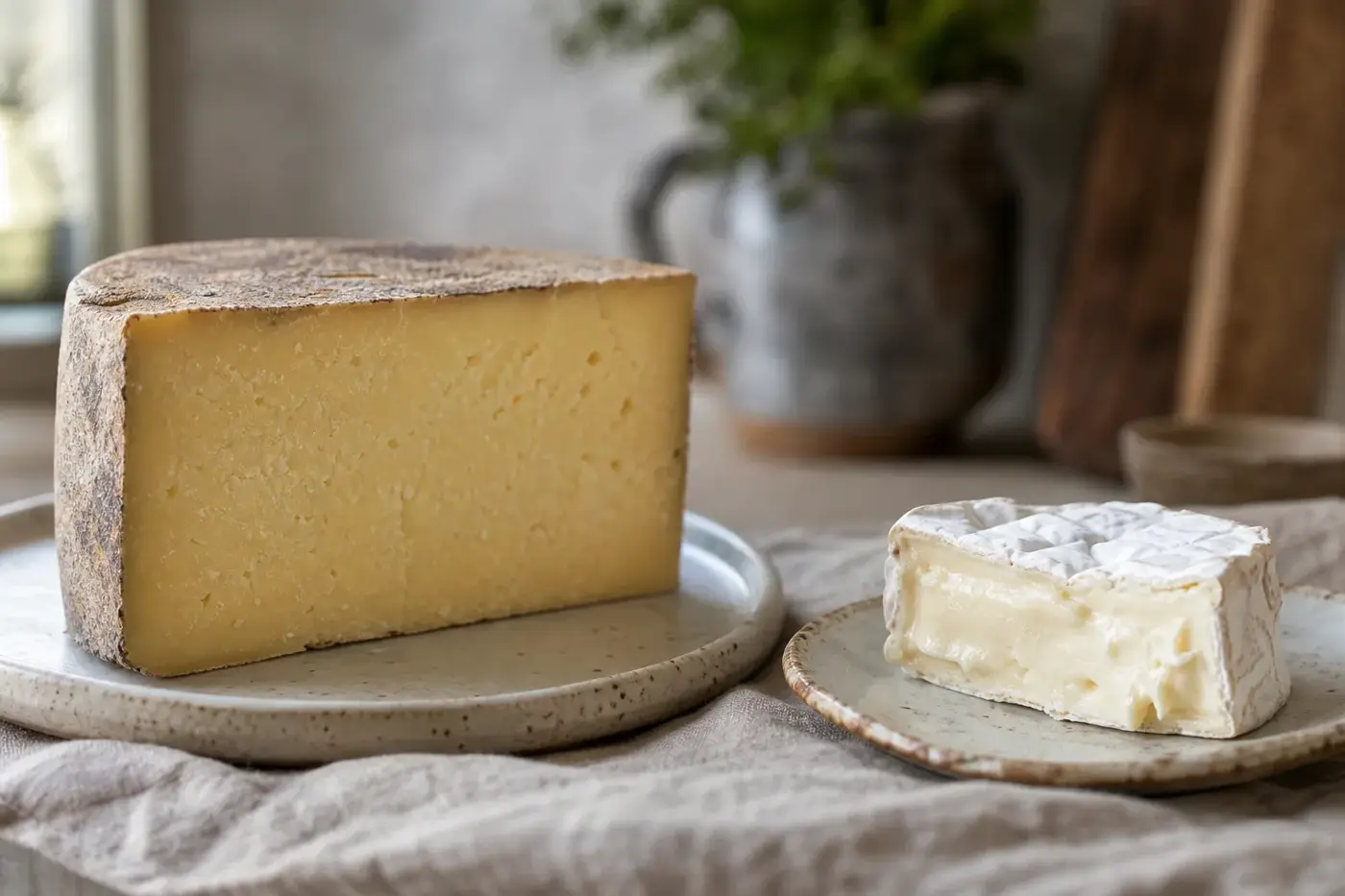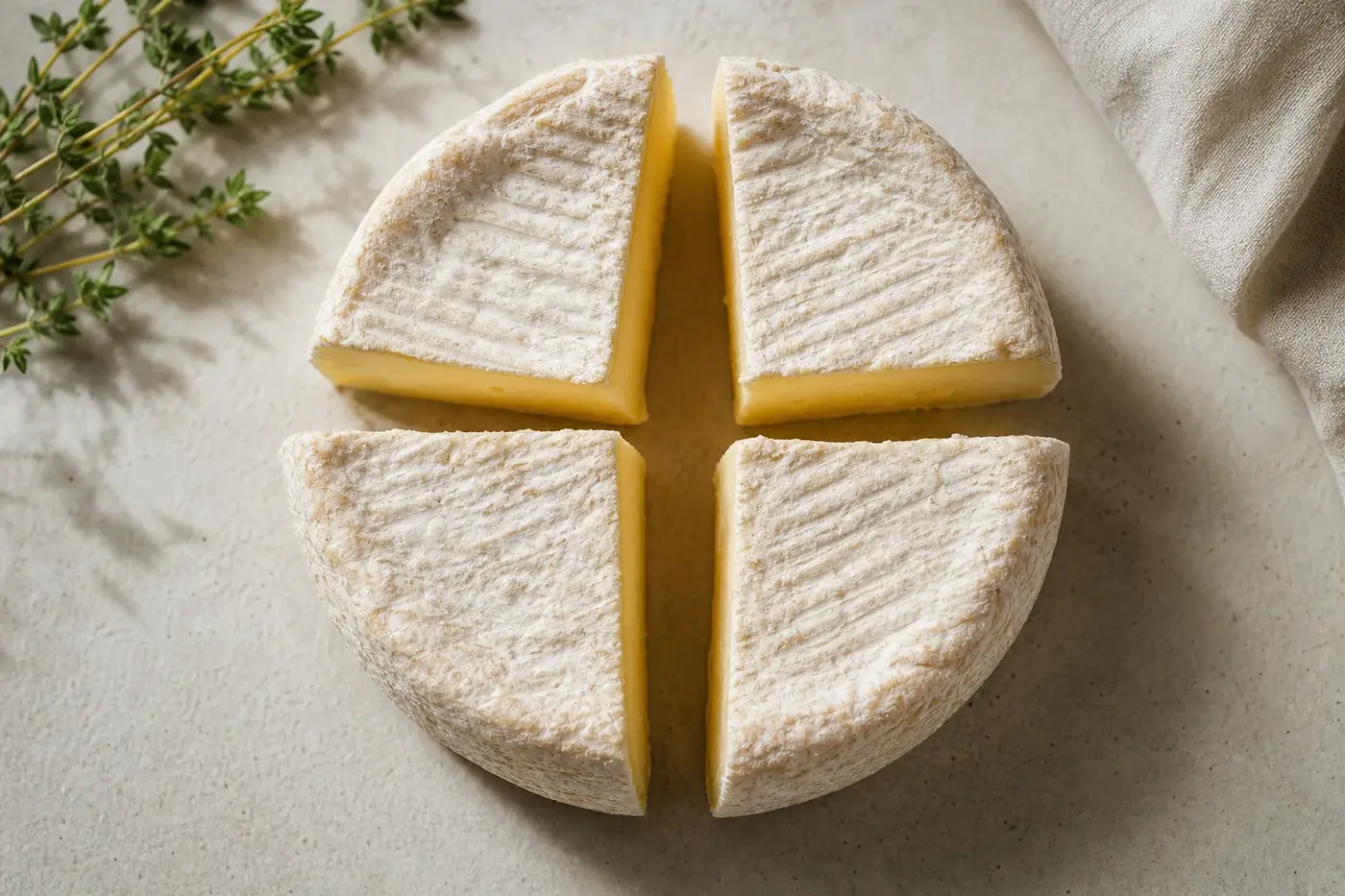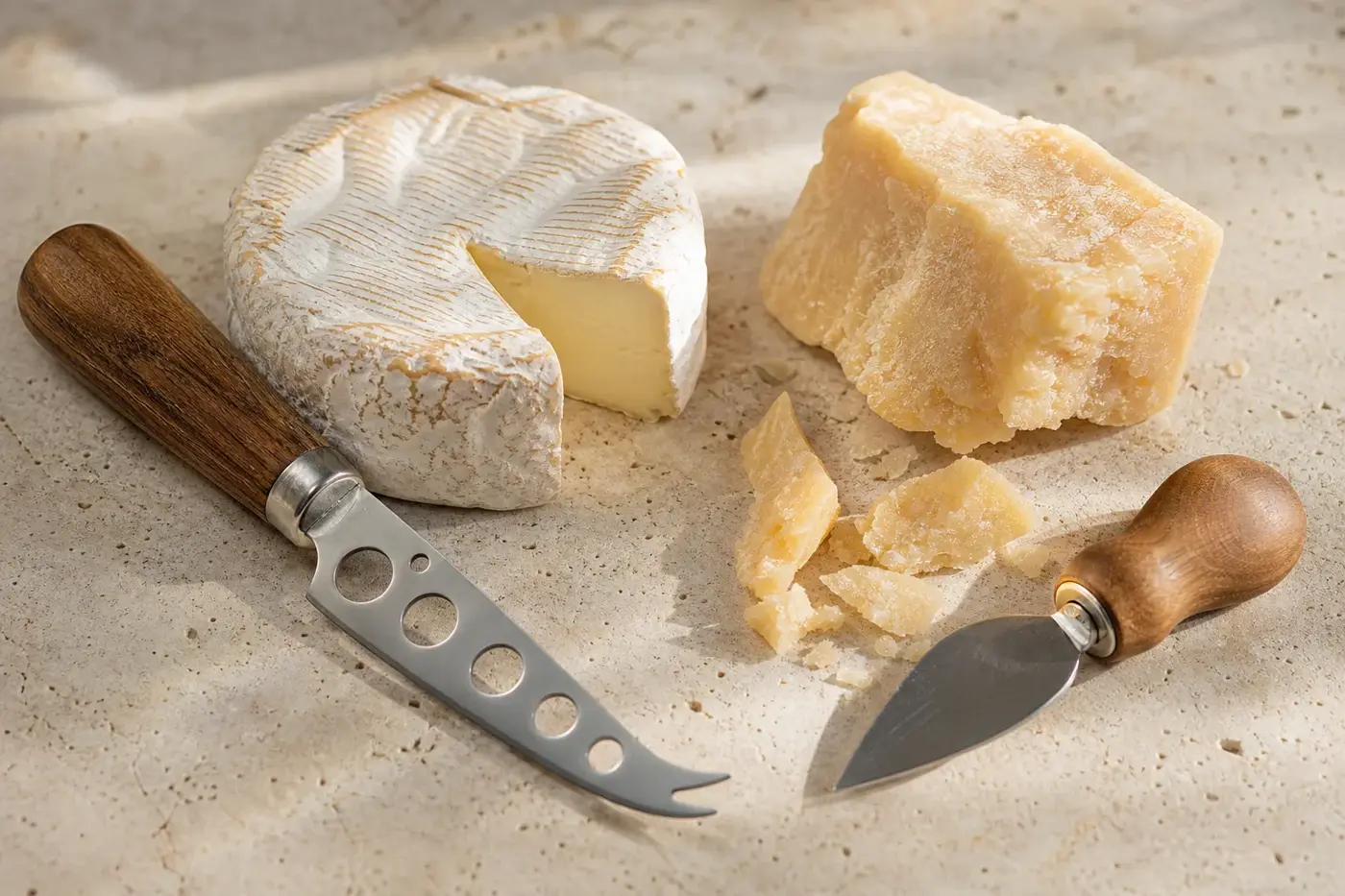
You lift the knife. The soft cheese comes too, apparently unwilling to be parted. At the other end of the board, a very hard piece needs breaking rather than coaxing into smooth slices. One job calls for less metal to cling to; the other needs a short, powerful blade with a sharp point.[2][3][5]
Let texture and task guide you. Start with a useful kitchen knife and a spreader, then add specialist tools for jobs you do regularly. You want equipment that earns its place, not a drawer full of good intentions.[1][2][3][4][5][6]
Meet the cheese before choosing its knife
Look past the wrapper and consider the portion in front of you. Do you want a clean wedge, a thin shaving, a broken morsel or something to spread onto bread? Manufacturers design tools for these different tasks, so their intended uses offer a useful starting point.[2][3][4][5][6]
| Texture or task | A useful tool | What to look for |
|---|---|---|
| Soft cheese that sticks | Narrow or perforated cheese knife | Less metal for your cheese to cling to.[2][3] |
| Delicate soft cheese | Cheese wire suitable for soft cheese | A model suited to the texture and portion size.[4] |
| Firm cheese, portioned | Sturdy cheese knife | A secure handle and a blade suited to firm cheese.[1][2] |
| Firm cheese, thinly sliced | Cheese plane | A slicer matched to your cheese’s firmness.[4] |
| Very hard cheese, broken pieces | Short, pointed hard-cheese knife | A strong blade designed for splitting.[5] |
| Crumbly cheese | Suitable knife | Let it crumble for broken pieces; do not force thin slices. |
| Fresh, spreadable cheese | Spreader | A comfortable blade for scooping and spreading.[6] |
Treat these as useful matches, not a shopping list. Begin with equipment you already handle comfortably, adding a specialist tool when it solves a recurring problem. If the texture categories leave you hesitating, try how to tell cheese styles apart.
Help soft cheese part company with the blade
When soft cheese clings to your knife, a smaller blade surface can help. BOSKA describes its narrow professional soft-cheese knife as designed to prevent sticking. The published design record for its Monaco+ range also identifies thin blades and perforated blades for soft cheeses.[2][3]
These designs approach the same problem differently. A narrow blade gives the cut portion little surface to cling to; a perforated blade puts openings in a wider blade. Either is worth considering if your ordinary knife keeps taking the slice with it.[2][3]
Choose for the job and the feel of the handle. On a small serving board, you want a manageable blade that reaches comfortably through the portion, rather than the largest knife in a matching set. Leave enough clear cutting space to put it down securely between portions.[1]
Give delicate soft cheese the wire treatment
A wire offers another way through soft cheese. BOSKA’s slicer guidance points you towards a cheese knife or wire cutter for soft cheeses that do not suit a conventional cheese plane. Let the cheese in front of you determine your choice.[4]
Cutting and lifting are separate jobs here. The wire makes the cut; another utensil carries the portion away. Put a small fork or spoon beside the cutter, rather than trying to balance a soft slice on the wire itself.
Set the cheese and any cutter base on a stable surface. Use the intended handle, keep your other hand outside the cutting path and follow the cutter’s instructions, including its wire replacement procedure. These precautions apply the Health and Safety Executive’s advice to choose equipment suited to the task and work on a stable surface.[1]
With crumbly cheese, picture what you want on the plate before choosing your cutter. A neat portion and a small pile of broken pieces call for different approaches. Use a suitable cutter when a defined portion matters; let irregular pieces be part of the serving when they suit it.
Give firm cheese a blade with backbone
Firm cheese offers resistance, so you need a blade suited to the piece. BOSKA distinguishes its professional semi-hard-cheese knife from its narrower soft-cheese model. The former also has a raised handle, giving you clearance above the board.[2]
At home, start with a sharp, sturdy kitchen knife that fits your hand and suits the portion’s size. A separate cheese knife earns its place when the blade shape or handle clearance makes a regular job more comfortable. HSE’s advice is straightforward: choose a knife suitable for both the food and the task.[1]
Think through the whole movement before you cut. Allow room for the handle, your supporting hand and the finished portion. If the position feels awkward, move the cheese and board first rather than completing the cut in a cramped space.[1]
Reach for a plane when thin slices beckon
If you want thin slices rather than wedges or cubes, a cheese plane, also called a cheese slicer, has a clear purpose. BOSKA’s instructions describe putting the cheese block on a flat surface, then drawing the slicer over it. You are slicing, not dividing the cheese into chunks.[4]
The manufacturer distinguishes shorter-bladed slicers for softer, younger cheeses from the familiar longer-bladed versions for mature and aged cheeses. It also notes that changing your pressure can change slice thickness. Match the model to your cheese: planes do not all behave alike.[4]
That makes the plane useful for repeated slicing for bread, sandwiches or a plate. If your usual serving is a substantial wedge, keep using a knife. If you regularly want thin, even slices, a plane is worth considering.
Keep your fingers clear of the cutting slot as well as the front edge. Set the tool down deliberately between uses. Follow its own cleaning and storage instructions, too.[1][4]
Let very hard cheese break into pieces
Very hard cheese asks you to split rather than slice. BOSKA describes its professional hard-cheese knife as having a short, powerful blade and a sharp point for applying controlled pressure. That is a different task from drawing a knife through a softer portion.[5]
For bite-sized servings, choose a tool expressly intended for breaking and follow its instructions. Your aim is a small broken piece, not a thin, smooth slice. Support the cheese on the board and keep fingers clear of both the point and the direction the tool could move.[1][5]
Consider this an optional addition if you regularly serve very hard cheese in pieces. Opening a whole wheel is another undertaking altogether. BOSKA’s published method uses several specialist knives, including scoring and breaking tools.[5]
Make spreading and serving a pleasure
Fresh, spreadable cheese needs a spreading tool, not a pointed cutting blade. BOSKA lists soft cheeses among the intended uses of its spreaders, alongside butter and other spreads. Keep your choice as straightforward as the task.[6]
An ordinary table knife that spreads comfortably is a sound starting point. Choose a dedicated spreader if its shape suits you better. Either way, look for something easy to hold and clean, paying particular attention to the junction between blade and handle.
For pieces you have already cut, put out a small serving fork. Your guests can transfer a portion to their plate without balancing food on a sharp blade. A particularly soft portion needs support from underneath, so offer a small spoon instead.
Place each utensil beside the food it belongs with. You make the arrangement easier to understand at a glance. This also helps maintain the utensil separation discussed below.[7]
Build a useful set, not a crowded drawer
You can begin with a few practical pieces. Give each one a clear job, based on the cheeses you actually serve:
- A sharp, sturdy knife suitable for your firm cheeses.
- A table knife or spreader for fresh, spreadable cheese.
- An ordinary fork or small serving utensil for moving portions.
- A stable cutting board with enough working space.[1][6]
Then add a specialist tool to solve a particular problem. Choose a narrow or perforated knife for persistent sticking, a suitable wire for delicate soft portions, a plane for regular thin slicing, or a pointed hard-cheese knife for breaking very hard pieces.[2][3][4][5]
Keep preparation separate from serving. Portion larger pieces in the kitchen, then bring manageable portions and their utensils to the table. Let the foods you are serving, and any allergen separation needed, determine how many utensils belong on the board.[7]
Get the board ready before the first cut
Before your blade touches cheese, give yourself a stable place to work. Sharp knives, a stable cutting surface and a knife suited to the task are central to the HSE’s November 2026 catering guidance for Great Britain. It also warns against leaving knives loose where they could be pushed off a worktop, or trying to catch a falling knife.[1]
Put those principles into practice before you begin. Make sure the board stays put, clear surrounding objects and keep your supporting hand away from the blade’s route. Work without reaching across another person’s hands: these are practical applications of the HSE guidance.[1]
Choose your tool first, then decide where to cut. The blade answers how to cut; the cheese’s shape determines how to divide it. Turn to the companion guide to cutting cheese by shape for that separate decision.
This page summarises published guidance from the official sources it cites. It is not medical advice. Guidance differs between countries and changes over time, so check the current source for where you live, and ask your doctor, midwife, pharmacist or dietitian about your own circumstances.
Give flavours and allergens their own space
Give noticeably different cheeses separate utensils, or clean the utensil before moving between them. This also stops visible smears travelling from one cheese to the next. Your next portion need not arrive wearing the previous one.
Allergen control calls for particular care. The Food Standards Agency’s November 2026 guidance for food businesses in England, Wales and Northern Ireland identifies shared cutting boards and utensils that have not been thoroughly washed and dried as routes for allergen cross-contact. It recommends appropriate cleaning and dedicated equipment where needed.[7]
Consider the whole arrangement, not just the cutting knife. That includes accompaniments and serving utensils. The FSA also advises careful management of cleaning materials, including dedicated, clean or new cloths and sponges where appropriate.[7]
If you need the distinction between the conditions themselves, read cheese allergy versus lactose intolerance. For allergen handling, consult the official guidance cited below.
Finish with clean, dry, safely stored tools
Clean utensils matter before preparation and between tasks. The FSA’s November 2026 cleaning guidance for England, Wales and Northern Ireland says to keep utensils clean before preparing food and wash them thoroughly between tasks. It also advises different utensils and boards for ready-to-eat foods and raw foods requiring cooking.[8]
Follow each tool maker’s care instructions rather than treating every tool alike. BOSKA recommends handwashing its cheese slicers, including dishwasher-suitable models. It specifically identifies wooden-handled, ceramic-handled and wire slicers as requiring handwashing.[4]
Dry cleaned tools before putting them away, and store sharp blades securely. HSE recommends a protective container or sheath and careful handling during washing up.[1][7] For whatever cheese remains after serving, follow how to store cheese at home.
Questions people ask
Why do cheese knives have holes?
Perforations reduce the amount of metal touching soft cheese, giving it less surface to cling to. A narrow blade tackles the same problem by leaving little surface for a cut portion to stick to.
What is a cheese wire used for?
A suitable wire can cut delicate soft cheese that is unsuitable for a conventional cheese plane. Use a separate fork or spoon to transfer the portion.
Which knife should I use for very hard cheese?
A short, pointed hard cheese knife is designed to split very hard cheese into pieces rather than draw smooth slices. BOSKA describes its professional version as having a powerful blade and a sharp point for controlled pressure.
Do I need a special set of cheese knives?
A sharp, sturdy kitchen knife, a table knife or spreader, a serving utensil and a stable cutting board make a practical starter set. Add a specialist tool when it solves a problem you encounter regularly.
How should cheese utensils be kept separate for allergens?
The Food Standards Agency identifies shared cutting boards and utensils that have not been thoroughly washed and dried as routes for allergen cross contact. Its guidance for food businesses in England, Wales and Northern Ireland recommends appropriate cleaning and dedicated equipment where needed. Consult the FSA’s official guidance for allergen handling.
Sources
[1] Health and Safety Executive. Safe use of knives in the kitchen. Web guidance, updated 18 November 2024. Official guidance.
[2] BOSKA. World of BOSKA, PRO. Manufacturer’s professional product catalogue, undated retrieved edition, hosted by a distributor. Relevant entries: professional soft-cheese, semi-hard-cheese and general-purpose knives. Catalogue PDF. Commercial manufacturer source.
[3] Red Dot. Monaco+. Product Design 2018 design record, manufacturer identified as BOSKA. Relevant passage: thin, perforated and pointed blade designs. Design record. Used for documented design purposes, not competition results or quality claims.
[4] BOSKA. The Perfect Slice: All you need to know about cheese slicers and helpful tips & tricks. Undated manufacturer’s guidance, retrieved November 2026. Slicer guidance. Commercial manufacturer source.
[5] BOSKA. Parmesan Knife PRO, 11 cm. Undated manufacturer’s product guidance, retrieved November 2026. Product instructions. Commercial manufacturer source.
[6] BOSKA. Spreading Knives. Undated manufacturer’s intended-use guidance, retrieved November 2026. Spreader guidance. Commercial manufacturer source.
[7] Food Standards Agency. Precautionary allergen labelling. Published 4 September 2023. Sections 5.1 to 5.3, covering cleaning, dedicated equipment and food preparation. Applies to England, Wales and Northern Ireland. Official allergen guidance.
[8] Food Standards Agency. Why is cleaning important. Published 18 December 2017, current retrieved web edition. Sections 2.1 to 2.3. Applies to England, Wales and Northern Ireland. Official cleaning guidance.
Researched through official UK safety guidance, manufacturers’ intended-use information and a published product-design record, with practical recommendations identified as editorial judgement.
Last checked: November 2026
Last checked November 2026.
The editors suggest you read next