How to Cut Cheese by Shape
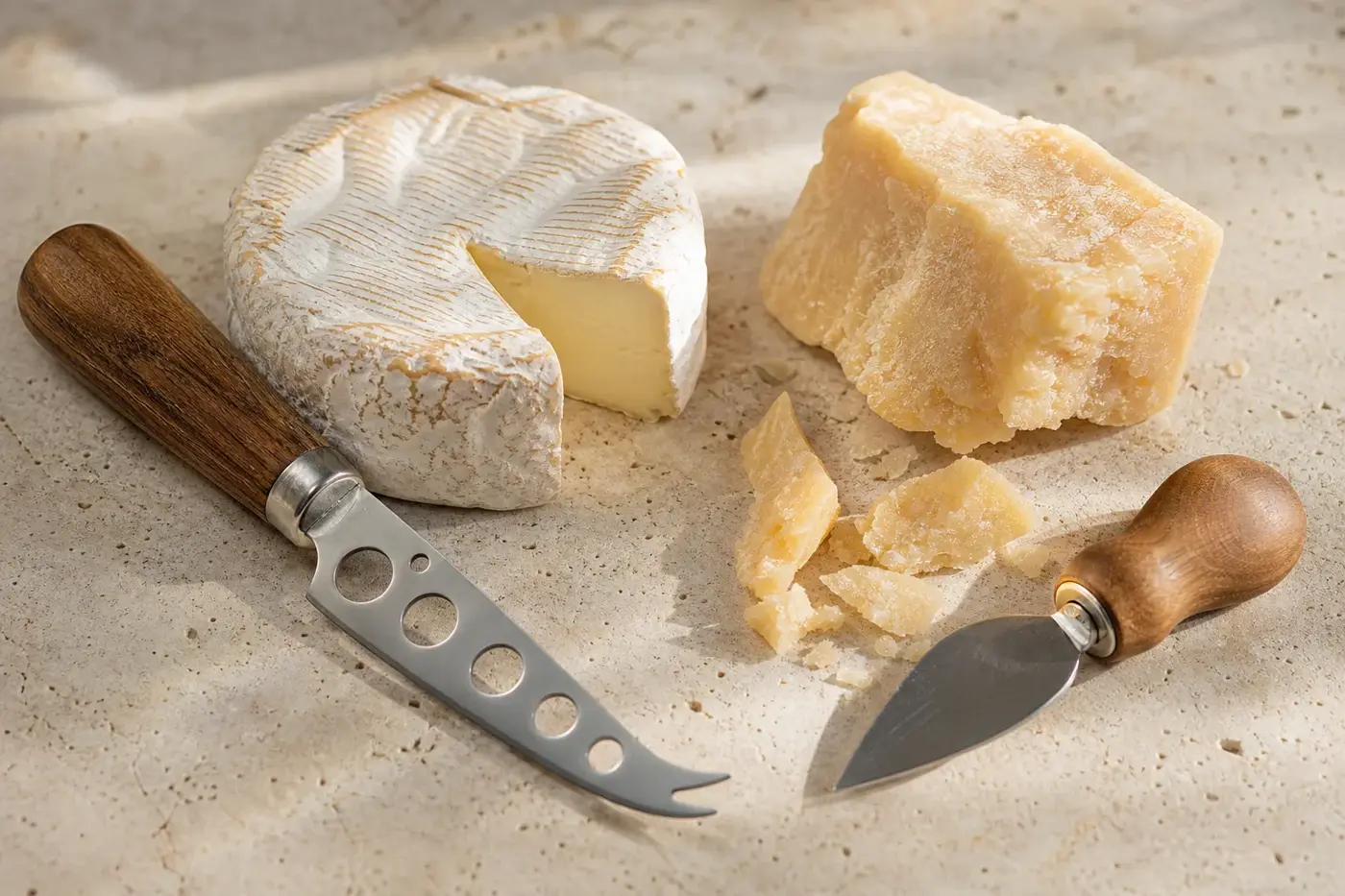
Slip an almond-shaped knife into Parmigiano Reggiano and lever off a small piece.
Slip an almond-shaped knife into Parmigiano Reggiano and lever off a small piece. Grains and crumbs tumble free, qualities that become more pronounced as the cheese ages. Your plans for a neat slice were apparently not on its agenda. [9]
For most shapes, aim for a portion that travels from the centre to the outside edge, sharing the paste, or interior, and any rind. That route serves you well with rounds, wedges, squares and pyramids. Cut logs across their length, and let brittle cheeses break. [1,2]
First, find the heart of your cheese
Before you cut, look for the original outside edge and the centre. Taking the point off a wedge leaves the next person a broader piece, heavy on rind. A slice from point to heel gives you both ends. [1,5]
French dairy industry body CNIEL recommends sharing centre and rind because flavour and texture change across a cheese. You want comparable portions, not identical pieces worthy of a geometry examination. The guide to cheese styles explores the differences behind those shapes. [1]
Small rounds: a little centre for everyone
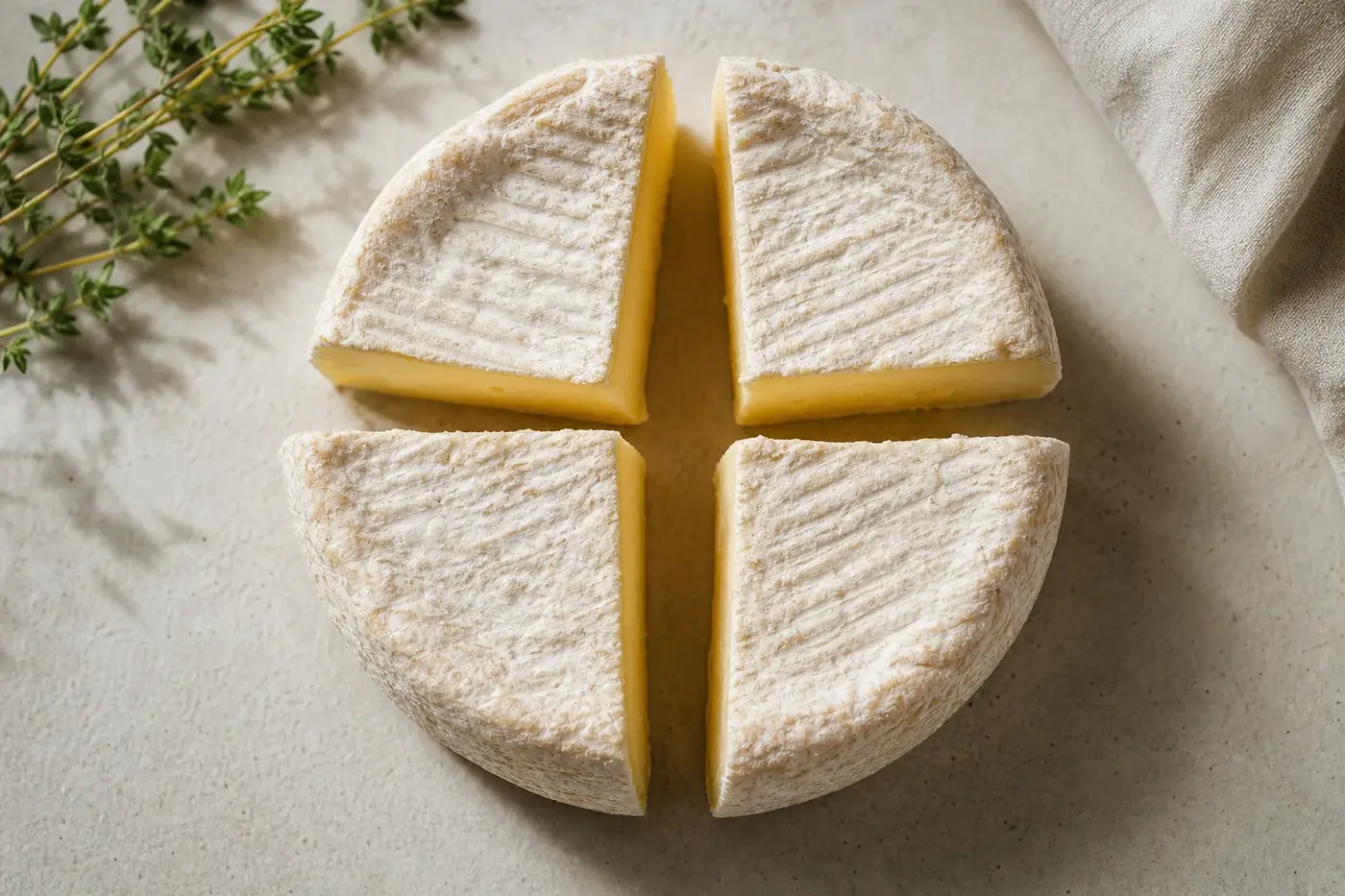
Set your cheese flat, with its circular face upwards. Cut through the middle from one edge to the opposite edge, then turn it and halve it again. You have four wedges; divide each quarter further if smaller portions suit your meal. [2,6]
Keep each wedge at full height, with an arc of outside rind and a point reaching the centre. A very small round may need only halving. Avoid cutting a little circle from the middle and leaving a ring behind: that separates centre from outside rather than sharing them. [1,2]
Large wheels: take them one sector at a time
If your wheel fits comfortably on the board, halve it through the centre, then divide the halves into sectors. Work on one sector and keep the rest covered. The California Milk Advisory Board recommends a long, sharp knife for wheel wedges, with larger specialist tools for whole wheels. [3,7]
At home, begin with a manageable piece rather than trying to open an unwieldy wheel. Professional cheesemongers use wires and double-handled knives for that job. A smaller sector lets you see the cutting line and support the cheese without struggling with its weight. [3,4]
Triangular wedges: keep the point in the picture
Lay your wedge on a broad, stable face. Its narrow tip came from the wheel's centre; the broad heel was at the outside. Cut slender triangles along that length, from tip to heel, rather than chopping straight across the nose. [5]
For a broad wedge, picture a fan of cuts meeting at the tip. Each slice should travel from inner paste to outer rind. Keep the blade upright, its bottom following the same line as its top, so a thin upper slice does not leave a thick base behind. [5]
Squares and rectangles: let the rind show you the way
For a small square cheese with rind all around, cut diagonally from corner to corner, then along the other diagonal. Each of your four triangles gets one original outside edge. For eight portions, halve each triangle from the centre towards the midpoint of its outer edge; producer Président recommends this diagonal approach for square cheeses. [6]
A rindless rectangular block makes life simpler: cut even slices, then smaller rectangles or triangles if you like. If rind runs along one long edge, cut across it so every portion gets a strip. Follow the shape in front of you rather than trimming a rind-bearing block into something decorative. [5,7]
For a whole rind-covered rectangle, cut through the centre from corner to corner in both directions. Your four triangles have equal areas, but their outside edges differ in length. Share those different shapes between plates rather than giving one person all the corner pieces. [6]
Logs and cylinders: know when to switch to wedges
A narrow log lends itself to rounds. Lay it on its side and cut across its length into discs of similar thickness, keeping your blade perpendicular rather than sharply diagonal. Each middle round gets a ring of rind around its paste; the end pieces naturally have more outside surface. [2,6]
A broad cylinder calls for a different approach. Cut a crosswise section, lay it flat, then divide it through the centre into wedges. CNIEL recommends this method for cylindrical blue cheeses, so you can share the section rather than serve someone an oversized disc. [1]
Pyramids: take it from the top
Leave your pyramid standing on its base. Cut vertically through the middle of the top, right down to the board, to make two halves. Turn it and cut again through the same central line for quarters. [2,6]
Keep making portions in that top-to-base direction, each with upper paste, a share of the sloping sides and part of the base. If your pyramid has a flat top, use its centre as your reference. Horizontal slices separate the narrow top from the broad, rind-heavy base. [2,6]
Blue wedges and odd shapes: find their natural line
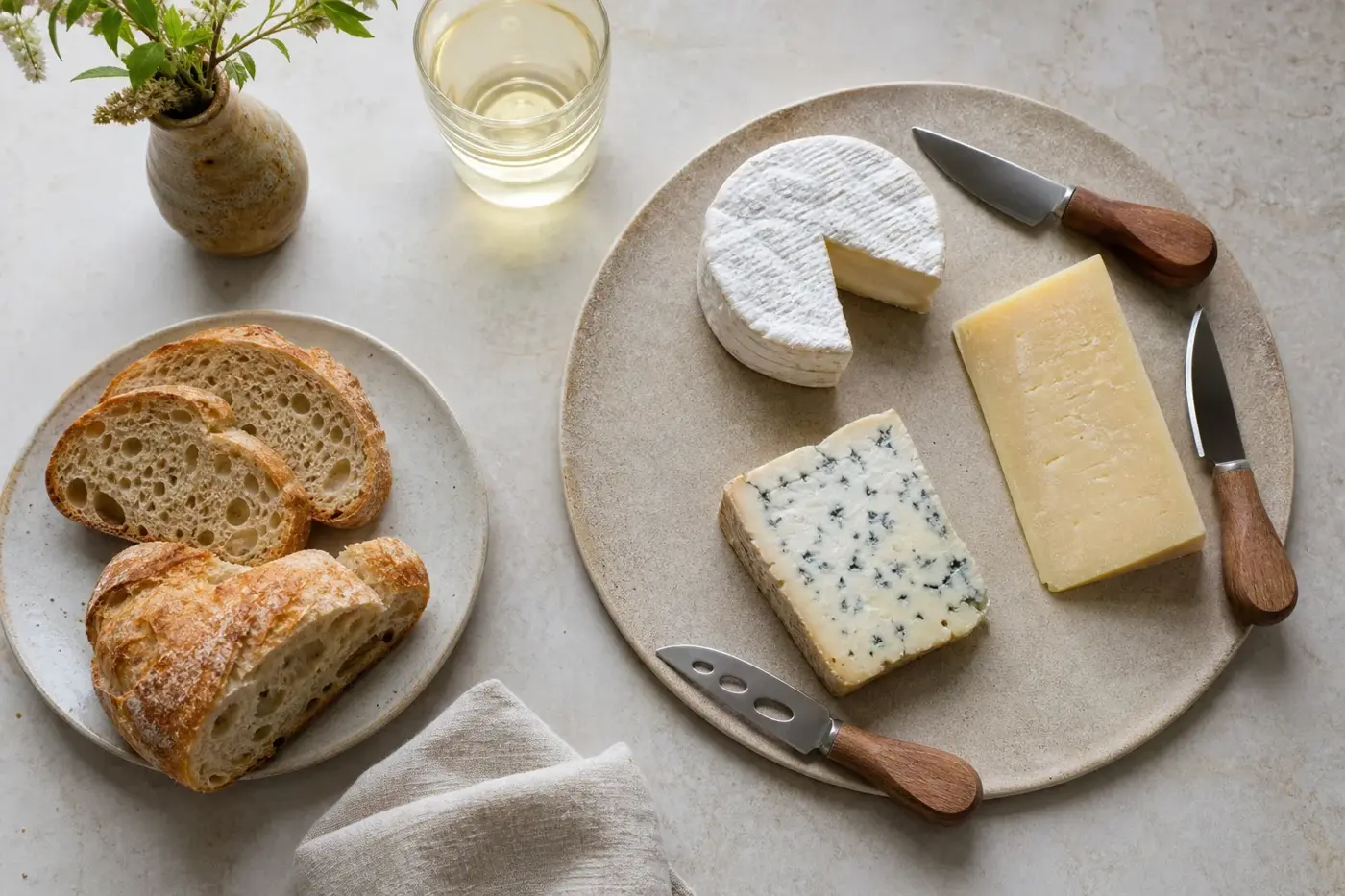
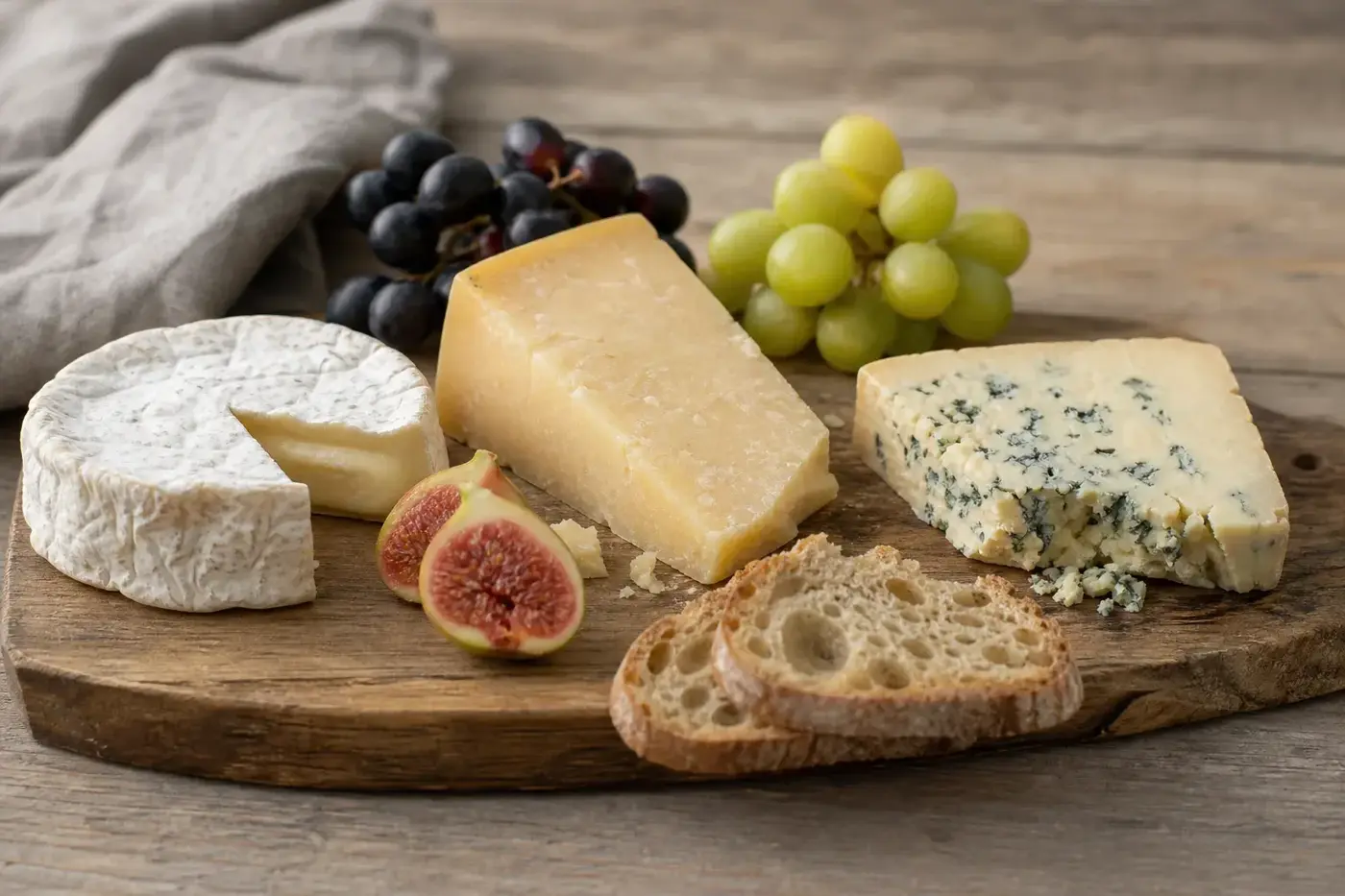
With a blue wedge, share the veined paste as well as the rind. Set it flat and cut a fan from the narrow inner end towards the outside, rather than picking out blue pockets or leaving a thick outside strip for the last plate. For soft blue cheeses, a cheese wire or lyre, a framed cutting wire, suits the job. [1,8]
An irregular piece needs a stable face and a moment of your attention to find any original outside edge. Then borrow the closest pattern: a fan for a tapering piece, crosswise slices for an even block. If it breaks along a vein, serve the fragments together as a portion instead of repeatedly trimming them smaller. [1,7]
Very hard cheese: make room for shards and crumbs
With brittle cheese, an unbroken slice need not be your goal. Make shavings for scattering over food, or small broken chunks for a plate. Switzerland Cheese Marketing recommends a hard-cheese chisel for extra-hard cheese and a securely positioned slicer for very thin slices. [8]
The Parmigiano Reggiano Consortium describes levering off small pieces with an almond-shaped knife. Its sensory guide identifies granularity and crumbliness as characteristics that become more pronounced with ageing. Let those qualities lead you: serve the shards and crumbs rather than pressing harder in pursuit of an unbroken rectangle. [9]
Give your cheese the right tool
Before choosing a tool, consider your cheese's firmness and stickiness. A blade that cuts cleanly, plus a separate utensil for each cheese, matters more than a serving-knife collection with its own drawer. [3,8]
| Your cheese's texture | Reach for | How to cut it |
|---|---|---|
| Soft or sticky | Thin-bladed or open-bladed cheese knife | Keep blade contact with the cheese to a minimum. [8] |
| Soft blue or delicate crumbly cheese | Cheese lyre or wire | Draw through gently, without compressing the cheese. [3,8] |
| Firm or semi-firm cheese | Sharp utility knife | Cut manageable pieces on a stable board. [3] |
| Very hard brittle cheese | Hard-cheese knife or chisel | Break off small pieces rather than forcing slices. [8,9] |
Switzerland Cheese Marketing makes the distinction clear: thin blades for soft cheese, lyres for soft and blue cheese, and chisels for extra-hard cheese. Match your tool to the texture in front of you. [8]
For hard cheese, pay attention to what your cutter is designed to do. The USA Cheese Guild distinguishes cutters for softer cheeses from equipment for firmer pieces, and advises against platform wire cutters for hard grana-type cheeses. Follow the tool manufacturer's instructions. [7]
Start with a board that stays put
If your cheese rocks or the blade jams, stop and reposition it. Give yourself a clear working area and a board that stays put. Rest the cheese on its broadest practical face, leave room for the knife to reach the board, keep fingers away from the cutting line and reduce the piece's size before attempting fine portions. [4,7]
Remove clinging paste between cuts so your next portion gets a clean edge. Wash your knife between different cheeses rather than carrying residue across the board. Separate serving knives keep the flavours distinct, too. [3,8]
For England, Wales and Northern Ireland, the Food Standards Agency advises washing hands before preparing food, keeping utensils clean and washing them thoroughly between tasks. Keep utensils and boards for ready-to-eat foods separate from those used for raw foods requiring cooking. That separation matters when your cheeseboard shares kitchen time with other preparation. [10]
Share the rind, leave the choice to your guests
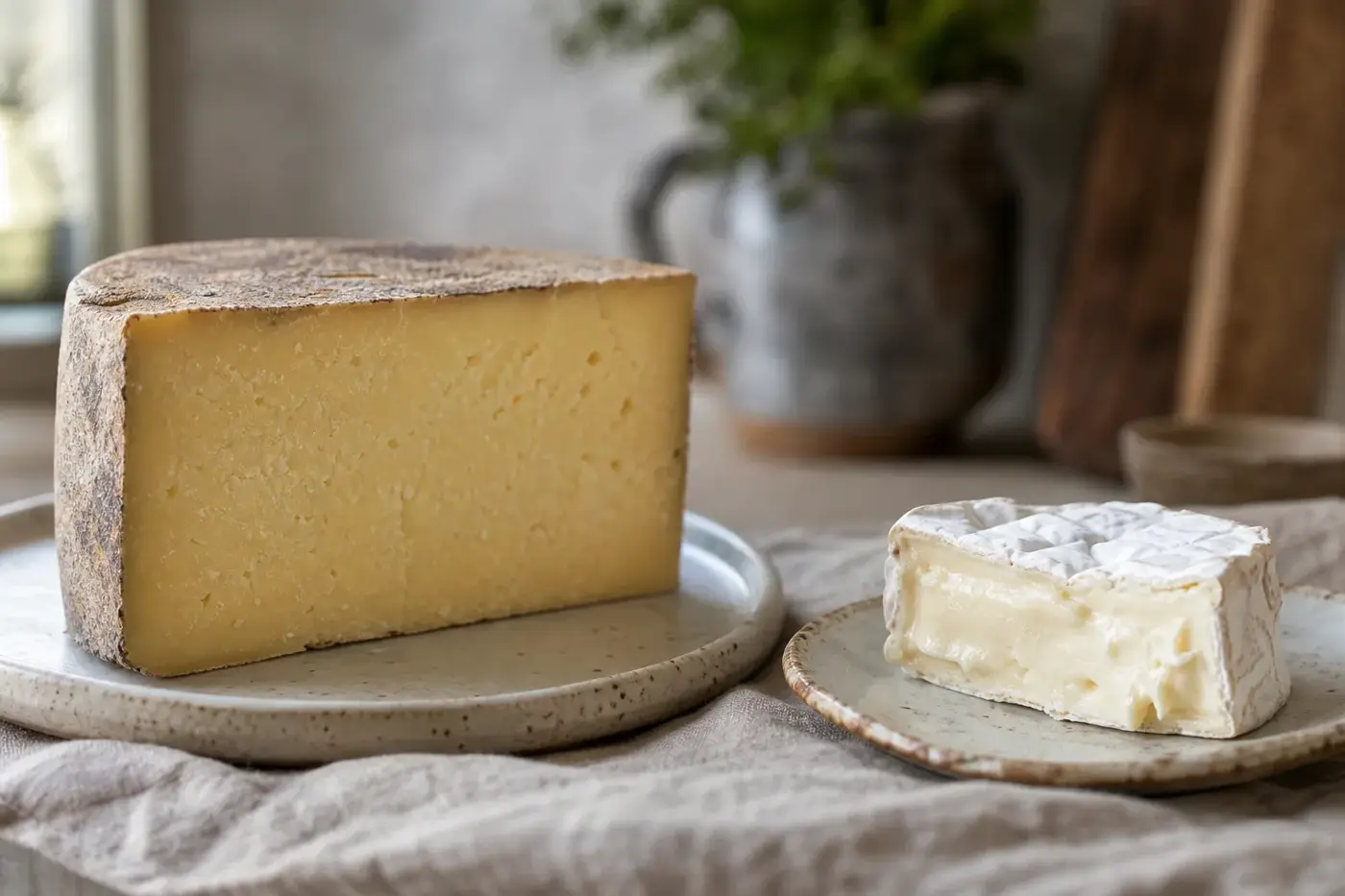
Give guests their share of rind and let them choose whether to eat it. Ask the maker or cheesemonger whether that particular rind is intended to be eaten. Remove non-food coverings such as wax, plastic or cloth before eating; automatically peeling every cheese can take useful paste away with the covering.
The Parmigiano Reggiano Consortium says its rind can be eaten and recommends cleaning it before use. Follow the information for the cheese in front of you. Anyone who dislikes an edible rind can simply leave it on their own plate. [11]
Unexpected mould is a different question from portioning. Turn to mould on cheese guidance, rather than assuming a generous trim answers every change in appearance.
Cut a little now and save some for later
For easy self-service, cut a few portions and set them beside the remaining piece. They give your next guest a cutting direction to follow. Pre-cut firm cheese if it makes serving easier; leave a soft round whole until needed if that helps it hold its shape, and work in small batches rather than filling the board at once. [3,7]
Cutting and tasting need not happen at the same temperature. The California Milk Advisory Board's serving guidance distinguishes aged cheeses brought towards room temperature from fresh cheeses kept cold until serving. Follow the maker's preparation advice within the official food-handling limits where you live. [3]
For England, Wales and Northern Ireland, the FSA's November 2026 guidance recommends a fridge between 0 and 5 °C (32 and 41 °F). It advises keeping chilled food out for the shortest possible time during preparation, with a maximum of four hours. Include preparation time when planning how long your cheese will be out, and follow its label instructions. [12]
Replenish your board with small portions and cover the reserve to limit waste, rather than slicing everything at the start. Wrap and store the remaining cheese according to its label; the guide to storing cheese at home takes you through the next step. Keep clean offcuts together for another use: symmetry is no reason to cut them away. [3,7,12]
General information only, not medical advice: follow the official guidance where you live.
Questions people ask
How should I cut a triangular wedge of cheese?
Lay it on a broad, stable face and cut slender triangles from the tip to the heel. For a broad wedge, make a fan of cuts that meet at the tip so each slice runs from the inner paste to the outer rind.
How do I cut a pyramid shaped cheese?
Stand it on its base and cut vertically through the middle of the top to the board. Turn it and cut through the same central line to make quarters, then make any further cuts in the same direction.
Can I eat cheese rind?
Ask the maker or cheesemonger whether the particular rind is intended to be eaten. The Parmigiano Reggiano Consortium says its rind can be eaten and recommends cleaning it before use. Remove non food coverings such as wax, plastic or cloth before eating.
What knife should I use for soft blue cheese?
A cheese lyre or wire suits soft blue cheese. Draw it through gently without compressing the cheese.
How long can cheese be left out while preparing a cheeseboard?
For England, Wales and Northern Ireland, the Food Standards Agency advises keeping chilled food out for the shortest possible time during preparation, with a maximum of four hours. It recommends a fridge between 0 and 5 °C. See the Food Standards Agency guidance and follow the cheese label instructions.
Sources
- CNIEL, French dairy industry body. How to cut cheese. Undated online guidance, retrieved November 2026. Shape-specific cutting patterns, sharing centre and rind, and adapting tools to texture.
- The Original Chèvre, Goat Cheeses of France. Press kit, “How to cut the different shapes of chèvre”. Undated edition. Industry promotional material, retrieved November 2026; cutting illustrations and the principle of sharing rind.
- California Milk Advisory Board. Professionals' Guide to California Cheese. Undated retrieved edition, sections “Merchandising Cheese for Restaurants and Foodservice” and “Cheese Cutting and Handling”. Tool selection, small-batch service and preparation for serving.
- Borough Market. Tools of the trade: the cheese wire. 28 November 2023. Published account from a practising cheesemonger about professional wires and manageable pieces for home use.
- University of California Agriculture and Natural Resources. Slicing Cheeses 101, page 11 in the retrieved cheeseboard handout. Undated edition. Photographic cutting guide for wheels, wedges, blocks and logs.
- Président. Comment couper le fromage ? Undated producer guidance, retrieved November 2026. Round, square, pyramid, cylinder and log cutting patterns. Commercial producer source.
- USA Cheese Guild, managed by the U.S. Dairy Export Council. Reference Manual for Cheeses from the USA. Retrieved edition, pages 44 to 48. Cutting equipment, covered handling and shape-specific portioning.
- Switzerland Cheese Marketing. Cutting implements and techniques. Undated industry guidance, retrieved November 2026. Thin-bladed knives, lyres, wires, slicers and hard-cheese chisels.
- Consorzio del Formaggio Parmigiano Reggiano. Sensory Analysis. Undated online edition, retrieved November 2026. Almond-shaped knife, breaking into pieces, granularity and crumbliness. Industry consortium source.
- Food Standards Agency. Why is cleaning important. Current retrieved GOV.UK edition, November 2026, sections “Hand washing” and “Utensils, dishes, and containers”.
- Consorzio del Formaggio Parmigiano Reggiano. FAQ, “Can you eat Parmigiano Reggiano rind?” Undated online edition, retrieved November 2026. Product-specific rind guidance.
- Food Standards Agency. How to chill, freeze and defrost food safely. Published 18 December 2017, current retrieved GOV.UK edition, November 2026. Applies to England, Northern Ireland and Wales.
Researched from professional cheese-cutting guidance, producer and industry publications, illustrated reference material and current retrieved Food Standards Agency advice, with geometric explanations added through desk research.
Last checked: November 2026
Last checked November 2026.
The editors suggest you read next