Alpine Summer Cheese and Transhumance
Evening milk rests in shallow tubs in the Vaud Alps.
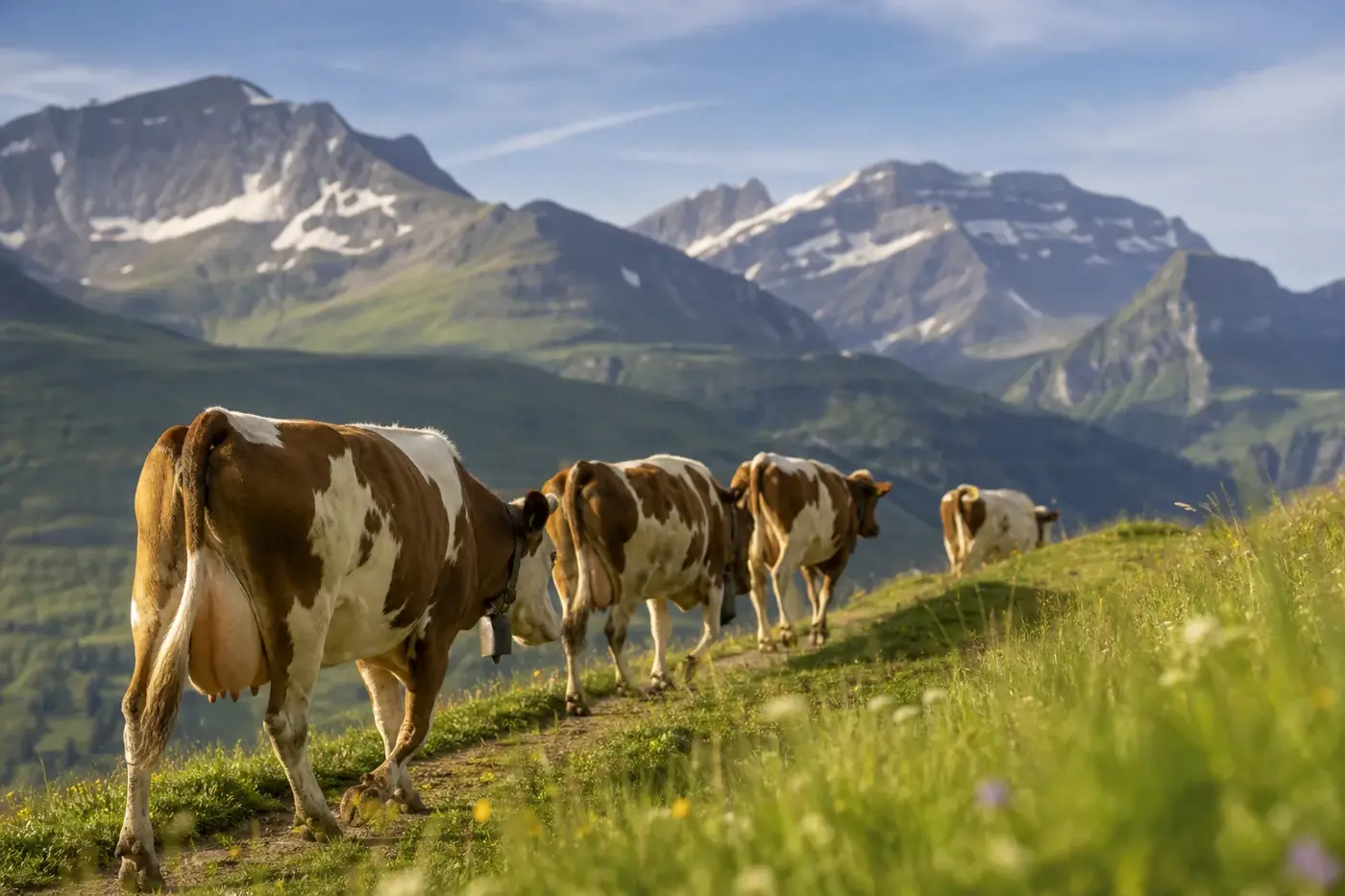
Evening milk rests in shallow tubs in the Vaud Alps. By morning, it will join the fresh milk in a copper cauldron over a wood fire. The animals will eventually leave their summer pasture, but the wheels made here have a longer appointment with the mountain season: they will keep maturing long after the herds go home. [1,9,13]
Follow the herd into summer
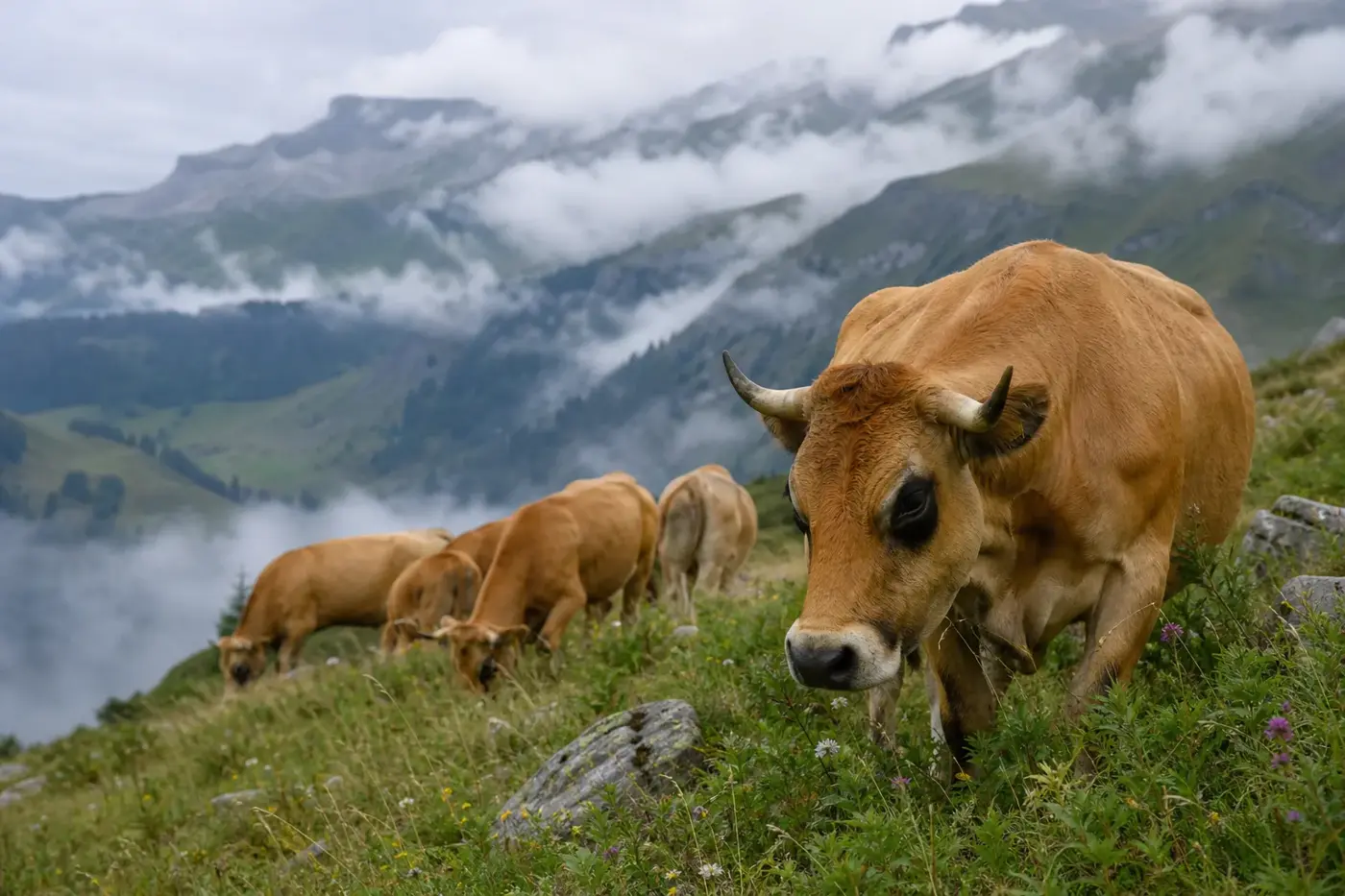
Picture yourself on the journey uphill, alongside animals and the people who care for them. This seasonal movement is transhumance. In the Alps, it often links a settled valley or mountain farm with higher pastures usable in summer, followed by the journey home. UNESCO recognises its knowledge, skills and social practices as living cultural heritage. [1,2]
The recurring circuit and a home base chiefly distinguish transhumance from pastoral nomadism. The boundaries are not quite so tidy: FAO notes that nomadic households can also practise seasonal transhumance. For Alpine cheese, picture permanent homes connected to summer grazing, rather than an entire household moving throughout the year. [2]
Summer grass above, winter stores below
As snow retreats, grazing appears on ground that cannot support animals all year. Taking herds uphill makes use of that extra forage. Meanwhile, people at the home farm can get on with making winter fodder. A Swiss research synthesis describes the summer holding and permanent farm as two connected parts of the same agricultural system. [3]
On the mountain, grazing and cheesemaking share the working day. The L’Etivaz cooperative describes producers leaving the valley for mountain chalets, then bringing their young cheeses to its cellars. You are following two stages of one journey: cheese made on the mountain, then matured in the village. [10,13]
The descent closes the grazing season, not the cheesemaking year’s work. UNESCO records festivities for seasonal departures and returns, alongside practical knowledge of routes and animal care. The procession gets its public moment. Down in the cellars, the wheels quietly carry on ageing after the animals are home. [1,9]
Every pasture has its own way up
The first question is practical: how do you reach the grass? UNESCO describes traditional pastoral paths travelled on foot or horseback, while Swiss farm research identifies accessibility as a major difference between holdings. A remote summer holding needs different arrangements for moving people, animals and products from one easily reached by road. [1,4]
Height alone will not tell you how a farm works. A Swiss study of census records for 5,900 summer farms identified six types, distinguished by organisation, livestock, terrain and access. These included private dairy farms, communal mixed cattle and dairy farms, remote farms and sheep farms. Ownership and management vary, and not every animal has come uphill for milking. [4]
Grass and weather have a say in the calendar, too. Gruyère d’Alpage’s production conditions depend on sufficient pasture grass, while L’Etivaz’s published requirements set calendar limits. Even neighbouring communities may begin and end their seasons at different times. [8,9]
Meet the people behind the daily rhythm
Someone must manage the grazing. Someone must turn the milk into cheese. Sometimes that is the same person: families and employed herders divide responsibilities in different ways, while sending animals uphill can free other family members to harvest forage below. Knowledge passes through watching and doing, as well as formal training. [1,3]
Milking sets the daily rhythm, but the timetable can change. A Bern University of Applied Sciences research project followed a Swiss summer holding where roughly 55 lactating cows were milked once daily rather than twice. Across four summers, researchers examined milk yield and constituents, animals’ energy supply and body condition, cheese quality, behaviour and labour organisation. One milking decision touches almost every corner of animal care and dairy work. [5]
Fetching animals from distant pasture takes time, too. The university’s research programme identifies distance, feed availability and labour shortages as reasons to investigate different milking systems. The task is to fit grazing, animal observation, milk collection and processing into a routine that people can sustain. [5]
Why send cheese downhill instead of milk?
Turn milk into cheese and you change what needs transporting. Rather than repeatedly moving liquid milk away from a remote dairy, a holding can process it there and send the cheese onwards for maturation. L’Etivaz’s production documents set out that sequence: milking and manufacture on the same summer holding, followed by transfer to cellars. [9,13]
Cooking, draining, pressing and salting concentrate the milk into something intended for ageing. A seasonal flow of fresh milk becomes cheese that can be distributed later. The mountain cheesemaker and the affineur, the specialist who matures cheese, can care for the same wheel without sharing a roof. [9,10,13]
Come inside the mountain dairy
Inside the dairy, you follow the milk through preparation, coagulation, cutting, cooking, draining, pressing, salting and maturation. Coagulation turns liquid milk into curd; whey is the liquid that separates from it. You can explore the principles in the broader milk-to-cheese process, then see how mountain production rules give each cheese its particular form. [8,13]
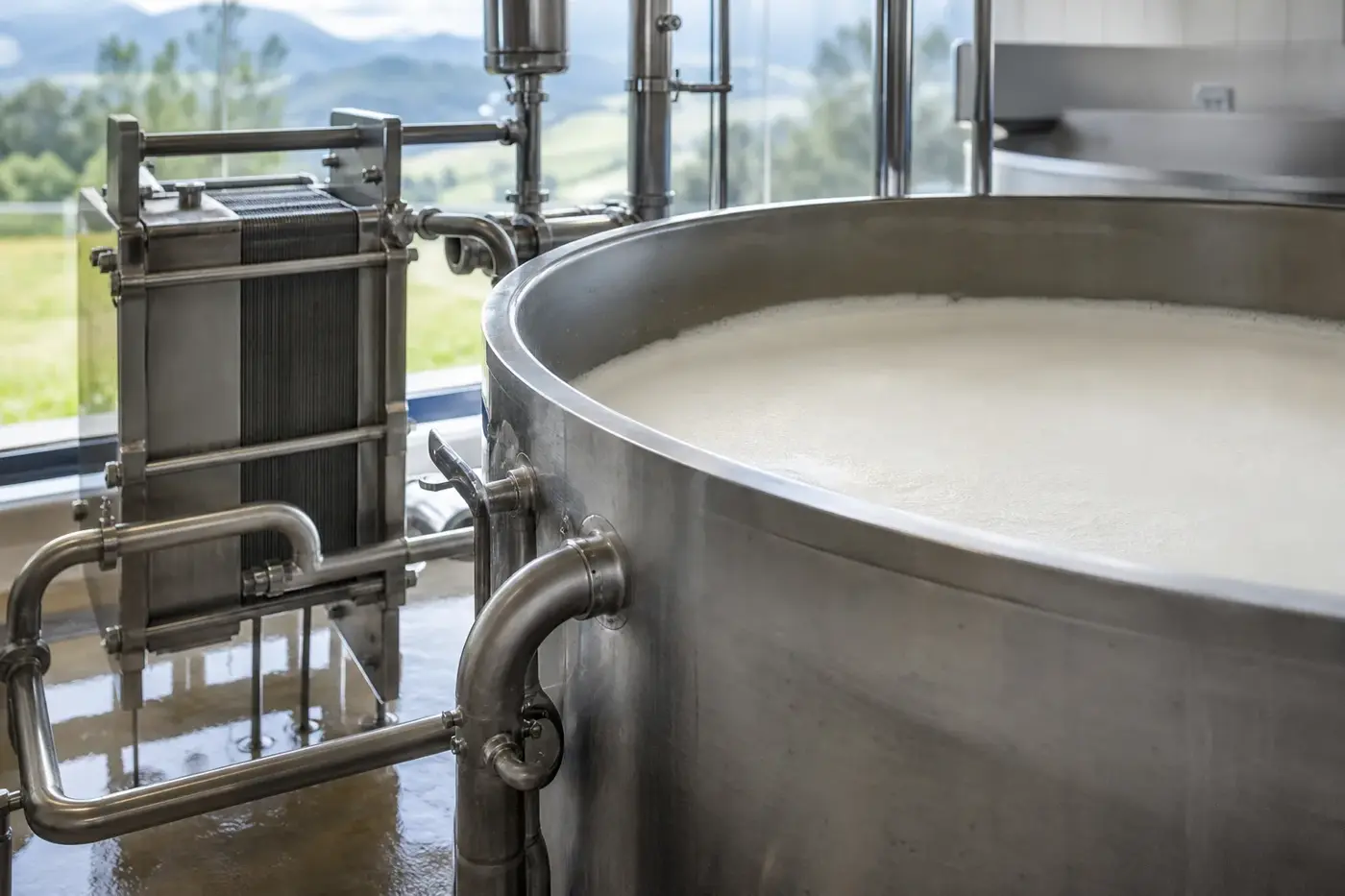
L’Etivaz’s account begins with evening milk standing in tubs, ready for skimming before the next make. Once the milk sets, the cheesemaker cuts the curd into very small grains. Heating and stirring follow, before the mass is gathered in cloth and pressed. “Cooked, pressed” sounds rather less effortless when you see the work behind it. [9,13]
After shaping comes salting, then the long attention of maturation. The Swiss AOP-IGP association describes L’Etivaz wheels being salted and rubbed regularly in the cooperative’s cellars. What you eventually taste owes something to that continuing care, not just the day the cheese was made. [12]
Gruyère d’Alpage and L’Etivaz: a closer look at the vat
These two Swiss cheeses both connect summer grazing with mountain manufacture. Their published requirements tell distinct stories, though. The comparison below draws on the Gruyère specification and the Federal Office for Agriculture’s L’Etivaz registration summary. AOP means appellation d’origine protégée, the Swiss protected designation of origin. [8,9]
| What to look for | Gruyère d’Alpage | L’Etivaz |
|---|---|---|
| Where it is made | Defined Gruyère area: Fribourg, Vaud, Neuchâtel, Jura and specified Bernese communes, plus named dairy catchments. [8] | Ten Vaud communes; manufacturing chalets at 1,000 to 2,000 metres. [9] |
| When it is made | While permanent pasture supplies sufficient basic forage. [8] | 10 May to 10 October. [9] |
| Where the milk comes from | Milk from the manufacturing alp or a neighbouring alp, within transport limits. [8] | Raw cows’ milk, milked and processed on the same summer holding. [9,13] |
| How the curd is heated | 53 to 57 °C. [8] | Copper cauldron over direct wood fire; no higher than 57 °C. [9] |
| Minimum time in maturation | Five months, measured as lot average. [8] | 135 days. [9] |
L’Etivaz’s production area takes in Château-d’Oex, Rougemont, Rossinière, Ollon, Villeneuve, Ormont-Dessus, Ormont-Dessous, Corbeyrier, Leysin and Bex. Its maturation area is the Pays-d’Enhaut. Making and maturing each have their own geography. [9]
Look beyond the shared mountain setting and ask three questions. Where does the milk come from? Where is it processed, and what happens in the vat? Those details reveal the differences between the cheeses; you can read more about Le Gruyère.
For L’Etivaz, the defined summer window, local raw milk and direct wood firing sit at the heart of its published production description. Here, mountain tradition comes with precise requirements, not simply an appealing view. [9,13]
What reaches your palate from the pasture?
Before pasture plants enter a conversation about flavour, they are the animals’ feed. The Gruyère d’Alpage specification makes permanent alp grassland the basis of the ration, with management that favours a balanced, species-rich plant community. Its general cheese description also attributes flavour to lactic fermentation and rind flora. The pasture matters, but it does not work alone. [8]
Milk composition can change, too. The university’s milking trial assessed milk constituents alongside feeding, animal condition and cheese quality. If you are comparing pastures, ask whether the animals, milk composition, cultures, manufacture and ripening were comparable. Those details tell you more about differences than altitude alone. [5]
L’Etivaz has its own documented sensory identity. The official registration summary describes fruitiness with slight hazelnut and smoke notes. The Swiss AOP-IGP association describes an ivory-yellow paste, fine, supple and slightly firm. Keep those descriptions attached to this cheese, rather than asking every Alpine wheel to taste alike. [9,12]
Read beyond the mountain name
An Alpine cheese is not necessarily a summer cheese. Gruyère’s main specification allows both fresh-forage and winter feeding regimes, while its alpage provisions add separate seasonal conditions. The broader cheese and its summer-pasture form are distinct. [8]
Summer grazing alone does not confer a protected designation, either. Production documents tie together a name, an area and a method, so distinguish the grazing location from the places of manufacture and maturation when assessing a claim. The guide to protected cheese names explains why you must also consider protection in the jurisdiction concerned. [8,9]
Keeping the pasture, and its people, going
An open mountain pasture takes work to stay open. Agroscope describes Swiss alpine farming as caught between abandonment and intensification, with pressures involving labour, suitable livestock, biodiversity and climate. Turning animals out is only one part of caring for the landscape. [11]
The ground makes demands of the animals, too. Milking research considers energy supply, body condition and animal behaviour, while the Swiss summer-farming synthesis discusses injuries and losses on hazardous terrain. Alongside the grass, you need suitable animals and enough people to watch them. [3,5]
Then there is water. Agroscope’s drought research expects increasing summer dryness in inner Alpine valleys and investigates irrigation and changes in grassland composition. A longer growing season offers little straightforward advantage if water becomes scarce just when animals need pasture. [7]
A 2025 Swiss study brought together remote sensing, census records, interviews and questionnaires. It identified labour constraints and climate-related water scarcity among the challenges: cheese production had remained resilient, but pasture maintenance was under pressure. Shorter staff retention and reduced grazing contributed to shrub and woodland encroachment. Keeping the cheese tradition alive means sustaining the working system around it, too. [6]
Find your summer cheese and give it the table
Start with the full name, not the mountain picture. Gruyère d’Alpage’s specification requires that wording and identification on the wheel, while L’Etivaz’s official registration summary describes a numbered casein mark identifying the producer or mountain chalet. Ask your cheesemonger for the cheese’s name, its producer or alp, and its production season. [8,9]
Buying a cut piece? Ask to see the original label or product information. Keep your questions precise: was it manufactured on a summer holding, when was it made, and where was it matured? Reading a cheese label helps you distinguish those details from a broader account of mountain origin.
At the table, give the cheese your attention. Bread or an unseasoned boiled potato leaves room to notice it, with no glass alongside and no adornment. Cut pieces small enough to compare texture and aroma, then note the maker, production season and age beside your tasting observations. Keep its documented origin alongside what you actually notice, even if your notes have to compete with the temptation of another piece.
Ask whether your piece is for slicing or shaving, too. The L’Etivaz cooperative distinguishes its extra-hard rebibes cheese, served in thin curls, from its younger cheeses. Production season and time in the cellar tell different parts of the story. Your summer cheese may reach the table long after that summer has ended. [9,10]
Let your cheese curiosity wander a little further
- Rennet Explained: Animal, Microbial and Fermentation Produced: get to know the ingredient that sets the milk.
- How to Store Cheese at Home: practical guidance for looking after the cheese you bring home.
Questions people ask
What is transhumance in the Alps?
Transhumance is the seasonal movement of livestock between grazing areas, accompanied by the people who care for them. In the Alps, herds often move from a valley or mountain farm to higher summer pastures, then return home.
What is the difference between Gruyère d’Alpage and L’Etivaz?
Both are made in the Swiss mountains during the grazing season, but their production requirements differ. L’Etivaz is made from raw cows’ milk on the same summer holding where it is milked, in a copper cauldron over a direct wood fire. Gruyère d’Alpage can use milk from the manufacturing alp or a neighbouring alp, within transport limits.
When and where is L’Etivaz made?
Its production season runs from 10 May to 10 October. It is made in mountain chalets at 1,000 to 2,000 metres in ten Vaud communes, then matured in the Pays d’Enhaut for at least 135 days.
What does L’Etivaz taste like?
The official registration summary describes it as fruity, with slight hazelnut and smoke notes. The Swiss AOP and IGP association describes its paste as ivory yellow, fine, supple and slightly firm.
How can I tell whether a cheese was made on a summer holding?
Start with the full name and ask the cheesemonger about the producer or alp and the production season. For a cut piece, ask to see the original label or product information, and ask where it was manufactured and matured.
Sources
- UNESCO, Transhumance, the seasonal droving of livestock, nomination file 01964, inscription extended in 2023. Official cultural heritage record.
- Food and Agriculture Organization of the United Nations, Transhumant grazing systems in temperate Asia, undated online chapter. FAO chapter.
- Agroscope and Swiss Federal Research Institute WSL, Swiss alpine summer farming: current status and future development under climate change, The Rangeland Journal, volume 40, 2018, pages 501 to 511. Published research synthesis.
- Agroscope, Understanding the heterogeneity of Swiss alpine summer farms for tailored agricultural policies: A typology, Mountain Research and Development, volume 44, issue 1, 2024. Institutional research record.
- Bern University of Applied Sciences, Alpine and mountain farming, section “Once-a-day milking on Alpine pasture holdings processing their own milk”, undated project account describing research conducted from 2015 to 2019. University research account.
- Agroscope and collaborating institutions, Resilience of Swiss summer farms: An interdisciplinary analysis of key challenges and adaptations, Agricultural Systems, volume 227, article 104365, 2025. Institutional research record and full-text download.
- Agroscope, Adaptation to Dry Spells, undated online research account. Official research page.
- Swiss Federal Office for Agriculture, Cahier des charges pour Gruyère AOP, official specification; corresponding interprofession copy records amendments through 14 December 2015. FOAG specification.
- Swiss Federal Office for Agriculture, L’Etivaz: Résumé de la demande d’enregistrement, undated registration-summary PDF. Official registration summary.
- Coopérative des Producteurs de Fromages d’Alpage L’Etivaz, Etivaz AOP, undated homepage, sections on mountain life and cheese formats. Producer source with a commercial interest in the cheeses described. Cooperative website.
- Agroscope, Focus Alpine Farming, published 28 October 2025. Official research overview.
- Association suisse des AOP-IGP, L’Etivaz AOP, undated product account. Industry association source, including its own sensory description. Association product account.
- Coopérative des Producteurs de Fromages d’Alpage L’Etivaz, L’Etivaz AOP, undated production account. Producer source with a commercial interest in the cheese described. Production account.
Researched through official production documents, UNESCO and FAO accounts, agricultural research and attributed producer descriptions, with practical connections drawn through desk research.
Last checked: November 2026
Last checked November 2026.
The editors suggest you read next