Your knife meets resistance. You take a bite, and the cheese feels softer than that first cut promised. Porcelain white, with a smooth exterior: this is Mozzarella di Bufala Campana as its consortium describes it.[8] Rich buffalo milk starts the story; stretching the curd gives the cheese its recognisable structure.[7]
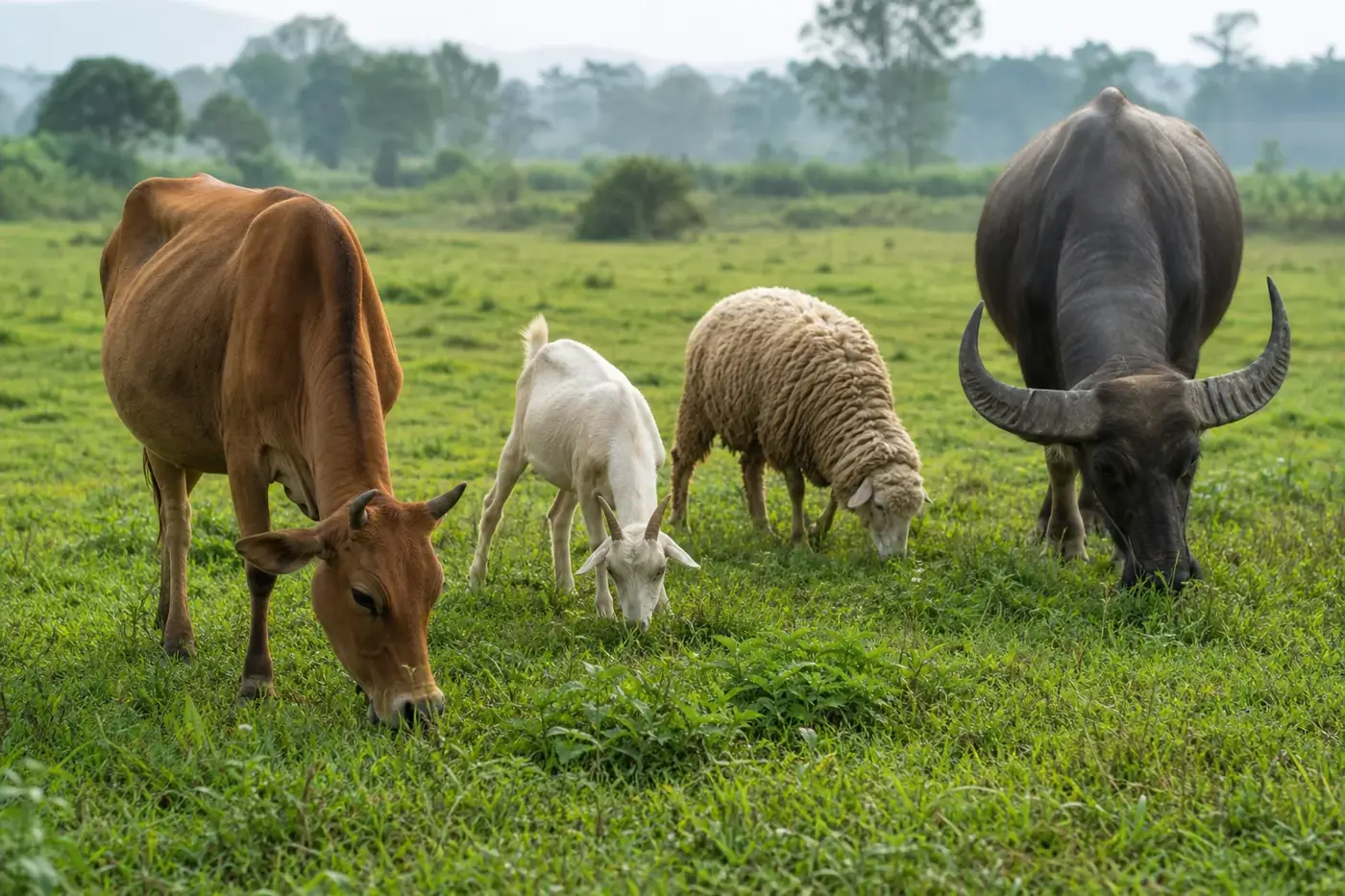
Sheep and buffalo milk usually bring more fat and protein to the vat than cow and goat milk. But richness is only the beginning. Proteins, the minerals holding them together, moisture and ripening all help decide what you taste. The animal supplies the material; the cheesemaker gives it direction.[1][2][3]
Meet the four milks at the dairy door
Milk is mostly water. Its cheesemaking promise lies chiefly in the fat and protein dispersed through it, alongside lactose, the milk sugar, and minerals. For a useful comparison between species, you need to start with whole milk before manufacture. Finished cheeses can contain very different amounts of moisture.[2][3]
The study averages below, rounded to one decimal place, give you a feel for those differences. Think of them as a snapshot of research samples, not a specification every herd must meet. Animals are not especially interested in keeping a tidy spreadsheet.
Comparative research samples: composition as a percentage of whole milk, approximately grams per 100 g. Ten samples per species; these are study means, not worldwide ranges.[1]
| Milk | Fat | Protein | Lactose |
|---|---|---|---|
| Cow | 3.9% | 3.2% | 4.6% |
| Goat | 3.1% | 3.3% | 4.1% |
| Sheep | 6.4% | 5.0% | 4.7% |
| Buffalo | 7.7% | 4.4% | 5.0% |
Minerals occupy a smaller share, but they matter enormously in the dairy. A separate Pakistani study measured laboratory ash, the mineral residue left after combustion. It averaged 0.72% for cow milk, 0.82% for goat and buffalo milk, and 0.85% for sheep milk. Researchers examined six samples per species, from specified breeds at one university farm.[2]
Keep those two studies separate in your mind. Composition shifts with breed, feed, season and stage of lactation, meaning how far an animal is through its milk-producing cycle. A species average suggests a tendency. The milk arriving at the dairy determines that day’s make.[2][3]
This page summarises published guidance from the official sources it cites. It is not medical advice. Guidance differs between countries and changes over time, so check the current source for where you live, and ask your doctor, midwife, pharmacist or dietitian about your own circumstances.
Why richer milk can fill more cheese moulds
Think of protein as the framework, with fat contributing to texture and flavour. Casein, the principal group of milk proteins involved in conventional cheesemaking, gathers into the network that becomes curd. As that network forms and drains, it releases the liquid you know as whey.[3]
More fat and casein generally mean greater potential cheese yield from the same quantity of milk. You can see the appeal of sheep milk to a cheesemaker. But the final yield also depends on how much fat and protein the process retains, and how much water stays behind.[3]
That makes weighing a fresh, moist cheese against a dry, aged one a slippery comparison. You are measuring two things together: recovered milk solids and retained water. The useful question is how efficiently a particular milk becomes a particular style, not simply how many kilograms of any cheese it produces.[3]
Curious about the journey from vat to cheese? How cheese is made takes you through coagulation, draining, salting and ripening.
Inside the curd, the small details count
Two milks can have similar protein percentages and still behave differently in the vat. Casein composition helps explain why. Coagulation turns liquid milk into a gel; acid development and rennet, a preparation containing milk-clotting enzymes, offer different routes to that change.[3]
The Wisconsin Center for Dairy Research points to goat milk’s generally lower proportion of alpha-s1-casein as one reason its curd can be more fragile than cow milk curd. Sheep milk offers another revealing example. The report describes experimental sheep milk cheeses so densely structured that they resisted forming regular eyes, the openings you recognise in some Swiss-style cheeses.[3]
Fat arrives in globules, rather than one continuous layer. Their size and retention affect how much fat stays in the cheese and how much leaves with the whey. Calcium and phosphorus also take part in curd formation. That mineral balance deserves your attention alongside the headline protein figure.[3]
For a cheesemaker, changing species means more than replacing a name on an ingredient list. Acid development, clotting, cutting and draining may all need adjusting to suit the milk. The guide to rennet explores the coagulant choices and their differences.
Cow milk: see how far one milk can travel
Cow milk gives you a useful reference point. Its composition often sits relatively close to goat milk, with less fat and protein than sheep or buffalo milk. That still leaves considerable room for the making method to shape the finished cheese.[1]
During manufacture and ripening, bacteria turn sugars into acids. Enzymes break proteins into smaller components, while fat breakdown releases fatty acids. Those processes help explain how one milk species can produce such a range of flavours and textures.[4]
Try two labelled cow milk cheeses with different moisture levels or maturation methods. Record texture first, then compare aromas. You may learn as much from that pair as from comparing different animals. Your observations stay rooted in the cheeses, rather than an imagined single “cow milk flavour”.
Goat milk: follow your nose, not its reputation
Goat milk’s distinctive animal aroma has a chemical basis. The Wisconsin dairy research report identifies higher proportions of caproic, caprylic and capric acids in goat and sheep milk fat than in cow milk fat. Released as fat breaks down, these acids help shape characteristic flavours.[3]
That does not confine goat cheese to one aromatic corner. France’s INAO describes Rocamadour as a small cheese made from raw, whole goat milk, with a soft paste, cream and butter aromas, and a delicate goat smell.[5] Set that beside the sharply aromatic or dry styles the words “goat cheese” might bring to mind.[5]
INAO’s published description gives you something useful to look for. Notice the softness of the paste, the balance of aromas and the strength of the goat character. An individual cheese deserves more than a verdict based on its milk.
When you compare goat cheeses, ask about the making method as well as age. Note whether each is fresh or ripened, how firmly it holds together, and whether its aroma gathers at the surface or runs throughout the paste.
Sheep milk: follow the richness in different directions
Sheep milk brings relatively high fat and high protein to the vat. In the Pakistani composition study, it also contained more casein than the cow, goat and buffalo samples. For the cheesemaker, that means a substantial protein framework with fat to retain within it.[2]
Those high solids do not dictate one style. The Wisconsin report discusses both soft sheep milk cheese and hard pressed sheep milk cheese. Manufacture and moisture management send the same milk source in different directions.[3]
To taste that difference, choose a fresh sheep milk cheese and an aged, pressed example. Check that both labels confirm the milk source, then note moisture, firmness, salt perception and the way the paste breaks. Keep those observations separate. Concentration through drying and changes caused by ripening are different parts of the story.
You get a fuller understanding of sheep milk’s richness by looking at composition and structure together. The milk supplies abundant material. The cheesemaker decides how it is organised in the finished cheese.[2][3]
Buffalo milk: richness with a remarkable stretch
Buffalo milk had the most fat of the four species in the comparative samples above; sheep milk had the most protein. Both bring substantial fat and protein to the vat. But “high solids” is not a single recipe. The balance of those components differs.[1]
Mozzarella di Bufala Campana shows you how thoroughly a process can transform that starting material. Its consortium describes manufacture with buffalo milk, whey starter and rennet, followed by curd maturation and stretching. Hot water helps work the curd into a cohesive mass before shaping.[7]
That working stage is central to the cheese’s character. Concentrated milk supplies the ingredients; acid development and the stretched-curd process help create the recognisable structure.[7] Composition alone cannot explain the texture you meet with your knife and teeth.
The consortium’s description moves from a porcelain-white, smooth exterior to resistance under the knife, then a softer sensation when bitten.[8] Compare that account with the other examples in the mozzarella guide. Mozzarella is not a single milk type, so keep the milk declaration firmly in your comparison.
Give milk and method a place at the table
Start with a reasonably similar pair, then bring in a contrasting cheese. The pair helps you explore milk differences. The contrast reveals how strongly cheesemaking can redirect them. It is also a respectable explanation for opening another cheese.
The examples below distinguish explicitly labelled selections from named products with published production descriptions. For “mixed milk”, ask which species are present and, where disclosed, in what proportions. Give a blend attention as a formulation in its own right, rather than treating it as something caught between categories.
| Milk or blend | A cheese to explore | What to notice |
|---|---|---|
| Cow | Fresh cheese explicitly labelled cow milk | Compare it with a fresh cheese of similar moisture |
| Goat | Rocamadour, described by INAO as raw whole goat milk cheese [5][6] | Get to know a soft, predominantly lactic cheese |
| Sheep | Fresh and hard pressed sheep milk cheeses discussed in Wisconsin research [3] | Compare moisture retention, pressing and ageing |
| Buffalo | Mozzarella di Bufala Campana, described as exclusively buffalo milk [7][8] | Notice what curd stretching contributes |
| Mixed milk | Experimental cow and goat or sheep milk blends reported by Wisconsin researchers [3] | Consider the blend as its own formulation |
Rocamadour and Mozzarella di Bufala Campana appear as registered protected designations of origin on the Great Britain register, November 2026.[9][10] PDO means protected designation of origin. Its production requirements belong to the named product, not to every cheese made from that species.
Before choosing, read the actual product’s milk declaration. Record the producer’s description of milk treatment and making method alongside it. How to read a cheese label explains wording that deserves a closer look.
Let cultures, moisture, salt and time tell their story
Milk gets the process started; cultures, draining, salting and ripening carry it onwards. Starter cultures are microorganisms introduced to guide fermentation. They convert lactose into lactic acid, changing the environment in which the curd develops. Later microbial and enzymatic activity brings further flavour changes.[4]
Rennet helps establish the initial protein network. Cutting and draining then influence what stays inside it. Moisture makes a particularly useful comparison, because two cheeses from the same species can contain very different proportions of water and milk solids.[3]
Salt is part of manufacture, not simply a final flourish of seasoning. The buffalo mozzarella consortium, for example, describes salting within a process that also includes fermentation, stretching and shaping.[7] Ripening adds another dimension as proteins and fats break down.[4]
Give your tasting notes four headings: milk, method, moisture and maturity. Together, they tell you more than species alone. Add breed, feed and production season where the maker documents them, and record milk treatment separately. Use raw, thermised and pasteurised cheese as your guide.
Lactose and milk allergy: know the distinction
All four milks contain lactose, as the composition table shows. The animal’s species is therefore a poor shortcut to the lactose content of a finished cheese.[1]
Manufacture changes the picture. In a published analytical study using capillary electrophoresis, researchers measured lactose in fresh cheese but reported none detected in the aged varieties examined. That finding applies to those samples and that analytical method. It points you towards the particular cheese, rather than a lactose level assumed from the animal.[4]
For measurements tied to specific products, and the limits of those measurements, turn to lactose in cheese.
Milk allergy is a different question. The Food Standards Agency’s guidance for England, Wales and Northern Ireland explains that allergy involves the immune system, whereas intolerance does not. It advises seeking medical advice if you suspect a food allergy or intolerance.[11]
Do not assume goat, sheep or buffalo milk cheese is a safe alternative to cow milk cheese for someone with a milk allergy. Species alone cannot establish suitability. Consult current official guidance for your country and a doctor or dietitian about individual circumstances.[11][12]
The NHS advises seeing a GP if you think you or your child may have a food allergy; this guidance is dated here to November 2026.[12] You can explore the fuller distinction in cheese allergy and lactose intolerance.
Questions people ask
Which milk has the most fat and protein?
In comparative research samples, buffalo milk had the most fat at 7.7%, while sheep milk had the most protein at 5.0%. These were study means based on ten samples per species, not worldwide ranges.
Why can sheep milk yield more cheese?
More fat and casein generally mean greater potential cheese yield from a given quantity of milk. The finished yield also depends on how much fat and protein the process retains and how much water stays in the cheese.
Why can goat milk curd be more fragile than cow milk curd?
The Wisconsin Center for Dairy Research identifies goat milk’s generally lower proportion of alpha-s1-casein as one reason. Milk proteins help form the curd network during cheesemaking.
Does aged cheese contain lactose?
In one analytical study, researchers measured lactose in fresh cheese but reported none detected in the aged varieties they examined. That finding applies to those samples and the analytical method used.
What should I do if I suspect a milk allergy?
The Food Standards Agency advises seeking medical advice when a food allergy or intolerance is suspected. The NHS advises seeing a GP if you think you or your child may have a food allergy; see its food allergy guidance.
Sources
- American Dairy Science Association, Detailed mineral profile of milk, whey, and cheese from cows, buffaloes, goats, ewes, and dromedary camels, and efficiency of recovery of minerals in their cheese, article identifier S0022030224009767. Comparative composition table, ten samples per species. Publication year not independently verified.
- Asian-Australasian Journal of Animal Sciences, Chemical Composition, Nitrogen Fractions and Amino Acids Profile of Milk from Different Animal Species, volume 29, issue 7, 2016. Materials and methods; Tables 1 and 2.
- University of Wisconsin Center for Dairy Research, Making Cheeses from Different Milks, in Dairy Pipeline, volume 25, number 4, 2013. Composition, yield, fatty acids, coagulation and blending sections.
- American Dairy Science Association, Rapid Simultaneous Determination of Organic Acids, Free Amino Acids, and Lactose in Cheese by Capillary Electrophoresis, Journal of Dairy Science 85, 2002. Introduction, analytical method and cheese results.
- Institut national de l'origine et de la qualité, Rocamadour, current product information, undated. Product and aroma descriptions.
- French Ministry of Agriculture, Cahier des charges relatif à l'appellation d'origine protégée Rocamadour, Bulletin officiel number 42, 16 October 2014. Specification linked by INAO.
- Consorzio di Tutela Mozzarella di Bufala Campana DOP, Manufacture, undated. Consortium production account.
- Consorzio di Tutela Mozzarella di Bufala Campana DOP, Bufala Campana, undated. Milk source, ingredients and product characteristics. The consortium represents the product's producers.
- Department for Environment, Food & Rural Affairs, Rocamadour, Great Britain protected food names register, published 4 January 2021; current entry checked November 2026.
- Department for Environment, Food & Rural Affairs, Mozzarella di Bufala Campana, Great Britain protected food names register, published 4 January 2021; current entry checked November 2026.
- Food Standards Agency, Food allergy and intolerance advice for consumers, updated 7 August 2026. Applies to England, Northern Ireland and Wales.
- NHS, Food allergy, current online guidance, checked November 2026.
Researched through comparative dairy studies, university dairy research, official product information, published specifications and official allergy guidance.
Last checked: November 2026
Last checked November 2026.
The editors suggest you read next
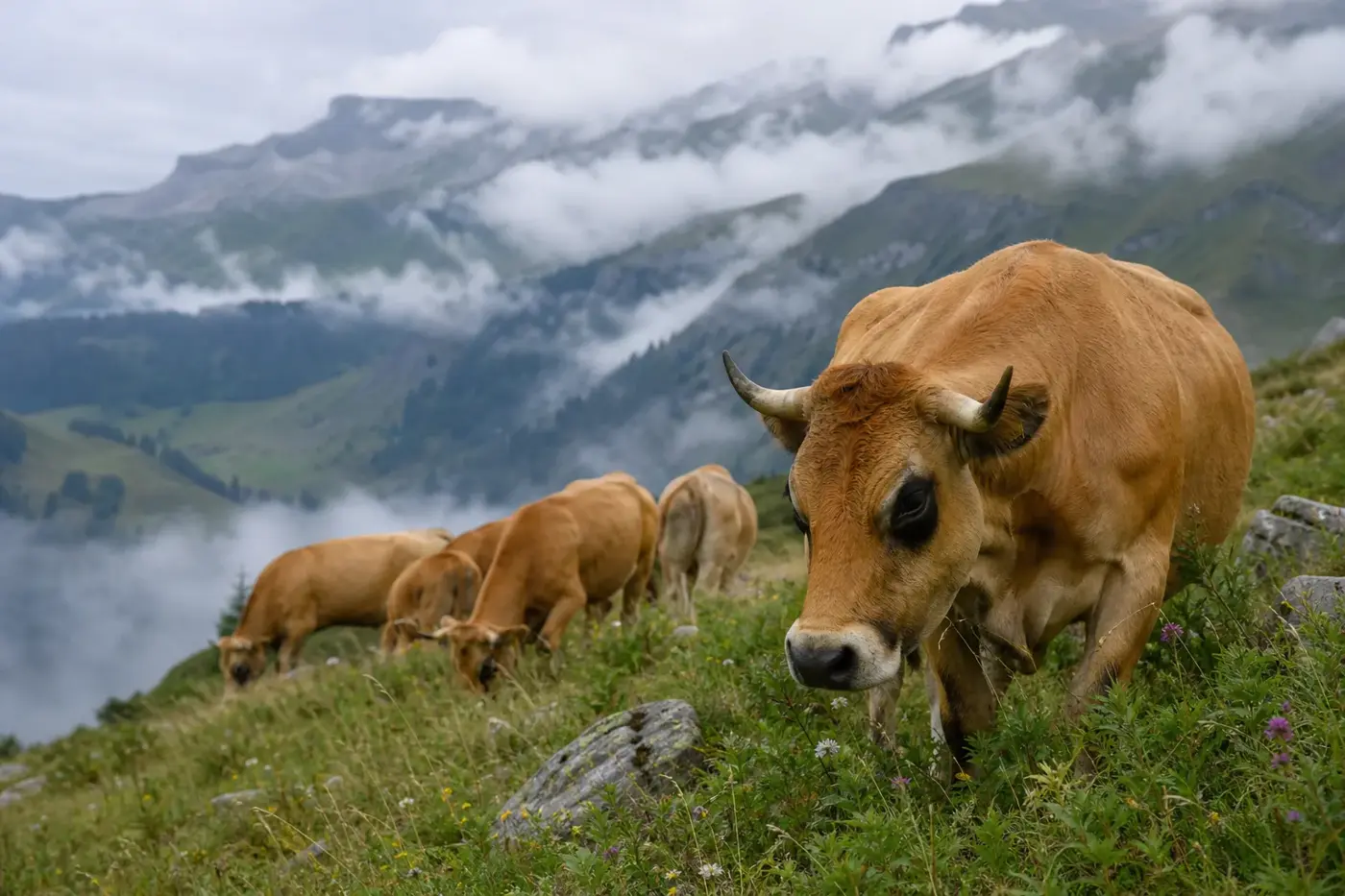
Dairy Breeds and Why They Matter
High in the mountains where Beaufort is made, Tarine cattle turn coarse winter forage into milk.