Baked Cheesecake
Your fork presses through a substantial slice, then meets the crisp biscuit base.
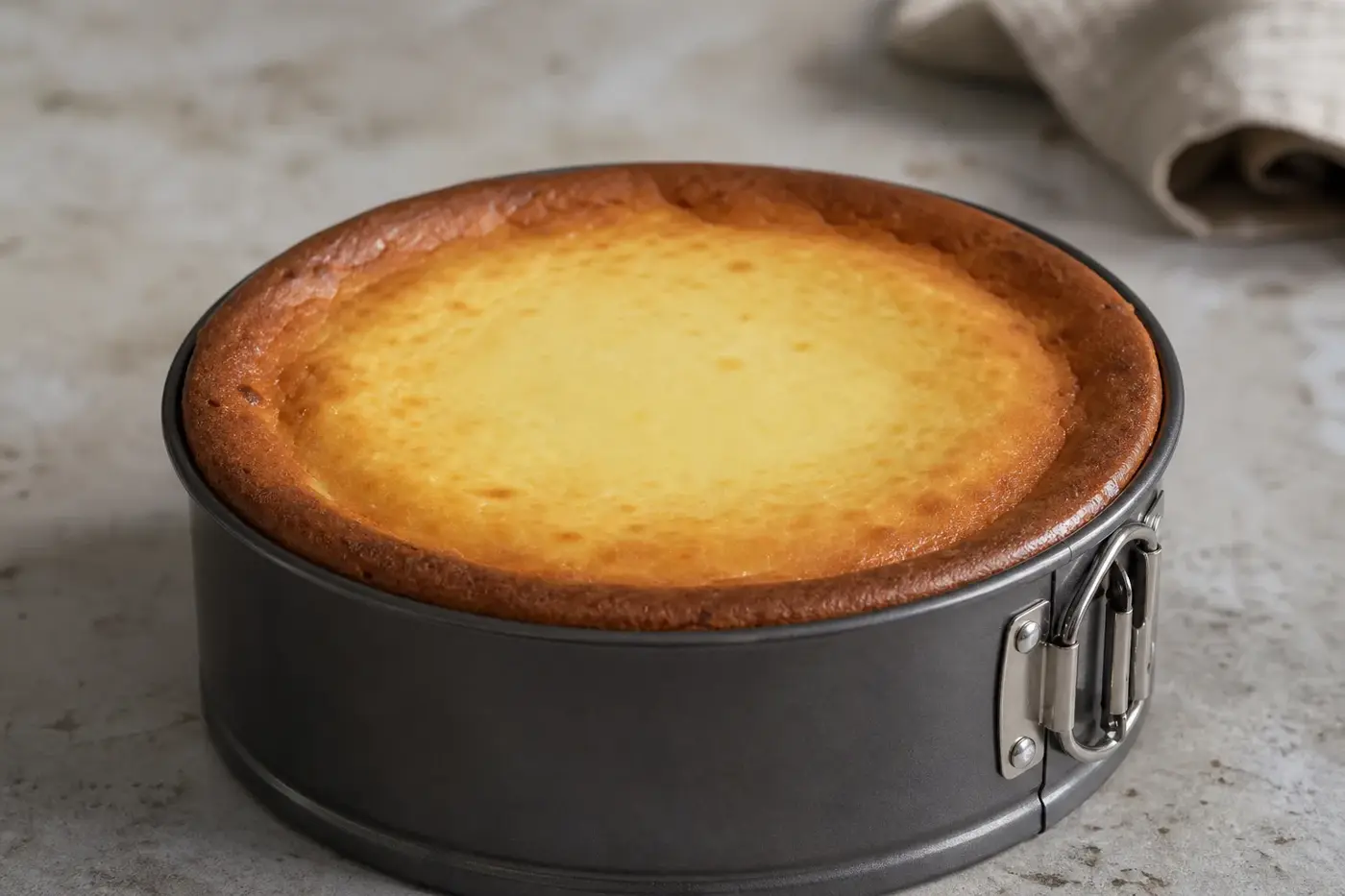
Your fork presses through a substantial slice, then meets the crisp biscuit base. This is the dense cream cheese richness described in Bake from Scratch's New York cheesecake baking school, not a light, whipped confection.[4] Underneath that richness is a gently set custard: eggs hold the filling together, while restrained mixing and careful heat keep it smooth rather than foamy. Bake until the centre meets the cooking check below but still trembles gently, then cool and chill for clean slices.[1][2]
New York style: richness with a little backbone
Heat gives a baked cheesecake its structure. Eggs thicken the filling, allowing it to hold a slice once cool. A chilled cheesecake sets in the fridge instead, often with help from whipped cream or another setting ingredient. King Arthur Baking's no-bake version, for instance, combines cream cheese with whipped cream and needs no eggs.[2][3]
In New York style, dense cream cheese filling takes centre stage, enriched with eggs and sour cream or cream. That substantial texture, described by Bake from Scratch, sets it apart from a light, whipped filling.[4] You want richness with a little weight behind it. This is not a slice likely to float off your plate.
A smooth filling begins with a gentle hand
As eggs heat, their proteins join into a network that supports the filling. This is coagulation, and it rewards gentleness. Too much heat makes that network firmer and less flexible, helping explain graininess and cracks. You are aiming for soft custard, not the springy crumb of a sponge cake.[5]
Full-fat cream cheese supplies body and dairy richness, while soured cream loosens the mixture and adds tang. Sugar does more than sweeten: it helps protect the custard against curdling, so reducing it changes how the filling behaves. A little flour brings stabilising starch. Lemon zest and vanilla supply the flavour.[4]
Give your cream cheese time to soften before you begin. Fridge-firm cheese leaves lumps that tempt you into harder beating, whereas softened cheese combines readily at low speed. Mixing traps air, and too much makes the cheesecake rise and fall more dramatically. Cracks may follow.[2][5]
Your 23 cm cheesecake, from first crumb to final chill
This recipe is adapted from Good Food's New York cheesecake, with metric spoon conversions. It uses a shorter oven-cooling stage, followed by room-temperature cooling and prompt refrigeration.[1][2][7][11]
Yield: 12 slices.
Tin: 23 cm round springform.
Preparation: about 20 minutes, plus ingredient softening.
Baking: 10 minutes for the base, then about 55 minutes for the filling, subject to the cooking check below.
Cooling and chilling: up to 2 hours cooling, including 1 hour in the switched-off oven, then at least 8 hours refrigerated.
Equipment: baking parchment, baking sheet, mixing bowl, electric mixer, spatula, wire rack and clean digital food thermometer.
Get your ingredients ready
For the base
- 140 g digestive biscuits, finely crushed
- 85 g unsalted butter, plus a little for greasing
- 12 g granulated sugar
For the filling
- 900 g plain full-fat cream cheese
- 250 g caster sugar
- 24 g plain wheat flour
- Small pinch of salt
- 7.5 ml vanilla extract
- Finely grated zest of 1 lemon
- 7.5 ml lemon juice
- 3 large hen eggs, plus 1 yolk
- 200 ml soured cream
Use 200 ml soured cream in the filling, following the original recipe's method. Its ingredient list calls for a larger carton because that also supplies the topping.[1]
1. Give those biscuit crumbs a firm foundation
Heat your oven to 180 °C conventional (356 °F) or 160 °C fan (320 °F). Line the tin base with parchment. Mix the crumbs, sugar and melted butter until evenly moistened, then press firmly across the bottom. Bake for 10 minutes and leave to cool on a rack.[1]
Aim for fine, even crumbs rather than biscuit chunks. A flat-bottomed cup helps you press them into a level layer, particularly around the edge where loose crumbs can break away. Prebaking gives the filling a firmer barrier to sit on.[4]
2. Mix until smooth, then leave well alone
Soften the cream cheese until it mixes readily, then beat on medium-low speed until smooth, about 2 minutes. Add the sugar, flour and salt on low speed. Scrape the bowl's base and sides, along with the beaters: firm streaks can hide underneath.[1][2]
Add the vanilla, zest and lemon juice, followed by the eggs and extra yolk individually. Let each disappear into the mixture before adding the next. Stir the soured cream until smooth, then incorporate it gently. Scrape once more and pour onto the cooled base in the lightly buttered tin.[1][2]
You want uniformly smooth batter, not a bowl of foam. Deal with visible cheese lumps now; the oven is not taking on your unfinished business. Keep the mixer slow, especially once the eggs go in.[2]
3. Bake, with your attention on the centre
Put the tin on a baking sheet. Bake for 10 minutes at 220 °C conventional (428 °F) or 200 °C fan (392 °F). Reduce the heat to 110 °C conventional (230 °F) or 90 °C fan (194 °F), then bake for about 45 minutes more.[1]
Give the tin a gentle nudge. The outer filling should be set, while a small central area trembles as one. A liquid wave through the middle means it needs longer. Waiting for a rigid surface from edge to edge risks overcooking the outside.[2][5]
For food safety, follow the Food Standards Agency's guidance for England, Wales and Northern Ireland. Use a clean probe to check that the centre reaches 70 °C (158 °F) and remains at or above that temperature for 2 minutes, or meets an official equivalent.[8]
4. Cool gently and give the fridge its turn
Switch off the oven, leave the door ajar and let the cheesecake cool inside for 1 hour. Move it to a wire rack to finish cooling at room temperature. FSA guidance for England, Wales and Northern Ireland says to refrigerate cooked food within 2 hours of cooking, while avoiding putting it in the fridge hot.[2][7]
The oven rest counts towards your cooling period. If the whole cake is cooling too slowly, divide it into smaller portions to speed things up. Once cool, cover and refrigerate for at least 8 hours before unmoulding. That long chill gives the filling the firmness you need for slicing.[1][7]
What a water bath brings to the bake
Water around the tin buffers the heat reaching the cheesecake's sides. In King Arthur Baking's published trials, a water bath prevented cracking more effectively than a separate tray of water beneath the cake. Steam in the oven and water surrounding the tin do different jobs.[6]
If you would like to use a water bath, choose a recipe developed for one, such as Bake from Scratch's baking school version. Wrap the springform base and sides in two layers of heavy-duty foil, keeping the edges above the water. Its published method also offers an oven bag outside the foil.[4]
Choose a roasting tin with room around the cake, and keep the water below every opening in the wrapping. Put the roasting tin in the oven before adding hot water, rather than carrying a sloshing tray. Follow that recipe's temperatures and timings. The bath changes how heat reaches your filling.[4][6]
Cracks or soggy crumbs? Here is what to change
Overbaking, excessive beating and rapid cooling can all cause cracks; King Arthur Baking names each as a culprit. Graininess, especially beside a firm, browned edge, also points towards too much heat. Next time, check earlier, mix at low speed and cool gradually.[5]
A baking crack is a quality defect, and fruit can cover it. Consider it a small job for the berries, rather than a reason to abandon dessert. A damp base needs a different investigation: loosely packed crumbs, missed prebaking or a leaking water bath. Improve your crumb preparation and protect the tin, rather than baking the filling longer.[4][5][6]
Before you swap, read the labels
Another plain full-fat cream cheese is a straightforward swap that Good Food explicitly allows. Use the same quantity. Lower-fat cheese, ricotta, mascarpone, yoghurt and plant-based alternatives need recipes designed around their particular fat and moisture levels. Here, keep the eggs, flour and soured cream as specified.[1][4]
With standard digestive biscuits and wheat flour, this cheesecake contains milk, eggs and wheat, a cereal containing gluten. These are among the FSA's regulated allergens. Read every ingredient label, including biscuits, flavourings and toppings, and check precautionary statements. Keep utensils and work surfaces free from cross-contamination.[10]
For gluten-free or egg-free baking, choose a separately developed recipe that makes the whole dessert suitable. If you want to understand how reactions to milk differ from difficulty digesting lactose, read cheese allergy and lactose intolerance.[10]
Egg guidance for readers in a higher-risk group
In England, Wales and Northern Ireland, the FSA says young children, pregnant people, older people and people with an underlying health condition can eat raw or lightly cooked hen eggs carrying the British Lion mark or produced under the Laid in Britain scheme. That exception does not extend to severely immunocompromised people needing medically supervised diets, who should seek medical advice. Check the current official guidance for your circumstances.[9]
Give that rich slice a sharp companion
Tart fruit gives all that richness a fitting finish. King Arthur Baking pairs its cheesecakes with tart cherries and raspberry sauce. Alongside this lemon and vanilla filling, try a small spoonful of sharp berry sauce or fresh berries. Leave the biscuit edge visible.[2][3]
Offer sauces separately so everyone can choose how much to add. For drinks, try black coffee, unsweetened black tea or sparkling water with a little citrus. You are looking for contrast with the rich filling, rather than another thick, sweet accompaniment.
Keep it chilled and make every slice count
Keep your cheesecake refrigerated at 0 to 5 °C (32 to 41 °F), following FSA advice for England, Wales and Northern Ireland. Eat within 48 hours of cooking or freeze portions promptly. Defrost in the fridge and use within 24 hours of fully thawing. Keep toppings covered and chilled too.[7][8]
Write the baking time on the storage container. An overnight chill should not obscure when the storage period began.
Wait until the cake is thoroughly chilled before unmoulding. Run a round-bladed knife around the edge, release the springform ring and lift away the parchment beneath the base. For neat slices, use a warm, dry knife and wipe it between cuts.[1][4]
Serve chilled, taking out only the portions you need. Return the rest promptly to the fridge. For broader storage principles, see how to store cheese at home, and turn to cheese food safety for the wider official guidance.[7]
General information only, not medical advice: follow the official guidance where you live.
Questions people ask
What makes a cheesecake New York style?
New York style cheesecake has a dense cream cheese filling enriched with eggs and sour cream or cream. Bake from Scratch describes its texture as substantial rather than light and whipped.
How can I tell when a baked cheesecake is done?
The outer filling should be set, while a small central area trembles as one. For the food safety check in England, Wales and Northern Ireland, the Food Standards Agency advises checking that the centre reaches 70 °C and stays at or above it for 2 minutes, or meets an official equivalent. See the agency's cooking guidance.
Why did my cheesecake crack?
King Arthur Baking identifies overbaking, excessive beating and rapid cooling as causes of cracks. For the next bake, check earlier, mix at low speed and cool gradually.
How long does baked cheesecake keep?
The Food Standards Agency advises keeping it refrigerated at 0 to 5 °C and eating it within 48 hours of cooking or freezing portions promptly. Defrost frozen portions in the fridge and use them within 24 hours of fully thawing. See the agency's storage guidance for England, Wales and Northern Ireland.
Can I use a different cream cheese?
Good Food allows another plain full fat cream cheese in the same quantity. Lower fat cheese, ricotta, mascarpone, yoghurt and plant based alternatives need recipes developed for their particular fat and moisture levels.
Sources
- Good Food. New York cheesecake. Recipe from the July 2004 magazine issue; current online method checked November 2026. Original publisher's recipe, including the 23 cm tin, ingredient quantities and staged baking temperatures.
- King Arthur Baking. NY Cheesecake. Current online edition, publication date not stated; checked November 2026. Baking company guidance, a commercial source, used for low-speed mixing, gradual cooling and fruit accompaniment.
- King Arthur Baking. No-Bake Cheesecake with Raspberry Sauce. Current online edition, publication date not stated; checked November 2026. Baking company recipe, a commercial source.
- Bake from Scratch. Baking School In-Depth: New York-Style Cheesecake. May 2022 teaching module. Ingredient functions, crumb preparation, water-bath protection and serving technique.
- King Arthur Baking. Why did my cheesecake crack? 9 May 2024. Baking company explanation, a commercial source, covering egg coagulation, excess heat, mixing and cooling.
- King Arthur Baking. Baking trials: What's the best way to keep cheesecake from cracking? 5 August 2024. The company's own comparative baking trials, rather than independent research.
- Food Standards Agency. How to chill, freeze and defrost food safely. Published 18 December 2017; current online text checked November 2026. Applies to England, Northern Ireland and Wales.
- Food Standards Agency. Cooking your food. Current online edition checked November 2026. Sections on cooking temperatures and using leftovers.
- Food Standards Agency. Home food fact checker. Updated 21 August 2026; checked November 2026. Consumer advice on eggs and higher-risk groups, applying to England, Northern Ireland and Wales.
- Food Standards Agency. Food allergy and intolerance advice for consumers. Updated 7 August 2026; checked November 2026. Allergen identification, label checking and cross-contamination guidance.
- King Arthur Baking. Ingredient Weight Chart. Current online edition, publication date not stated; checked November 2026. Used alongside the baking-school module for metric spoon conversions.
- Food Standards Agency. Alerts. Live official alert index inspected November 2026 for editorial recall checking.
Researched from the original recipe publisher, published baking-school explanations and comparative trials, with handling and storage instructions cross-checked against FSA consumer guidance.
Last checked: November 2026
Last checked November 2026.
The editors suggest you read next