Cheese Soufflé
Your spoon breaks through a browned top and finds an airy centre.
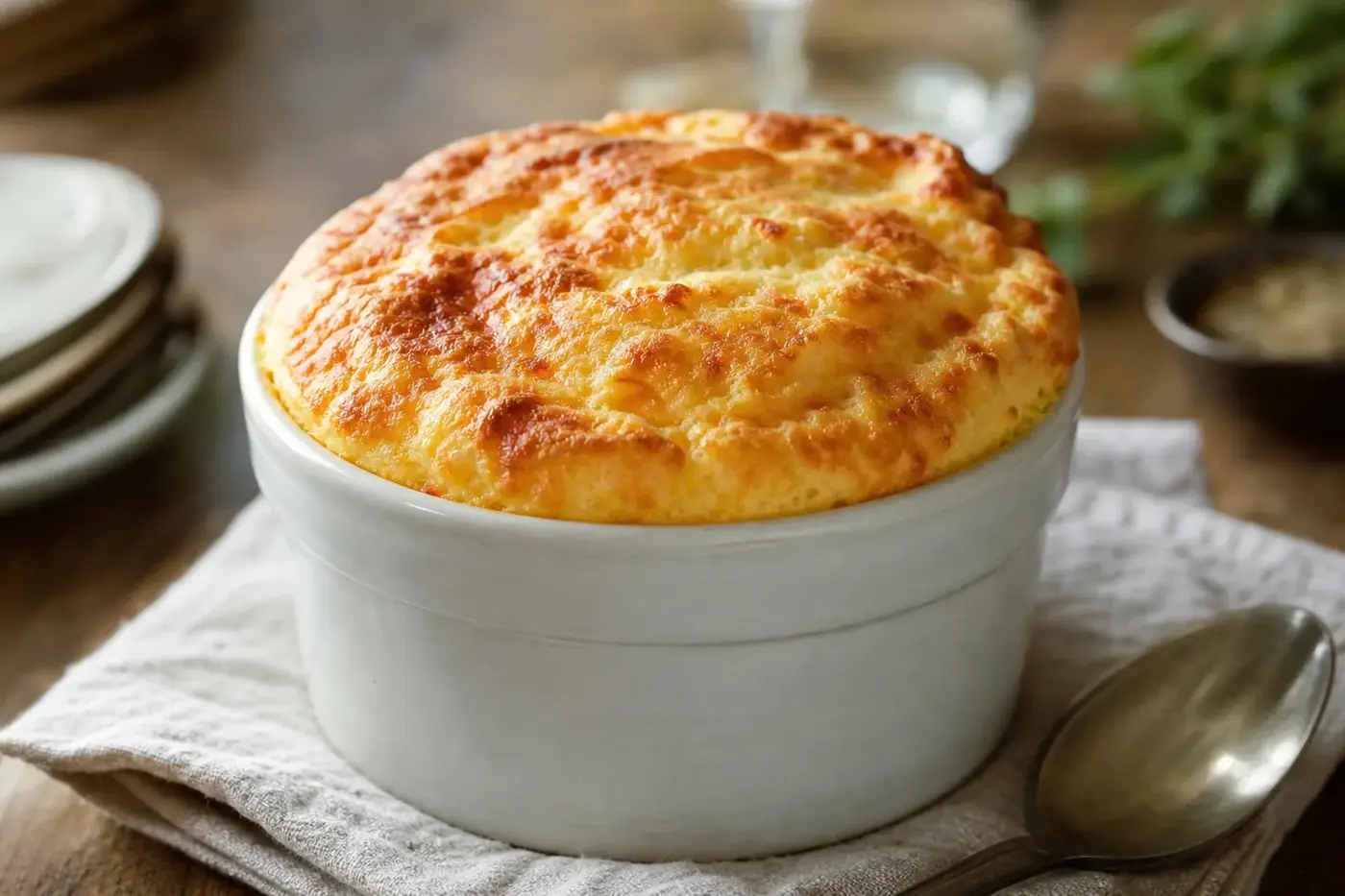
Your spoon breaks through a browned top and finds an airy centre. A thick cheese sauce has become something altogether lighter, with whisked egg whites supplying the lift. The groundwork is less theatrical: a prepared dish, a fully heated oven and gentle folding. Once your soufflé rises, take it straight to the table. It has little interest in waiting for an audience.[1][3]
A cheese soufflé for your table of four
This recipe adapts Good Food’s published four-serving recipe. It leaves out the mustard and specifies a thoroughly cooked centre.[1]
Independent recipe testing by fromage.co.uk: none.
Serves: four
Preparation: approximately 15 minutes, plus cooling the sauce
Baking: approximately 25 to 30 minutes, with longer cooking if the centre needs it
Oven: 200 °C conventional (392 °F), or 180 °C fan (356 °F).[1]
Get your ingredients and kit ready
- 50 g butter, plus extra for greasing
- 25 g dry breadcrumbs
- 50 g plain flour
- 300 ml milk
- 4 hen eggs, separated
- 100 g mature Cheddar, finely grated
- Salt and black pepper, to taste.[1]
You’ll need a straight-sided 15 cm soufflé dish, baking sheet, saucepan, two mixing bowls, measuring jug, grater, whisk, large spoon and spatula. Have a clean food thermometer ready to help you check the centre.[1][9]
Take it from saucepan to table
- Preheat the oven with the baking sheet on the middle shelf. Butter the dish, coat with breadcrumbs and shake out the excess.
- Melt the butter. Stir in the flour and cook for one minute. Take it off the heat and gradually incorporate the milk.
- Return to the heat and stir until very thick, approximately ten minutes. Transfer to a bowl and cool. Mix in the yolks, cheese and seasoning.
- Whisk the whites to firm peaks. Fold gently into the sauce, then transfer to the dish.
- Bake on the heated sheet for approximately 25 to 30 minutes. In England, Northern Ireland and Wales, check that the centre reaches 70 °C (158 °F) for two minutes. In the United States, the FDA specifies 71 °C (160 °F) for egg dishes. Continue cooking if necessary, then serve immediately.[1][9][10]
Allergens: the listed ingredients contain milk, egg and wheat. Check the breadcrumbs and every substitution against your guests’ requirements.
Give your soufflé room to rise
Get the dish ready before you whisk the whites. Butter its base and sides thoroughly, paying attention to the corners where they meet. Rotate it to spread the breadcrumbs evenly, then set it within reach.[1]
Greasing helps stop the setting egg mixture from sticking. Wipe any smeared mixture from the rim: an attached patch can hold back an even rise. The dish’s straight sides give your expanding soufflé a consistent shape.[3]
Let the oven reach its setting before you put the filled dish inside. Leave clear space above for expansion, too. Heat needs to reach the mixture while its foam remains intact, and an oven still warming up changes that balance. Give preheating its full turn rather than trusting the dial alone.[3]
Build a cheese sauce with backbone
You want a sauce with substance, not one that simply pours. It must support the lighter mixture you’ll fold into it. Butter and flour form the roux that starts your white sauce; add the milk progressively, stirring each addition into the flour mixture before adding the next. Work around the saucepan’s bottom and corners, where thickened sauce can collect.[1][2][3]
If the base looks too thick for pouring, resist the urge to add extra milk. That thickness carries the cheese’s flavour and gives your finished soufflé structure.[3]
Cool the base before adding your yolks. Good Food’s alternative cheeseboard soufflé follows the same sequence: cool the cheese sauce, then incorporate the egg yolks. Keep this stage separate from the initial cooking.[2]
For the recipe above, stir the finely grated cheese and yolks through your cooled base until evenly distributed. Finish before you whisk the whites. That way, folding leads straight to baking, with no awkward pause in between.[1][3]
Let Cheddar or Gruyère set the character
Mature Cheddar is your starting point here. Good Food’s source recipe specifies extra-strong Cheddar, so this is not a dish in which the cheese should be shy. Explore the style in Cheddar.[1]
Swiss Gruyère takes you in another direction. A 2016 Swiss Gruyère AOP specification describes its paste as supple, moderately firm and only slightly crumbly. Its flavours are predominantly fruity, supported by a variable salty note.[6]
Fancy trying that variation? Replace the Cheddar with the same weight of finely grated Gruyère. Treat it as a kitchen trial, because moisture, salt and melting behaviour all affect your finished sauce. The specification describes the cheese, not its performance in this recipe.
Keep your milk quantity unchanged initially. A cheese’s name alone cannot tell you how to adjust it. Read Le Gruyère for a fuller account of the named cheese.
Whichever cheese you choose, make a note of it as you refine the recipe. Change the cheese and oven setting in the same attempt, and you’ll have a harder time working out which made the difference.
Whisk for firm peaks, not dry clumps
Start with a clean bowl and carefully separated whites. Keep yolk out: fat interferes with egg-white foam, however enthusiastically you whisk afterwards.[3]
Whisking brings in air, while egg proteins help stabilise the bubbles. Later, those proteins contribute to the network supporting the expanded mixture as it bakes. There is more going on in your bowl than a gathering of froth.[5]
As the whites approach readiness, stop frequently and lift the whisk. Look for peaks that stand and hold their shape, with foam still smooth enough to fold. Stop before it looks dry, clumpy or grainy; Good Food identifies overwhisking as one reason its soufflé may fail to rise.[1]
Firm whites are useful; dry ones are not. Excessively beaten whites become awkward to distribute through your thick base. Watch the foam rather than following a fixed whisking time, judging both the standing peaks and the texture around them.[1][5]
Fold gently and keep that precious air
Loosen your thick base with a little foam first, then fold in the remaining whites. Working in stages narrows the difference between the stiff flavouring base and the light foam. That makes them easier to bring together.[3]
Use a large spoon or spatula to lift mixture from the bottom and turn it over the top. Rotate the bowl between movements, looking underneath for pockets of unmixed cheese sauce. Stop when it is substantially uniform. A perfectly polished finish is not worth all that extra stirring.[1][2]
Transfer the mixture gently to your prepared dish and put it straight into the oven. Your aim is to distribute the sauce while keeping the bubbles you’ve beaten into the whites. This is not the moment to whisk everything smooth again.[1][3]
Enjoy the rise, then check the centre
The bubbles are already there when your soufflé enters the oven. Warming gases and evaporating water increase their volume. Meanwhile, setting proteins form the structure that holds the expanded mixture.[3][5]
A tall, browned top looks splendid, but it cannot tell you whether the centre is cooked. The outside heats first. Even an impressive rise can hide insufficiently cooked mixture beneath it.[3]
Begin checking near the end of the stated baking window. Look for a risen, golden top, then use a clean probe to check the centre. For this thoroughly cooked version, follow the FSA’s published benchmark for England, Northern Ireland and Wales: 70 °C (158 °F) for two minutes. Continue cooking if necessary.[9]
If you’re in the US, follow the FDA’s consumer guidance for dishes containing eggs. It specifies 71 °C (160 °F).[10]
Read the signs in your soufflé
A disappointing rise and an insufficiently cooked centre need different responses. These signs help you distinguish a technique problem from a cooking problem. Use them to choose the correction that matters.[1][3][9]
| What you notice | What it may mean | What to do |
|---|---|---|
| Dense, with little rise | A quality problem: foam lost before baking | Next time, check bowl cleanliness, peak stage and folding. |
| One side rises more | A quality problem: sticking may restrict expansion | Butter evenly and clean the rim. |
| Gradual settling after serving | Expected as your soufflé cools | Take it directly to the table. |
| Rapid collapse with a wet centre | Possible undercooking | Continue cooking immediately; check the centre temperature. |
| Brown outside, insufficiently cooked inside | Possible safety concern and uneven cooking | Continue cooking; check oven setting and dish dimensions before your next batch. |
If an attempt disappoints, change one practical detail at a time. First note your dish, cheese, oven setting, baking time and centre temperature. Alter several things together and your next result becomes harder to interpret.
Get ahead before you whisk
Grate your cheese, weigh the ingredients, prepare the dish and arrange the accompaniments ahead of time. These small jobs earn their keep when you reach the folding stage. Keep ingredients chilled as their labels require, and allow time for the sauce to cool before incorporating the eggs, as the source recipe directs.[1][8]
For your first attempt, make and bake the complete mixture in one session. Wait to whisk the whites until your base, dish and oven are ready. The foam should not stand around while you finish other jobs.[3]
Have everyone seated before your soufflé comes out. It shrinks as it cools, so a prompt journey to the table preserves more of that just-baked height.[3] Set the hot dish on a suitable trivet and serve with a large spoon.
Keep the company sharp and simple
A green salad with a sharp vinaigrette makes a simple companion. Add plain bread if you fancy it, and dress the leaves at the last moment so they’re ready when your soufflé is. Good Food’s cheeseboard version also brings a dressed salad to the finished dish.[2]
For an alcohol free pairing, try sparkling water with lemon. It brings freshness alongside your warm soufflé.
If you’d like a broader approach to matching drinks and cheese, explore cheese and wine pairing.
Choose the right egg guidance for your guests
In England, Northern Ireland and Wales, the FSA allows raw or lightly cooked hen eggs bearing the British Lion mark, or produced under the Laid in Britain scheme, for young children, pregnant people, older adults and people with underlying health conditions. If you cannot establish that those assurance schemes apply, its catering guidance says to cook egg dishes thoroughly or use pasteurised egg products.[7]
That advice excludes severely immunocompromised people requiring medically supervised diets. The FSA directs anyone preparing their food to seek medical advice. Non-hen eggs should be thoroughly cooked.[7]
The recipe above takes the thoroughly cooked route. After handling raw eggs, wash your hands and clean your equipment. Keep raw egg away from the ready-to-eat salad.[7][10]
This page summarises published guidance from the official sources it cites. It is not medical advice. Guidance differs between countries and changes over time, so check the current source for where you live, and ask your doctor, midwife, pharmacist or dietitian about your own circumstances.
Keep leftovers safely, with different expectations
For England, Northern Ireland and Wales, the FSA advises cooling cooked food and refrigerating it within one to two hours. Divide your leftovers into smaller portions to speed cooling. Eat refrigerated leftovers within 48 hours or freeze them.[8]
In the United States, the FDA specifies reheating previously cooked egg dishes to 74 °C (165 °F) throughout. Reheating will not restore the original height. Expect a settled portion rather than the soufflé’s first rise.[10][3]
Before saving a portion, consider its original cooking and cooling history. For broader household guidance, turn to cheese food safety.
Questions people ask
How do I make a cheese soufflé rise evenly?
Butter the base and sides of the dish thoroughly and wipe any mixture from the rim. Whisk the egg whites to firm peaks, then fold them gently into the sauce and bake straight away.
Can I use Gruyère instead of Cheddar in a cheese soufflé?
The page suggests trying the same weight of finely grated Gruyère in place of Cheddar, while initially keeping the milk quantity unchanged. The substitution needs a kitchen trial because moisture, salt and melting behaviour affect the sauce.
How can I tell when a cheese soufflé is cooked?
A browned, risen top does not show whether the centre is cooked. For England, Northern Ireland and Wales, the FSA advises checking that the centre reaches 70 °C for two minutes. In the United States, the FDA specifies 71 °C for egg dishes. Check the relevant agency’s published guidance.
Can I prepare a cheese soufflé ahead of time?
You can grate the cheese, weigh the ingredients and prepare the dish ahead. For a first attempt, the page recommends making and baking the complete mixture in one session, whisking the whites only when the base, dish and oven are ready.
Can I keep leftover cheese soufflé?
For England, Northern Ireland and Wales, the FSA advises cooling cooked food and refrigerating it within one to two hours, then eating refrigerated leftovers within 48 hours or freezing them. In the United States, the FDA specifies reheating previously cooked egg dishes to 74 °C throughout. Check the relevant agency’s guidance; reheating will not restore the soufflé’s original rise.
Sources
[1] Good Food. Cheese soufflé in 4 easy steps. Good Food magazine, November 2007; online recipe retrieved November 2026. Ingredients, equipment, preparation, baking and troubleshooting. Recipe and method.
[2] Good Food. Cheeseboard soufflé & seasonal salad. Good Food magazine, January 2012; online recipe retrieved November 2026. Sauce preparation, cooling before yolks, folding and accompanying salad. Recipe and method.
[3] Springer. The Science of Cooking, chapter 12, “Soufflés”, published book excerpt, pages 199 to 204; retrieved November 2026. Dish preparation, preheating, foam, heat penetration and serving. Published excerpt.
[4] American Chemical Society. Molecular Gastronomy: A New Emerging Scientific Discipline. Chemical Reviews, 2010, DOI 10.1021/cr900105w. Idealised air-and-water soufflé model and discussion accompanying figure 17. Publisher record.
[5] American Egg Board. Aeration/Foaming/Structure. Undated technical explanation, retrieved November 2026. Protein behaviour during whipping and baking. This is an egg-industry source. Technical explanation.
[6] Swiss Federal Office for Agriculture. Cahier des charges pour Gruyère AOP. Published 2016 file hosted by the cheese’s interprofession, article 5, paragraphs 3 and 4. Used for sensory descriptions, not current registration status. Published specification.
[7] Food Standards Agency. Advice on safe storage, handling and use of eggs for catering. Updated 20 August 2026. Assurance schemes, vulnerable consumers, hygiene and non-hen eggs. Official egg guidance.
[8] Food Standards Agency. How to chill, freeze and defrost food safely. Published 18 December 2017; current online text retrieved November 2026. Cooling and leftovers. Official chilling guidance.
[9] Food Standards Agency. Food safety for community cooking and food banks. Current online guidance retrieved November 2026, “Cooking temperatures”. Official cooking guidance.
[10] US Food and Drug Administration. What You Need to Know About Egg Safety. Current consumer guidance retrieved November 2026, “Preparing” and “Serving”. Official US egg guidance.
Researched through published recipes, food-science explanations, a Swiss cheese specification and official food-safety guidance.
Last checked: November 2026
Last checked November 2026.
The editors suggest you read next