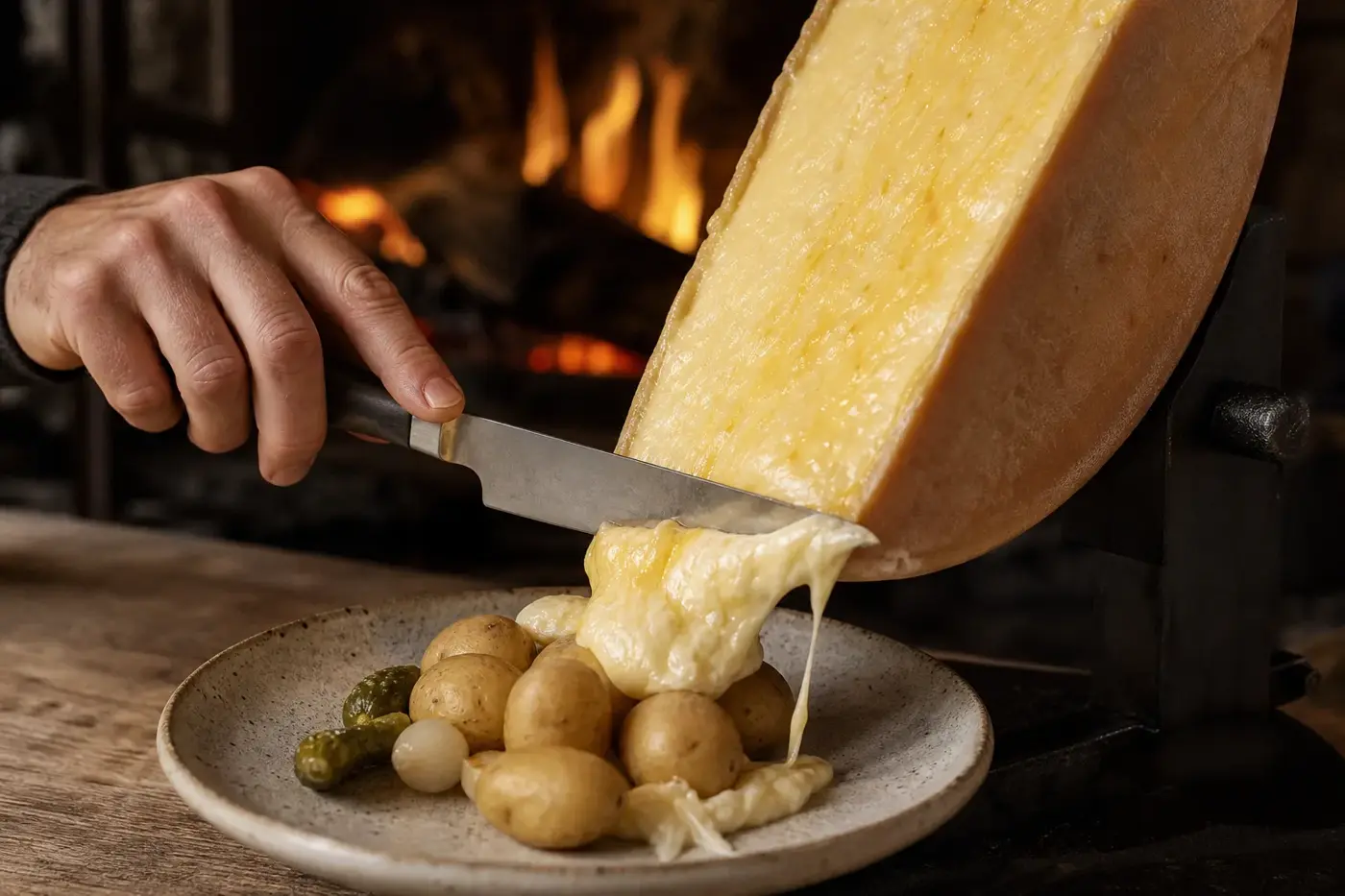
The cheese softens beside the fire. You scrape a melted layer over hot potatoes, then leave the next portion to warm. In 1574, someone recorded this pleasure in Valais, in the Swiss Alps. With a tabletop raclette grill and individual pans, or small portions beneath an ordinary oven grill, you can settle into the same rhythm at home.[1,2]
Beside the fire, the ritual begins
Raclette is both the cheese and the meal you make with it. The Swiss Culinary Heritage inventory traces its Valais roots through that 1574 description. Treat it as a glimpse of the practice, rather than a birth certificate for the invention.[1]
Traditionally, the cut face of a half wheel sits beside a fire or beneath a dedicated heater. The server scrapes the softened surface onto a plate, then returns the cheese to the heat. Your tabletop pans change the equipment, but the ritual stays reassuringly simple: melt, serve, eat immediately.[1,2]
Find your cheese, read its story
Look for Raclette du Valais if you want the registered Swiss appellation of origin, or AOP. Its official specification limits production to the canton of Valais and requires raw cows' milk and animal rennet from calves. The protected full name is explicitly distinguished from the word raclette alone.[3]
The specification describes a smooth, supple paste, with fresh lactic flavours and vegetal and fruity notes. Other cheeses sold for raclette vary in origin and milk treatment. According to the Swiss Culinary Heritage inventory, industrial production outside Valais generally uses pasteurised milk, so give your chosen cheese's label a moment before you reach for the pans.[1,3]
If your guests avoid animal rennet, choose cheese explicitly confirmed as suitable for vegetarians. Check the coagulant, which turns milk into curd, separately from the milk treatment. The rennet guide untangles the distinction.
How much cheese makes a supper?
Allow 200 to 250 g of cheese and the same weight of potatoes per person, following Raclette Suisse's serving guide. Its classic recipe uses 200 g of each. These are meal planning quantities, not nutritional recommendations, so let appetite and your other courses have a say.[2,4]
For four people, the recipe below gives you 800 g cheese and 1 kg potatoes. For eight, double both amounts and make sure everyone has a pan. Sharing is admirable; negotiating custody of the last pan is less relaxing. If you're serving a starter or substantial sides, put out less cheese initially and keep the reserve refrigerated.
Settle in for a tabletop raclette supper
This recipe draws on Raclette Suisse's classic preparation and Good Food's raclette recipe, with quantities adjusted for four. Raclette Suisse represents producers and promotes their cheese.[4,5]
Serves: 4. Preparation: approximately 10 minutes. Potato cooking: 15 to 30 minutes, depending on size.
Cheese melting: follow your appliance instructions and watch each pan. Heat setting: use the manufacturer's recommendation; fan oven temperature does not apply.[2,5]
Equipment: tabletop raclette grill with individual pans and suitable scrapers, saucepan, colander, serving bowls and a heatproof surface.
Gather everything for the first round
- 800 g (28.2 oz) raclette cheese, sliced to fit the pans
- 1 kg (35.3 oz) small waxy potatoes, scrubbed, skins left on
- 150 g (5.3 oz) cornichons, drained
- 150 g (5.3 oz) pickled silverskin onions, drained
- 200 g (7.1 oz) salad leaves or sliced sweet peppers, optional
- 200 g (7.1 oz) ready to eat charcuterie, optional
- Black pepper, to taste
From bubbling potatoes to the first scrape
-
Get the potatoes bubbling. Cover them with water in a saucepan and bring to the boil. Simmer until a knife slides in easily, checking smaller potatoes after 15 minutes; larger ones may need around 30 minutes. Drain and bring them to the table just before you eat.[2,5]
-
Give the accompaniments their places. Drain the pickles, wash the salad and arrange everything in small bowls. Bring out only enough cheese and charcuterie for the first rounds, then replenish from the fridge.[5,6]
-
Warm up your machine. Follow its instructions for positioning, preheating and using the pans. Add a slice of cheese to each pan in a single layer, rather than a tightly packed heap.[5]
-
Watch for that lovely flow. Once the cheese melts, use your scraper to slide it over the potatoes on your plate. Raclette Suisse advises against heating pans too long because the fat can separate. Add pepper at the table.[4,5]
-
Enjoy one small round at a time. Eat each portion as it becomes ready, with potatoes and pickles alongside. Keep raw meat out of this preparation: the optional charcuterie is ready to eat, and you can prepare vegetables separately.
Allergens: the cheese contains milk. Check every accompaniment's label, including pickles and charcuterie, for additional allergens, and check substitutions individually.
For pregnancy, UK NHS guidance advises cooking cold cured meats until steaming hot throughout. It says all cheeses can be eaten when cooked until steaming hot throughout.[8] Follow the storage and reheating instructions below for this recipe.[6]
No machine? Bring your oven grill into play
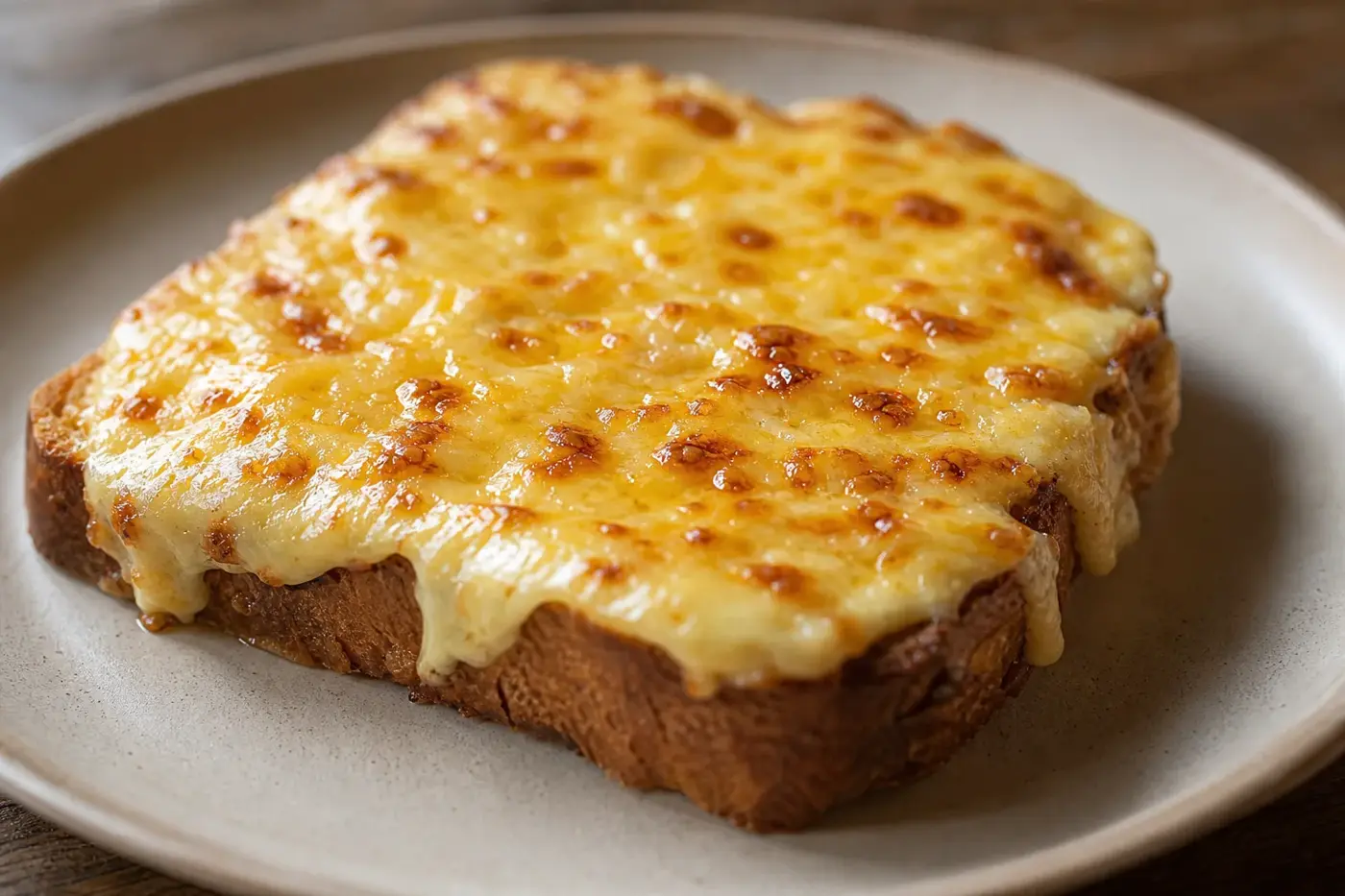
Your cooked potatoes and accompaniments stay the same. Set your oven grill according to its instructions and choose a shallow metal dish approved for grilling. Lay the cheese slices in one layer beneath the element and watch continuously until melted, then lift out with oven gloves and scrape onto your potatoes.[2]
Start your first batch farther from the element, rather than immediately beneath it. If the surface colours before the centre melts, move the dish farther away. Stop when the cheese flows: you're after melted cheese, not a deeply browned crust. Small batches mean everyone gets a freshly melted serving.[4]
Let the pickles cut through the richness
A crisp, acidic pickle cuts through each mouthful of hot cheese. Cornichons and pickled onions are the customary accompaniments recorded by Valais's regional food guide. Drain them well and serve separately, with small waxy potatoes that stay easy to lift and split.[7]
Charcuterie is optional, not an entrance requirement. Good Food includes cured meats, peppers and salad; Raclette Suisse also suggests mushrooms and other vegetables. With potatoes, two pickles and one vegetable side, you still have room to notice the cheese. Cook mushrooms separately before bringing them to the table.[2,5]
Give another cheese a small audition
Start with one small portion of younger Gruyère or Gouda, rather than committing the whole meal. Use the same weight of cheese, slice it evenly and melt one pan first. Taste for salt and strength of flavour, and notice whether it flows or turns stringy or oily.
For your next pan, try thinner slices or gentler heat if needed. Moisture, salt and maturity vary between products, so these are alternative versions of the meal, not replacements for Raclette du Valais's specified character. Whenever you change cheese, check the rennet and milk treatment again.
Find a glass to sit beside your plate
Fendant is the regional white wine served with raclette in the Valais food guide published on the regional wine body's website. Offer a small glass to adults of legal drinking age who choose alcohol. Dry cider is another suggestion, with apple acidity to sit alongside those pickles.[7]
For an alcohol free glass, try sparkling water with lemon, or sparkling apple juice diluted with water for less sweetness. Raclette Suisse also mentions black tea. The NHS advises avoiding alcohol during pregnancy; the wine pairing guide explores more pairing principles.[2,8]
This page summarises published guidance from the official sources it cites. It is not medical advice. Guidance differs between countries and changes over time, so check the current source for where you live, and ask your doctor, midwife, pharmacist or dietitian about your own circumstances.
Keep your table safe and supper relaxed
Follow your appliance manual, keep its cable clear of walkways and rest hot pans only on designated heatproof rests. Keep children away from heating elements and hot cheese. When you've finished, switch off and unplug the machine, then let it cool before cleaning.
FSA guidance for England, Wales and Northern Ireland, as of November 2026, says to keep your fridge between 0 and 5 °C (32 to 41 °F) and follow packaging instructions. Keep chilled food out for the shortest possible time during preparation, with a maximum of four hours. Replenish small platters rather than leaving the whole spread beside the heater.[6]
Refrigerate cooked leftovers within one to two hours and eat them within 48 hours, or freeze them, as the FSA advises. Reheat only once, until steaming hot throughout. For unused cheese, follow the label's storage and opening instructions. The cheese storage guide helps with everyday storage.[6,9]
UK NHS pregnancy guidance, as of November 2026, lists pasteurised semi-hard cheeses among suitable choices and says any cheese can be eaten when cooked until steaming hot. It also advises cooking cold cured meats until steaming hot. Choose a clearly labelled pasteurised product for guests avoiding unpasteurised cheese.[8] You'll find the full advice in the NHS pregnancy guidance.
The NHS identifies pregnancy, newborn babies, weakened immunity and older age as risk factors for serious listeriosis. Its listeriosis guidance, as of November 2026, should guide those guests' decisions alongside their healthcare professional's advice.[10]
Raclette, fondue or tartiflette: what's your evening?
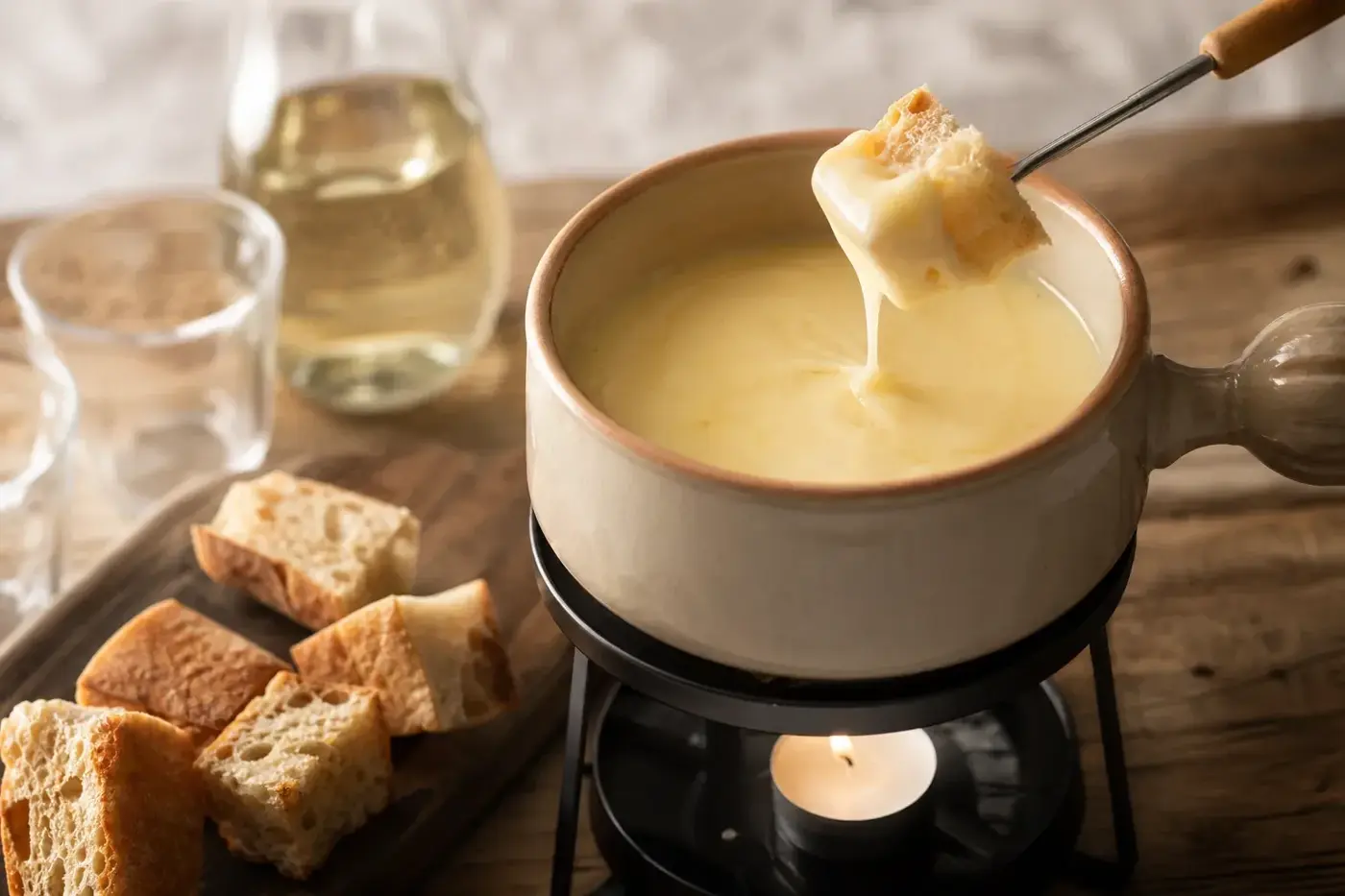
With raclette, you get separate portions of melted cheese scraped onto your plate. Cheese fondue keeps the melted cheese in a communal pot for dipping. Tartiflette is a baked potato dish made with Reblochon, usually with onions and bacon. Choose raclette when you fancy successive small servings, or a baked dish when you want dinner to arrive at the table together.[1,11]
Questions people ask
How much raclette cheese and potato do I need per person?
Raclette Suisse's serving guide suggests 200 to 250 g of cheese and the same weight of potatoes per person. Its classic recipe uses 200 g of each.
Can I make raclette without a raclette machine?
Yes, you can melt small portions under an oven grill in a shallow metal dish approved for grilling. Arrange the slices in one layer, watch until melted and scrape the cheese onto cooked potatoes.
Is raclette cheese suitable for vegetarians?
Raclette du Valais is required to contain animal rennet from calves. For guests avoiding animal rennet, choose cheese explicitly confirmed as suitable for vegetarians.
Can I eat raclette during pregnancy?
The NHS says any cheese can be eaten when cooked until steaming hot throughout. It also advises cooking cold cured meats until steaming hot, and avoiding alcohol during pregnancy. See the NHS pregnancy guidance for the full advice.
What is the difference between raclette, fondue and tartiflette?
Raclette is served in separate portions of melted cheese scraped onto a plate, while fondue keeps melted cheese in a communal pot for dipping. Tartiflette is a baked potato dish made with Reblochon, usually with onions and bacon.
Sources
- Swiss Culinary Heritage, Raclette du Valais (AOP), online inventory, historical bibliography and production account, undated current page. Sections “Histoire”, “Ingrédients” and the account of traditional and tabletop service.
- Raclette Suisse and Switzerland Cheese Marketing, Raclette Suisse. Useful tips., undated English product leaflet. Portions, potatoes, accompaniments and equipment. Producer promotion material; its digestion and storage claims were not adopted.
- Swiss Federal Office for Agriculture, Cahier des charges pour Raclette du Valais (AOP), official published specification, file identified as the 2018 amendment. Articles 1, 2, 5, 7 and 9.
- Raclette Suisse, Raclette klassisch, undated online recipe. Portions and advice against prolonged melting. Producer association recipe.
- Good Food, Raclette, undated online recipe. Ingredients, preparation time, potato cooking and individual-pan method.
- Food Standards Agency, How to chill, freeze and defrost food safely, published 18 December 2017, current GOV.UK page. Applies to England, Northern Ireland and Wales.
- Les Vins du Valais, Restaurants Saveurs du Valais, regional food guide, PDF hosted in its February 2019 directory, printed pages 30 and 31. Traditional service, accompaniments and Fendant.
- NHS, Foods to avoid in pregnancy, current online guidance, accessed November 2026. Dairy, cold cured meats and alcohol sections.
- Food Standards Agency, Cooking your food, published 18 December 2017, current GOV.UK guidance. Cooking and reheating advice.
- NHS, Listeriosis, current online guidance, accessed November 2026. Foods associated with infection and groups at greater risk.
- Reblochon producer organisation, Reblochon, fromage de Savoie et pour tartiflette, current website, 2026. Establishes the association between Reblochon and tartiflette; the full recipe requires further verification before publication.
Researched from Swiss cultural records, the federal cheese specification, producer guidance, a published domestic recipe and official British food safety guidance.
Last checked: November 2026
Last checked November 2026.
The editors suggest you read next