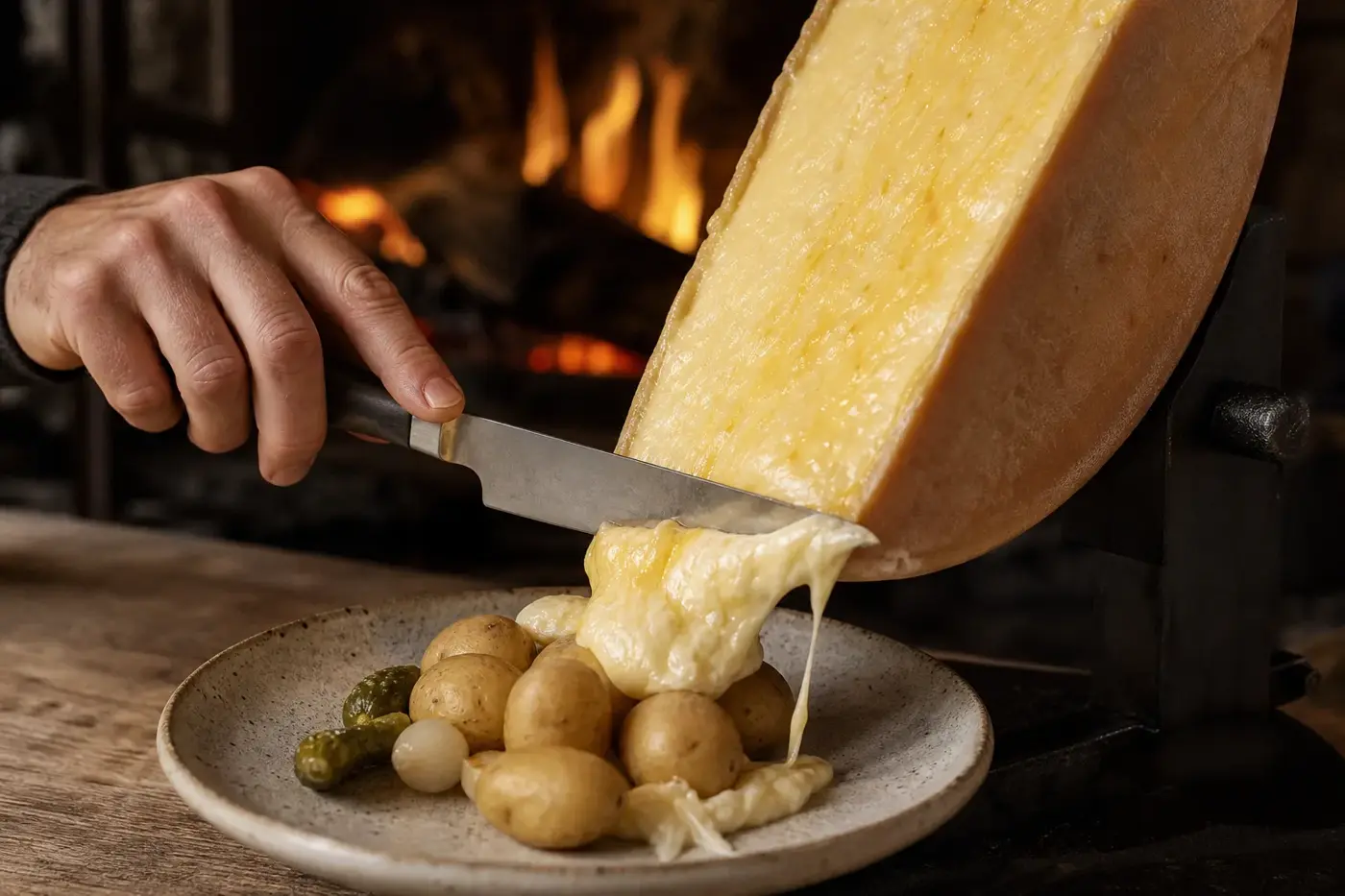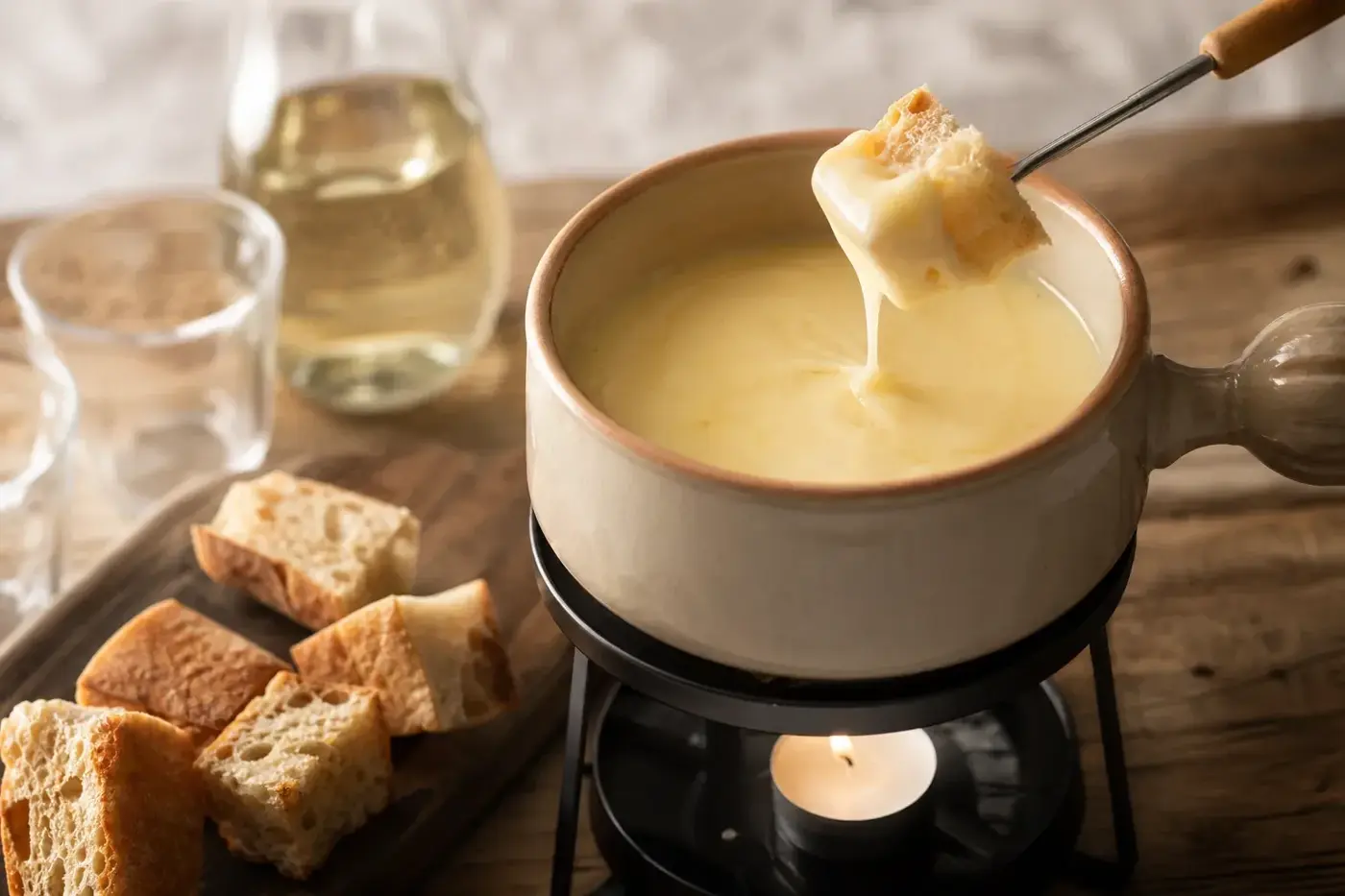
Turn a piece of bread through the pot. Cheese and wine cling to it, smooth enough to pour, thick enough to coat. That shared pleasure carried fondue from regional speciality to the Swiss national table, helped along by promotion and public tastings. Even a pot this inviting had a publicity campaign. [1][2]
Behind the smoothness sits a little kitchen discipline: measured liquid, a little starch, steady stirring and controlled heat. Get those working together and you can give the bread your full attention. [2][3]
How Switzerland gathered round the pot
Fondue belongs to the Alpine food traditions of Switzerland and neighbouring France. The Swiss National Museum traces its regional roots to French-speaking Switzerland and Savoy. Cheese promotion helped turn that communal pot into a national symbol, though there was never one uniform Swiss recipe. [1]
Between the world wars, the Swiss Cheese Union promoted cheese dishes. After the Second World War, it worked to establish fondue as a national dish, with public tastings reaching German-speaking Switzerland during the 1950s. The museum’s account includes a surviving 1954 newsreel: advertising and demonstrations helped make a regional preparation something people recognised, cooked and shared across the country. [1]
You can borrow the most enduring part of that ritual without mounting a campaign. Have one warm pot, your accompaniments prepared and everyone ready to eat as soon as the cheese is smooth. [2]
Meet the cheeses at the heart of the pot
Start with moitié-moitié, meaning half-and-half. This traditional blend combines equal weights of Gruyère and Vacherin Fribourgeois. Both Swissmilk and the Interprofession du Gruyère publish recipes pairing them with white wine and cornflour in a pot rubbed with garlic. [4][5]
That gives you a clear reference point while you find your feet. Get to know this published combination before changing cheese, liquid and seasoning together. For more about the first cheese, see Le Gruyère.
Other regions have their own loyalties. Swissmilk describes blends containing one third Appenzeller, alongside a separate Fribourg fondue made entirely with Vacherin Fribourgeois. Choose a recipe written for your blend: its moisture, salt, melting behaviour and flavour all need accommodating. [6]
Cooking for vegetarian guests? Choose a clearly labelled vegetarian melting blend and confirm the rennet with its maker. Find the background in rennet explained.
A fondue for two, ready for your table
Recipe status: an adaptation of Swissmilk’s Fondue moitié-moitié, using the gradual melting sequence described by Switzerland’s Federal Department of Foreign Affairs, rather than an independently tested fromage.co.uk recipe. Swissmilk represents Swiss milk producers and has a commercial interest in dairy consumption. [2][4]
Serves: two as a main course.
Time: allow about 25 minutes, following Swissmilk’s published preparation time.
Cooking: hob, then a suitable table warmer. No oven required. [4] For cooling, storage and reheating, follow the Food Standards Agency guidance in the leftovers section below.
Gather the good things
- 200 g (7.1 oz) Gruyère, grated
- 200 g (7.1 oz) Vacherin Fribourgeois, grated
- 200 ml (6.8 US fluid ounces) dry white wine
- 8 g (0.28 oz) cornflour
- 1 garlic clove, halved
- 10 ml (0.34 US fluid ounces) kirsch, optional
- 300 g (10.6 oz) bread, cut into small pieces
- Black pepper and grated nutmeg, to taste
The cheese and wine quantities are half those in Swissmilk’s four-person recipe. The weighed cornflour, garlic and kirsch quantities are adaptations. Swissmilk measures its cornflour in teaspoons and gives its optional kirsch as a small glass. [4]
Get your pot and tools ready
You need a grater, scales, measuring jug, wooden spoon or heat-resistant spatula, and a fondue pot with its compatible warmer. Check which hob, if any, your pot accepts. If necessary, cook in a saucepan, then transfer to the serving pot according to its instructions. [7]
Stir your way from cheese to supper
- Prepare your landing place. Cut the bread and arrange the accompaniments. Put the warmer on a stable surface, following its instructions, so your finished fondue can go straight to the table. [2][7]
- Give the pot its garlic. Rub the cut surfaces of the clove around the inside of the cooking pot. The cheese interprofession also suggests leaving the garlic in, if you like. [5]
- Smooth out the starch. Reserve a little of the measured cold wine and stir it into the cornflour until smooth. Pour the remaining wine into the pot and warm gently. [2][8]
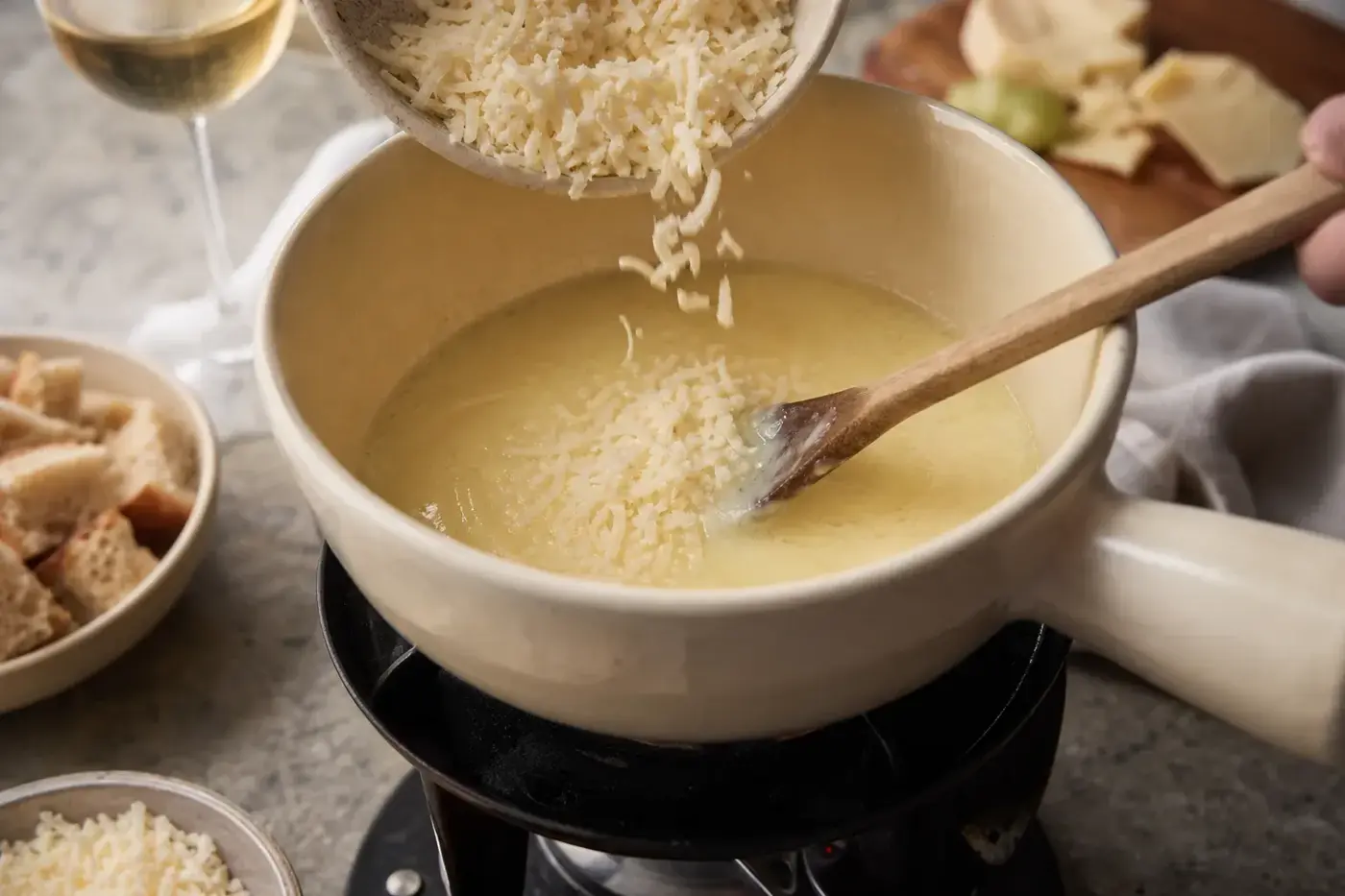
- Let the cheese melt gradually. Add the grated cheese a little at a time, stirring as each addition melts into the wine. Sweep across the base rather than stirring only in the centre. Continue until all the cheese has melted. [2]
- Bring it together. Stir the cornflour mixture again before pouring it in. Keep stirring the fondue until it comes together and briefly bubbles, then reduce the heat once smooth. Swissmilk specifies that the finished mixture should stop cooking. [4][8]
- Season, then gather round. Stir in the optional kirsch, then add pepper and nutmeg to taste. Transfer to the compatible warmer, using low heat to keep the cheese melted without continued boiling. [4][5]
Allergen check: the cheese supplies milk. Bread may contain wheat, and wine may contain sulphites. Check every ingredient and accompaniment against its actual label, including precautionary statements. For personal allergy questions, consult a doctor or dietitian and check current official guidance for your country.
Make a swap without losing the smoothness
For an alcohol-free fondue, replace the wine with 200 ml apple juice and omit the kirsch, following Swissmilk’s suggested substitution. Expect a different flavour, particularly the juice’s fruit sweetness. [4]
Fancy another cheese blend? Use a published recipe for that combination, such as the Appenzeller variation mentioned above. Check its balance of liquid and seasoning rather than carrying over quantities unchanged: each cheese behaves differently in the pot. [3][6]
The small science behind that smooth spoonful
Your fondue is more than liquefied cheese. It is a mixture of water, cheese proteins and fat. In 2019, an ETH Zurich study examined model half-and-half fondues made with Gruyère and Vacherin, measuring how starch, alcohol and acidity affected flow and stability. [3]
Starch helped prevent separation and thickened the mixtures. Wine supplies acidity and alcohol, both of which affected the proteins and reduced viscosity in the study. More acid was not always better, though: excessive acidification destabilised the experimental mixtures. [3]
At your hob, the lesson is straightforward. Melt while stirring, bring the mixture together, then turn down the heat. Brief bubbling during preparation or a texture correction is quite different from leaving the finished fondue boiling throughout the meal. [4][5][8][9]
Bring a wayward fondue back together
Keep a little wine, cornflour and lemon juice to hand. Swissmilk gives separate remedies for three common texture problems. Make small adjustments and see what happens before adding more. [8][9][10]
| What you see | What needs attention | Your next move |
|---|---|---|
| Too thick | It needs loosening | Stir in a little white wine and heat while stirring. Check before adding more. [9] |
| Too thin | It needs thickening | Add a little more cheese, or gradually stir in cornflour mixed smoothly with cold water or lemon juice. Heat while stirring until thickened. [8] |
| Oil and cheese separate | It needs bringing together | Swissmilk suggests a little lemon juice, or cornflour mixed with wine or water. Stir and bring briefly to a simmer. [10] |
These fixes are for texture, not food safety. If ingredients have been recalled or your fondue has been mishandled, follow the recall or food safety instructions instead.
Give your bread some good company
Bread is the starting point, but cooked potatoes have a place at the fondue table too. Switzerland’s official account describes pieces of both dipped into the communal mixture. You need not turn your first attempt into an elaborate spread: the pot already has everyone’s attention. [2]
Keep your selection manageable:
- Bread cut into pieces that fit comfortably on a fondue fork.
- Cooked potatoes in bite-sized pieces.
- Broccoli, cauliflower or carrots, prepared to your preferred texture.
- Pickles, olives or dried tomatoes alongside the pot. [2]
Give pickles and other accompaniments their own plates. Keep bread and potatoes nearest the fondue, so you can reach what you need without crowding the pot.
Cook vegetables that require cooking before bringing them to the table. In its guidance for England, Northern Ireland and Wales, the Food Standards Agency specifically advises following frozen vegetable instructions and thoroughly cooking products that require it. [11]
Find a glass to sit beside your fondue
Swissmilk recommends dry, acidic white wine for the pot. To drink alongside, it suggests Swiss white wines, including Fendant, or fruity Pinot Noir without oak influence if you prefer red. These pairings come from the producer organisation. [12]
Adults of legal drinking age who choose wine can serve a small glass alongside water. People who are pregnant, driving, taking medicines that interact with alcohol or recovering from alcohol dependence should not drink. Check current national advice for your circumstances.
Still water and apple juice give you alcohol-free options. For broader pairing principles, see cheese and wine pairing.
Cooking reduces alcohol, but does not reliably remove it. USDA retention data record alcohol remaining after several cooking methods, including simmering, though those figures cannot establish how much remains in this particular fondue. Optional kirsch adds another alcoholic ingredient. [13]
If you want to avoid alcohol, start with the apple-juice version and leave out the kirsch completely. Cooking a wine mixture for longer is not the answer. The juice version tastes different from the wine-based recipe, so season after the cheese has melted. [4]
Get to know your pot and its flame
A traditional caquelon carries the cooking vessel straight to the table. Cast-iron and ceramic fondue pots are documented options, but hob compatibility depends on the model. A ceramic pot’s instructions may exclude particular hobs, so read the actual product manual before applying heat. [2][7]
If you use a fuel burner, stick to the fuel and assembly specified for that model. BOSKA’s instructions require a stable, flat surface, clearance from flammable materials and continuous supervision while the burner is lit. They also warn against moving the burning holder or topping up a hot burner. [7]
Extinguish the burner with its supplied cover. Let the equipment cool completely before handling or refilling it, and keep children away while the set is operating. Once your fondue is ready, turn the heat down: the cheese interprofession specifies a very low flame to keep it warm. [5][7]
The table burner has one job: keeping finished fondue melted. Reheat refrigerated leftovers in the kitchen, not at the table.
This page summarises published guidance from the official sources it cites. It is not medical advice. Guidance differs between countries and changes over time, so check the current source for where you live, and ask your doctor, midwife, pharmacist or dietitian about your own circumstances.
Put your leftovers away safely
These handling instructions follow Food Standards Agency consumer guidance for England, Northern Ireland and Wales, as of November 2026. If you live elsewhere, consult your national authority. [11][14]
Begin cooling food as soon as it is no longer being served, rather than waiting for the meal to end. Divide leftovers into smaller containers so they cool promptly instead of leaving a full pot on the table. The FSA advises cooling cooked food and refrigerating it within one to two hours, with the fridge between 0 and 5 °C (32 to 41 °F). Eat leftovers within 48 hours or freeze them. [14]
Reheat only the portion you need, stirring frequently on the hob until steaming hot throughout. Gentle heat at the start makes the cold mixture easier to stir, but the food must finish steaming hot throughout. The FSA advises reheating leftovers only once. [11]
For ingredient storage before cooking, see how to store cheese at home.
Questions people ask
What cheese goes into a traditional Swiss fondue?
The traditional moitié-moitié combines equal weights of Gruyère and Vacherin Fribourgeois. Swissmilk and the Interprofession du Gruyère pair them with white wine and cornflour in a pot rubbed with garlic.
Can you make cheese fondue without alcohol?
Swissmilk suggests replacing the wine with apple juice. For the recipe for two, use 200 ml of apple juice and omit the kirsch.
How do you fix a separated cheese fondue?
Swissmilk suggests adding a little lemon juice, or cornflour mixed with wine or water. Stir and bring the mixture briefly to a simmer.
What can you dip in cheese fondue?
Switzerland’s official account describes dipping pieces of bread and cooked potato into fondue. Broccoli, cauliflower and carrots are also suggested, with pickles, olives or dried tomatoes alongside.
How should you store and reheat leftover fondue?
For England, Northern Ireland and Wales, the Food Standards Agency advises cooling cooked food and refrigerating it within one to two hours, then eating leftovers within 48 hours or freezing them. It advises reheating leftovers only once, until steaming hot throughout. Consult the agency’s current guidance, or your national authority if you live elsewhere.
Sources
- Swiss National Museum. Fondue, a ‘natural processed product’. Published 2019, modified December 2025. Regional background, cheese promotion and the 1954 newsreel. Source.
- Federal Department of Foreign Affairs, Switzerland. Fondue, the convivial Swiss dish par excellence. Undated online edition, retrieved November 2026. Preparation sequence, communal serving, equipment and accompaniments. Source.
- ETH Zurich researchers. Rheology of Swiss Cheese Fondue. ACS Omega, volume 4, issue 1, 2019, pages 1103 to 1109. DOI: 10.1021/acsomega.8b02424. Full paper.
- Swissmilk. Fondue moitié-moitié. Undated online recipe, retrieved November 2026. Source.
- Interprofession du Gruyère. Fondue Half & Half. Undated online recipe, retrieved November 2026. Source.
- Swissmilk. 12 astuces pour une fondue parfaite. Undated online edition, retrieved November 2026, section 3. Source.
- BOSKA. Fondue set, Nero ceramic model 853528, manufacturer’s multilingual instructions, undated edition hosted by an equipment distributor. English warnings and two-way burner instructions. Manual.
- Swissmilk. Que faire si ma fondue est trop liquide? Undated online guidance, retrieved November 2026. Source.
- Swissmilk. Que faire si ma fondue est trop épaisse? Undated online guidance, retrieved November 2026. Source.
- Swissmilk. Que faire si ma fondue se sépare? Undated online guidance, retrieved November 2026. Source.
- Food Standards Agency. Cooking your food. GOV.UK consumer guidance, online edition retrieved November 2026, sections 6 and 7. Source.
- Swissmilk. Fondue: quel vin, quelle quantité? Undated online guidance, retrieved November 2026. Source.
- USDA Agricultural Research Service. USDA Table of Nutrient Retention Factors, Release 6, December 2007. Alcohol preparation categories 5001 to 5010. Source.
- Food Standards Agency. How to chill, freeze and defrost food safely. Published 2017, online edition retrieved November 2026, section 1. Source.
Researched from Swiss institutional histories, published Swiss recipes, experimental fondue research, manufacturer instructions and official food handling guidance.
Last checked: November 2026
Last checked November 2026.
The editors suggest you read next