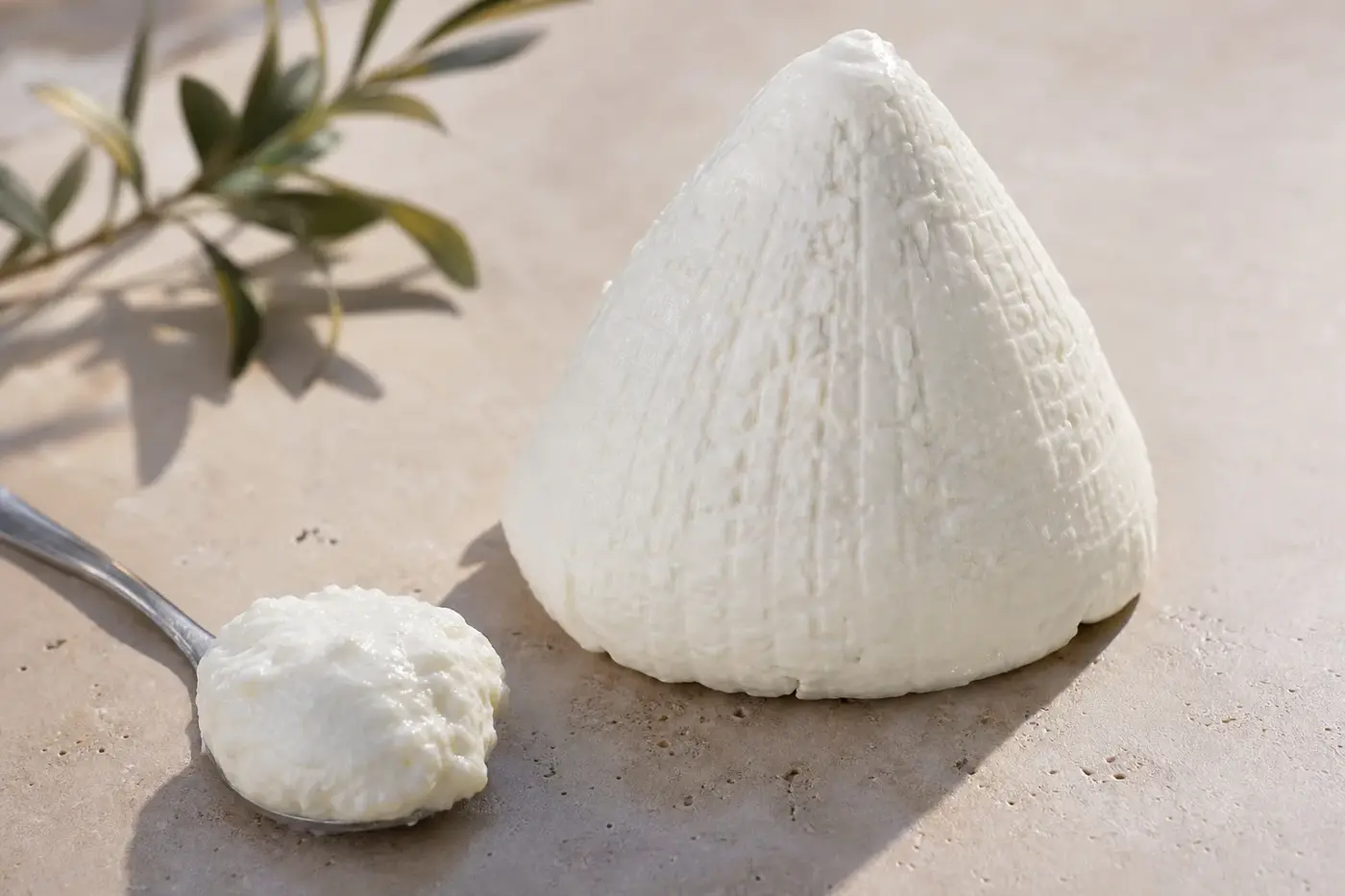
A spoon slips into a slender cornet of white cheese. No rind to negotiate, no knife required. This is Brousse du Rove, made from the whole milk of Rove goats browsing the dry, scrub-covered hills around Marseille. Heat and white spirit vinegar coax the milk into soft flakes, gathered by hand; its EU protected designation of origin ties that little cornet to the goats, the landscape and the making.[1][2][3]
| What you might want to know | The detail |
|---|---|
| The name to look for | Brousse du Rove.[2][4] |
| Registration authority and regulation | European Commission; Commission Implementing Regulation (EU) 2020/708.[2] |
| Its EU designation | Protected designation of origin, PDO; AOP in French.[2] |
| Its Great Britain designation | Registered PDO; UK scheme registration dated 31 December 2020, 23:00.[4] |
| Where it must be made | Specified communes and parts of communes in Bouches-du-Rhône, southern Vaucluse and western Var, France.[1] |
| The milk | Exclusively whole Rove goat’s milk, introduced raw and heated during manufacture.[1] |
| How the milk sets | Heat and white spirit vinegar; no rennet.[1][3] |
| What you will see | White, rindless, smooth and slightly glossy; sold in its tapered mould.[1] |
| What is in it | Maximum 30% dry matter in the whole cheese; minimum 45% fat in dry matter.[1] |
| Freshness, not ageing | Fresh, without maturation; sale permitted no later than eight days after acidification.[1] |
| Pregnancy guidance | UK: consult NHS guidance, November 2026, and confirm the product’s milk-treatment information.[7] |
Follow the goats into limestone Provence
Start in the hills around Marseille and Aix-en-Provence, rather than at the cheese counter. Brousse du Rove’s defined territory stretches through lower Provence into southern Vaucluse and western Var. INAO describes an area covering 131 communes, some only partly within the boundary.[1][3]
That boundary is more precise than a regional address. The specification’s commune list and maps determine where milk may be produced and transformed; a departmental address alone is not enough. Le Rove, the village that gives both cheese and goat breed their name, sits within this wider pastoral territory.[1]
Here you find garrigue: Mediterranean scrubland, with woody shrubs on dry ground. INAO connects the cheese to goats feeding on rough, dry terrain, rather than uniformly lush pasture. Those hills have work to do, beyond looking lovely in a photograph.[3]
The designation brings these things together: a particular animal, an established way of keeping it and cheesemaking within a defined place. You need the whole picture to understand the name. For the wider distinction between origin and production method, explore protected cheese names.
Meet the Rove goat, not just any goat
The Rove is hardy, suited to finding food on dry, uneven ground. According to INAO, it gives comparatively little milk, but that milk delivers a good cheesemaking yield. The specification requires this breed, not simply a goat that happens to live nearby.[1][3]
So “du Rove” tells you something more precise than “from Provence”. A fresh cheese made locally with another breed’s milk does not meet the milk requirement. Even Rove goat’s milk is only part of the story: the place and production method must qualify too.[1]
Keep those three requirements together when you shop. A pastoral photograph, a village name or the words “goat’s milk” gives you only part of the picture. Start with the full registered name, then look for the producer and accompanying product information.
Watch the cheesemaker gather the flakes
Here, the cheesemaker’s hands do much of the work. Through flocculation, milk solids collect into soft flakes, ready to be lifted out. The specification requires whole milk heated over a direct flame to 85 to 95 °C, followed by white spirit vinegar added when the milk is at 65 to 75 °C. Stirring, collection and moulding are all manual.[1]
The vinegar supplies acid, working with heat to form the curd: those gathered milk solids. There is no rennet, the coagulating enzyme used in many other cheeses. INAO describes slow, regular stirring, then collection with a skimmer before moulding.[3]
Picture those fragile flakes being lifted from the heated, acidified milk. This is quite different from cutting a firm, rennet-set curd into pieces, and it helps explain the cheese’s fresh character. You can follow the broader sequence of curd formation and separation in how cheese is made.
The milk enters raw, then undergoes heating. Keep both details in mind when you read a label, because one word cannot capture the whole sequence. For pregnancy questions, establish the particular product’s milk-treatment information before applying the guidance below.
Start with whole milk, not leftover whey
Brousse du Rove begins with whole goat’s milk, rather than primarily with whey left from making another cheese. Whey is the liquid that separates from curd during cheesemaking. It also separates during Brousse du Rove’s own manufacture.[1]
When you compare fresh cheeses, that starting material matters. White flakes and heat can lead to similar-looking results in a bowl, despite different routes from milk to finished food. “Ricotta-like” may suggest an appearance or serving idea, but whole-milk cheese is the more precise description here.
Looking for a substitute in the kitchen? Decide what your dish needs: a delicate, spoonable texture, fresh dairy flavour or that intact tapered presentation. A useful stand-in need not be entitled to carry the protected name.
A small cornet, measured to the millimetre
The prescribed cornet is a truncated cone, 85 mm tall, with an upper diameter of 32 mm and a lower diameter of 22 mm. Three holes in its base let liquid drain away. The cheese stays in this mould for sale, rather than being unmoulded beforehand.[1]
You will recognise the tall, narrow shape immediately. This is a slender individual portion, not a round disc waiting to be divided into wedges. Put out a spoon and a small dish; your cheese knife can enjoy a rare afternoon off.
INAO describes the paste as white, smooth, slightly glossy, supple and non-granular. Think softness with a cohesive texture, not dry crumbs. If you have never tasted it, that description gives you a useful idea of what awaits.[3]
There is no rind or matured outer layer to trim away. You can leave the cheese in its cornet, or turn it gently into a dish if the product’s handling instructions allow. Either way, a light touch suits it.
Take a spoonful and see what you find
Fresh milk and sweet almond lead INAO’s description of the aromas, alongside a restrained animal note. Its account also records variable notes linked to the goats’ feeding, including rosemary, broom and kermes oak. That quiet white spoonful has more going on than you might expect.[3]
Begin with a small taste, unadorned. Expect a delicate fresh cheese, rather than a forceful goat’s cheese, and notice the dairy aroma, the feel against your tongue and the finish. Then decide whether you want seasoning, fruit or sweetness.
Rosemary, broom and kermes oak are aroma descriptions here, not ingredients. INAO links variation to feeding, so use these notes as a vocabulary for tasting. You need not find every one in every portion.[3]
Choose Brousse du Rove for an early meal, not for setting aside like a matured cheese. INAO emphasises fresh milk character and delicate texture, rather than charting flavour changes over time.[3] Freshness is the destination, not a stage on the way to something else.
Look for the full name on the label
PDO means protected designation of origin; AOP, appellation d’origine protégée, is the French wording. The European Commission adopted the registration regulation on 19 May 2020 and published it on 28 May 2020. Under Article 2, it took effect on the twentieth day after publication, 17 June 2020.[2]
Great Britain has a separate register. It records PDO registration under the UK scheme on 31 December 2020 at 23:00, and gives 28 May 2020 as the original EU registration date. These dates refer to distinct recorded events.[4]
At the counter, look for Brousse du Rove in full, not simply “brousse”. Read the accompanying information and ask who made it if that is unclear. The complete name and traceable details tell you more than the tapered shape alone.
Before deciding how many portions to take home, read the date and refrigeration instructions. Ask: “When should I eat this, and what changes after opening?” Plan around the answer for that particular product, rather than a general idea of how long cheese keeps.
Bring a spoon, then choose sweet or savoury
Plain, sprinkled with sugar or served with fruit coulis: INAO documents all three ways of enjoying Brousse du Rove. Each gives you a good first encounter. There is little handling involved, leaving the cheese at the centre of the plate.[3]
For something sweet, taste it plain before adding sugar or a little coulis at the table. Keep the fruit alongside rather than covering the whole portion. You can then give each spoonful as much or as little accompaniment as you fancy.
For a savoury plate, try a little olive oil, freshly ground pepper and bread, or a spoonful beside tomatoes. These are serving suggestions, separate from the documented preparations above. Season lightly, taste, then decide whether you want more.
Fresh berries and a little honey offer another option for a modern dessert plate. Keep the components separate enough to compare each combination with a plain spoonful. Water makes an uncomplicated accompaniment, whether you choose sweet or savoury.
Bring the cheese out of refrigeration promptly before serving. For England, Wales and Northern Ireland, FSA guidance says chilled food should spend the shortest possible time outside the fridge during preparation. Its maximum is four hours.[5]
Keep it chilled and follow its label
Keep dairy products refrigerated and follow the product’s storage instructions, including directions for after opening. For households in England, Wales and Northern Ireland, the FSA recommends a fridge temperature between 0 and 5 °C. Give this fresh cheese the chilled storage its instructions require.[5]
A use by date concerns safety; a best before date concerns quality, according to UK government guidance. Do not eat the cheese after its use by date. Incorrect storage can make it unsafe sooner, so follow both the storage instructions and any shorter period specified after opening.[6]
If you are pregnant in the UK, the NHS lists pasteurised soft goat’s cheese without a white rind among foods you may eat. It also lists hard cheeses such as cheddar made with pasteurised or unpasteurised milk. Read its current advice on unpasteurised products and cooking, and ask your midwife for help applying it if needed.[7]
Brousse du Rove begins with raw milk and undergoes substantial heating during manufacture.[1] Ask the producer or seller to confirm the particular product’s milk-treatment information. If you need help applying NHS guidance, take those details to your midwife or another appropriate healthcare professional.
For household handling, turn to the cheese storage guide. For label terminology, see the guide to milk treatments. Outside the UK, follow your own country’s current official advice on pregnancy and food safety.
General information only, not medical advice: follow the official guidance where you live.
Questions people ask
What is Brousse du Rove?
Brousse du Rove is a fresh, rindless cheese made exclusively from whole Rove goat’s milk. Its protected name is tied to a defined area of Provence and a specified production method.
Is Brousse du Rove made from raw milk?
The milk enters production raw and is then heated over a direct flame to 85 to 95 °C. Ask the producer or seller to confirm the particular product’s milk treatment information.
How should I store Brousse du Rove?
Keep it refrigerated and follow the product’s storage instructions, including any directions for after opening. The FSA recommends a fridge temperature between 0 and 5 °C in England, Wales and Northern Ireland. Do not eat the cheese after its use by date.
Can I eat Brousse du Rove during pregnancy?
The NHS lists pasteurised soft goat’s cheese without a white rind among foods that may be eaten. Brousse du Rove starts with raw milk and is heated during manufacture, so ask the producer or seller about the particular product’s milk treatment. Check current NHS pregnancy guidance and ask your midwife for help applying it if needed.
How is Brousse du Rove served?
INAO documents serving it plain, sprinkled with sugar or accompanied by fruit coulis. Other suggestions on the page include olive oil, pepper and bread, or tomatoes.
Sources
[1] French Ministry of Agriculture, Cahier des charges de l’appellation d’origine « Brousse du Rove », approved by the order of 31 May 2018, published in Bulletin officiel No 24, 2018. Official specification.
[2] European Commission, Commission Implementing Regulation (EU) 2020/708 of 19 May 2020 entering a name in the register of protected designations of origin and protected geographical indications (‘Brousse du Rove’ (PDO)), Official Journal L 166, 28 May 2020, Articles 1 and 2. Official regulation.
[3] INAO, La « Brousse du Rove » reconnue en AOP, press release, 4 June 2020. Official account.
[4] Department for Environment, Food & Rural Affairs, Brousse du Rove, protected food name register entry, published 4 January 2021, retrieved November 2026. GB register entry.
[5] Food Standards Agency, How to chill, freeze and defrost food safely, published 18 December 2017, current retrieved version November 2026; applies to England, Northern Ireland and Wales. Official chilling guidance.
[6] UK Government, Understanding food labelling: Best before and use-by dates, current retrieved version November 2026. Official date guidance.
[7] NHS, Foods to avoid in pregnancy, current retrieved version November 2026. Official pregnancy guidance.
Researched through official French production documents, the EU registration instrument, the GB register and current retrieved UK consumer guidance; serving suggestions identified as editorial are desk-research recommendations.
Last checked: November 2026
Last checked November 2026.
The editors suggest you read next