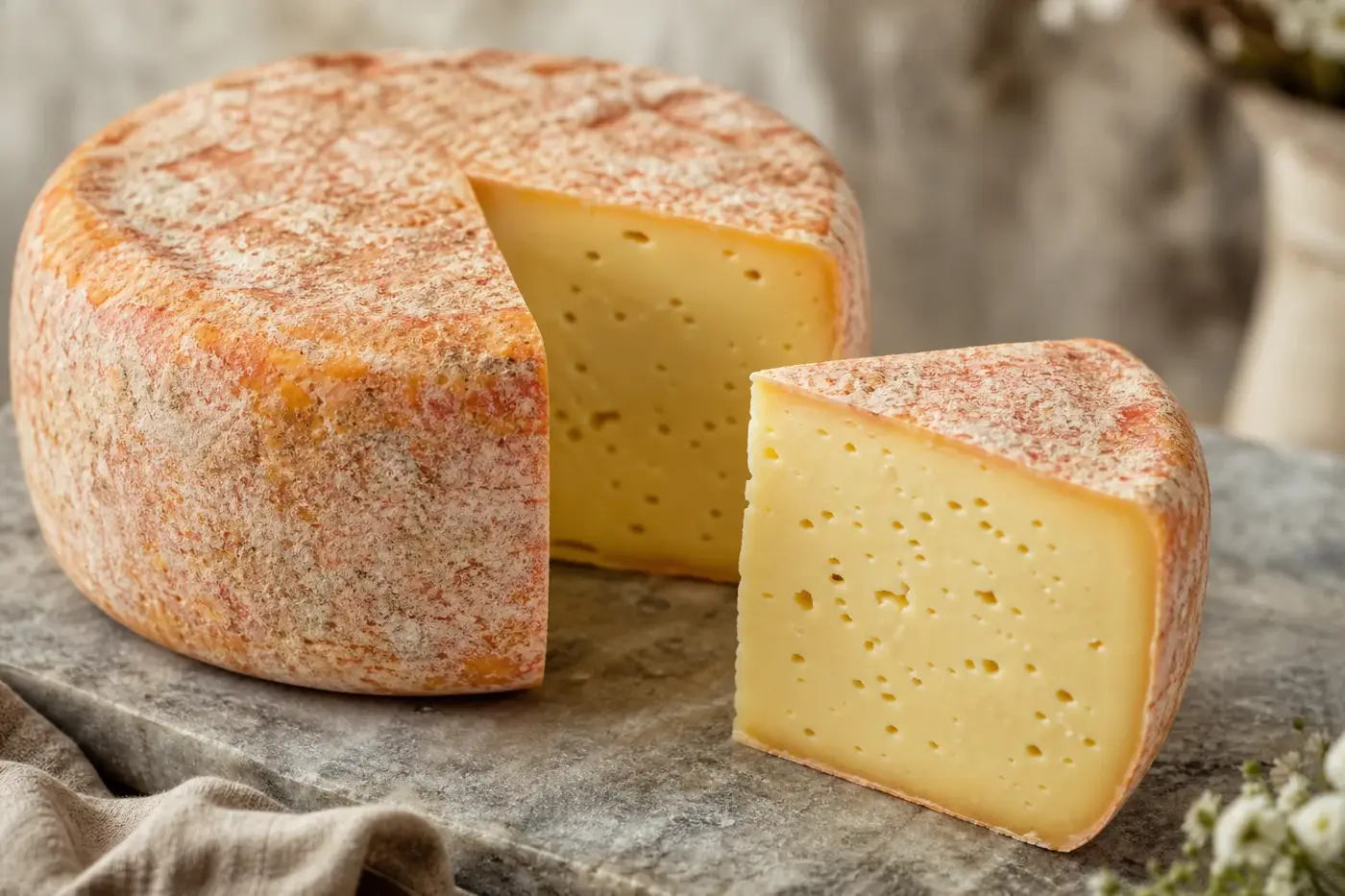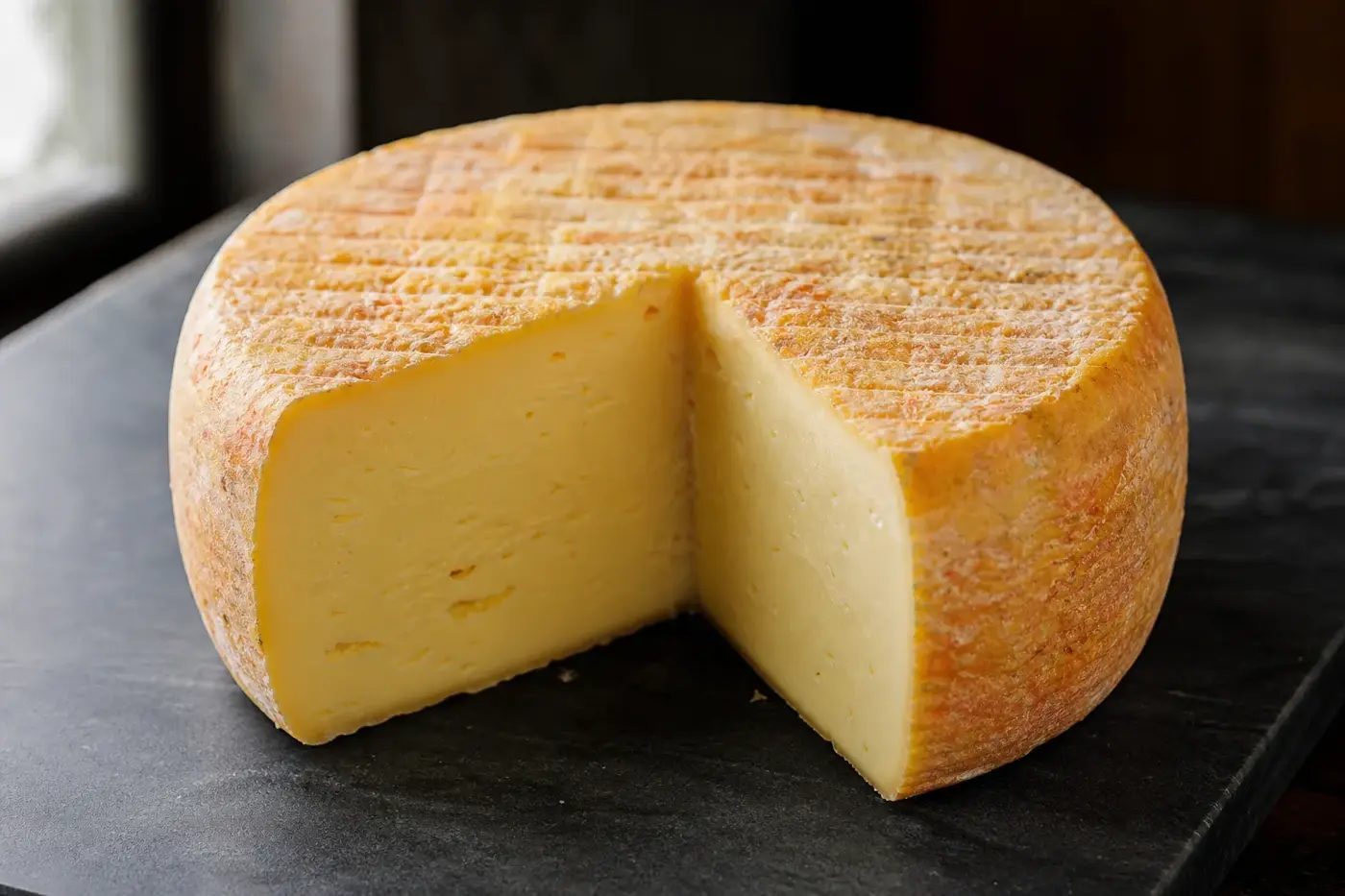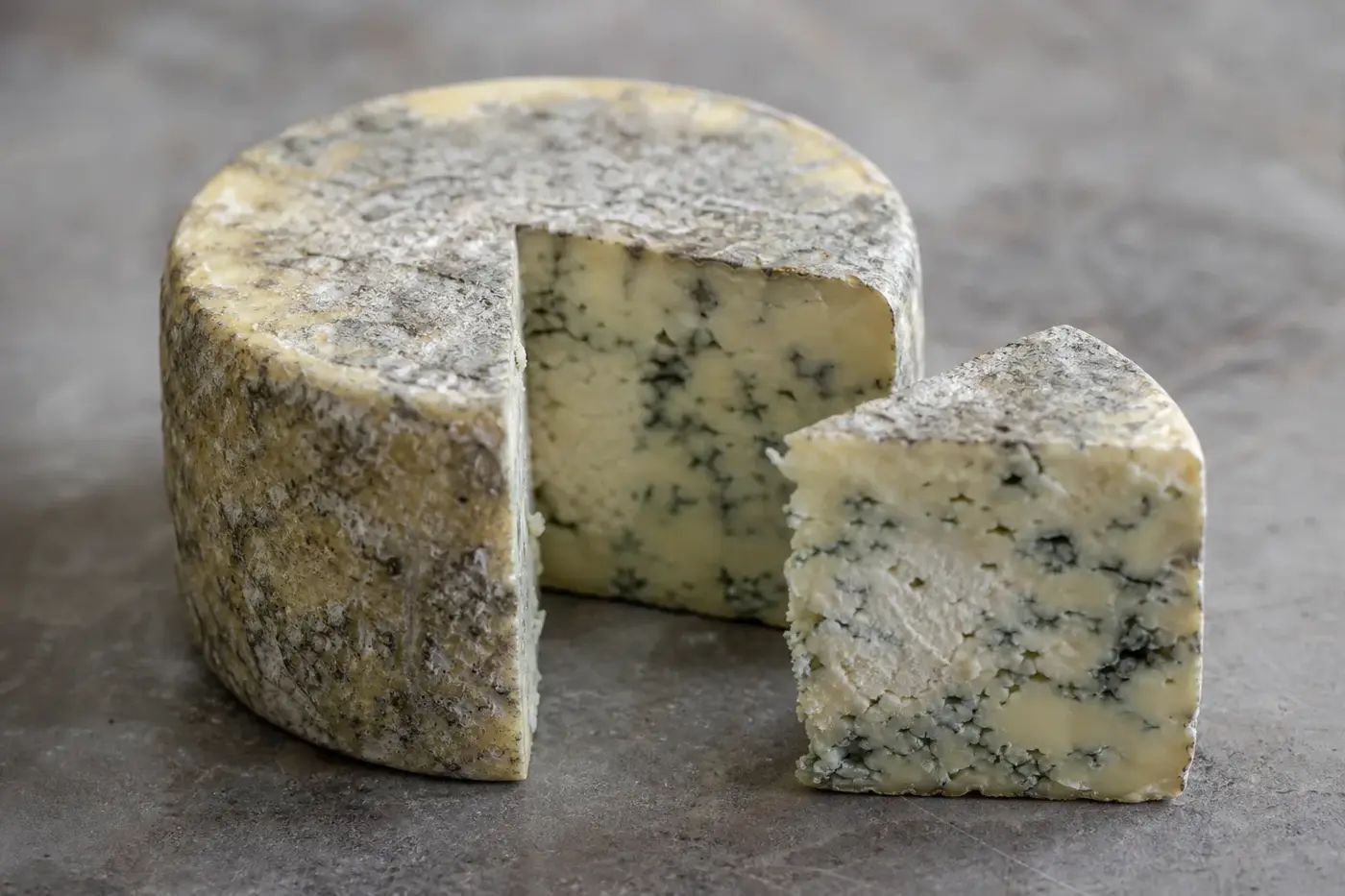
Take a look at your wedge before the first bite. Ivory paste, greenish-blue veins, perhaps a chalkier centre: Cashel Blue gives you plenty to notice. Young, it tastes mildly blue with a little acidity; given time, its flavour grows fuller. [1][2]
That changing character began with Jane and Louis Grubb, who created this cow’s milk blue in 1984 at Beechmount Farm in County Tipperary, in the Republic of Ireland. Texture develops alongside flavour, making your choice of wedge part of the pleasure. A little deliberation at the cheese counter is entirely justified. [1][2]
| Get to know it | Cashel Blue |
|---|---|
| Name | Cashel Blue, a named cheese also sold under the maker’s brand [2] |
| Home | Beechmount Farm, County Tipperary, Republic of Ireland [1][2] |
| Milk and treatment | Pasteurised cow’s milk [3] |
| What sets the curd | Vegetarian rennet, currently declared by the maker [1] |
| The blue mould | Penicillium roqueforti [1] |
| Style and size | Soft blue cheese; approximately 1.5 kg wheels [3] |
| Rind | Natural, grey to pale yellow [2] |
| Usual ages | Approximately 10 weeks to six months in the Academy of Cheese reference [3] |
| Declared allergen | Milk [1] |
| Pregnancy guidance | UK NHS and Ireland’s HSE advice, November 2026, appears below [7][8] |
Meet Jane and Louis, who started with an experiment
Before there was Cashel Blue, there were experiments. Jane Grubb took a cheesemaking course, spent several years trying things out and sold different cheeses at a local country market. The maker’s chronology places Cashel Blue’s beginnings in 1984, within Ireland’s modern farmhouse cheesemaking story. [1]
Jane had worked as a chef; Louis had been an agricultural research manager. A company presentation records those backgrounds, bringing together an interest in food and experience of farming and milk production. It also recalls parcels of cheese sent to Myrtle Allen at Ballymaloe Restaurant in the early days. [4]
This wasn’t an inherited, anonymous regional recipe. Cashel Blue grew from the family’s milk and the style they wanted to make, giving you a cheese with a distinctly personal beginning. Bord Bia, Ireland’s food promotion body, names Jane and Louis as the founders and places production, maturation, grading and selection at Beechmount Farm. [2]
Return to Beechmount with the next generation
In 2004, the founders’ daughter, Sarah, and her husband, Sergio Furno, returned to manage the business. The maker’s current account identifies them as the second generation continuing the operation, with responsibility for maturation. Beechmount remains at its heart. [1]
The milk comes from the family herd and neighbouring suppliers. The Academy of Cheese describes Cashel Blue as made on the same family farm, using milk from its own herd and a handful of other local farms. It identifies Friesian cows and pasteurised milk. [3]
Beechmount, then, is much more than a name for you to spot on the label. It supplies milk and is where the cheese is made, alongside those additional local milk supplies. A Bord Bia case study published in 2022 records that the cheeses were made, matured, graded and selected there. [5]
Those last two stages matter when you’re choosing a wedge. Making a cheese is one job; deciding when it is ready is another. Selection helps determine what finally reaches your counter.
Follow the blue from milk to wheel
The mould arrives before there is even a cheese to pierce. The maker starts by pasteurising whole milk, then adds starter culture, blue mould and vegetarian rennet. Rennet helps form the curd, the solid portion separated from liquid whey. [1]
Next, the curd is cut, transferred into moulds and turned to drain. Salting follows on day three. On day four, each wheel is pierced so air can reach the interior and encourage the blue mould to develop. [1]
The spores are already there; piercing gives them the conditions they need to grow inside the cheese. During maturation, the wheels are turned and subsequently wrapped in foil. The dairy’s tasting team grades batches and chooses their ageing period, usually two to three months in the maker’s current account. [1]
That sequence explains the blue you find within the paste, rather than simply across its surface. If you’re curious about the work before those veins appear, explore how cheese is made for more on curd formation and drainage.
Look closely, then take your first bite
Ivory paste threaded with greenish-blue colouring gives Cashel Blue its distinctive look. You’ll usually meet this relatively small blue as a wedge cut from a wheel. The Academy of Cheese gives an approximate whole-cheese weight of 1.5 kg and classifies it as a soft cheese with internal blue mould and a natural rind. [3]
Bord Bia’s producer profile describes the rind as grey or pale yellow, with paste that can be chalkier towards the centre. Don’t expect every wedge to be uniformly soft or evenly threaded with blue. Those variations are part of what you’re looking at across the counter. [2]
The same profile describes young cheese as mildly blue and slightly acidic. With age, a balance develops between the soft dairy character and the blue flavour. These tasting descriptions come from that profile, rather than a fromage.co.uk tasting account or aroma assessment. [2]
Ask about texture as well as strength. “Mild” won’t tell you whether your wedge will spread or break. At the table, that can matter just as much as how strongly the blue flavour comes through.
Choose your favourite age, not just the oldest
Older Cashel Blue isn’t simply younger cheese made softer. Beyond 18 weeks, Bord Bia’s profile describes a more assertive blue flavour and a more granular texture. More age gives you a different experience, not an automatic promotion. [2]
The same profile identifies young wheels at around eight weeks and extra-mature selections at roughly 12 to 14 weeks or more. Selection also shapes the description. Age is therefore one of the most useful things you can ask about when choosing between stages. [2]
If you want a gentle blue flavour, choose the younger end. If you’d like the blue character to take a larger part, ask for a more developed selection. Neither preference outranks the other: choose for your taste and your plans.
For a shared board, tell the cheesemonger who’s eating and how you’ll serve it. “A gentle blue for bread” or “a fuller-flavoured cheese for cooking” gives them something useful to work with. “The oldest piece, please” is less a plan than a birthday competition.
Make room for Cashel Blue at your table
Try a small piece on its own first. Then decide how much sweetness, acidity or crunch you’d like beside it. The suggestions below are editorial serving ideas, not pairings tested by the site.
| Put it alongside | Try it this way | What it brings |
|---|---|---|
| Plain bread or an unsweetened cracker | Start here | Keeps your first taste focused on the cheese |
| Pear or apple | Offer separate slices | Lets you choose your fruit-to-cheese balance |
| Walnuts | Serve alongside and identify their allergen | Adds contrasting texture |
| Fruit preserve | Put a little on the side | Leaves sweetness up to you |
| Water or an alcohol-free apple drink | Offer with the board | Gives you an uncomplicated alcohol-free choice |
Keep the cheese refrigerated and follow the storage instructions on its packaging. [9]
Bread and fruit give Cashel Blue a straightforward setting, with room for you to find your preferred balance. A little can also be the main cheese element in a salad. In the kitchen, consider a potato filling, a vegetable tart or a blue-cheese sauce.
Treat those as dish ideas, not tested recipes. Use a complete recipe for quantities, cooking and handling instructions. If pregnancy guidance calls for thorough cooking, follow the official advice below: softened cheese is not enough.
This page summarises published guidance from the official sources it cites. It is not medical advice. Guidance differs between countries and changes over time, so check the current source for where you live, and ask your doctor, midwife, pharmacist or dietitian about your own circumstances.
Bring home the right wedge and store it well
Tell the seller what texture and strength you enjoy. Ask when the cheese was made, how developed they consider it and whether a cut piece comes with storage instructions. Published ages are useful reference points, but the seller’s knowledge of that particular wheel matters more than a general maturity label. [2]
Before you discard the packaging, keep the product name, batch information, date mark and storage directions available. That’s especially useful if you transfer the cheese to another container. For help making sense of those details, turn to the guide to reading a cheese label.
For household refrigeration, FSA guidance recommends a fridge at 5 °C or below and keeping dairy products refrigerated. Its consumer research guidance also stresses leaving room for air to circulate. These UK household recommendations are from November 2026. [10]
After opening, follow the pack’s instructions. For cheese cut to order, ask the retailer for the relevant directions. Buy an amount that fits your plans, rather than assuming a shelf life that might not apply to your piece.
Blue veining and a natural rind are part of Cashel Blue’s documented appearance. [2][3] If you suspect the cheese is unsafe, don’t eat it; throw it away. Follow any recall notice.
Ireland’s HSE advises pregnant readers not to eat food beyond its use-by date. If you suspect food poisoning, contact a GP. [8]
Your guide to rennet, milk and pregnancy advice
Cashel Blue’s maker currently declares vegetarian rennet and lists milk as an allergen. Those answer two different dietary questions. Vegetarian rennet doesn’t change the fact that the cheese contains milk. [1]
Check the current pack when buying for a dietary requirement. For personal advice about milk allergy or lactose intolerance, ask an appropriate clinician or dietitian. You can also consult cheese allergy versus lactose intolerance.
UK pregnancy advice, November 2026: the NHS says pasteurised and unpasteurised soft blue-veined cheeses must be thoroughly cooked. Cheese cooked until steaming hot is among the foods it says you can eat during pregnancy. Pasteurisation alone therefore does not meet its advice for this cheese category. [7]
Republic of Ireland pregnancy advice, November 2026: the HSE’s public guidance lists blue cheeses among foods to avoid. Consult the current HSE guidance and ask your midwife about your circumstances. [8]
For a cooked dish under NHS guidance, the instruction is steaming hot throughout. Merely softening the cheese or warming a topping does not meet that instruction. [7]
Questions people ask
Where is Cashel Blue made?
Cashel Blue is made at Beechmount Farm in County Tipperary, Republic of Ireland. It uses pasteurised cow’s milk from the family herd and local farms.
What does Cashel Blue taste like?
Young Cashel Blue is mildly blue and slightly acidic. As it ages, the blue flavour becomes fuller, and beyond 18 weeks it can be more assertive.
Is Cashel Blue vegetarian?
The maker currently declares vegetarian rennet. The cheese contains milk, which the maker lists as an allergen.
Can I eat Cashel Blue during pregnancy?
The NHS says soft blue cheeses must be thoroughly cooked and identifies cheese cooked until steaming hot as a food that can be eaten during pregnancy. Ireland’s HSE lists blue cheeses among foods to avoid. Consult the current NHS or HSE guidance for where you live and ask your midwife about your circumstances.
How should I store Cashel Blue?
Keep it refrigerated and follow the instructions on its packaging. The FSA recommends keeping the fridge at 5 °C or below and leaving room for air to circulate.
Sources
[1] Cashel Farmhouse Cheesemakers. Our Story, including the production account and product information. Undated live edition, retrieved November 2026. Official source.
[2] Bord Bia. Cashel Farmhouse Cheese, producer and product profile. Undated live edition, retrieved November 2026. An industry promotion source, not a regulator or independent sensory study. Producer profile.
[3] Academy of Cheese. CASHEL BLUE, Level Two cheese reference, February 2022 edition, retrieved November 2026. Reference document.
[4] Sarah Furno, Cashel Farmhouse Cheesemakers. Building Exports In the U.K, company presentation hosted by the Irish Foodservice Suppliers Alliance. Publication date not verified; retrieved November 2026. Company presentation.
[5] Bord Bia Origin Green. Cashel Farmhouse Cheesemakers, Gold Member case study, 2022. Retrieved November 2026. Case study.
[7] NHS. Foods to avoid in pregnancy. Live edition retrieved November 2026. UK pregnancy guidance.
[8] Health Service Executive, Ireland. Foods to avoid in pregnancy. Reviewed 3 December 2025; retrieved November 2026. Irish pregnancy guidance.
[9] Food Standards Agency. How to chill, freeze and defrost food safely. Published 18 December 2017; live edition retrieved November 2026. Applies to England, Northern Ireland and Wales. Household chilling guidance.
[10] Food Standards Agency. Storing chilled foods at incorrect temperatures. Household guidance summary, page 8; retrieved November 2026. Research report.
[11] Health Service Executive. Clinical Practice Guideline: Nutrition During Pregnancy. Online edition retrieved November 2026, pages 37 to 39. Clinical guideline.
This piece combines desk research from the cheesemaker, published cheese references and official food-safety guidance; it includes no site tasting or recipe test.
Last checked: November 2026
Last checked November 2026.
The editors suggest you read next
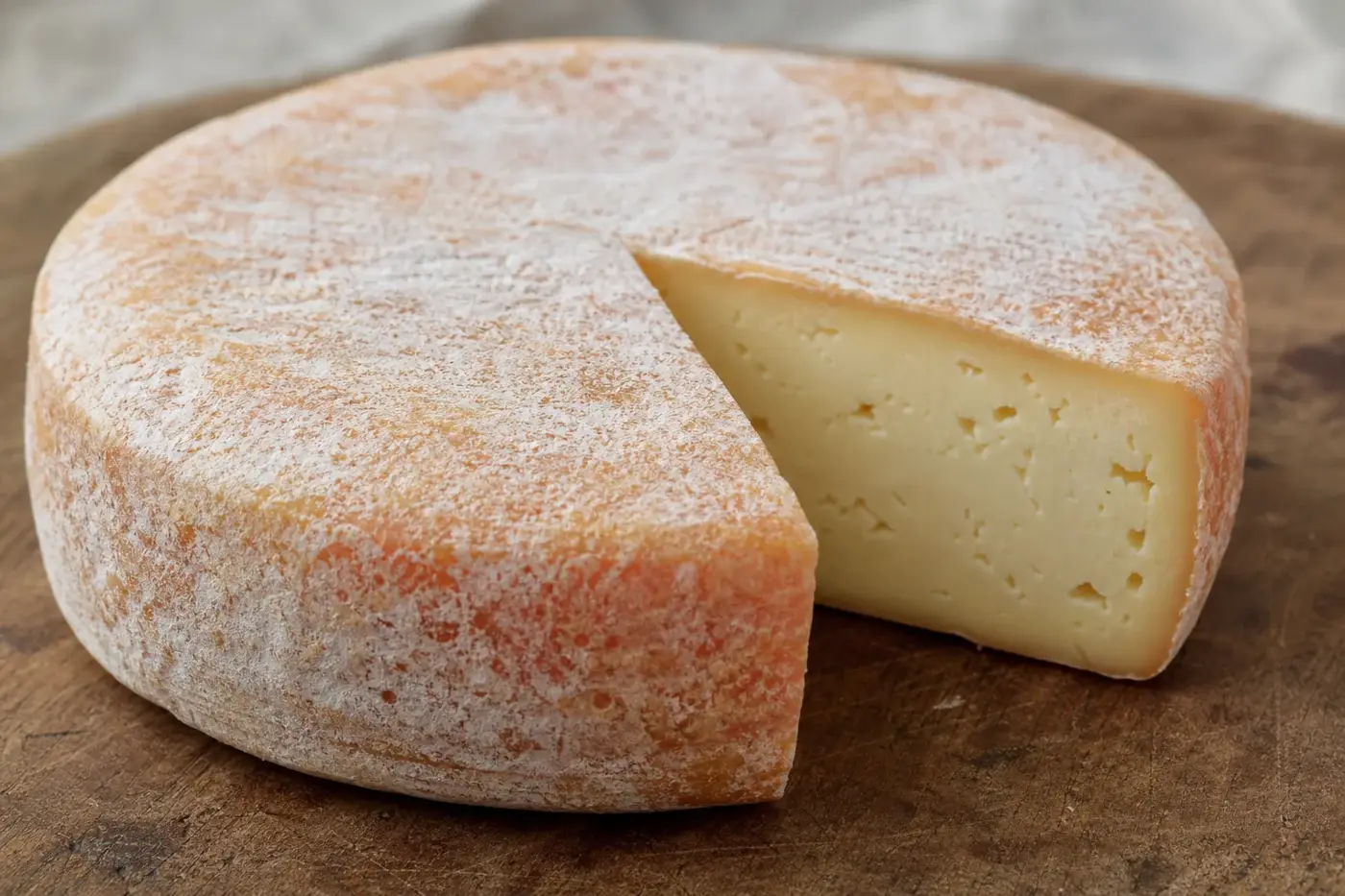
Gubbeen
The Atlantic lies along one boundary, Mount Gabriel rises behind you, and in the dairy a cheese is quietly finding its character.