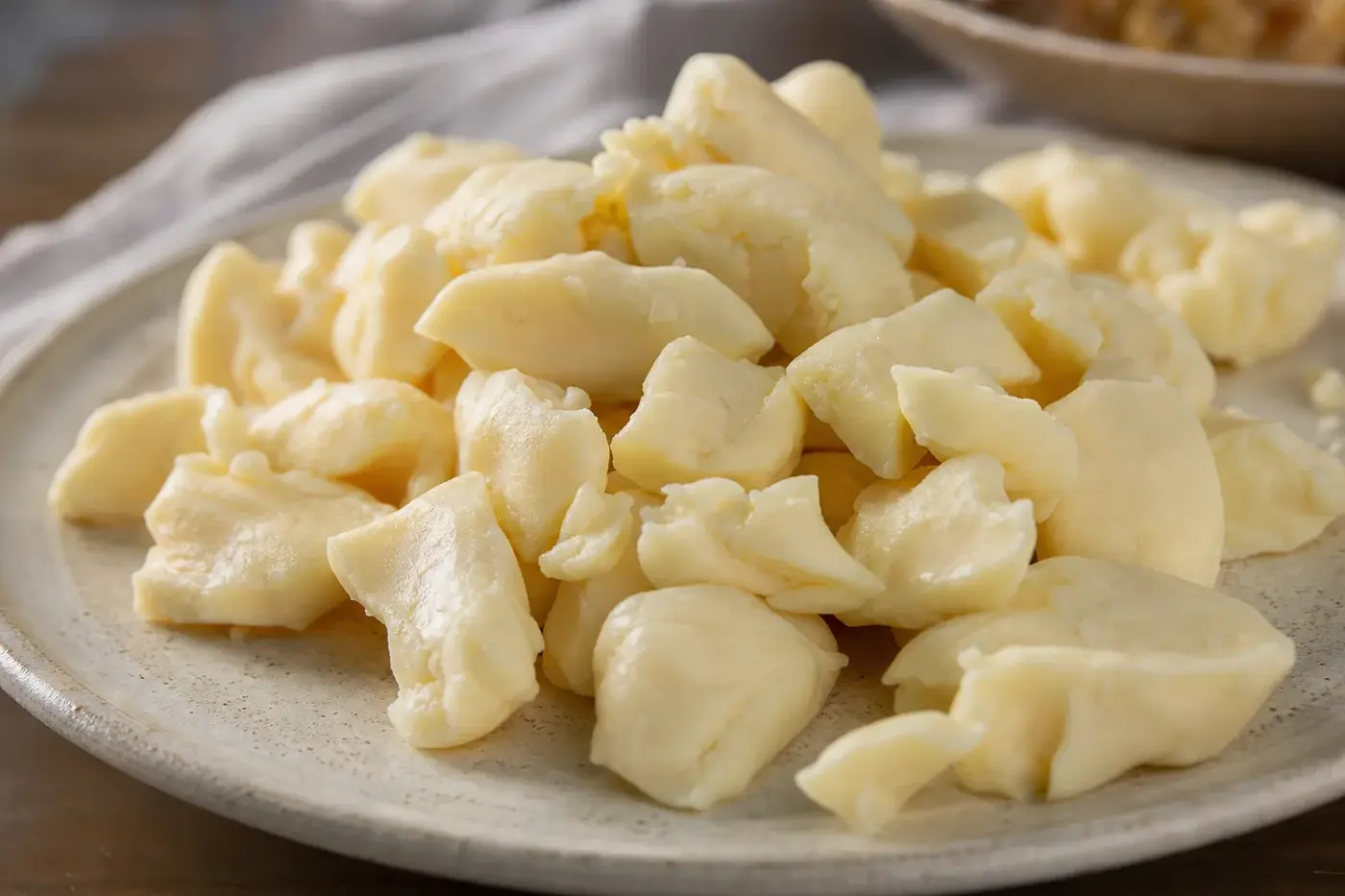
You bite. The cheese pushes back, then squeaks against your teeth. It is a surprisingly vocal mouthful: University of Wisconsin researchers trace that little performance to a springy protein network that resists movement, then yields as you chew. Fresh and elastic, these are pieces a cheesemaker can sell as they are, or press together into cheese for ripening. [4]
Those fresh cheddar style curds are milk solids separated from whey. But “curd” has a much bigger life beyond the sometimes squeaky morsels in a bag. How the milk sets matters: curds formed mainly by acid can behave very differently from those made with rennet. [1][2][4]
Pull up a chair beside the vat
Before you have a curd, milk must set into a gel. Called coagulation, this process creates a network of milk proteins, chiefly casein, holding moisture and fat. Cutting and draining releases whey, the liquid containing water, lactose, minerals and whey proteins. [1]
Open a bag labelled “cheese curds” and you will usually find salted, unpressed cheddar style pieces. Peer into a cheesemaking vat, though, and curd takes many forms, including the delicate material destined for fresh acid-set cheeses. The difference lies in the method, not just the size of the pieces. [2][4]
Want to see where it all leads? Follow the full journey in how cheese is made.
Rennet and acid take different routes
Rennet changes casein so its particles can join into a gel. This preparation of enzymes works alongside starter cultures in cheddar making: bacteria added to turn milk sugar into lactic acid. When you see “rennet-set”, it tells you the main setting mechanism, not that acid is absent. [2]
With acid-set curds, acid changes the conditions around the proteins until they gather together. Cheesemakers can develop that acidity with cultures or add acid directly. Some methods bring heat into the picture: acid-and-heat coagulation helps recover whey proteins as well as casein from suitable milk mixtures. [2][7]
You might end up with something fragile and spoonable, or firm enough to cut. The setting method, the heating that follows and the drainage all help decide which texture reaches your plate. [2][7]
A small cut makes a big difference
The first cut turns one continuous gel into pieces. Those newly exposed surfaces let whey escape, with smaller pieces generally losing moisture more readily than larger ones. Stirring keeps the grains apart. [1]
Warm the curd and its protein network contracts, squeezing out more whey in a process called syneresis. Cutting, stirring, temperature and acidity all give the cheesemaker ways to control moisture and texture. Draining removes the released liquid, but plenty of water stays tucked inside the curd. [1]
Cheddar takes a pause before the block
Traditional cheddaring begins after much of the whey has drained. The curds knit into a mass, which the cheesemaker cuts into slabs, turns and stacks. As acidity develops and more whey escapes, those slabs become increasingly cohesive and fibrous. [3]
Then comes milling: cutting or tearing the slabs into smaller pieces. This exposes enough surface to distribute salt through the curd. Once salted, the pieces can be chilled and sold as fresh curds, or put into moulds and pressed together. [3][6]
Pressing joins the pieces into one body; ripening then develops texture and flavour through biochemical activity, including protein breakdown. The fresh curds you eat are a deliberate stopping point, not merely unfinished aged cheddar. They have a character all their own. [3][5]
Listen closely for the squeak
That sound is curd rubbing against your teeth. University of Wisconsin researchers propose that an interconnected, elastic protein network resists movement before giving way as you chew. Your snack has, briefly, become its own soundtrack. [4]
Storage changes that network. Researchers have proposed that calcium, moisture and protein breakdown all help the sound fade, although their relative contributions remain under investigation. [4][5]
Enjoy the squeak as a texture characteristic, not a precise clock. Wisconsin researchers also identify storage and serving conditions as influences. For safety, let the pack’s storage instructions and date guide you. [5][10][11]
Get to know that milky, springy bite
Wisconsin’s Center for Dairy Research describes fresh curds as clean, milky and salty, with a springy, rubbery texture. You get mild flavour and a little resistance to the bite, before ripening brings its changes. Ellsworth Cooperative Creamery describes their random shapes as the form the cheese takes before being made into blocks. [4][6]
Choose plain curds if you want to give that texture your full attention. Herbs and seasonings change the flavour, so read the product description rather than expecting every bag to taste alike. If you are choosing curds for a dish, the maker’s description tells you more than colour alone. [6]
Curds, cottage cheese or something to peel?
All these products can begin with curd. What happens next gives each its own identity, whether you end up with separate pieces, a creamy spoonful or something to peel. [1][3]
| Product | What makes it distinctive |
|---|---|
| Fresh cheddar style curds | Salted, separate pieces you buy before pressing and ripening. [3][6] |
| Pressed and aged cheese | Curds joined together, then ripened to develop texture and flavour. [3][5] |
| Cottage cheese | Acid-developed curd that is cut, cooked, washed and commonly mixed with a cream dressing. [1] |
| String cheese | Usually a mozzarella style, made by stretching heated curd into a fibrous, peelable structure. [1][4] |
Take your curds from Quebec to the table
In Quebec, fresh cheese curds meet chips and brown gravy in poutine. Tourisme Montréal records competing origin stories from Warwick and Drummondville. Its place in Quebec’s food culture is clear, even if the identity of its inventor remains disputed. [9]
Fried curds are especially associated with the American Midwest. A coating encloses the cheese as it heats, giving you a contrasting bite around a softened centre. Ellsworth describes its own fried curds as slightly stringy, served with dipping sauces such as tomato sauce or ranch dressing. [4][6]
You can keep things simpler with plain curds, bread, sliced apple or pickles. Something crisp or acidic gives contrast to that milky, salty character. Put out a small portion and keep the rest refrigerated. [4][10]
Before you turn up the heat
Cheddar style curds can soften and melt, but they do not all behave alike. Acidity, calcium, moisture and the condition of the protein network make a difference. Very fresh curds can remain in recognisable pieces beneath a hot topping rather than immediately becoming a smooth sauce. [8]
Acid-set curds are another matter. At the acidity where casein coagulates, protein interactions can prevent the flowing melt you get with many rennet-set cheeses. Acid-and-heat-set cheeses can also hold their shape when heated, so find out which kind of curd you have before cooking. [7][8]
If your dish depends on melting, choose curds identified as cheddar style rather than swapping in a spoonable acid curd. Change the coagulation method and you should expect a different texture. Curds do not all follow the same kitchen instructions. [2][8]
That choice can change the whole dish. Curds that stay distinct give you individual bites; curds that flow become part of the sauce or topping. Decide which you want before you choose. [8]
Bring a few good questions to the counter
Ask what kind of curds you are buying, when they were made and how the producer intends you to use them. The production date helps you choose for fresh texture; storage instructions and the use-by date govern handling. Check whether the milk was pasteurised, too. [4][10][11][13]
Avoiding animal rennet? Ask which coagulant the maker used: rennet can come from animal sources, microorganisms or fermentation production, and the word alone does not reveal its origin. Look for a clear vegetarian declaration or confirmation from the maker. The rennet guide explains the distinctions. [2][7]
Give fresh curds a place in the fridge
Keep fresh curds chilled. For England, Wales and Northern Ireland, the Food Standards Agency advises storing dairy products in the fridge and keeping it between 0 and 5 °C. Follow the pack’s instructions after opening, minimise time out during preparation and use a fridge thermometer to check the actual temperature. [10]
UK official guidance draws an important distinction: use-by dates concern safety, while best-before dates concern quality. Eat curds by their use-by date and follow any shorter instruction for an opened pack. Smell and appearance cannot tell you whether food with a use-by date is safe. [11]
If you are in the US, consult current CDC food storage guidance for refrigeration temperatures and limits on time at room temperature. For more practical detail, turn to storing cheese at home.
Know the milk treatment and the advice for you
In the United States, the CDC recommends choosing pasteurised milk and dairy products. Raw milk products can expose you to harmful germs. The CDC identifies children under five, adults aged 65 and older, pregnant people and people with weakened immune systems as being at greater risk of serious illness. [13]
For pregnancy in the UK, the NHS says you can eat hard cheeses such as cheddar whether made with pasteurised or unpasteurised milk. It advises avoiding soft mould ripened cheeses with a white rind and soft blue cheeses unless cooked until steaming hot all the way through. Check its current pregnancy guidance for the full advice and exceptions. [12]
Milk treatment is only part of the picture: the FDA explains that cheese can be contaminated after pasteurisation. Its US guidance for queso fresco-type cheeses advises people at higher risk to avoid that particular category whether made with pasteurised or raw milk. Check the product type as well as the milk treatment, and consult the official advice for your circumstances. [14]
General information only, not medical advice: follow the official guidance where you live.
Questions people ask
Why do cheese curds squeak?
The sound comes from curd rubbing against your teeth. University of Wisconsin researchers propose that its elastic protein network resists movement before yielding as you chew.
Do cheese curds melt?
Cheddar style curds can soften and melt, although very fresh ones may remain in recognisable pieces beneath a hot topping. Curds formed mainly by acid can behave differently and may hold their shape when heated.
How should cheese curds be stored?
The Food Standards Agency advises keeping dairy products in the fridge at between 0 and 5 °C in England, Wales and Northern Ireland. Check its guidance and follow the pack’s storage instructions and use by date.
What does the NHS say about eating cheese during pregnancy?
The NHS says hard cheeses such as cheddar can be eaten whether made with pasteurised or unpasteurised milk. It advises avoiding soft mould ripened cheeses with a white rind and soft blue cheeses unless cooked until steaming hot all the way through. Check its current pregnancy guidance at https://www.nhs.uk/pregnancy/keeping-well/foods-to-avoid/ for the full advice and exceptions.
Are cheese curds vegetarian?
Rennet can come from animal sources, microorganisms or fermentation production, so the word itself does not reveal its origin. Look for a clear vegetarian declaration or ask the maker which coagulant was used.
Sources
- Tetra Pak, Dairy Processing Handbook, chapter 16, “Cheese”, online edition retrieved November 2026. Sections on coagulation, curd treatment, cheddar, pasta filata and cottage cheese. Source.
- American Cheese Society, Best Practices Guide for Cheesemakers, 2025. Sections on acid coagulation, rennet coagulation and coagulation by acid and heat. Source.
- American Cheese Society, Best Practices Guide for Cheesemakers, second edition, February 2017, chapter 6, page 65. Retrieved indexed passage on cheddaring and milling. Source.
- University of Wisconsin-Madison and Wisconsin Center for Dairy Research, Squeakiness of fresh cheese curds: Analysis methods and shelf-life extension research, Cheese Industry Conference presentation, 2023. Source.
- Wisconsin Center for Dairy Research, “Can the dairy industry extend the squeakiness of fresh cheese curds?”, researcher-authored article in Dairy Foods, online version retrieved November 2026. Source.
- Ellsworth Cooperative Creamery, “Frequently Asked Questions”, undated, retrieved November 2026. A commercial producer’s account, used for its descriptions of shape, flavourings and fried curds. Source.
- American Cheese Society, “Cheese Definitions and Categories”, undated online edition, retrieved November 2026. Section “Method of coagulation”. Source.
- Cheese Science Toolkit, “Cheese Melt and Stretch”, undated educational explanation, retrieved November 2026. Source.
- Tourisme Montréal, “Everything you need to know about poutine”, updated 10 June 2025. Used for customary ingredients and its record of competing origin accounts. Source.
- Food Standards Agency, How to chill, freeze and defrost food safely, published 18 December 2017, current online text retrieved November 2026. Applies to England, Northern Ireland and Wales. Source.
- GOV.UK, Understanding food labelling: Best before and use-by dates, current online edition retrieved November 2026. Source.
- NHS, Foods to avoid in pregnancy, current online edition retrieved November 2026, section “Cheese, milk and other dairy”. Source.
- US Centers for Disease Control and Prevention, Raw Milk, 31 January 2025, sections “Risk” and “Prevention”. Source.
- US Food and Drug Administration, Queso Fresco-type Cheeses Consumer Guidance, current online edition retrieved November 2026. Source.
This piece was researched from dairy science publications, cheesemaking references, a Quebec tourism authority, an attributed producer account and official food safety guidance.
Last checked: November 2026
Last checked November 2026.
The editors suggest you read next
Smoked Cheese Explained
Your knife slips through the golden skin of a Puglian scamorza.