Cheese of North Macedonia
Above Galichnik and Lazaropole, sheep graze Bistra’s summer pastures, their milk destined for kashkaval.
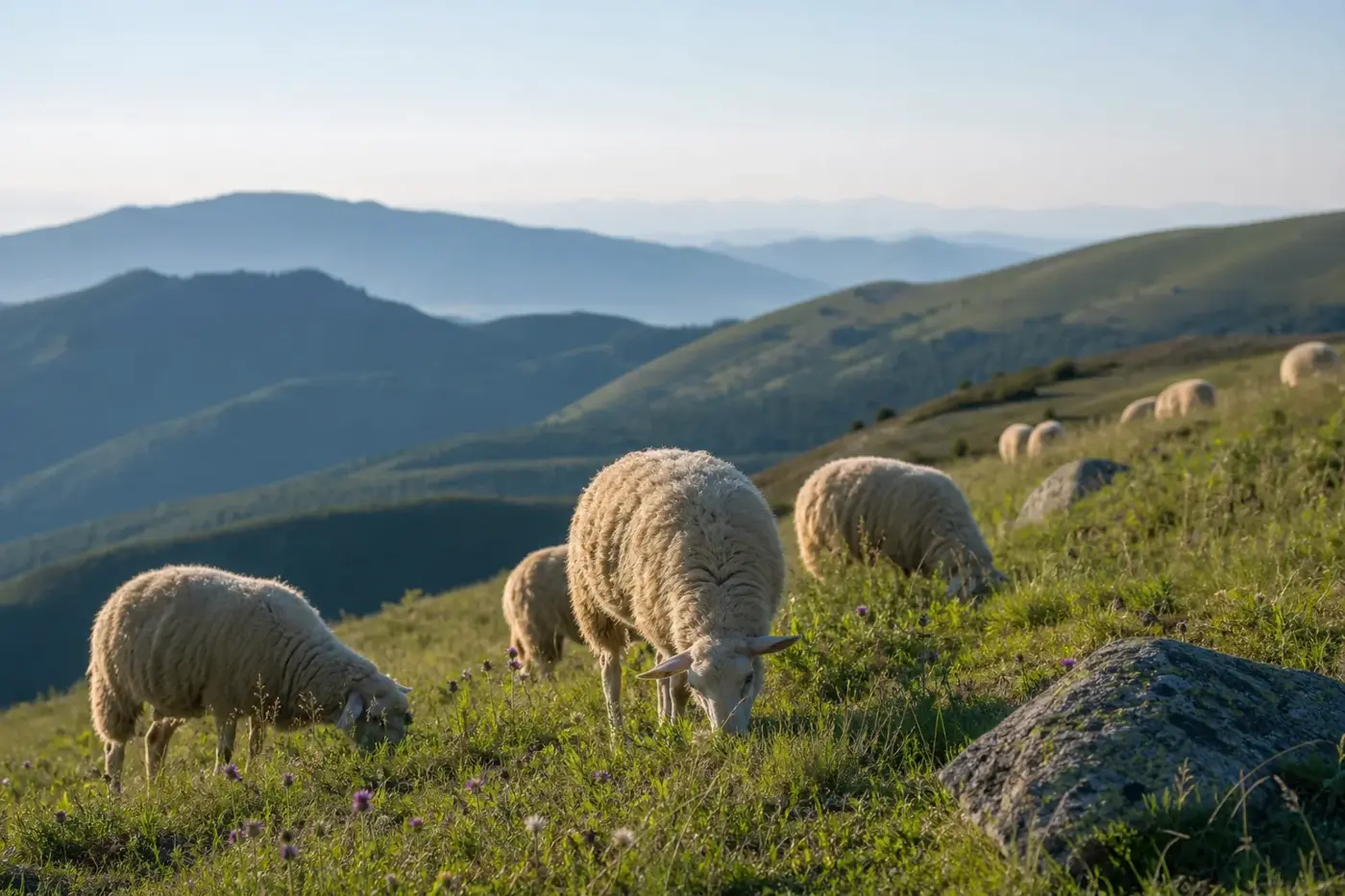
Above Galichnik and Lazaropole, sheep graze Bistra’s summer pastures, their milk destined for kashkaval. In Galichnik, the mountains also frame a celebrated village wedding. Follow the milk beyond the festivities and you meet North Macedonia’s three principal cheese styles: white brined sirenje, firm bieno sirenje and matured kashkaval. A wedding invitation is lovely; a cheese itinerary has its own attractions. [1][2][3]
| Your country guide | What to know |
|---|---|
| Country | North Macedonia. [5] |
| Three cheeses to start with | White brined sirenje, bieno sirenje and kashkaval. [3] |
| Milk you may encounter | Sheep, cow and goat milk, including mixtures in traditional production. [3] |
| Places behind your cheese | Galichnik and Lazaropole on Bistra; Mariovo is an important locality for bieno sirenje research. [3][4] |
| National cheese definition and current statutory standards | Not established here |
| Protected cheese names in force, count and register identifiers | Not established here |
| Where to find official agricultural statistics | State Statistical Office regional yearbook and livestock production releases. [5][6] |
Start with a wedding, then follow the sheep
Around the Petrovden weekend in July, Galichnik’s wedding celebration brings village customs into public view. The local community selects a couple to marry according to those customs. If you would like to visit, consult the organiser’s programme for that particular year before arranging your journey. [1]
The cheese connection lies in the land, not the ceremony. Galichnik stands on Bistra, where documented kashkaval production uses milk from sheep grazing mountain pastures in summer. The national tourism food guide places cheese alongside bakrdan, a maize-flour dish, and other village foods. The wedding introduces you to the community; the grazing country opens another chapter. [2][3]
For your first tasting, ask for three named cheeses rather than a plate of “local cheese”. White sirenje, bieno sirenje and kashkaval show you what different ways of handling curd can achieve. Ask your host to identify each milk and maker before you taste. Keep the bread plain: the cheeses have enough to say.
Read the landscape through its milk
There is more here than the mountain postcard
Pelagonia is the country’s largest milk-producing region, according to the State Statistical Office’s regional yearbook. Its extensive basin and agricultural land give you an important counterpoint to the western mountains. The yearbook maps pasture and livestock across all eight statistical regions, placing mountain sheep farming within a much broader, lower-lying agricultural economy. [5]
In the pasture systems of the Šar Mountains and Mavrovo region, let questions lead your visit. Do the animals graze locally? Does the producer move them seasonally, and does the dairy buy additional milk? The answers help you connect what is on your plate with the landscape around you.
Bistra offers a documented example of that seasonal relationship. Research on traditional kashkaval describes summer sheep grazing and production in Galichnik and Lazaropole, so summer matters when you ask about milk being processed. The cheese you taste, though, may have been made and matured earlier. Ask for its production date and age separately. [3]
Meet the animal behind the cheese
Sheep’s milk anchors both the documented Bistra kashkaval tradition and research on traditional Mariovo bieno sirenje. Across the country, cow’s milk occupies a much larger place: the statistical office recorded 282.317 million litres in 2024. That figure measures milk production, not the amount used specifically for cheese. [3][4][6]
Goat milk deserves a place in the conversation too. Technical literature records white brined cheese made from sheep, cow or goat milk, and bieno made from different milks or mixtures. Even when you know the cheese’s name, you still have an excellent question to ask: which milk went into this batch? [3]
Keep the producer and method in view alongside the animal. For mixed-milk cheese, ask whether the proportions are stated and whether they change through the season. Note the answer beside the cheese’s age. “Mixed milk” gives you a starting point, not a single recipe followed by every dairy.
Meet the three cheeses, one bite at a time
Sirenje: give the brine its due
Begin with white brined sirenje. Brine, a solution of salt in water, is both its ripening and keeping medium. The documented style has a white to yellowish interior without a developed rind. Milk, acidification and time in brine all help explain why one example tastes or feels different from another. [3]
Give saltiness and texture their own moments of attention. Ask the seller about the batch: is it softer or firmer, milder or more assertively salted? Then taste small pieces and let the cheese answer. Whiteness alone does not establish youth, and firmness does not necessarily mean sheep’s milk.
To make a useful tasting note, record four things: how readily the cheese breaks, how moist the broken surface looks, how strongly the salt registers and how sharp the finish seems. Keep those observations attached to your sample, rather than turning them into rules for every sirenje. For the broader picture, see how to tell cheese styles apart.
Bieno sirenje: a little work goes into that bite
Bieno sirenje is commonly translated as beaten cheese. Its character begins with breaking and working the curd, followed by scalding, draining and salting. Published accounts describe a yellowish cheese, firm to semi-hard, sometimes with irregular openings. Traditional examples may then mature in brine: “beaten” describes the curd work, while “brined” tells you what happens later. [8]
Mariovo makes a particularly useful starting point. A field study published in 2017 examined traditional bieno production there, covering the milk, manufacturing process and cheese after maturation. Think of it as a close look at particular producers and samples. It is not a compulsory recipe for everything sold under the name. [4]
The differences continue beyond the village dairy. A 2015 university study compared traditionally and industrially produced bieno and reported sensory differences between them. Ask how your cheese was made, then taste it on those terms. Neither “traditional” nor “industrial” can tell you which one you will prefer. [9]
If you find two examples, taste them side by side. Establish whether they use the same milk and whether one has spent longer in brine. Compare firmness, the distribution of openings and how cleanly a slice breaks. Those separate observations tell you more than declaring one simply “stronger”.
Kashkaval: follow the making of a wheel
Kashkaval takes another route. In documented Bistra production, the drained curd first develops acidity, then is cut, softened in hot brine and worked into a mass for shaping. This is a pasta filata process, meaning stretched or worked curd. The wheels mature with surface care rather than remaining submerged like white brined cheese. [3]
Ask a cheesemaker how they know the curd is ready to work. You will get a more revealing introduction to the craft than you would from memorising a production temperature. Then follow the wheel through maturation: how is its surface cared for, and how does the maker decide it is ready to sell?
Look beyond the place name on the label
Galichnik, Bistra and Mariovo can tell you where a producer places a cheese’s story. Legal protection is a separate question, requiring the exact registered name, its specification and the jurisdiction concerned. To untangle cheese styles from registered products, see protected names explained.
Treat the registration status of the cheese names discussed here as unresolved across national, EU and international records. A familiar place name alone does not settle that question.
If a seller describes a cheese as geographically protected, ask for the registered wording and relevant authority. Note both alongside the producer’s name and production address, particularly when a familiar English spelling differs from the local wording. This keeps the place of production distinct from a protected-name claim and gives you a clear record for further enquiries.
Pull up a chair: cheese beyond the tasting plate
White cheese appears among the meze in the national tourism food guide, those small dishes that begin or accompany a meal. The guide’s examples include sheep’s and cow’s milk cheeses alongside vegetable preparations. In Shopska salad, grated white cheese joins tomatoes, cucumber and onion. [2]
Then come the pastries. The same guide records a Maleshevo zelnik filled with leek and white cheese, plus other pies served with white cheese or sour milk. Around Galichnik, its example of bakrdan finishes the maize-flour dish with sheep’s milk cheese. You can follow the ingredient from plate to pastry to maize without losing interest. [2]
Start simply: order cheese with bread, then try it in a prepared dish. Ask which cheese the kitchen uses in its salad or pastry, and whether you can taste it separately. Moving between ingredient and finished dish helps you recognise what the cheese contributes.
Let each style open a different conversation. Which white cheese does the cook favour for crumbling, and which bieno does the household serve sliced? Which kashkaval does the dairy recommend at its present age? Those answers bring you closer to everyday eating than a hunt for one national favourite.
Meet the breeders, researchers and changing dairies
Published literature links bieno with Ottoman period production and Vlach sheep breeders. Read that connection as a published historical account. The primary historical evidence behind it remains an open question. [3]
The technical record gives you firmer reference points from the Yugoslav period. Cheese literature cites a 1969 investigation of Macedonian beaten cheese and a 1974 study of its composition, characteristics and rheology, meaning the way it deforms and flows. Researchers were examining regional production well before the recent interest in documenting farmhouse foods. [3]
Skopje’s market operator contributes another institutional marker. Its own history dates the establishment of the city’s market administration to 9 May 1952. Read alongside later studies comparing household and industrial bieno, it suggests a useful distinction: equipment and organisation can change while cheese names and household preferences continue. [9][10]
If you gather oral histories, begin with the maker’s own experience. Who taught them, where did the family previously keep animals, and which pieces of equipment have changed? Record the replies as that person’s account. A remembered family practice can add considerable detail without becoming a story that stands for every household.
Find your next memorable cheese
Let Skopje’s markets introduce you
Skopski Pazar’s current website confirms that it manages green markets in the capital and provides a directory. Use it to choose a location, then confirm where dairy sellers are trading before travelling specifically for cheese. The pleasure lies in comparing producers, rather than expecting every stall to carry the same selection. [10]
Begin with four direct questions: who made this, where was it made, which milk was used and when? Ask whether a taste is offered before choosing. If the seller is a trader, request the dairy’s name. A knowledgeable trader can explain one part of the journey; the cheesemaker can explain another.
Take your curiosity into the mountains
Galichnik and Lazaropole are documented places to explore Bistra’s kashkaval tradition, while Mariovo gives you a reference point for bieno. Visitor access at individual dairies is a question for each producer. Establish arrangements before building your journey around a particular dairy. [3][4]
Keep a Šar or Mavrovo itinerary flexible. Ask whether cheesemaking will take place during your visit and whether the milk comes from the current grazing season. Consult the official website, then confirm booking, language and accessibility directly. If a working dairy cannot receive visitors, a meal featuring an identified local cheese can still offer a worthwhile introduction.
As you taste, keep a short record: maker, locality, milk, production month and stated age. Those details let you compare cheeses more precisely. Better still, they give you something useful to ask for when you meet a memorable cheese again, at a market, a dairy or a table in the mountains.
Questions people ask
What are the main cheeses of North Macedonia?
The three principal styles are white brined sirenje, bieno sirenje and kashkaval. Sirenje matures in brine, bieno is made by working the curd, and kashkaval is shaped into matured wheels.
What milk is used to make these cheeses?
The page documents sheep, cow and goat milk, including mixtures. Traditional Bistra kashkaval uses milk from sheep grazing mountain pastures in summer.
Why is bieno sirenje called beaten cheese?
Bieno sirenje is commonly translated as beaten cheese because its curd is broken and worked. The curd is then scalded, drained and salted, and traditional examples may mature in brine.
How is cheese eaten in North Macedonia?
White cheese is served among meze and grated over tomatoes, cucumber and onion in Shopska salad. The national tourism food guide also records Maleshevo zelnik filled with leek and white cheese, and bakrdan finished with sheep’s milk cheese around Galichnik.
Where can I explore North Macedonia’s cheese traditions?
Galichnik and Lazaropole are documented places to explore Bistra kashkaval, while Mariovo is a reference point for bieno. Skopski Pazar also provides a directory of green markets in Skopje, but visitor access at individual dairies has not been verified.
Sources
[1] Local Community of Galichnik. Новости, official community notices, including wedding selection and Petrovden arrangements, 2026.
Read at galichnik.com.mk
[2] North Macedonia Timeless, national tourism publication. The taste of MACEDONIA, undated online edition. Sections on Galichnik, meze, Shopska salad, bakrdan and Maleshevo zelnik.
Read at macedonia-timeless.com
[3] Ss Cyril and Methodius University repository. Characteristics of Traditional Cheeses Produced in the Republic of North Macedonia, author manuscript carrying a 2019 volume heading. The publisher lists the chapter in its 2020 volume.
Read at repository.ukim.mk
[4] University St Kliment Ohridski repository. Quality and Technology of Indigenous Traditional “Bieno” Cheese in the Region of Mariovo, Macedonia, AGROFOR International Journal, volume 2, issue 2, 2017, pages 116 to 123. Repository abstract retrieved; full text unavailable there.
Read at eprints.uklo.edu.mk
[5] State Statistical Office. Regions of the Republic of North Macedonia, 2024, regional yearbook, 2024. Agricultural maps and Pelagonia regional profile.
Read at stat.gov.mk
[6] State Statistical Office. Livestock production, 2024, release dated 28 March 2025.
Read at stat.gov.mk
[7] North Macedonia Timeless. Galicnik Wedding, undated tourism account. Search retrieval supplied the event description; opening the address subsequently redirected to the homepage.
Read at macedonia-timeless.com
[8] Ss Cyril and Methodius University, Journal of Agricultural, Food and Environmental Sciences, volume 78, issue 1, 2024, pages 103 to 109. Discussion of Macedonian cheese production and microbiological diversity, subsection “Beaten cheese (Bieno sirenje)”.
Read at journals.ukim.mk
[9] Ss Cyril and Methodius University. Technology of Production and Properties of Beaten Cheese Made in Traditional and Industrial Conditions, Journal of Agricultural, Food and Environmental Sciences, volume 65, published 1 June 2015. Article abstract.
Read at journals.ukim.mk
[10] Skopski Pazar. Official website, market directory and institutional history, undated current pages.
Read at skopskipazar.com.mk
Read at skopskipazar.com.mk
This desk-researched draft combines university cheese research, official agricultural statistics, national tourism material and community and market-operator records.
Last checked: November 2026
Last checked November 2026.
The editors suggest you read next

French Cheese: The Complete Guide
Picture Normandy’s pastures, then follow the milk towards the Loire’s goat dairies, the Jura’s shared cheesemaking traditions and the sheep country of the Pyrenees.


