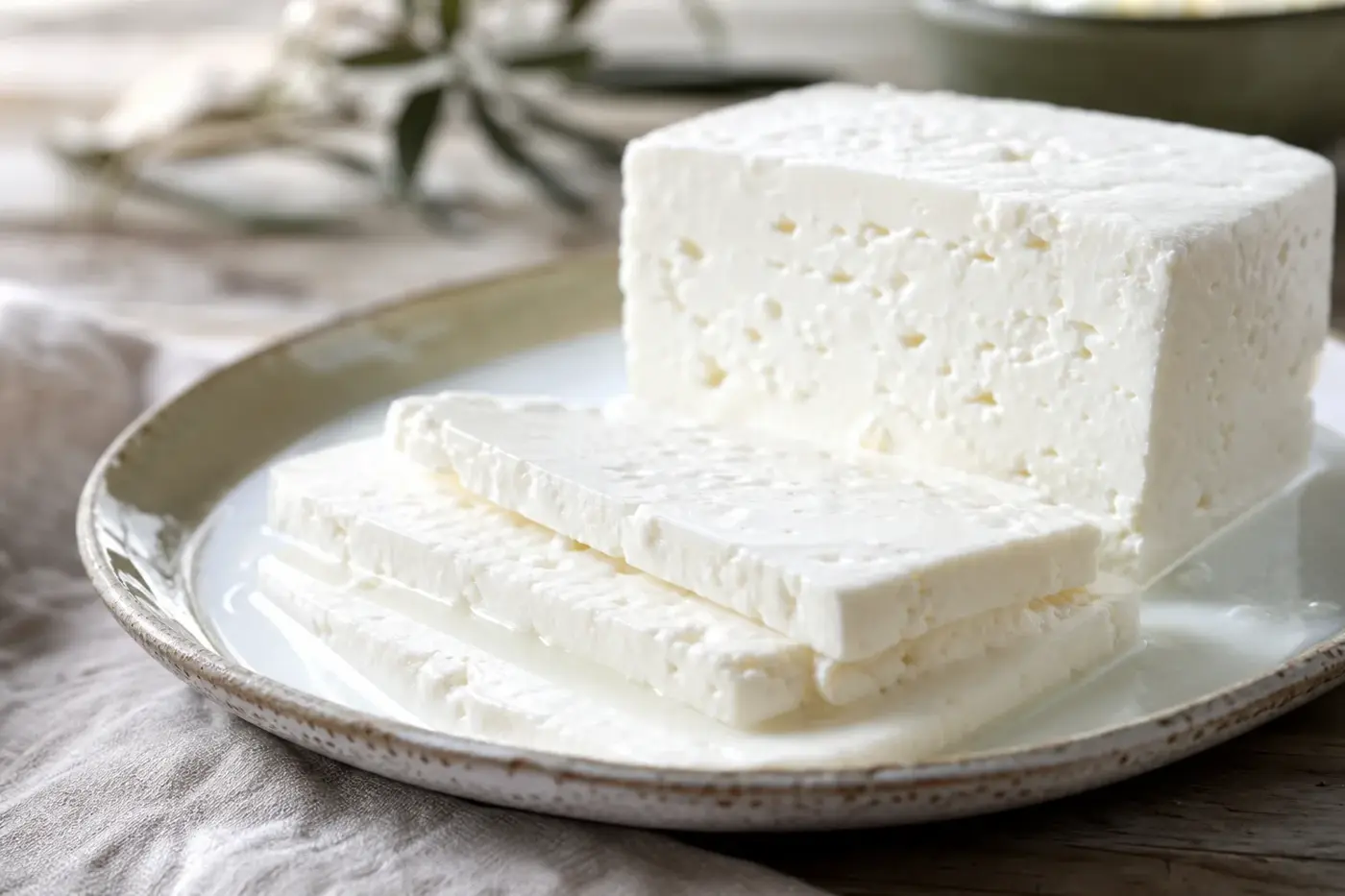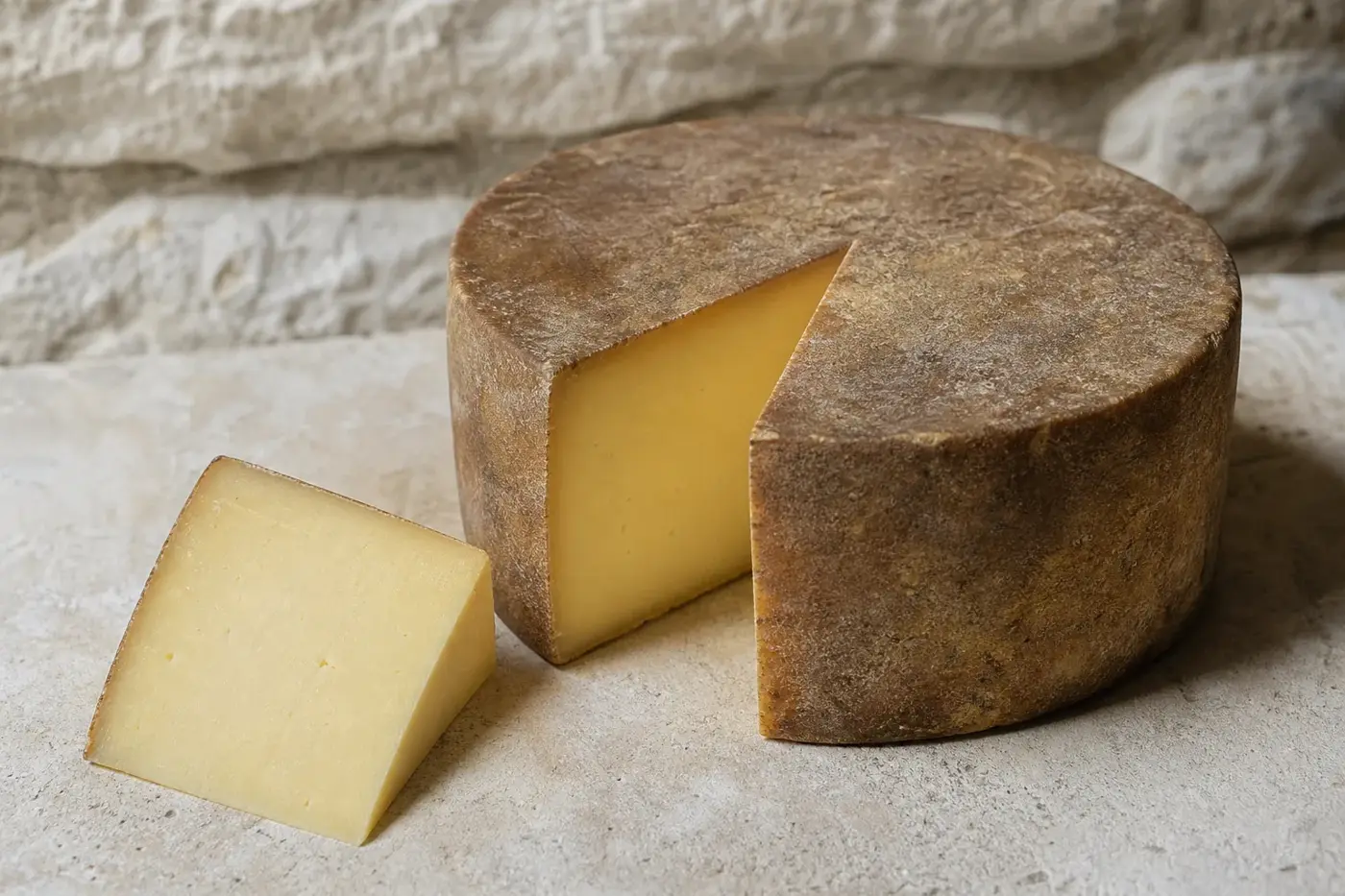
Sliced curd slips into hot water or brine. The cheesemaker kneads it into a pliable mass, turning acidified curd into something ready to shape and salt.[1,4] This is kashkaval taking shape: a family of firm, pale yellow stretched-curd cheeses found across the Balkans and neighbouring eastern Mediterranean countries. Sheep’s milk, cow’s milk, mixtures and different ripening practices give you plenty of reasons to linger at the counter.[1,2,3]
| Field | What to know |
|---|---|
| The method behind it | Acidifying, heating, stretching and kneading the curd: the pasta filata technique.[1,2] |
| Milks you’ll meet | Sheep’s milk, cow’s milk and mixtures of the two.[1,2,3] |
| Where it feels at home | The Balkans, with related production in the eastern Mediterranean.[1,3] |
| Shapes to look for | Cylindrical wheels; moulded blocks also occur.[1,2] |
| What’s on the outside | Developed rind, wax coating or protective packaging, depending on production.[1,2] |
| Family-wide legal minimum ageing | No single minimum specified here. |
| Close relations | Turkish kaşar and Greek kasseri, each with production rules to consider separately.[1,6,7] |
Start with the curd, stay for the character
Start with the curd, not the country on the packet. Fermentation develops the acidity that allows heated curd to come together under the cheesemaker’s hands. Research describes the resulting structure as fibrous, with a plastic, elastic consistency.[2]
That technique puts kashkaval alongside other pasta filata cheeses, but maturation carries it beyond fresh cheese territory. The FAO’s traditional account describes a compact, semi-hard cheese without eyeholes. Research on Galichki kashkaval follows a sheep’s milk cheese through an extended period of ripening and storage.[1,3]
Think of kashkaval as a method with a local accent, shaped by milk and practice. At the counter, the milk, maker and stated age tell you more than the English name alone. Those details distinguish one piece from another within this broad family. For the bigger picture, see how to tell cheese styles apart.
Follow a name across borders
Follow the name and its spelling changes with the language. The Bulgarian standards document uses кашкавал; the Romanian dictionary entry gives cașcaval. Research from what is now North Macedonia uses Galichki kashkaval for the cheese associated with the Bistra Mountain area.[3,4,5]
Turkish kaşar and Greek Κασέρι / Kasseri belong in the conversation, too. Their names help you trace the relationship, but they identify distinct local products and traditions. To find out what actually goes into a particular cheese, turn to its specification or the maker’s information.[1,6,7]
The FAO’s older technical survey attributes kashkaval to Bulgaria and records a sixteenth-century history there. Read that as the survey’s historical account, not contemporary evidence of a first invention.[1] The word’s history, the movement of pastoral cheesemaking and the development of today’s recipes are separate threads. Keep them distinct as you follow the cheese across borders.
Get to know the milk in your piece
Sheep’s milk sits at the heart of documented traditional production. The Galichki study examines sheep’s milk cheese from Bistra Mountain. The FAO account also describes a sheep’s milk version.[1,3]
Cow’s milk and mixed-milk cheeses appear in present-day research, too. At a dairy in Bitola, one study used nine parts cow’s milk to one part sheep’s milk. That was the formula for the production studied, not a compulsory recipe for kashkaval.[2]
Want a revealing comparison? Ask for two pieces with their milk and age identified. Choose a sheep’s milk cheese and a cow’s milk cheese of very different maturity, and you’ve changed two things at once. Note both details so you know what you’re comparing; a second piece is, of course, a perfectly respectable research tool.
Colour cannot do this job for you. Read the milk declaration rather than judging by the paste alone. If a cut portion has parted company with its original packaging, ask the seller to identify the milk before you choose.
Watch hot water work its transformation
Before the stretching comes the setting. Rennet, a preparation of enzymes that coagulate milk, or another suitable coagulant turns milk into the solid curd that will become cheese. Cutting and working release whey, the liquid portion. Draining and pressing bring the curd together before stretching.[1,2,4]
Then comes the turning point: acidification. The FAO account, a Bulgarian draft technical standard and the Bitola production study document the stages below. Together, they describe traditional and commercial practice, not instructions for making kashkaval at home.[1,2,4]
| Stage | What happens in the dairy |
|---|---|
| Forming the curd | The cheesemaker coagulates the milk, then cuts, stirs and warms the curd to encourage whey drainage.[1,2] |
| Building acidity | The drained curd rests while fermentation develops the acidity needed for stretching.[2,4] |
| Heating and stretching | Sliced curd goes into hot water or brine, then is kneaded into a cohesive mass.[1,4] |
| Giving it shape | The warm cheese is worked into moulds to establish its final shape.[1,2] |
| Salting and ripening | Salt is added during processing or later surface salting, then the cheese matures under controlled conditions.[1,4] |
The Bulgarian draft calls the acidification stage cheddarisation. Scalding, salting, kneading and forming follow. Don’t let the name steer you towards Cheddar: here, it describes a manufacturing stage, and the finished cheese remains kashkaval.[4]
Salting has its variations, too. The FAO account describes hot-brine treatment followed by repeated dry salting.[1] Keep that sequence in mind when you compare producers. They may share the stretching technique while handling, salt distribution and maturation differ.
Read the wheel, inside and out
Picture a low cylindrical wheel with a close-textured interior. The FAO describes wheels weighing 3 to 8 kg, with smooth surfaces commonly coated in wax.[1] Modern production also uses square moulds. That rectangular piece at the counter can belong to exactly the same technical family.[2]
The pale yellow paste gives you a first impression, not the whole story. The maker’s description fills in the details for that cheese. Before trimming, find out whether you’re looking at natural rind, wax or another coating. Wax and plastic coatings are not food.
That outer layer also helps shape what happens inside. In the packaging study, researchers compared uncoated cheese with wax, polymer emulsion and shrink-bag treatments. Moisture loss and protein breakdown differed between treatments, showing how cheeses of the same age can develop differently.[2]
The Galichki research tracked composition through ripening and later storage.[3] Age, then, deserves more than a passing glance at the label. For aroma and flavour, ask for the maker’s description of the specific batch. Give each piece its own hearing, rather than expecting one tasting note to speak for the whole family.
Kashkaval, kaşar or kasseri? Meet the distinctions
A broad family name tells you one thing; a cheese governed by a particular specification tells you another. Keep the documented examples separate, and your comparison becomes much more useful. Here’s what each source covers.
| Name and source scope | Milk | What sets the account apart |
|---|---|---|
| Kashkaval, documented examples | Sheep’s milk, cow’s milk or mixtures.[1,2,3] | Production and ripening vary between examples. |
| Kaşar, traditional Turkish account in the FAO survey | Sheep’s milk, sometimes mixed with goat’s milk.[1] | A hard, ripened pasta filata cheese in this historical account, which does not cover all current Turkish production. |
| Κασέρι / Kasseri | Consult the current EU registration and production requirements. | Use the EU register and current specification to complete the comparison. |
For a fuller Kasseri comparison, turn to the current EU registration and production requirements in the official register and operative specification. Those are your references for that particular cheese. Its neighbours’ rules cannot stand in for its own.
Take four good questions to the counter
Read the label first. Then bring appearance, aroma and texture into your assessment of the cheese’s character and condition. Keep its storage instructions and date marks alongside those sensory clues.[8,9,10]
These four questions will help you choose:
- Which milk? Find out the species and any stated mixture.
- How mature? Ask for an age or production date where available.
- What covers it? Identify rind, wax and packaging before cutting.
- What should it be like? Compare your piece with the maker’s product-specific description.
Let the cut face help you decide whether a portion suits your plans. For slicing, choose a piece that holds together; for grating, consider how firmly it handles. If the surface and centre look or feel markedly different, ask the seller to explain.
Keep the original label with your cut portion. Once you leave the counter, it remains your reference for storage, milk treatment and any product-specific suitability claim. You’ll find the wider terminology in reading a cheese label.
Give it a place at the table, or in a toastie
For table service, take out only the portion you intend to eat and let it lose its refrigerator chill towards room temperature. Food Standards Agency guidance for England, Wales and Northern Ireland says to keep chilled food out for the shortest possible time, with a maximum of four hours during preparation. In temperatures higher than usual, its hot-weather advice reduces that limit to two hours.[9,11]
Ready to put your piece to work in the kitchen? These are suggestions, rather than a tested recipe:
- Salads: cut small cubes or thin strips to combine with tomatoes, cucumber, peppers or cooked beans.
- Pastries: grate cheese into a savoury filling. Taste the other ingredients before adding further salt.
- Toasties: use thin slices to distribute the cheese evenly through the sandwich.
- Cooked dishes: scatter grated cheese over baked vegetables, or fold small pieces into an omelette.
When you switch products, start with a small quantity. Keep milk and maturity in mind as you choose. The right piece gives you the texture and seasoning you want in the finished dish, whether or not a little grating happens to disappear along the way.
Keep your cheese well, and check who it suits
For home storage in England, Wales and Northern Ireland, the FSA advises a refrigerator temperature between 0 and 5 °C. Follow the packet’s storage instructions, including directions for use after opening. Keep the identifying information with the cheese.[9]
For mould guidance, turn to the Food Standards Agency’s home food fact checker for England, Wales and Northern Ireland, with November 2026 as the reference point.[10] You can also read mould on cheese for further discussion.
Treat milk treatment and rennet as separate questions. If you require pasteurised milk, look for an explicit product declaration. For vegetarian eating, confirm a suitable non-animal coagulant, asking the maker if the wording is unclear. Government labelling guidance exempts some cheeses from a full ingredients list, so a short label may still leave you with questions.[8]
Milk is among the allergens listed in that guidance.[8] Allergen information and vegetarian claims answer different questions, so keep both in view when assessing suitability. For practical detail, see rennet explained and storing cheese at home.
General information only, not medical advice: follow the official guidance where you live.
Questions people ask
What is kashkaval cheese?
Kashkaval is a family of firm, pale yellow cheeses found across the Balkans and neighbouring eastern Mediterranean countries. Its defining method involves acidifying, heating, stretching and kneading the curd.
Is kashkaval made from sheep’s milk or cow’s milk?
Documented examples include sheep’s milk, cow’s milk and mixtures of the two. Check the milk declaration or ask the seller, as colour alone cannot tell you which milk was used.
Is kashkaval vegetarian?
Check whether the cheese uses a suitable non-animal coagulant. If the label is unclear, ask the maker.
Can you eat the rind on kashkaval?
Kashkaval may have a developed rind, a wax coating or protective packaging. Identify the surface before cutting, because wax and plastic coatings are not food.
How should kashkaval be stored?
For home storage in England, Wales and Northern Ireland, the Food Standards Agency advises a refrigerator temperature between 0 and 5 °C. Consult its guidance and follow the packet’s storage instructions, including any directions for use after opening.
Sources
- Food and Agriculture Organization: The technology of traditional milk products in developing countries, online chapter, entries 4.13 and 4.16. Publication year not displayed on the retrieved chapter. Retrieved chapter.
- Mljekarstvo: Influence of packaging materials on Kashkaval quality, volume 67, issue 1, pages 25 to 32, 2017. Research paper.
- Mljekarstvo: Traditional production and main characteristics of Galichki kashkaval, volume 64, issue 2, pages 119 to 126, 2014. Retrieved abstract and bibliographic record. Journal record.
- Bulgarian Institute for Standardization: prBDS 14:2010, Bulgarian kashkaval draft standard for public consultation, May 2010. Used as a historical technical document, not as evidence of the current adopted standard. Draft document.
- dexonline: cașcaval, dictionary entry, retrieved November 2026. Used for the displayed Romanian spelling only. Dictionary entry.
- European Union: Publication of the communication of an approved standard amendment to a product specification of a geographical indication, C/2026/192, 12 January 2026. Includes the single document for Κασέρι / Kasseri, reference PDO-GR-0440-AM01. Official Journal document.
- Greek Ministry of Rural Development and Food: Προδιαγραφές του προϊόντος: Κασέρι / Kasseri, specification linked from the 2026 Official Journal document. Product specification.
- UK Government: Food labelling: giving food information to consumers, current online guidance retrieved November 2026. Sections on allergens and ingredients lists. Official guidance.
- Food Standards Agency: How to chill, freeze and defrost food safely, current online guidance retrieved November 2026, applying to England, Wales and Northern Ireland. Official guidance.
- Food Standards Agency: Home food fact checker, online guidance updated August 2026. Section “Can you still eat food if you remove the mouldy part?” Official guidance.
- Food Standards Agency: Food safety in a heatwave: advice for consumers, current online guidance retrieved November 2026. Official guidance.
- Food Standards Agency: Alerts, live official alert index retrieved November 2026. Official alert index.
This desk-researched article brings together documented production examples, the published kasseri specification and current official consumer guidance.
Last checked: November 2026
Last checked November 2026.
The editors suggest you read next