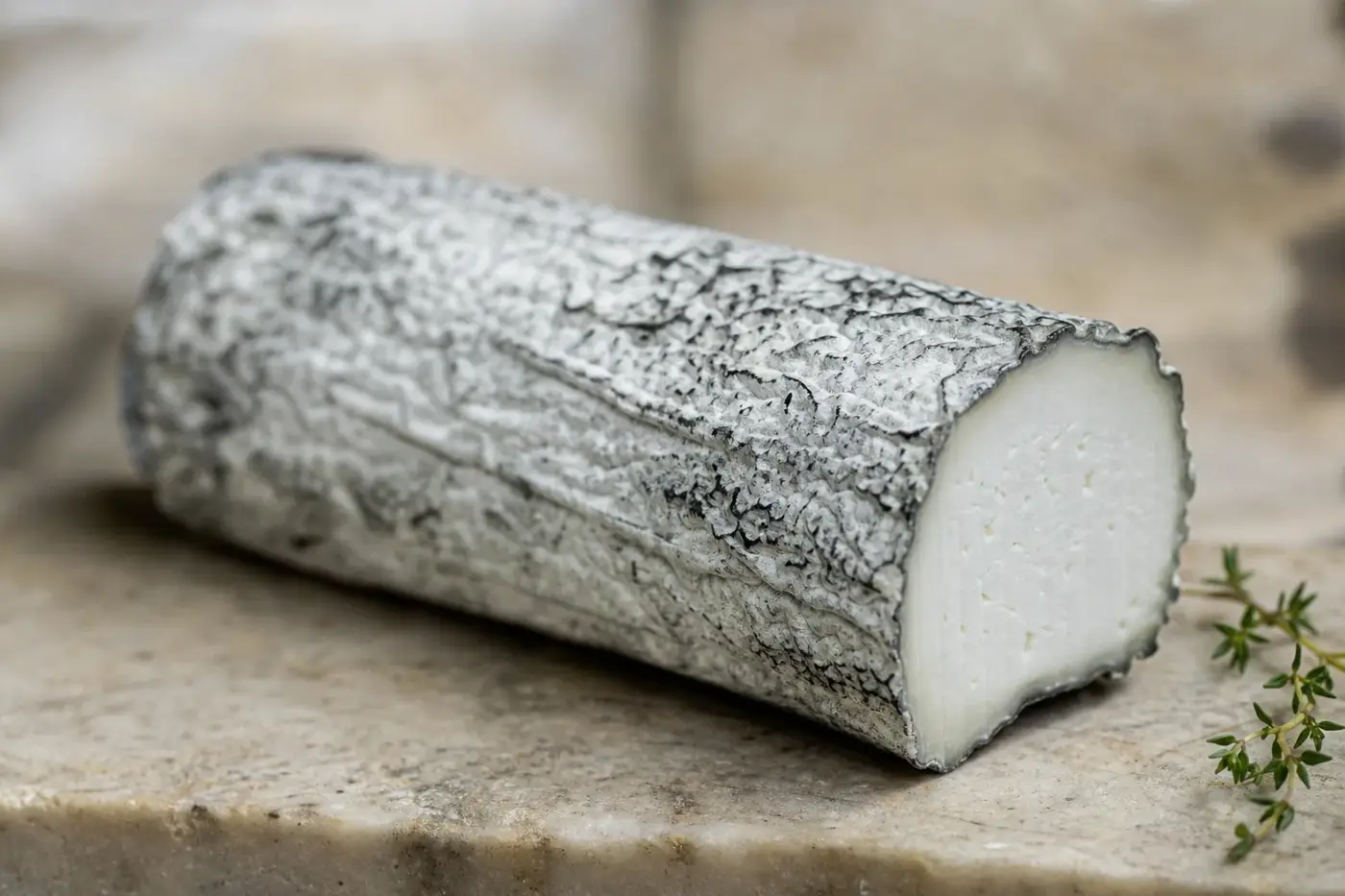
Auvergne Cheeses
Milk arrives in a gerle, the traditional wooden vessel where Salers begins.

Milk arrives in a gerle, the traditional wooden vessel where Salers begins. Outside, cows graze in Auvergne’s volcanic uplands, and the cheesemaking season keeps to its boundaries: 15 April to 15 November.[4] This is one of five principal cheeses rooted in these mountain pastures, alongside Cantal, Saint-Nectaire, Bleu d’Auvergne and Fourme d’Ambert.
Together, they give you substantial pressed cheeses, supple Saint-Nectaire and two distinctly different blues. The regional cheese association gathers them under its Auvergne AOP identity, the French abbreviation for protected designation of origin.[1] There is plenty to explore before you even reach for the bread.
| Get your bearings | What to know |
|---|---|
| Where you are | Central France, within the Massif Central.[2][5] |
| The former regional map | Allier, Cantal, Haute-Loire and Puy-de-Dôme.[2] |
| Today’s administrative home | Part of Auvergne-Rhône-Alpes since 1 January 2016.[2][3] |
| The principal cheese family | Cantal, Salers, Saint-Nectaire, Bleu d’Auvergne and Fourme d’Ambert.[1] |
| Where each cheese belongs | Every designation has its own defined area, rather than one shared regional boundary.[4][5][6][7] |
Let the pastures show you the way
To get to know Auvergne’s cheeses, follow the mountains and pastures before the administrative lines. Saint-Nectaire belongs to the Monts Dore and neighbouring uplands; Salers centres on the Cantal volcanic massif. Fourme d’Ambert has historical connections with the high pastures of the Forez. Their mountain traditions are related, but their methods are not interchangeable.[4][5][6]
You are in central France, where the familiar four-department outline comes from the former administrative region: Allier, Cantal, Haute-Loire and Puy-de-Dôme. Since 1 January 2016, those departments have belonged to the larger Auvergne-Rhône-Alpes region. Historical and cultural Auvergne follows a different outline from that former administrative boundary.[2][3]
At the cheese counter, these distinctions matter. A cheese can belong to the Auvergne tradition while its authorised production area reaches into a neighbouring department. Equally, a dairy’s address within the former region does not establish that its cheese meets a particular designation’s rules. Look at the cheese’s identity as closely as its address.[4][6][7]
From volcanic pasture to your plate
Grass connects Auvergne’s volcanic landscape to its cheeses. INAO, France’s national institute for origin and quality, describes Saint-Nectaire’s territory as fertile volcanic land with abundant grass and varied pasture flora. For Fourme d’Ambert, it highlights altitude and rainfall, which sustain the grass at the heart of the cows’ diet.[5][6]
That gives you something more useful than the picturesque phrase “volcanic flavour”. Soils, rainfall and elevation shape what livestock can graze. Cheesemaking and maturation take over from there, turning milk into supple pressed paste, substantial seasonal wheels and blue-veined cheeses within this broad mountain setting.[4][5][6][7]
With Salers, the season is part of the cheese’s identity. INAO describes production between 15 April and 15 November, while the cows are grazing. Farmhouse manufacture and the traditional wooden vessel matter as much as the pasture. You are tasting the result of a farming calendar, not simply a regional name.[4]
Beyond the fields, there are people and buildings to consider. INAO records Fourme d’Ambert’s historical manufacture in jasseries, the buildings associated with the Forez high pastures. Here, mountain cheesemaking brought grazing and milk processing together with the patient work of preserving a harvest through maturation.[6]
Find your way into the five cheeses
Before choosing a name, think about how the cheese is made. The regional association’s five-cheese grouping gives you a useful introduction. For a first selection, though, a pressed cheese, a supple round and a blue will tell you more than several pieces chosen simply because their labels say Auvergne.[1]
| Cheese | What makes it stand out | What to ask at the counter |
|---|---|---|
| Cantal | Its interprofession presents it at different ages.[8] | How mature is this piece? |
| Salers | Farmhouse, raw-milk production during the grazing season.[4] | When was it made, and how long has it matured? |
| Saint-Nectaire | Supple paste; farmhouse and dairy production.[5] | Who made it, and who matured it? |
| Bleu d’Auvergne | Broad, relatively low cylinder with intense blue character.[7] | How pronounced is this batch’s blue flavour? |
| Fourme d’Ambert | Distinctive cylindrical blue with supple paste.[6] | How does it compare with the Bleu d’Auvergne? |
You will meet AOP along the way: it is the French term corresponding to PDO, protected designation of origin. For the distinction between a geographical designation and a general cheese style, turn to protected names explained. The regional association promotes these cheeses as an industry organisation; a separate authority maintains the EU register.[1]
Cantal: find the age you love
With Cantal, make age your first question. Its interprofessional organisation presents this pressed curd cheese at one, four and eight months, illustrating different stages rather than establishing legal maturity categories.[8] Then ask how the texture and flavour of the piece in front of you have developed.
Let its actual maturity and the maker’s description of the batch guide your choice. If two ages are available, taste them side by side. Notice the resistance under the knife, how the paste breaks, the balance of milky and sharper impressions, and how long the flavour stays. Older cheeses do not all follow the same script.
Look closely at the cut surface, too. Cantal’s pressed-curd character gives you a reason to ask how the curd was handled, rather than letting the rind do all the talking. For the background to curd formation, whey drainage and pressing, explore how cheese is made.
One clearly identified Cantal maturity is enough for your first regional selection. Save two ages for another occasion, when maturation can have your full attention. The oldest piece in the shop is not automatically your favourite: cheese is not a seniority contest.
Salers: taste the grazing season
Salers has a wonderfully specific production identity. It is exclusively farmhouse-made from raw cows’ milk, between 15 April and 15 November, while the animals are grazing. INAO describes the milk being received and transformed in the traditional wooden vessel, the gerle.[4]
The finished cheese is firm, pressed and uncooked. INAO describes an ivory to straw-yellow paste beneath a dry, uneven rind, with aromas chiefly in the lactic, vegetal and fruity range. Minimum maturation is three months.[4]
These details give you good reasons to talk about Salers in its own right, rather than introducing it as an older Cantal. Farmhouse manufacture, raw milk, grazing-season production and the gerle form its distinctive framework. Age alone cannot tell that story.[4][8]
The name does not necessarily tell you the cow’s breed, either. INAO explains that the additional designation “Tradition Salers” is reserved for cheeses made exclusively with milk from Salers-breed cattle.[4]
Saint-Nectaire: follow your nose towards the woodland
Beneath Saint-Nectaire’s varied rind lies the supple, unctuous paste described by INAO. The rind can be white, brown or grey, sometimes showing orange, red or yellow beneath. Its flavour description begins with milk, then moves towards woodland notes, occasionally with a suggestion of hazelnut.[5]
That woodland character gives you something specific to explore with your cheesemonger. A strong smell alone is not a reason to assume quality. Ask how this particular cheese tastes, and where it has reached in its maturation.
Farmhouse Saint-Nectaire is made with raw milk immediately after milking the farm’s herd. Dairy production draws milk from several farms. INAO also highlights the affineurs, the specialists who mature cheese, working in the Cantal and Puy-de-Dôme.[5]
Ask for two names: the maker and the affineur. To explore farmhouse and dairy production, choose examples of similar maturity and find out who has cared for each. You will learn more from the cheeses themselves than from setting their label words against one another.
Make room for a blue-cheese comparison
Bleu d’Auvergne and Fourme d’Ambert reveal differences before you take a bite. The 2017 Bleu d’Auvergne specification describes a relatively flat cylinder. INAO describes Fourme d’Ambert as cylindrical, with a dry grey rind.[6][7]
Their published flavour descriptions bring the contrast into sharper focus. Bleu d’Auvergne has a fine, yielding texture and an intense, balanced flavour, with blue, woodland and sometimes mushroom aromas; a slight salty or bitter edge may occur. INAO’s Fourme d’Ambert account emphasises supple paste, dairy flavour and a fruity character associated with its blue mould.[6][7]
For Bleu d’Auvergne, INAO also explains how those veins develop. Penicillium roqueforti, the mould responsible, is introduced into the milk. The cheeses are then pierced to admit the air it needs to develop.[9]
If dairy and fruit appeal to you, begin with Fourme d’Ambert. For the more emphatic blue and woodland character described in its specification, choose Bleu d’Auvergne. Better still, compare small pieces from the actual wheels on offer. Published descriptions can guide you, but they cannot do the tasting for you.[6][7]
Get to know the neighbour, Fourme de Montbrison
Cheese geography is not especially interested in tidy regional borders. Bleu d’Auvergne’s specification includes communes in seven departments, extending beyond the former Auvergne region. Fourme d’Ambert’s area includes parts of Puy-de-Dôme, Cantal and Loire.[6][7]
That brings neighbouring Fourme de Montbrison within reach of your cheese board. Its territory occupies the Forez uplands around the Loire and Puy-de-Dôme boundary. INAO describes an orange rind, cream-coloured paste lightly marbled with blue, and a slightly firm texture.[10]
Fourme de Montbrison is a separate designation from Fourme d’Ambert. INAO records their shared recognition in 1972 and their separation into distinct appellations in 2002. That history helps explain the close connection, while their separate identities give you another comparison to enjoy.[10]
Farmhouse or dairy? Keep the conversation going
The farmhouse and dairy distinction begins with milk sourcing and manufacture. Saint-Nectaire makes it especially clear: farmhouse production uses the farm’s own herd and immediate raw-milk manufacture, while dairy production brings together milk from several farms. Salers is exclusively farmhouse; Fourme d’Ambert can be made on a farm or in a dairy.[4][5][6]
For the piece you are taking home, ask a little more. Who matured it, how old is it, and how has it been kept? Does its present character suit your occasion? These questions turn a production description into something you can use.
Compare like with like where possible. Two similarly matured Saint-Nectaires reveal more about farmhouse and dairy production than a young cheese beside a substantially more developed one. Taste for the differences and your own preference, without declaring a winner before either cheese reaches your plate.
This page summarises published guidance from the official sources it cites. It is not medical advice. Guidance differs between countries and changes over time, so check the current source for where you live, and ask your doctor, midwife, pharmacist or dietitian about your own circumstances.
Choose thoughtfully, store carefully, serve simply
Start with a selection you can get to know: one pressed cheese, Saint-Nectaire and one blue. Or give the meal a comparison to explore, with both blues or two Cantal maturities. Ask the seller to identify every piece clearly, including its milk treatment and any handling instructions.
For storage, follow the product label and the food authority where you live. The UK Food Standards Agency’s consumer guidance for England, Northern Ireland and Wales recommends a fridge between 0 and 5 °C. Keep each cheese’s original identification so its instructions remain close to hand.[11]
For serving, follow the product label and your local food authority, too. In hotter-than-usual weather, the FSA advises keeping chilled food cold and discarding perishables left unrefrigerated for more than two hours. This heatwave advice, for England, Northern Ireland and Wales, is the November 2026 reference here.[12]
Keep your first accompaniments simple: plain bread and water, followed by fresh pear or apple. A straightforward first mouthful makes comparison easier. If you enjoy walnut bread, try it separately and see which cheese you prefer it with. No single accompaniment has to please every cheese on the plate.
Alcohol free pairings can make the whole occasion. For practical help with wrapping and refrigerator organisation, see how to store cheese at home.
Follow your curiosity into the kitchen and onto the cheese route
Truffade, a potato dish, gives you a good reason to find a documented regional recipe and see which cheese it specifies. The Cantal interprofession also publishes dishes ranging from starters to desserts. Choose a complete recipe with its own quantities and handling instructions.[8]
Taste the named cheese before cooking with it. Afterwards, notice what remains recognisable: its texture, its blue character or its place among the other ingredients. Keep the cheese’s name attached to the recipe, rather than assuming every regional potato dish calls for the same one.
To explore in person, look to the regional association’s Route des Fromages, which brings together farmhouse producers, dairies and affineurs. Choose a small number of contrasting stops, rather than trying to see everything. Before travelling, consult each operator’s official information for booking, accessibility and visitor arrangements.[1]
At each stop, ask what makes this cheese different from the next. Milk sourcing, the grazing season, the gerle, curd handling and maturation tell you far more about Auvergne than collecting five names. They connect the piece on the counter to the people, pastures and practices behind it.[4][5][6]
Questions people ask
What are the five principal cheeses of Auvergne?
The regional association groups Cantal, Salers, Saint-Nectaire, Bleu d’Auvergne and Fourme d’Ambert under its Auvergne AOP identity. Each designation has its own defined production area.
What is the difference between Salers and Cantal?
Salers is made exclusively on farms from raw cows’ milk during the grazing season, using a wooden vessel called a gerle. Cantal is a pressed curd cheese presented by its interprofessional organisation at different ages.
Does Salers cheese have to come from Salers cows?
Not necessarily. INAO says the additional designation “Tradition Salers” is reserved for cheese made exclusively with milk from Salers cattle.
How do Bleu d’Auvergne and Fourme d’Ambert differ?
Bleu d’Auvergne is a relatively flat cylinder with an intense flavour and blue and woodland aromas. Fourme d’Ambert is cylindrical, with a supple paste and dairy and fruity flavours.
What is the difference between farmhouse and dairy Saint-Nectaire?
Farmhouse Saint-Nectaire is made with raw milk immediately after the farm’s herd is milked. Dairy production draws on milk from several farms.
Sources
- Association des Fromages AOP d’Auvergne, Association des fromages AOP d’Auvergne, undated website, retrieved November 2026. Regional grouping, association role and cheese route.
- INSEI, La région Auvergne : les départements, educational map and accompanying description, undated, retrieved November 2026.
- INSEE, Région Auvergne-Rhône-Alpes, Code officiel géographique at 1 January 2026.
- INAO, Salers, undated product record and reproduced regulatory extract, retrieved November 2026. The accessible extract includes the decree of 14 March 2000 and later procedural material.
- INAO, Saint-Nectaire, printable product record, undated, retrieved November 2026.
- INAO, Fourme d’Ambert, printable product record, undated, retrieved November 2026.
- French Ministry of Agriculture, Cahier des charges de l’appellation d’origine « Bleu d’Auvergne », consolidated specification accompanying the notice in Bulletin officiel 2017-43, associated with Commission Implementing Regulation (EU) 2017/1931.
- Comité Interprofessionnel des Fromages, J’aime le Cantal, undated website, retrieved November 2026. Homepage references to Cantal at one, four and eight months and its recipe collection.
- INAO, Bleu d’Auvergne, undated product record, retrieved November 2026.
- INAO, Fourme de Montbrison, undated product record, retrieved November 2026. Accessible search extract.
- Food Standards Agency, How to chill, freeze and defrost food safely, published 2017, current retrieved guidance, November 2026.
- Food Standards Agency, Food safety in a heatwave, advice for consumers, published 27 June 2024, retrieved November 2026. Applies to England, Northern Ireland and Wales.
Research combined official geographical records, INAO product accounts, the retrieved Bleu d’Auvergne specification, regional industry material and attributed food safety guidance; outstanding legal checks are recorded below.
Last checked: November 2026
Last checked November 2026.
The editors suggest you read next

French Cheese: The Complete Guide
Picture Normandy’s pastures, then follow the milk towards the Loire’s goat dairies, the Jura’s shared cheesemaking traditions and the sheep country of the Pyrenees.